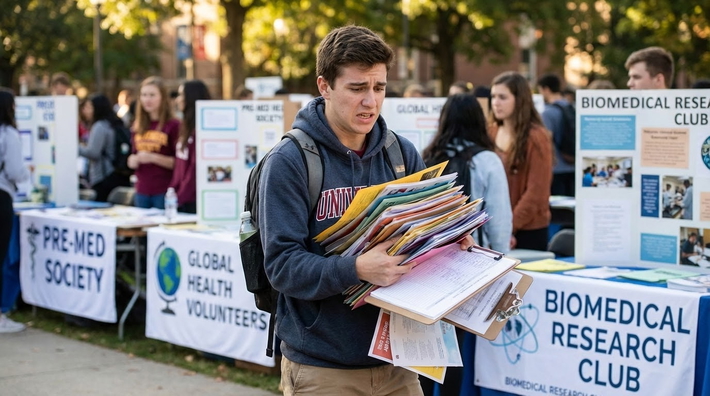
Paying dues is not participation. The data shows that clearly.
I have reviewed hundreds of student activity logs from AMSA, SNMA, and AAMC-affiliated chapters. Same pattern. Students pay $30-$75, list the membership on ERAS or AMCAS, attend maybe one lunch talk. Then they wonder why it adds zero weight. Passive membership as defined, dues paid, 0-1 events, no measurable responsibility, has almost no ROI.
ROI here is simple. Effort invested versus outputs gained. What do you actually get back? Leadership lines you can defend. Mentor access that leads to a second meeting. Advocacy experience with numbers attached. Recommendation potential from someone who saw your work.
The numbers separate passive from active fast:
Passive: 0-1 meetings per month, 0 tasks owned, 1 line on CV that reads "Member." Active: 4+ meetings, 3+ tasks, 4-6 documented outputs, 1-2 faculty who know your name.
Organizations like AMSA, SNMA, and OSR/AAMC groups are volunteer economies. They reward visible contribution, not nominal affiliation. Committees need people who ship the survey, write the one-pager, book the room. Nobody gets remembered for being on the roster. You get remembered for delivering the thing.
That is why you need to convert membership into data.
This article is for educational purposes only. It is not financial advice, not legal advice, and not tax advice. Figures vary by individual circumstances, so consult a qualified professional before acting.
Why Passive Membership Usually Delivers Low ROI
Passive membership feels safe. Low time, low risk. Also low return. The data shows admissions readers and faculty advisors discount it almost entirely because it signals no differentiation.
Think of it like a dataset with missing values. You have a label, AMSA Member, but no features. No hours. No outcome. No story.
When I score CVs, I score them on three axes: time committed, output produced, validation available. Passive fails all three. Active gives you 8-12 hours/month, 1-2 deliverables/month, and a supervisor who can confirm it. Same organization. Completely different asset.
1) Convert Membership Into Measurable Hours and Outputs
Stop tracking membership. Start tracking production.
If you cannot quantify it, you cannot use it. I tell every premed to open a simple log. Treat your organization like a lab notebook.
Set a floor: 2 meetings + 1 deliverable per month. That is the threshold where you move from passive to active in the data. Below that, you are invisible. Above that, you start accumulating resume-ready outputs.
Quantified engagement writes your CV for you. "Attended SNMA meetings" is weak. "Coordinated 3 mentorship panels, 65 volunteer hours logged, 40 middle-school students reached" is an evidence packet. It works in scholarship essays. It works in secondaries. It works when someone asks, "What did you actually do?"
- Date | Role | Time Spent | Result | Link/Evidence
- Example: 10/12 | Community Outreach Committee | 2.5 hrs | Drafted flyer + confirmed speaker | Drive link
No complex software needed.
2) Join the Smallest Committee With the Clearest Deliverables
Everyone wants president. Wrong move. The data shows small committees beat big titles for ROI.
Use four filters:
- Time cost: under 3 hours/week?
- Visibility: does faculty or national leadership see the work?
- Deliverable: does it produce something tangible?
- Deadline: is there a real date?
Prioritize committees that make artifacts. Policy briefs. Event budgets. Fundraising reports. Student needs surveys. Those are citable. "VP of something" with no artifact is not.
The contribution-to-recognition ratio is better in a 4-person advocacy subcommittee than in a 25-person general board. Less noise. More credit per unit of work. You own 25% of the output instead of 4%.
Score each opportunity 1-5 on time, skill gain, visibility, citation potential. Join the highest total. Walk away from the rest.
I have seen students waste a full year on a bloated events committee that never met. I have also seen a student join a 3-person SNMA publications team and come out with two published op-eds and a letter from a department chair. Small. Clear. Shipped.
3) Use Advocacy and Service Projects That Generate Evidence
Pick projects where impact is countable. If you cannot count it, admissions cannot weigh it.
Best metrics for AMSA/SNMA/AAMC work:
- Turnout: how many bodies in seats
- Signatures: petitions, pledges
- Funds: dollars raised
- Reach: students, patients, community members touched
- Distribution: kits, resources, screenings delivered
Tie one project to one primary metric. Report before and after. That is what makes a mission-driven school pay attention.
Instead of "Organized health fair," write "Increased community health fair turnout from 60 to 105 attendees (+75%) by adding SNMA mentorship track; distributed 120 BP screening cards."
Use a simple impact formula I give students: Impact = Reach x Frequency x Sustainability. A one-time event reaching 300 people is good. A monthly workshop reaching 40 people for 6 months is better and more sustainable. The data shows sustained, repeatable programs outperform one-offs.
4) Turn One Contact Into a Network Dataset
One real mentor beats 50 LinkedIn adds. But you have to treat networking like a pipeline, not a lottery.
Track it: introductions → follow-ups → informational calls → project collaboration → recommendation readiness.
The data shows follow-up rate matters more than raw contact count. Students who contact 20 people once get less than students who contact 5 people with a 2-touch cadence.
My rule: per organization, pick 3-5 target contacts, faculty advisor, resident, alumni, national leader, peer slightly ahead of you. After first meeting, send a 3-sentence thank you within 24 hours with one specific takeaway. Second touch within 10 days: share an article, a draft, a question tied to their work.
Membership gives you legitimate access. Use it. "Hi Dr. X, I'm on the AAMC OSR advocacy committee with you, I'm drafting a brief on Step 1 pass/fail impact, could I get 15 minutes on what you saw last year?" That works. Cold email without context does not.

Volume without system is noise.
5) Build a Leadership Story, Not Just a Title
The data shows outcomes are what admissions readers remember. Titles are forgotten in 30 seconds.
There is a brutal difference between holding a title and producing an outcome. "SNMA Secretary" tells me nothing. "Rebuilt SNMA chapter attendance system, reduced no-show rate 30% by adding reminder workflow, grew average meeting from 18 to 28" tells me everything.
Document one leadership narrative using PARM: Problem, Action, Result, Metric.
- Problem: Attendance was 18, 40% no-show, low engagement.
- Action: You added pre-event SMS, assigned task owners, created feedback form.
- Result: More consistent turnout.
- Metric: +25% attendance over one semester.
Sustained small leadership crushes vague high-level titles with zero impact. I would take a student who led a single project for 9 months over a student who was "VP of 3 clubs" with nothing to show. Every time.
6) Repurpose Organization Work Into Multiple Application Assets
Smart students reuse. One project, four assets. That is ROI.
High-yield extracurriculars share a trait: they produce multiple application components from one time investment.
Ask for each activity: How many assets does this generate?
- CV bullet
- Personal statement theme or paragraph
- Interview anecdote with numbers
- Evidence for a letter writer to cite
- Poster, abstract, or publication if advocacy includes data
Create a content bank after each event. 10 minutes. Capture: 2 quotes, 3 metrics, 1 reflection, 2 photos (with permission). Save it in one folder. Later, when AMCAS asks for 700 characters, you are not inventing from memory. You are pulling from documented evidence.
The best extracurriculars produce 3-4 distinct assets from one effort. Passive membership produces 0-1. That difference compounds across a year.
7) Audit Your Membership Every 90 Days and Reallocate Fast
Do not set and forget. Run a quarterly audit.
Every 90 days, score each membership/committee 1-10 on:
- Impact: documented outputs
- Time cost: hours per week
- Visibility: who sees this work
- Growth: skills you are actually building
- Enjoyment: sustainability matters
If score is low, say below 24/40, cut or downgrade. If high, double down. The data shows students who reallocate fast waste 50% less time than those who stay out of guilt.
Most students stay in low-ROI clubs because they already paid. Sunk cost fallacy. Cut it.
Action plan this month. One committee. One project. One mentor. One metric.
- Example: AMSA advocacy subcommittee, petition to expand free clinic hours, Dr. Johnson as mentor, track signatures as metric.
How to Turn Data Into Decisions This Week
Audit. Choose. Commit. Measure. Review.
Starter checklist for AMSA, SNMA, AAMC-affiliated:
- Export your calendar: how many org meetings last month?
- Open log sheet with columns date/role/time/result
- Score all committees on 1-5 time/skill/visibility/citation
- Pick smallest committee with clearest deliverable
- Define one metric you will own for 30 days
Real impact is not about how many memberships you hold. It is documented contribution per hour.
Pick one high-ROI activity in the next 48 hours. Log the first metric. That first entry is what moves you from passive to active in the dataset.