
Introduction: The Reality of the SOAP Black Box
Let me be blunt about what happens during the Supplemental Offer and Acceptance Program. The rules you read on the AAMC website are not the rules that govern your fate. They are the public-facing infrastructure. The actual decision-making operates on a parallel track, one built on administrative bandwidth, file compatibility, and a coordinator's patience. If you are reading this during Match Week, understand that the window for gentle preparation has closed. You are now in a triage environment.
I have spent enough time on the other side of the glass, speaking with coordinators who run these intake processes, to know that the average applicant misunderstands the power dynamic. You believe you are marketing your clinical potential. You are actually submitting raw data to an overworked human being who has exactly three seconds to decide if your file is worth opening.
Before you take action, ensure you are not falling for common misconceptions about how program directors interpret overapplication, as detailed in our guide on how program directors interpret overapplication.
The unspoken rule of SOAP is simple: ease of processing supersedes excellence of content. A candidate with a mediocre Step 2 score and a cleanly formatted, instantly readable PDF is often viewed more favorably than a candidate with a stellar score and a 4 MB scanned addendum that crashes the viewer. I have seen this happen. I have seen a program coordinator hold up a stack of papers and say, "If I cannot read it in the time it takes to drink this coffee, it does not get read at all."
You also need to understand the distinction between program capacity and administrative bandwidth. A program may have three unfilled categorical positions, that is capacity. But the coordinator and the program director have only so many hours to filter, review, and rank. That is bandwidth. Capacity attracts you. Bandwidth is what actually gets you an interview. During SOAP, bandwidth shrinks to near zero. The process moves fast. Your updates must match that velocity.
So when we talk about "last-minute ERAS updates," we are not talking about polishing your personal statement. We are talking about reducing friction. We are talking about understanding the machine you are feeding.
Before you rush, understand the timeline for updating ERAS materials specifically for SOAP to avoid common timing pitfalls.
This article is for educational purposes only. It is not financial advice, not legal advice, and not tax advice. Figures vary by individual circumstances, so consult a qualified professional before acting.
The Logistics of Last-Minute Document Uploads
First, let us kill a myth. The ERAS server is not "laggy" because it is overwhelmed. The throttle rate is by design. ERAS processes uploads in batches, particularly during high-traffic windows like the opening morning of SOAP. When you click "submit" and the status spins for two minutes, that is not a server failure, it is the system enforcing a queue. I have watched applicants panic, hit refresh, and accidentally upload the same document three times, creating a versioning nightmare for the program. Wait for the confirmation. Do not refresh. Do not re-upload.
To improve your chances of getting a second look, consider how to coordinate calls, emails, and ERAS updates during SOAP effectively, as outlined in our advice on how to coordinate calls, emails, and ERAS updates during SOAP.
Now, let me tell you what coordinators actually see on their end. When you push an update, it does not magically appear at the top of a neatly sorted inbox. It lands in a filter. Many programs use automated sorting rules to handle the deluge of SOAP documents. These rules are blunt instruments. They look for specific patterns. And here is the ugly truth: your file name matters more than you think.
If you upload a PDF named FINAL_PERSONAL_STATEMENT_v2_UPDATED.pdf, you have already told the coordinator two things. First, that you do not follow instructions. Second, that you are disorganized. Coordinators have seen applicants lose interviews because a file named with non-standard characters triggered a spam filter or, worse, got routed to a junk folder. The safe protocol is boring: LastName_FirstName_Specialty_Document_Date.pdf. It is not creative. It is not meant to be. It is meant to survive the filter.
Always keep in mind what PDs think when they see your unmatched status in SOAP when framing your narratives.
And the filters are ruthless. Many coordinators sort supplemental materials by "Date Uploaded" and "File Type." A JPEG screenshot of a letter is not a substitute for a PDF. A Word document with tracked changes enabled is an immediate disqualifier in some programs, not because of content, but because the file size balloons and the rendering breaks on the hospital's legacy viewer. I have seen a single merged PDF with 40 megabytes of scanned images stall an entire workstation. That applicant did not get a call back.
Here is the workflow in visual form:
The coordinators are not reading your document word for word. They are skimming it the way you skim a discharge summary you have seen a hundred times. They are looking for anchors: your name, your AAMC ID, the specialty, and one or two high-yield bullet points. If those anchors are not immediately visible, the document is discarded. Not because it is bad. Because it is invisible.
Strategy: Optimizing Your 'Remaining Potential' Narrative
Here is where most applicants make the fatal mistake during SOAP. They treat the update as an opportunity to explain why they did not match. They write a defensive, apologetic addendum. Or they rewrite their personal statement from scratch at 2:00 AM, convinced that a new adjective in the third paragraph will change their trajectory.
Both approaches are wrong.
I am going to state this as directly as I can: during SOAP, your personal statement is no longer a narrative. It is a fit assessment. Program directors are not asking, "Why did this person not match initially?" They are asking, "Can this person function in my program starting July 1st?" A good last-minute update answers the second question. A bad one wallows in the first.
If you must update your personal statement, the change should be surgical. Cut the flowery opening. Cut the story about your childhood dream. Replace it with three sentences that tie your skills to the program's specific needs. If you are applying to a community program with high volume, say you thrive in high-volume settings. If you are applying to a rural program, say you want to practice in a rural setting. This is not pandering. This is matching language to audience.
But here is the danger of over-editing. I have seen candidates push three updates to their personal statement in a single day. Each version "polished" a phrase, tightened a transition, or swapped a synonym. Program directors notice this. It reads as panic. It reads as insecurity. It tells the PD that you are spending your time fiddling with syntax instead of preparing for interviews or researching programs. The candidate who uploads one clean, focused update on the first morning of SOAP is seen as prepared. The candidate who uploads four minor revisions by Thursday afternoon is seen as flailing.
Stop after one revision.
The more powerful tool is the "Supplemental Document" section. This is where you can upload a single-page brief that does the heavy lifting. I call it a "Fit Brief." It is not a cover letter. Cover letters are dead during SOAP. Nobody reads them. The Fit Brief is a formatted grid or bulleted list that takes exactly 20 seconds to scan. Top section: your name, AAMC ID, contact. Middle section: three bullet points, your clinical strengths, your geographic or program fit, and your immediate availability. Bottom section: one line about a specific credential or experience that distinguishes you. That is it. Under 300 words. If a coordinator opens that and cannot find the information in the time it takes to sip coffee, you have failed.
The data shows this, though most applicants refuse to believe it:
This is not hypothetical. This is what coordinators report. One targeted update on day one: high seriousness. A cascade of edits: diminishing returns, then active irritation. The moment you become a source of extra work, you are no longer a candidate. You are a problem.
The Psychology of the Program Coordinator
Let me give you the anatomy of a program coordinator's day during SOAP. They arrive at 7:45 AM. They have 500 unread documents. They have a program director hovering over their shoulder asking for a "short list" by noon. They have not eaten breakfast. They have not had coffee. They have three other jobs besides managing this intake. They are not reading your five-page addendum. They are not moved by your eloquence. They are trying to clear the queue before the next wave hits.
This is not cynicism. This is operational reality.
If you want to understand why long-form cover letters are ignored, you need to understand the physical layout of the review screen. A coordinator opens your file. The default view shows a thumbnail of the PDF. If the thumbnail is a solid block of text, the coordinator's brain, already fatigued, already overstimulated, immediately registers "burden." The file gets set aside. Maybe it gets opened later. Usually not.
Now compare that to a Fit Brief with clear headers, white space, and bullet points. That thumbnail says "efficient." That gets opened first. It is not because the coordinator dislikes prose. It is because the coordinator is a human being with finite working memory. You are not competing against other applicants. You are competing against the coordinator's exhaustion. You win by being the path of least resistance.
And here is the hidden signal that almost no one talks about: response time to inquiries.
When a program sends you a message during SOAP, a request for an interview, a clarification question, a "can you talk at 3 PM?" email, the speed and clarity of your reply determine your spot in the pile. I have seen a candidate lose a spot because they responded two hours later with a rambling explanation. Another candidate responded in four minutes with "Yes, 3 PM works. Confirm number and I will call." Guess which one got ranked higher.
Coordinators track this. Not formally. They do not write "slow responder" in a spreadsheet. But they remember. A fast, clean response signals that you are attentive, that you understand the stakes, that you are not going to be a liability when a nurse pages at 2 AM. A slow, sloppy response signals the opposite. During SOAP, you are always on the clock. Set your phone to a distinct ringtone. Check your email every 15 minutes. Be ready to act.

Execution: What You Should Actually Do Now
You are past the point of theory. Here is the protocol. Follow it exactly.
Day one of SOAP, morning. Your priority is not the personal statement. Your priority is the Fit Brief. Open a blank document. Set margins to one inch. Use a standard font, Calibri or Arial, 11 point. Do not use tables that render poorly in PDF converters. Do not use images. Do not use headers with shading. Just clean, scannable text.
Top line: your full name, AAMC ID, phone number, email. Bold. Left-aligned.
Next line: the specialty and the specific program if you are targeting one. Do not write "To Whom It May Concern." That is a dead phrase. If you must address someone, "Dear Program Selection Committee" is acceptable. Better yet, no salutation at all, just start with your name and purpose.
Then three bolded section headers: Clinical Strengths. Program Fit. Immediate Availability.
Under Clinical Strengths, two bullet points. Maximum. Not three, not five. Two. The first should be a procedural or clinical skill that matters for that specialty. The second should be a systems-based strength, teamwork, efficiency, patient communication. Be specific. Do not write "hard worker." Write "Comfortable managing 8+ patients per shift independently in a community hospital rotation."
Under Program Fit, one bullet point. Connect your background to their stated mission or patient population. If they serve a Spanish-speaking community and you speak Spanish, write that. If they are a rural program and you grew up in a town of 4,000, write that. If you do not have an obvious connection, find one. Research the program. This is not optional.
Under Immediate Availability, one line. "Available for interview any time. Available to start on time. No visa requirements." Or whatever your status is. Be direct.
Footer: your email and phone again. That is it. Under 300 words. One page. Save as LastName_FirstName_Specialty_ProgramFit_DATE.pdf.
Upload it to the Supplemental Document section. Do not attach it to the personal statement slot. Do not merge it with other files. One file. One upload.
The 48-hour protocol. After you push the Fit Brief and one targeted personal statement revision, stop. You are done updating. For the next 48 hours, your job is not document management. Your job is responsiveness. Every call. Every email. Every ERAS message. Pick up on the first ring. Reply in under five minutes. Keep a professional tone. No apologies, no nervous laughter, no rambling explanations. "Thank you for contacting me. Yes, I am available at that time. I will confirm the details now."
If you do not hear anything for 24 hours, that is normal. Do not interpret silence as rejection. Do not upload a "revised" version of the same document. Do not call the coordinator to confirm they received your file. The system already told them. Your call will not create a spot that does not exist. It will only add to the workload, and that is the one thing guaranteed to move you to the bottom of the pile.
Closing the loop. If the week ends and you do not match, you still have a professional obligation. Send a brief, gracious note to any program that interviewed you or showed interest. Not a lengthy apology. Two sentences. Thank them for their time. Express continued interest if it is genuine. Then step back. The residency application cycle is brutal, and the SOAP is the hardest part of it. But how you handle the final hours, the discipline, the restraint, the professionalism, is itself a signal. It is a signal that you can handle pressure. And even if it does not pay off this week, it will pay off.
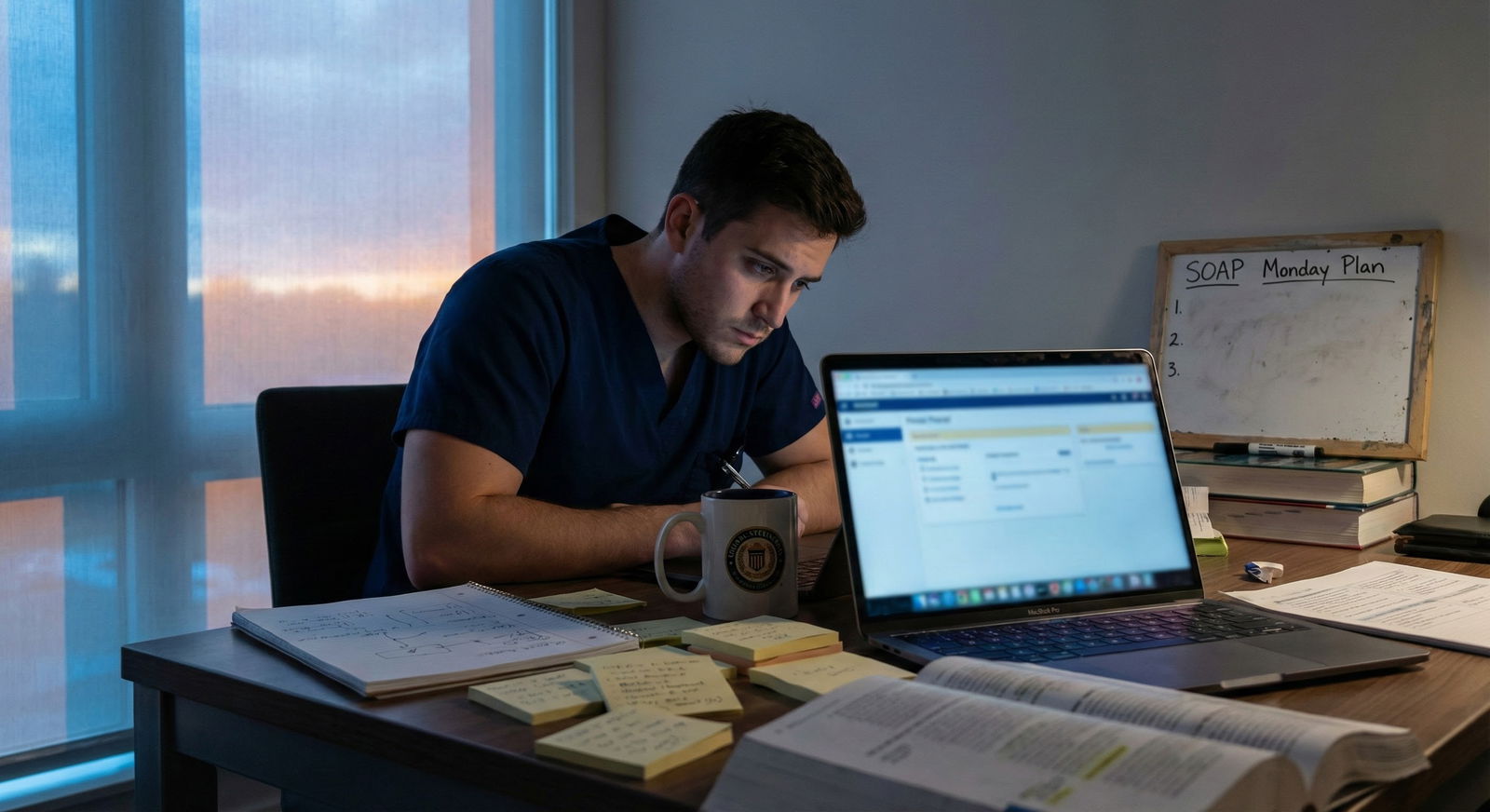
The Mechanics of a Clean File
I have said this in pieces, but let me consolidate it. Coordinators have told me that the single most common reason a document is not reviewed is not content. It is format. Not the paper. The PDF. I am going to give you a short technical checklist. This is not optional.
File naming. Use only letters, numbers, and underscores. No spaces. No em dashes. No parentheses. The system can handle spaces, but some programs export to older databases that cannot. Underscores are safe. Always start with your last name.
PDF compatibility. Save as PDF/A or standard PDF format. Do not use "PDF Portfolio." Do not use "Create PDF/XPS" from Microsoft Word if it produces a 20 MB file. Compress if necessary. A good rule: if your one-page Fit Brief is over 1 MB, it is too large. A one-page text document should be 100-200 KB. Anything more means there is embedded junk in the file.
Do not re-upload. If you change one paragraph of the personal statement, do not delete and resubmit the entire ERAS application. You risk a database sync error, and during SOAP there is no time to fix sync errors. Only upload what changed. Use the correct slot.
Proofread by a human. Not Grammarly. A human. A friend, a spouse, a colleague. Someone who is not staring at their own name and is actually reading for typos. One typo in a 300-word document is visible. It signals carelessness. Do not push an update you have not read aloud at least once.