Last March, a program director I know in the Midwest walked into the conference room holding a printout. “Here we go,” he said. “SOAP roulette.”
On the first page was a name they’d already seen that week—rank list in hand, not matched, now back in the pile. The room went quiet for a second. Then came the real conversation. The kind you’re never in the room to hear.
Let me tell you what they actually say—and think—when they see “Unmatched” next to your name during SOAP. It’s not what the official webinars tell you. And it’s not always fair. But it is predictable, which means you can play it.
First Thing: How PDs Actually Open Your SOAP File
Here’s the part no one tells you: your SOAP file is not read the way your original ERAS was.
During regular recruitment, PDs skim, rank, debate, send to faculty, talk about “fit.”
During SOAP, most programs are exhausted, annoyed, and in a hurry. The vibe is, very literally: “Who can we take quickly without creating a headache?”
Picture it.
Monday: Match results. PD learns they came up 2 spots short. Bad mood, long day.
Tuesday: SOAP opens. Inbox explodes. They might have 300–800 SOAP applications for 2–4 positions. They have hours, not weeks.
The process in many programs goes like this:
- Coordinator runs a quick filter: graduation year, Step status, visa status, school type.
- PD or associate PD does a brutal first-pass screen: 5–15 seconds per app.
- Only then—maybe—do they drill down to figure out “what happened” with your unmatched status.
And yes. That “Unmatched” line is visible, and it absolutely colors how they read the rest.
The Immediate Reaction: “Why Are You Here?”
The first thought when they see “SOAP applicant” or notice unmatched status is not sympathy. It’s a question:
“What went wrong… and is it my problem if I take you?”
There are five default interpretations they cycle through. Which bucket you fall into determines almost everything.
| Category | PD Gut Reaction |
|---|---|
| Overreach | Safe if ego is in check |
| Red Flag | Proceed with caution |
| Collateral Damage | Worth a closer look |
| Late Bloomer | Potential hidden gem |
| System Problem | Depends on program politics |
Let me break these down the way they talk about them behind closed doors.
Bucket 1: The Overreacher (“Tried to punch above their weight”)
This is the most common narrative PDs assume.
You: Mid-tier scores, average letters, okay CV.
Your rank list: All super-competitive university programs in saturated cities. Few or no community programs, no safety net.
In the room, it sounds like this:
- “This one just shot too high.”
- “Good enough for a match, just not where they aimed.”
PDs like this category. You’re not seen as dangerous. You’re seen as someone who misplayed the game.
What they check to confirm this theory:
- Did you apply broadly at baseline programs in your chosen specialty?
- Are your scores and CV consistent with matching somewhere in that field?
- Any catastrophic red flags? (Failed attempts, professionalism hits, big gaps)
If everything else is clean, your unmatched status is interpreted as “strategic error,” not “toxic applicant.”
This is where you want to be if you’re SOAPing into the same specialty or a related one.
Your job in SOAP:
Make your documents scream, “I belong in residency; I understand my situation; I’m ready to work hard anywhere that takes me.” No whining about the process. No emotional overshare.
Bucket 2: The Red Flag (“Got passed over for a reason”)
When PDs see “Unmatched,” their next suspicion is blunt:
“What did everyone else see that I’m not seeing yet?”
This is where they start hunting. Hard.
They’ll flip through quickly looking for:
- Failed Step/COMLEX attempts
- Large unexplained gaps
- Dismissal/suspension language in the MSPE
- Generic or lukewarm letters
- Weird shifts in specialty interest (“Last week they loved Derm, now they ‘always dreamed’ of Family?”)
I’ve heard variations of these lines many times:
- “If 15 IM programs interviewed you and not one ranked you high enough to match, something is off.”
- “Look at the MSPE carefully; there’s probably a hint.”
- “Why did their home program not keep them as a prelim?”
If they smell a red flag they don’t have time to investigate during SOAP, they move on. Quickly.
Here’s the key: the red flag itself is often less lethal than your attempt to hide it.
A failed Step attempt with a clean, straightforward explanation and evidence of later strong performance? Some PDs will live with that during SOAP.
A vague “personal circumstances” story and nothing else? They’ll assume the worst.
Bucket 3: Collateral Damage of a Bad Cycle
This is the group a lot of strong applicants secretly fall into: you’re fine; the system is not.
PDs know this group exists. They complain about it privately.
They’ve watched:
- Application inflation explode
- Well-qualified students get frozen out because they didn’t get early interviews
- Programs over-invite, then rank shallowly because they’re “safe”
In SOAP committee meetings, it sounds like:
- “We definitely missed good people this year.”
- “There are going to be some very solid unmatched folks in SOAP.”
- “Look for strong Step 2, good consistent narrative, but fewer interviews on paper.”
When they see strong stats, solid clinical comments, coherent story, and not much that explains being unmatched, experienced PDs will often say: “Okay, the cycle cooked them. Let’s look carefully.”
Your narrative matters a lot here.
If your personal statement, CV, and any updated communication hint at honest reflection—“I underapplied to community programs; I realized too late that X specialty was overloaded; I’ve refocused on Y for Z reasons”—that reads as mature, not desperate.
Bucket 4: The Late Bloomer / Specialty Switcher
SOAP is full of people whose applications “came together too late.”
Sometimes it’s:
- Late Step 2 CK score that changed the game
- Strong sub-I late in the fall that made them suddenly competitive
- Realization they chose the wrong specialty… after ERAS was already in
PDs know this type. They’ve seen M4s transform from disorganized to rock-solid between October and February.
The conversation behind doors:
- “They pivoted late, but their clinical comments are good.”
- “No time to do away rotations in this new specialty—makes sense.”
- “They were never competitive for ortho, but they look great for FM.”
These candidates can do very well in SOAP if they’re honest, quick, and clear.
The danger? Overcompensating in SOAP materials. Claiming you’ve “always been passionate” about a field you clearly never planned for. PDs see through that instantly.
Say this instead:
“I initially pursued X for reasons A and B. During my rotations in Y and Z, I realized that my skills and long-term goals align more with [new specialty]. I’m committed to building my career here and have already done [specific steps].”
Concise. Concrete. Adult.
Bucket 5: System Problem (“The unmatched but radioactive candidate”)
Here’s the harsh one.
Sometimes your record screams: “I should have matched,” and there’s something that screams: “You will be a problem for us.”
That “something” can be:
- Multiple professionalism comments in MSPE
- A pattern of “requires close supervision,” “needed frequent redirection,” “had challenges receiving feedback”
- Rumors—yes, PDs talk about specific students across institutions, especially in tight-knit specialties
- A late-breaking event your school alludes to but doesn’t detail
In SOAP, with the clock running, PDs do not have the appetite to reconstruct the truth.
They lean conservative.
You end up in the “too risky when we can find someone else by 3 p.m.” pile.
If you suspect you’re in this category, your best leverage is human to human advocacy.
That means:
- A trusted faculty member calling the PD directly
- Your dean emailing or phoning to contextualize what’s in your record
- A clear, non-self-pitying one-liner in your communication that frames the event and what changed
Not a three-page essay. A precise acknowledgment plus evidence of change.
How Different Program Types React to “Unmatched”
Not all PDs view SOAP the same way. There are patterns.
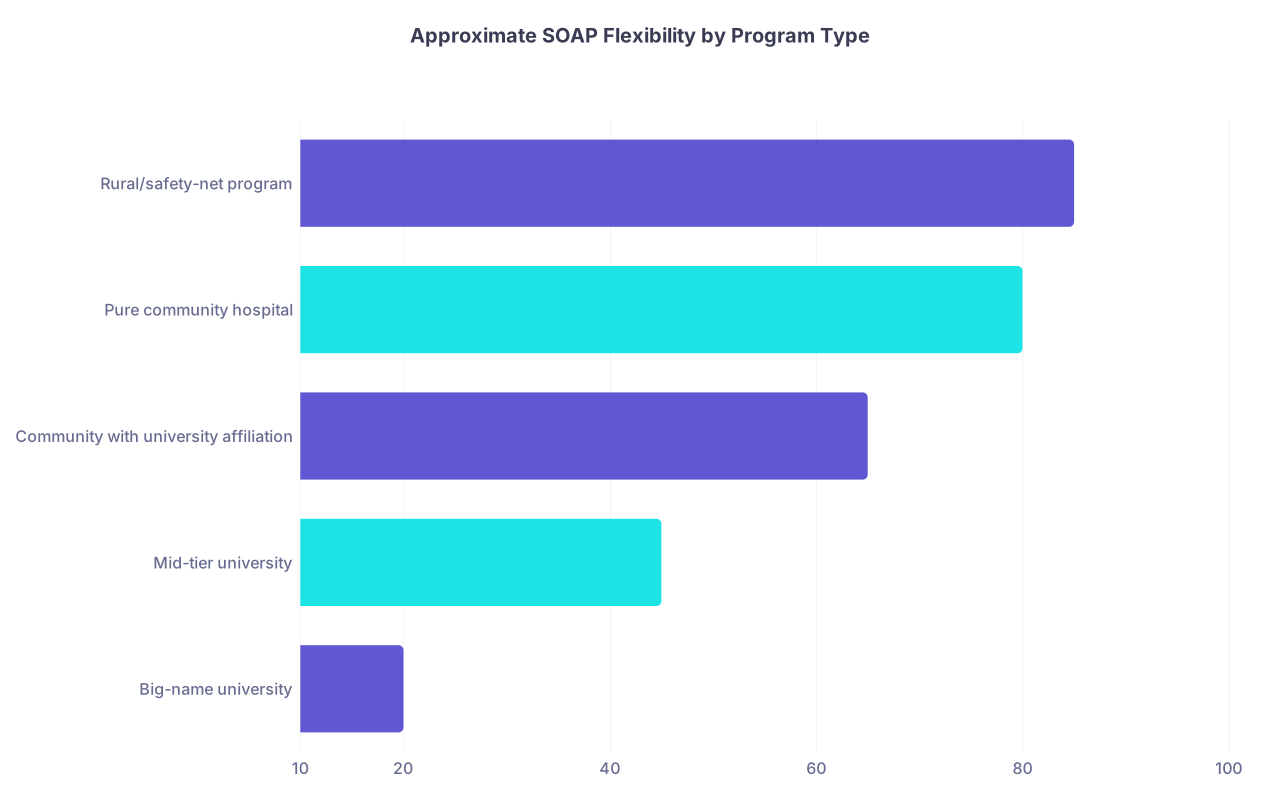
| Category | Value |
|---|---|
| Big-name university | 20 |
| Mid-tier university | 45 |
| Community with university affiliation | 65 |
| Pure community hospital | 80 |
| Rural/safety-net program | 85 |
Interpretation (yes, this is real-life mood, not official policy):
Big-name university programs: SOAP is often about “salvaging” a categorical or prelim spot. They’re picky. Unmatched status is a bigger mark. They’d rather go short than take someone that could be a political headache.
Mid-tier university programs: More open, especially if you fill a service need. They’ll entertain “collateral damage” and “late bloomer” applicants.
Community with university affiliation: Very SOAP-friendly. They’re under-recognized, often get excellent residents from SOAP, and are used to “second chance” narratives.
Pure community / rural / safety-net: They live in SOAP. They aren’t naïve—they still avoid major red flags—but unmatched status bothers them less. They care more about: Will you show up, do the work, not quit, not destroy morale?
If you’re unmatched, you should mentally target the bottom three categories above as your highest yield options during SOAP, even if your ego is still clinging to prestige.
What PDs Scan First When They See “Unmatched”
During SOAP, with “Unmatched” on the table, most PDs sprint through your file in a set pattern. It’s not always conscious, but it’s very consistent.
Roughly:
- Graduation year and med school
- Step 1/COMLEX 1 and Step 2/COMLEX 2
- MSPE summary and any negative language
- Clinical evaluations in core and relevant rotations
- Specialty pattern (what you originally applied to)
- Your SOAP personal statement or updated note
Notice what’s missing from that list: research, hobbies, “diverse interests.” They care about those eventually, but in SOAP the real question is: “Is there a reason everyone else said no?”
A PD friend of mine in IM phrased it best:
“In SOAP, I’m not trying to find the most impressive applicant. I’m trying to find the least risky safe bet before the deadline.”
Your entire SOAP strategy should be built around looking like that “least risky safe bet.”
How Your Original Specialty Choice Looks in SOAP
This part stings, but you need to know how they talk about it.
If you unmatched in:
Derm, plastics, ortho, ENT, neurosurg
PDs in IM, FM, psych, peds assume: “Okay, they were chasing prestige and re-centered.” They don’t hate that. But they do want to know you’re not just parking in their specialty until you reapply.EM, OB/GYN, gen surg
These are increasingly competitive, and PDs know it. They’re more sympathetic. But if you suddenly pivot from EM to psych during SOAP, you must articulate a sane story.IM, peds, FM, psych
If you couldn’t match in these with a full cycle, PDs look much harder at red flags. Here, “unmatched” raises more questions, because the baseline match rates are higher.
The quiet skepticism PDs often voice:
- “Is this applicant actually interested in us, or just taking anything to not sit at home?”
- “Are we going to invest two years in someone who re-applies to their original specialty as soon as they pass Step 3?”
You counter this by being specific. Not melodramatic.
“I plan to build a career in [new specialty]” is fluff.
“I’ve identified [fellowship or practice pattern] as my long-term path, and this specialty is the correct home for that because [short, concrete reason]” reads like a person who has thought this through.
What Your SOAP Personal Statement Actually Signals
Your SOAP PS is not a literary exercise. PDs are using it as a diagnostic tool.
When they see “Unmatched,” your statement either:
- Confirms their fears
- Neutralizes their fears
- Or very rarely, upgrades you in their mind
Here’s what kills you:
- Rambling about how unfair the Match is
- Blaming “the system” without taking any ownership
- Excessive emotional tone—anger, despair, grandiosity
- Whiplash pivot: “Derm has always been my passion… but I’m now equally passionate about Psychiatry.” No. You’re not.
What helps you:
One clean line acknowledging your situation indirectly:
“After an unsuccessful attempt to match in [prior specialty], I have re-evaluated my strengths and long-term goals.”A short, grounded explanation:
“I initially pursued X due to interest in Y. During rotations in A and B, I realized that my strengths in [concrete skills] and my satisfaction working with [patient population] aligned better with [new specialty].”Evidence you understand what this specialty actually is:
Specifics about workflow, patient types, training environment—none of the generic “I like continuity of care and teamwork” fluff.
The PD is reading that statement asking: “If I put this person on my call schedule in July, are they going to regret this and blow up my program?”
You want every line to quietly whisper: “No. I know what I’m signing up for. I’m ready.”
Behind-the-Scenes SOAP Triage: How Fast the Judgments Are
You probably imagine PDs sitting thoughtfully with your file, debating your character. That’s not SOAP.
SOAP looks more like this:

| Step | Description |
|---|---|
| Step 1 | Coordinator pulls SOAP list |
| Step 2 | Filter by eligibility |
| Step 3 | PD quick screen 5-15 sec |
| Step 4 | Reject |
| Step 5 | Shortlist |
| Step 6 | Deeper review of MSPE and red flags |
| Step 7 | Interview offer |
| Step 8 | Brief interview |
| Step 9 | Rank for SOAP offer |
Translation: most of the value you can add is in:
- Making yourself pass that 5–15 second screen
- Making your red flags easy to understand, not mysterious
- Coming across as stable, mature, and actually interested in the program
Strong letters that explicitly describe you as reliable, hard-working, and coachable are worth more in SOAP than another line of research.
What PDs Think When They See You Unmatched… and Still Picky
One more ugly truth.
PDs absolutely talk about SOAP candidates who act like they still have leverage they do not.
Examples PDs complain about:
- SOAP applicants who decline their interview invitation because the time “isn’t ideal”
- Students asking detailed questions about research infrastructure and away rotations for fellowship positioning—before getting an offer
- Applicants sending pushy emails: “I want to know my status ASAP so I can plan my other SOAP interviews.”
The subtext they hear: lack of insight, lack of humility, potential future headache.
You are allowed to have standards. You should not throw yourself into a malignant program. But in SOAP, your posture needs to be:
- Grateful for opportunities
- Focused on training and growth
- Logistical, not entitled
A PD in FM said this bluntly after SOAP last year:
“If you’re unmatched and still negotiating like you’re holding 10 offers, I assume you’re going to be a problem resident. Easy pass.”
When Being Unmatched Actually Helps You
Yes, sometimes “Unmatched” can be a weird advantage.
In certain programs, especially smaller or overlooked ones, PDs fully expect to get most of their class from SOAP. They know the pre-SOAP market ignored them.
To those PDs, an unmatched candidate who:
- Has decent numbers
- Comes across as grounded
- Shows understanding of their program’s patient population and mission
…can feel like a steal.
They tell themselves:
- “We’re giving this person a shot the system didn’t.”
- “They’ll be loyal. They won’t look down on us.”
- “We can mold them. They’ll remember who opened the door.”
You lean into that by showing you’ve actually looked at their program. Not copy-paste. A sentence or two that could only apply to them:
- Their safety-net mission
- Their rural catchment area
- Their specific patient population
- Their strong track record placing people into the fellowship or community jobs you realistically want
PDs have an ego, too. If you can make it feel like this isn’t just “any port in a storm,” they’re more likely to fight for you in committee.
The Bottom Line: What’s Really Going On in Their Heads
Strip away the noise, and PD thinking in SOAP when they see “Unmatched” boils down to three questions:
Is there a clear, non-scary reason this person didn’t match?
Overreach? Late pivot? Bad cycle? Those are survivable. Mysterious or multiple red flags? Usually not.If I take them, will they show up, work, and not blow up my program?
They don’t need you to be brilliant. They need you to be stable, coachable, and present.Are they actually interested in what we are, or just terrified of being unmatched twice?
Generic desperation repels. Specific, grounded interest sells.
If you keep those three questions in the front of your mind, everything you say and write during SOAP becomes easier to shape.
You’re not trying to convince them you’re perfect.
You’re trying to convince them you’re a safe, sane, motivated bet in a chaotic week.
Do that, and “Unmatched” becomes a data point—not a sentence.