
The worst decisions in SOAP don’t feel like decisions. They feel like panic.
That’s how people end up “settling” into something they never wanted and then spending the next three years wondering if they just destroyed every future option they cared about.
Let me be blunt: SOAP can absolutely box you in if you don’t think ahead. But it also doesn’t have to be a life sentence. The whole “if you SOAP you’re done for” narrative is exaggerated and, honestly, kind of lazy.
You’re worried about three things, whether you’ve said them out loud or not:
- “If I take the wrong SOAP spot, am I stuck in that specialty forever?”
- “If I don’t SOAP at all, am I basically ending my career?”
- “Will programs judge me forever for being a SOAP applicant?”
Let’s walk through this like we’re sitting in a call room at 1 a.m., hitting refresh on NRMP, trying not to spiral.
First, what actually counts as “settling” in SOAP?
“Settling” isn’t one thing. There are levels.
There’s:
- “This is not my dream specialty, but I can live with it.”
- “This environment will be brutal, but at least I’ll be a resident.”
- “This program is so bad it might make my long-term goals harder, not easier.”
The third one is the one you need to protect yourself from.
During SOAP, you will feel heavy pressure to take anything with a filled position and a paycheck. The messaging is basically: “Residency good. No residency bad.” And yeah, unemployment with loans is terrifying. But not all SOAP positions are equal in terms of how much they preserve your options.
Here’s how they roughly stack up in terms of future flexibility:
| SOAP Outcome Type | Future Flexibility |
|---|---|
| Categorical in desired specialty | High |
| Categorical in adjacent field | Moderate |
| Transitional / Preliminary year | Moderate–High |
| Categorical in very misaligned specialty | Low–Moderate |
| Malignant / poorly supported program | Low |
You can’t control what’s in SOAP, but you can control which of these outcomes you’re willing to accept based on your risk tolerance and long-term goals.
The big fork: take something vs wait and reapply
This is the nightmare decision.
On SOAP day, it usually feels like:
- Option A: Take a spot you’re not excited about → fear of being stuck forever.
- Option B: Don’t take anything → fear your career is over.
Both feel catastrophic. Neither actually is, if you’re intentional.
Let me split this into what’s actually dangerous vs what just feels terrifying.
When taking a SOAP offer protects your future
You’re probably protecting your future if:
It’s a categorical position in a field you can tolerate
Maybe you wanted Derm and what’s left is IM, FM, Psych, Peds, or even Path. No, it’s not your dream. Yes, it’s still a physician career with options. Internal medicine → cards, GI, heme/onc. FM → broad outpatient, urgent care, sports, admin. Psych → tons of job security. Peds → fellowships. You get the idea.The program has decent training and non-toxic vibes
People underestimate this. Being at a solid mid-tier community IM program is better than being in a malignant “name” program where you’re miserable, burning out, and tanking your evaluations. Future PDs actually care a lot about your performance and letters.You still have a path to pivot later
Certain specialties are more forgiving if you come from somewhere else. Example:- Want EM but SOAPed into IM or FM → still possible to pivot, especially via community EM or combined pathways, though it’s harder now with EM being chaotic.
- Want anesthesia but SOAPed into prelim IM or surgery → classic path is PGY1 prelim → reapply.
- Want radiology but SOAPed prelim → same story; people do this.
Transitional or prelim years can be fantastic “pause buttons” as long as you treat them as launch pads, not consolation prizes.
Transitional vs Preliminary vs Categorical in SOAP: which is safer?
This is one of the few times I’ll say this clearly: not all PGY1 paths are equally good for preserving options.
| PGY1 Type | Pros for Future Options | Main Risks |
|---|---|---|
| Transitional | Broad exposure, lighter schedule | Not guaranteed PGY2 spot |
| Prelim Medicine | Solid clinical base, respected | Must reapply and secure PGY2 |
| Prelim Surgery | Good for some fields (Anes, Rads) | Can be brutal, less time to apply |
| Categorical IM/FM/Psych/etc. | Stable, board-eligible | Harder (not impossible) to switch |
How I’d think about it, in pure “protect my options” mode:
Transitional year
Best if you’re not sure yet, or you’re pretty certain you’ll reapply. More balanced schedule (usually), access to different specialties, time to build relationships and rework your application.Prelim medicine
Very solid if you’re aiming at things like anesthesia, rads, neuro, or even reapplying to IM. You become a safe, clinically solid PGY1 with strong letters. That matters a lot.Prelim surgery
Good if you’re aiming surgery or anes, but these can be brutal and leave less time to reapply. Also, some surgery programs treat prelims like expandable labor. Not all, but enough that you should ask hard questions.Categorical in a non-ideal specialty
Safer if the specialty isn’t a total mismatch for you. If you think, “I could actually see myself living this life,” even if it’s Plan B or C—that’s worth a lot when your alternative is absolute uncertainty.
What’s dangerous: taking a prelim year “just to have something” and then not having the energy, plan, or support to actually reapply. That’s how you end up PGY1 → unemployed PGY2 with no spot and a messy story.
How much does SOAP actually hurt your reputation?
You’re imagining PDs across the country whispering: “Oh, that one SOAPed. Yikes.”
Reality is more boring and less personal.
Most PDs care about:
- How you performed where you actually trained
- Your letters from attendings who know you
- Your exams, work ethic, reliability
- Whether you’ll be a headache or a solid resident
SOAP is a factor, not a scarlet letter.
Here’s how SOAP usually looks from their side:
- If you SOAP into a decent program, do well, and later apply to another specialty or program, they’re mostly going to see: “Completed PGY1 with strong reviews” or “Completed 3 years, board-eligible, good letters.”
- If you don’t SOAP, take a strong research/clinical gap year, and come back with better scores/letters and a coherent story—that’s also fixable.
Where SOAP becomes a problem:
- You bounce from program to program, leave places under unclear circumstances, or collect bad evaluations. PDs absolutely talk about that.
- You take a miserable SOAP position and your performance suffers because you’re burned out, bitter, or disengaged.
The SOAP tag itself is not automatically fatal. What happens after SOAP is what makes or breaks you.
If you absolutely hate the specialty options in SOAP
This is the part people lie to you about. They’ll say, “Any match is better than no match.”
Not always.
If the only available options are:
- Specialties you viscerally dislike
- Programs with a known malignant reputation and terrifying reviews
- Locations where you have zero support, going into a brutal field you already know isn’t for you
You’re allowed to say no. Even in SOAP.
But you can’t do that blindly. You need a plan for the “no SOAP” route, because it’s not easy and it’s not short.
Think through:
Can you realistically improve your application in 1–2 years?
- Step/COMLEX scores aren’t changing (unless Step 2 still pending).
- But research output, publications, stronger letters, US clinical experience, targeted networking? Those can absolutely change.
Do you have financial and emotional support to handle a gap year (or two)?
This is not a luxurious sabbatical. It’s work: research assistant, prelim-level jobs, maybe hospitalist scribe, tutoring, something to pay bills while you rebuild your application.Can you explain the gap in a way that sounds intentional instead of “I panicked and bailed”?
Programs are okay with non-linear paths if you can own it:- “I chose not to enter a specialty I couldn’t see myself practicing long term, and I used that time to do X, Y, Z to prepare for this field instead.”
If your gut is screaming “I will be absolutely miserable and likely trapped,” it’s not irrational to decline SOAP. It’s just high-risk, high-effort. You have to be honest with yourself about whether you’re willing to carry that.
How to judge a SOAP offer in 15–30 minutes
SOAP doesn’t give you time to soul-search. You’re rushing, half-panicked, clicking between spreadsheets and program websites, trying not to cry.
Have a quick filter ready. Something like:
Specialty fit (green / yellow / red)
- Green: I could see myself doing this long term. Not my dream, but I can imagine contentment.
- Yellow: Don’t love it, but could use this year to pivot. Might tolerate short term.
- Red: I’d be miserable. This is everything I don’t want in my daily life.
Program quality and toxicity risk
- Ask about: resident attrition, board pass rates, how often they’ve had residents leave, what recent grads do.
- If every Glassdoor and Reddit mention screams “RUN”—take that seriously.
Future doors this position opens
- Transitional/prelim: Does this program support reapplicants? Have any done it successfully?
- Categorical: What fellowships do grads get? Do people ever switch fields? Do PDs help with that?
If it’s:
- Green specialty + decent program: strongly consider taking it.
- Yellow specialty + good environment + strong track record of people moving on: reasonable bridge option.
- Red specialty + malignant vibes: that’s when you seriously weigh not SOAPing—even if that terrifies you.
Actual trajectories I’ve seen (so you don’t feel like you’re making this up)
Nothing calms anxiety like real examples, so here are some very common patterns:
- SOAPed into prelim medicine → worked hard, got stellar letters → reapplied to anesthesia → matched PGY2 spot
- SOAPed into categorical FM after missing IM → ended up loving outpatient → now super happy in a lifestyle-friendly job making solid money
- Didn’t SOAP → did 2 years of research in desired specialty, got publications, improved Step 2 timing → matched into that specialty later
- SOAPed into malignant surgery prelim → crushed, burned out, didn’t get support to reapply → left medicine entirely feeling like they failed (this is what we’re trying to avoid)
You’re not deciding between “perfect path” and “end of career.” You’re choosing between different imperfect paths with different timeframes and levels of pain.
How to protect your future during a SOAP year
Let’s say you take a SOAP spot, but you’re still uneasy. How do you keep your doors open instead of silently resigning to “I guess this is my life now”?
Start strong in PGY1
First impressions matter. If you’re the SOAP resident who shows up hungry, prepared, and reliable, a lot of your past suddenly becomes irrelevant.Get 2–3 powerful advocates
Not random “Satisfactory Resident” letters. You want attendings or PDs who’ll say:
“This resident is in the top X% I’ve ever worked with. Absolutely recommend them for internal medicine/anesthesia/radiology/whatever.”Be honest (with tact) if you plan to pivot
Don’t blindside your PD in January of your reapplication cycle.
Come in early:
“I’m grateful for this opportunity and I’m committing fully to this year, but long term I’m very interested in [specialty]. I’d love your advice on how to position myself.”Don’t trash your current specialty
Ever. Not on rotations, not to residents, not in your new applications. Your narrative must be:
“I learned a ton, I appreciate this experience, but I discovered my skills and long-term goals align better with X.”
That’s how you keep your future from collapsing into a single, locked-in track.
A quick visual: timelines if you SOAP vs don’t SOAP
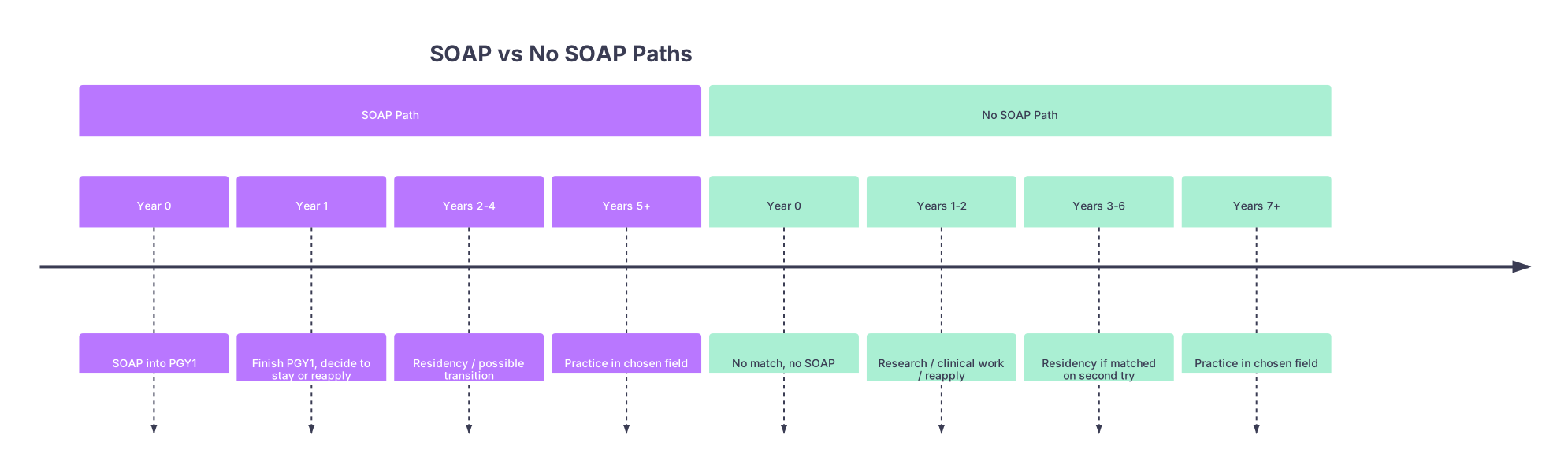
| Period | Event |
|---|---|
| SOAP Path - Year 0 | SOAP into PGY1 |
| SOAP Path - Year 1 | Finish PGY1, decide to stay or reapply |
| SOAP Path - Years 2-4 | Residency / possible transition |
| SOAP Path - Years 5+ | Practice in chosen field |
| No SOAP Path - Year 0 | No match, no SOAP |
| No SOAP Path - Years 1-2 | Research / clinical work / reapply |
| No SOAP Path - Years 3-6 | Residency if matched on second try |
| No SOAP Path - Years 7+ | Practice in chosen field |
Both paths can end in you practicing as an attending. One just has more immediate security; the other has more front-loaded uncertainty.
Mental rules to keep you from freezing in SOAP
You’ll probably be running on adrenaline and zero sleep. So keep a few simple, brutal rules in your head:
- Don’t take a position that guarantees burnout and blocks you from reapplying.
- Don’t reject every acceptable-but-not-dream option just because it stings right now.
- Protect future you, not your ego today.
And honestly: talk it out with at least one rational human who’s not in full panic mode. A trusted mentor, an upper-level, someone who knows the game. Not a classmate doom-scrolling Reddit.
One last thing: your career is not decided in one week
SOAP feels like a verdict on your entire worth. It isn’t.
The system is messy. People fall through cracks for reasons that have nothing to do with intelligence or potential: visa issues, bad advising, unlucky interview seasons, weird market shifts in EM or psych or IM.
You’re allowed to feel crushed. You’re allowed to grieve the path you thought you’d have.
But then you have to choose:
- A slightly messier route that still gets you where you want to go.
- Or a different destination that might end up being okay—or even better—than what you planned.
Either way, your future is not over. It’s just going to be more complicated than the brochure version.
Key points to hang onto:
- Not all SOAP positions are equal; prioritize roles that keep doors open (transitional, prelim, or livable categorical programs with decent reputations).
- Taking nothing in SOAP is risky but not terminal—if you commit to a real plan to strengthen your application, not just “wait and hope.”
- Your long-term options depend far more on how you perform after SOAP—in PGY1, in research, in your next application—than on the fact that you SOAPed in the first place.
You’re not choosing between “perfect career” and “no career.” You’re choosing between different hard paths. And you’re a lot less trapped than your 3 a.m. brain is telling you.