
It’s Monday night of SOAP week. You didn’t match. Your phone feels like a brick. ERAS is open on your laptop with a list of unfilled programs that looks like alphabet soup. Your dean said, “You should consider applying broadly.” Your brain heard: “Throw your career darts at random and pray.”
And now the worst thought shows up:
“What if I pick the wrong specialty in SOAP and ruin everything?”
Let’s walk through this like people who are scared but still have to act.
The ugly fear: “If I SOAP into the wrong specialty, I’m stuck forever”
This is the loop, right?
If I pick the “wrong” SOAP specialty → I’ll hate residency → I’ll be too miserable to switch → I’ll never get fellowship → I’ll be behind everyone → lifelong regret.
Here’s the part no one says out loud: everyone in SOAP is triaging. Nobody is making their dream decision in perfect conditions. You’re making the best call under time pressure with incomplete data and a bruised ego. That’s reality.
So, no, you’re not choosing your forever-life with godlike precision. You’re choosing:
- A survivable next 3–4 years
- That keeps you inside the system
- And keeps doors from slamming shut permanently
You’re not choosing “my final form as a physician.” You’re choosing “the branch that gives me the most options and the least long-term damage.”
Let’s actually put some structure around that instead of panic-vibes only.
Core decision framework: 4 questions you have to answer
When your brain is screaming, it helps to force it into yes/no or ranked choices. This is the framework I’d use if I were sitting next to you staring at the SOAP list.
1. What’s my non‑negotiable line?
Not: “What’s my dream?”
Instead: “What can I actually not tolerate for 3 years?”
Be brutally honest with yourself. Examples:
- “I cannot do shift work nights forever, but I can survive for 3 years.”
- “I cannot handle surgical culture. Like, at all.”
- “I can’t be in a specialty where I never see adults / never see kids.”
- “I cannot do procedures / I cannot avoid procedures.”
You are not picking what you love. You’re ruling out what would break you.
If a SOAP option crosses that line? Don’t rank it high, even if it’s “more competitive” and sounds fancy. A prestigious prison is still a prison.
2. Which specialties are exit‑flexible vs exit‑traps?
Some fields are easier to pivot from if you realize you’re wrong. Some are harder. Nothing is guaranteed, but trends are real.
Very rough, but honest:
| Specialty Type | Relative Flexibility to Pivot | Typical Length |
|---|---|---|
| Preliminary Medicine | High | 1 year |
| Transitional Year | High | 1 year |
| Categorical IM/FM | High–Moderate | 3 years |
| Pediatrics/Neurology | Moderate | 3–4 years |
| Surgery Categorical | Low–Moderate | 5+ years |
If you are truly lost on specialty identity, anything that gives you:
- Broad general training
- Exposure to multiple subspecialties
- A reputation as a solid foundation for other fields
…is safer as a SOAP choice.
Usually that means: Internal Medicine, Family Medicine, Transitional Year, or Preliminary Internal Medicine. Those are not consolation prizes. They’re structural beam specialties. They hold a lot of the house up.
Radiology, anesthesia, EM, surgery, etc. from SOAP? People do it, and some thrive. But if you’re already doubting specialty fit, jumping into a super-narrow lane during a crisis is risky.
3. How bad do I want to be in the system vs out for a year?
This is the real fork in the road:
- SOAP into something this year, even if imperfect
- Or don’t SOAP, take a research year / prelim / reapply later
SOAPing into a not-perfect-but-okay specialty:
- Pros: You’re a resident. You get paid. You gain experience. You have an institutional badge and a place.
- Cons: It’s harder (not impossible) to reapply to a completely different categorical spot later; you’ll be tired and busy while trying.
Skipping SOAP (or minimal SOAPing) to reapply:
- Pros: More time to clarify what you want, improve application, get stronger letters, retake exams if needed, do research.
- Cons: No guaranteed match next year, financial stress, emotional drain of a “gap” year, stigma you’ll invent in your head even if programs don’t care as much as you think.
If your worst fear is: “I will disappear from medicine if I don’t grab something,” then prioritize staying in. If your worst fear is: “I will feel trapped and resentful if I SOAP into something totally wrong for me,” then you may accept the risk of waiting.
There isn’t a clean answer. There’s just which risk you can sleep with.
4. Where do my actual strengths line up right now?
Not the fantasy version. The real stats:
- Step 1 (even if P/F, programs see it)
- Step 2 score
- Clerkship grades
- Letters
- Research (or lack of it)
- Red flags
If your app is already borderline for your dream specialty in the main Match, SOAP is not where that somehow gets easier. SOAP is survival mode, not wish fulfillment.
You want to aim where:
- Your scores are at or above the typical accepted range
- Your story (letters, experiences) actually matches the field
- There are enough unfilled spots to give you a realistic shot
If, for example, you have a 265 Step 2, outstanding medicine letters, and IM/FM spots open in SOAP? I’d lean hard into that rather than scrambling for the 3 open categorical surgery spots across the entire country.
A brutally honest specialty breakdown for SOAP
Let’s hit the usual suspects people panic about.
Internal Medicine (categorical)
Why it’s a good SOAP safety net:
- Opens doors to: cards, GI, pulm/crit, heme/onc, hospitalist, ICU, etc.
- Broad training: you see everything, meet everyone
- System values it: you will always be employable
Why people fear it:
- “What if I’m stuck as a general internist and I hate it?”
- “It’s not as ‘flashy’ as my original dream (ortho, derm, etc.)”
Reality: IM is one of the least “wrong specialty” choices because it’s the trunk of the tree. You can still branch later. Will it be easy to flip to something like neurosurgery from IM? No. But you’re not locked into one lifestyle within IM the way you are in super niche fields.
Family Medicine
Why it’s underrated:
- Wide scope: peds, OB, adult, procedures (if you want)
- Geographic flexibility: jobs almost everywhere
- Paths to sports med, geriatrics, addiction, etc.
Why people panic:
- “Will I be bored?”
- “Less prestige, less competitive, did I ‘settle’?”
- “I wanted hospital‑based; will clinic kill me?”
FM can feel “wrong” if you strongly want tertiary care, ICU, heavy inpatient. But if you like continuity, breadth, maybe rural or community vibes, it can actually be one of the least suffocating SOAP outcomes.
Transitional Year / Preliminary Medicine
These are the “I don’t know yet but I need a foothold” options.
Good if:
- You’re not ready to give up your original dream field
- You need time and credibility to reapply
- You want clinical experience while boosting your app
Risks:
- You are not guaranteed a PGY‑2 spot afterward
- You will have to reapply during intern year while exhausted
- Some programs treat prelims as disposable labor (not all, but enough)
Still: If you’re truly lost on specialty, a strong prelim medicine year at a good institution can be high‑value. You get IM experience, letters, and more clarity.
Surgery (categorical or prelim)
Look, if you already know you love surgery and the only reason you didn’t match was something like: too few applications, late Step 2, one bad rotation—SOAPing into a surgical prelim or categorical might be the right move.
But if your brain is doing: “Maybe I could learn to love surgery?”
During SOAP week? Under panic? I’d pause.
Surgical training is intense. Culture can be brutal. Switching out of surgery into something like IM is possible, but you’ll burn a lot of energy getting there. If you’re already specialty-uncertain, surgery is a high‑risk SOAP choice.
Pediatrics, Neurology, Psych, etc.
These sit in the middle.
- Peds: Great if you’re sure about kids, but not the best “generic” starting point if you’re not. Easier to pivot within kids; harder to pivot to adult specialties.
- Neurology: Decent bridge specialty; some cross‑talk with IM, but you’re still narrower.
- Psychiatry: Lifestyle can be better, work is interesting, but it’s a mental fit question. If you’re uneasy about the emotional weight of chronic mental illness, don’t SOAP into it hoping it’ll magically be fine.
If you have strong evidence you’d be okay in these fields (electives, letters, solid interest), they’re not “wrong.” But I would not use them as a default catch‑all just because they have open spots.
How to rank SOAP choices under time pressure without losing your mind
This is where the panic spikes: setting that actual rank list.
Here’s a structured way to do it without spiraling completely.
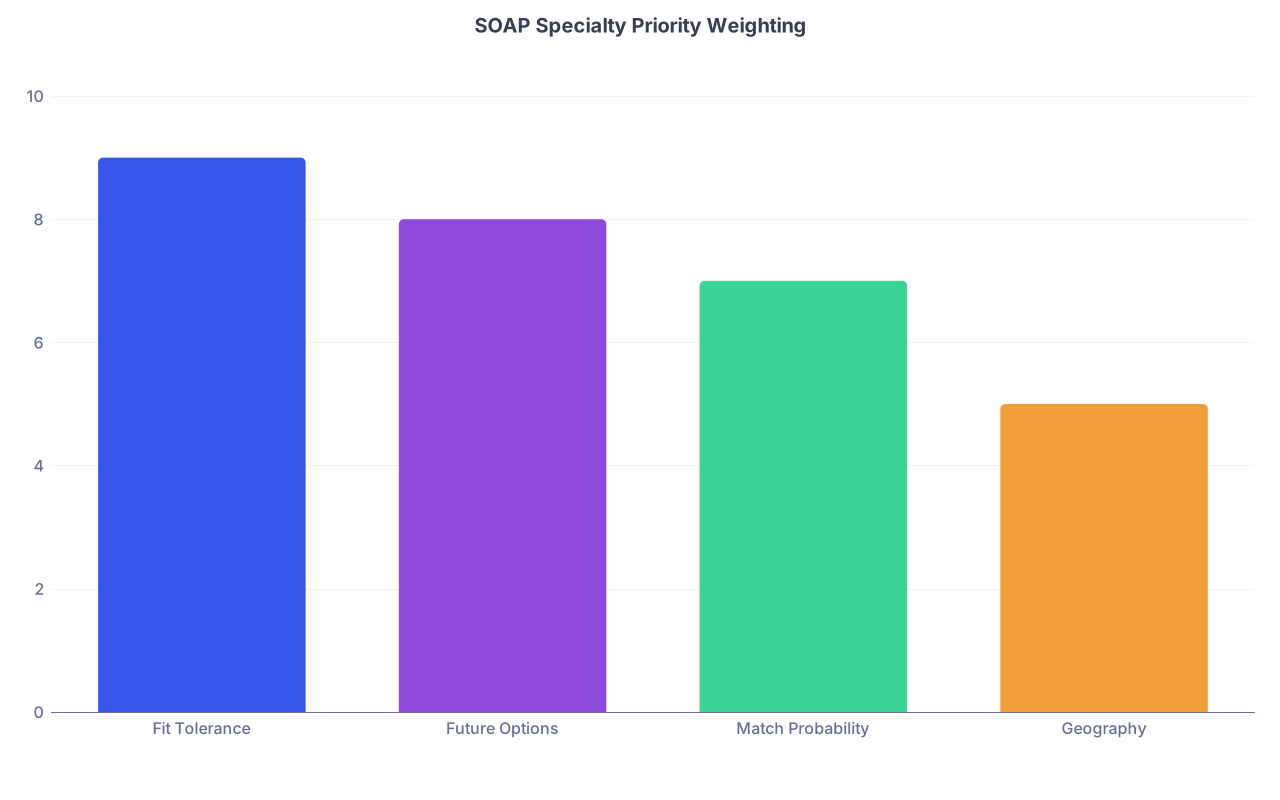
| Category | Value |
|---|---|
| Fit Tolerance | 9 |
| Future Options | 8 |
| Match Probability | 7 |
| Geography | 5 |
Think in weighted priorities:
- Fit tolerance (can I survive this day‑to‑day?)
- Future options (does this keep doors open?)
- Match probability (is this realistic?)
- Geography (nice to have, but in SOAP, usually not #1)
Then:
- Make three quick lists on paper:
- “Absolutely cannot do”
- “Could tolerate but not thrilled”
- “Okay with / could see myself here”
Your rank list should be built only from the middle and top two groups. The “absolutely cannot” group? Don’t touch it unless you’re okay being there. SOAP doesn’t magically turn those into good ideas.
Within each group, order by:
- Program vibes (if you know anything)
- Type of training (academic vs community, prelim vs categorical)
- Geography (last, not first, during SOAP)
You are not trying to optimize perfection. You are trying to avoid disaster.
How much does choosing “wrong” in SOAP actually lock you in?
Short answer: Less than your anxiety says. More than your magical thinking wants.
I’ve seen:
- IM interns switch to anesthesia, radiology, psych, even EM
- TY interns match into derm, ophtho, rads on second try
- Categorical FM residents move to IM (rare, but happens)
- Surgery prelims who pivoted to IM and were perfectly happy
Is it easy? No. Is it automatic? Definitely not. But are you embalmed in formalin the second you SOAP into something? No.
What does get harder if you SOAP “wrong”:
- Switching into a hyper‑competitive field (ortho, derm, ENT, neurosurg)
- Switching after PGY‑2 or later
- Switching if your new desired field is flooded with strong fresh grads
But:
- Moving to related fields (IM → cards, pulm, heme/onc; Peds → peds subs; FM → sports, addiction, etc.) is very doable.
- Being in any residency makes you more credible than sitting outside medicine entirely, in many cases.
So the catastrophic story in your head—“If I SOAP into X, my entire life is ruined”—is emotionally real, but not logically accurate.
Tiny mindset shift: You’re choosing a path, not a prison
Let me be harsh for one second because I’ve seen this mindset wreck people:
If you wait for a choice that feels 100% safe, clear, and perfect… you won’t move. At all.
SOAP is not forgiving of analysis paralysis. You will feel sick no matter what you pick. That doesn’t mean the choice is wrong. It means the situation sucks.
Your real questions are:
- Can I survive this field for a few years?
- Does this keep me employable?
- Does this leave me some plausible exit lanes if I truly hate it?
- Can I see any version of myself who might grow to like it?
If the answers are mostly yes, that’s probably the “right enough” choice under SOAP conditions.

Quick triage examples (because abstract advice only goes so far)
Scenario 1:
You wanted ortho. Didn’t match. SOAP list: some prelim surg, a bunch of IM/FM, a few TYs.
If you’re still dead‑set on ortho and your app is reasonably strong:
- High‑rank: TY + strong IM prelims at big hospitals
- Then: IM categorical at decent places
- Then: FM if location or fit makes sense
Why? TY or prelim gives you a shot to reapply ortho, IM categorical keeps you clinically solid with pivot options.
Scenario 2:
You thought you wanted EM but now you’re not sure. SOAP has a few EM spots and tons of IM/FM.
If you’re shaky on EM fit, I’d seriously consider:
- IM or FM categorical over SOAP EM
Why? EM is intense shift work and highly identity‑driven. If you’re already doubtful, SOAP is not the window to “try it out.”
Scenario 3:
You don’t know what you want at all. You just know you want to be a doctor.
Leaning IM, FM, or TY is usually best. They’re the least likely to be truly “wrong” and the most likely to keep you in the game.

| Step | Description |
|---|---|
| Step 1 | Unmatched in Main Match |
| Step 2 | Apply to that field plus broad options |
| Step 3 | Choose broad base fields IM/FM/TY |
| Step 4 | Prioritize IM/FM/TY/Prelim |
| Step 5 | Consider limited SOAP plus reapply later |
| Step 6 | Know clear specialty? |
| Step 7 | Field has SOAP spots? |
| Step 8 | Need to stay in system this year? |

FAQ (exactly 6 questions)
1. If I SOAP into a specialty I’m unsure about, will programs in other fields hold it against me later?
They might ask about it, but it’s not an automatic black mark. Programs mainly want a coherent story: “I SOAPed into IM because I needed to stay clinical and keep options open. During intern year, I realized my passion is X and here’s the evidence.” That’s way better than, “I sat out and did nothing.” What will hurt you is being obviously flaky: bouncing frequently, or bad performance/poor evaluations.
2. Is it better to SOAP into a prelim year or hold out for a categorical spot I’m not sure I want?
If you’re really uncertain about specialty but want to stay in the system, a strong prelim medicine year is usually safer than locking yourself into a 5‑year categorical program you might hate. But if the categorical is in a broad field you can see yourself tolerating (IM/FM/Peds) and the program seems decent, I’d lean categorical—stability matters, and you can always adjust your long‑term path within that field.
3. How much should geography matter in SOAP?
Way less than your brain thinks right now. In the main Match, geography is reasonable to prioritize. In SOAP, your hierarchy shifts: survivable specialty + decent program > location. A rough location in a tolerable field is almost always better than your preferred city in a specialty that’s a terrible fit for you.
4. What if I pick a broad field like IM but end up not competitive for any fellowship and feel stuck anyway?
Then your worst case is being a general internist or hospitalist—jobs that are in demand and can pay well. Yes, fellowship might not pan out if your application isn’t strong, but you’ll be a fully trained physician with multiple practice environments available. That’s still far less “stuck” than being in a hyper‑niche specialty you hate.
5. Will programs judge me for not SOAPing anywhere and choosing to reapply next year?
Some will be curious, but it’s not an automatic red flag if you have a clear, productive reason: research year, dedicated clinical work, major application repair (Step retake, extra rotations, etc.). Where it looks bad is if you essentially did nothing or can’t articulate why that gap made you stronger. SOAPing isn’t mandatory; it’s a tool. But you need a real plan if you skip it.
6. How do I know I’m not making a panic decision I’ll regret?
You can’t know with certainty. The goal is not “no regret,” it’s “minimize the odds of catastrophic regret.” Use the filters: Can I survive this day‑to‑day? Does this keep options open? Does this align even partially with my strengths? If a choice passes those tests and doesn’t cross your personal “absolutely not” line, then it’s probably as good as it gets in SOAP chaos. The anxiety won’t vanish—but that doesn’t mean the decision is wrong.

Key things to walk away with:
- You’re not picking your forever specialty in SOAP; you’re picking your next stable, survivable step.
- Broad, flexible fields (IM/FM/TY/prelim medicine) are almost never truly “wrong” when you’re uncertain.
- Your anxiety will scream either way—use structure (dealbreakers, flexibility, strengths) to make a decision you can at least defend to yourself later.