
It’s Monday of Match Week. Your group chat is blowing up with “I matched!!!” screenshots, colored confetti, and happy selfies. Your email, on the other hand, has that one line burned into your brain:
“We are sorry, you did not match to any position.”
Your stomach dropped. Your ears rang. And now you’re sitting there thinking:
I didn’t match. My friends did. What does that say about me? Am I done? Am I the failure of my class?
I’m going to be blunt: this moment sucks. It feels personal and humiliating and apocalyptic all at once. And you still have to somehow pull yourself together in a few hours and be “strategic” for SOAP when you can barely breathe.
Let’s walk through this like we’re sitting in a call room, door shut, vents humming, you on the edge of tears. I’m going to talk about the emotional part and the tactical SOAP part, because you need both.
You can’t think strategically if you’re busy mentally self-destructing.
First Hit: The Emotional Gut Punch
Your brain is probably doing some combination of the following right now:
- Replaying every “red flag” from your app and magnifying it x100
- Comparing your stats to friends who matched worse / better / easier than you
- Wondering if faculty secretly never liked you
- Thinking maybe you should’ve applied to 100 more programs, or a different specialty, or been born five years earlier
The cruel part is that you’re trying to process a major loss while needing to make rapid high-stakes decisions (SOAP). That’s a terrible combo.
Let me say this clearly:
Not matching does not mean:
- You’re not smart enough
- You’re not doctor material
- Your career is over
What it does mean:
- You ended up on the wrong side of a numbers game
- Your specialty / application mix / timing wasn’t aligned with reality this year
- You now have to pivot. Fast.
And yeah, it hurts extra because your friends matched. It feels like everyone is moving forward and you’re stuck at the starting line with a broken shoe.
You’re going to see:
- Instagram posts with white coats and balloons
- People talking about where they matched like it’s a personality trait
- Class emails about “celebrating our 99% match rate”
You are the 1%. It feels like that label is tattooed on your forehead.
Here’s the ugly truth I’ve seen over and over:
Residency selection is not a pure meritocracy. It’s a warped mix of:
- Applicant numbers
- Specialty competitiveness
- Geography
- Networking
- Random program preferences and vibes on one interview day
You’re not broken because the system didn’t pick you on this round.
Your Brain vs SOAP: Stopping the Spiral (Enough to Function)
You don’t have time for a full emotional recovery before SOAP. You just need enough stability to not self-sabotage.
Step one: give yourself one contained meltdown window.
Cry in the car. Swear in the stairwell. Sit in the dark for 20 minutes. Whatever. Let it hit.
Then, put a mental fence around it: “I will go back to this later. Right now, I have work.”
SOAP is not about pride. It’s not about matching your dream. It is about securing a spot that keeps your career alive and gives you options later.
This week, you’ll be tempted to:
- Avoid emails because you “can’t deal”
- Not call your dean because you feel ashamed
- Freeze instead of making decisions
- Wait too long hoping some magical option appears
Those are the ways people quietly tank their SOAP.
You need to do the opposite: over-communicate, over-ask for help, over-prepare.
Also: stop trying to explain or justify your situation to every friend who matched. You can literally say:
“Hey, I didn’t match, it’s been tough. I’m focusing on SOAP right now, so I might be quiet this week.”
You don’t owe anyone a detailed postmortem today.
SOAP Reality Check: What You’re Walking Into
Let’s talk mechanics, because this is where anxiety either gets worse or finally has something concrete to chew on.
SOAP is fast and brutal. You’re competing with thousands of other people who didn’t match or only partially matched. The available positions are limited and mostly in less competitive fields or less-desired locations.
Is it fair? No. But it’s what we’ve got.
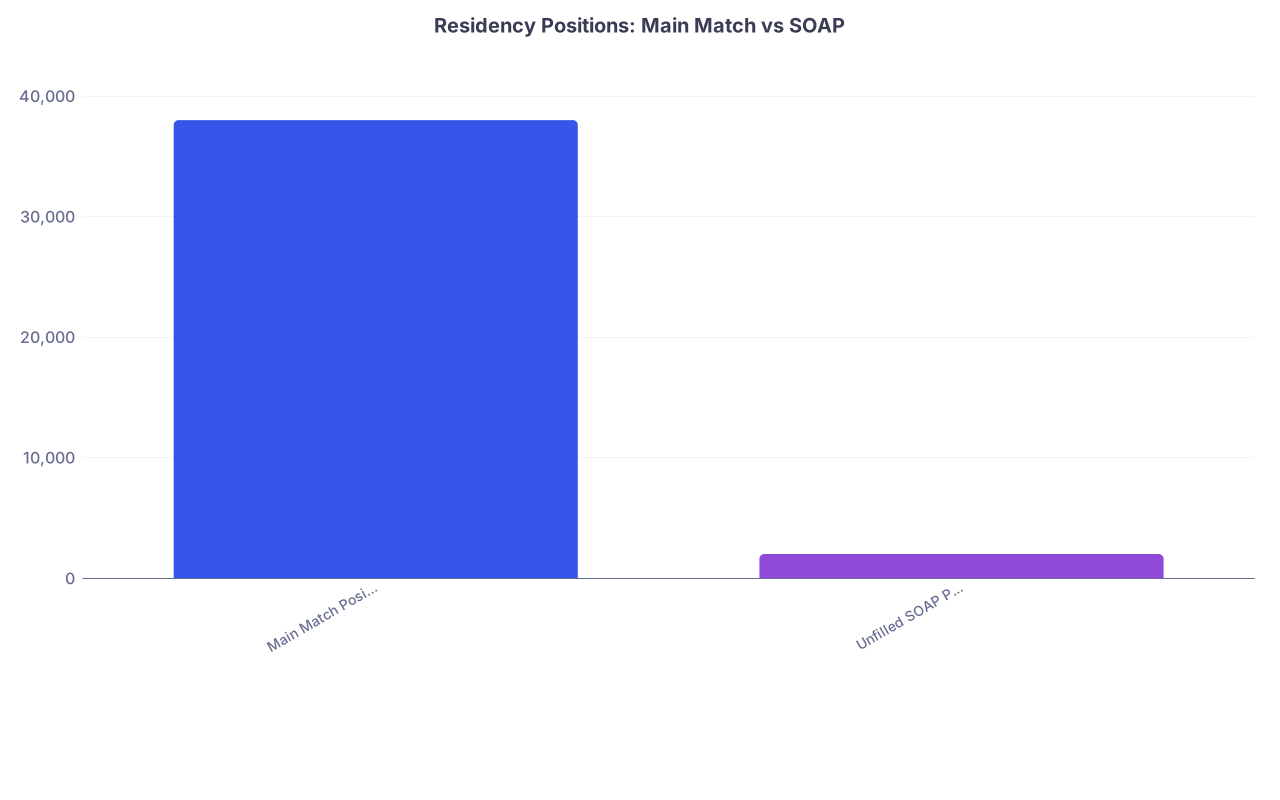
| Category | Value |
|---|---|
| Main Match Positions | 38000 |
| Unfilled SOAP Positions | 2000 |
Rough proportions: tens of thousands of positions are filled during the main match, and a much smaller fraction are left over for SOAP. So you’re playing musical chairs with way fewer chairs and a lot of anxious people.
You cannot approach SOAP like: “I’ll just selectively apply to a handful of places that sound okay.”
You are not in leverage mode. You are in survival mode.
You need a strategy that balances:
- Getting a spot this year
- Not completely destroying your long-term goals
And yeah, those two can clash. We’ll talk about that.
Step 1: Get Help, Even If You Feel Ashamed
This is non-negotiable: contact your dean’s office / student affairs / advising immediately.
You might be thinking:
- “They’ll judge me.”
- “They’re too busy with people who actually have a shot.”
- “They already know I didn’t match, and that’s humiliating enough.”
They already know who didn’t match. You are not surprising anyone. You’re only hurting yourself by staying silent.
What you want from them:
- An honest, specific assessment of your application: scores, red flags, competitiveness
- A SOAP game plan: which specialties are realistic, how broad to go, what to avoid
- Help rewriting your personal statement(s) fast, if needed
- Faculty who can call programs on your behalf
And yes, some schools are better at this than others. Some deans will be amazing advocates. Some will be useless and vaguely supportive. Use whatever you can get.
If your school has a “SOAP war room” or dedicated advising, go. Sit there. Plug into their system even if you feel like the dumbest kid repeating a grade. You’re not. You’re someone in a tough cycle.
Step 2: Be Brutally Honest About Your Position
This part is uncomfortable, but if you skip it, you’ll make fantasy-based decisions. That’s how you end up unmatched twice.
You need to ask:
- What were my scores (Step 1, Step 2)?
- How many programs did I apply to? Which specialties?
- Any gaps, failures, professionalism issues?
- Any visible “red flags” (LOA, failed rotation, low class ranking, no letters)?
Then categorize yourself honestly.
| Profile Type | Description | SOAP Outlook |
|---|---|---|
| Strong but Misaligned | Decent scores, few interviews, aimed too high/competitive | Good chance if flexible |
| Borderline | Scores okay but low, applied broad, few interviews | Possible with realistic choices |
| Red-Flagged | Fails, major gaps, professionalism issues | Harder, needs targeted support |
| Non-US / IMG | Competitive specialty, limited interviews | Must be very flexible |
If you’re “strong but misaligned” (e.g., 240s Step 2, applied only to derm/ortho/neurosurg, few back-up programs) then SOAP is a chance to pivot into something like IM, peds, psych, FM if spots exist.
If you’re borderline or have red flags, you may still match in SOAP—but now you need to widen absolutely everything: specialty, location, program type.
And yeah, it feels like swallowing glass to even admit that. But this is where people save their careers: by dropping the ego fast enough.
Step 3: Choosing SOAP Specialties Without Panicking
You’re probably stuck between two terrifying thoughts:
- “If I pick something ‘easy’ like FM just to match, I’m stuck forever.”
- “If I hold out for my original dream specialty, I’ll end up with nothing.”
The truth is in the middle. Some choices can box you in, but very few are truly irreversible, especially between primary care and other cognitive fields.
Here’s the mental model I like:
You’re choosing a platform, not a prison. Some platforms give you way more future moves than others.
| Specialty | SOAP Availability | Future Flexibility |
|---|---|---|
| Family Med | High | Can move to rural EM, urgent care, primary care, admin |
| Internal Med | High | Cards, GI, hospitalist, heme/onc (if strong later) |
| Pediatrics | Moderate | General peds, subspecialties, hospitalist |
| Psych | Moderate | Outpatient, inpatient, consult, lots of locations |
| GSurg / Ortho / Derm | Very low | Hard to get via SOAP |
If your dream is derm, ortho, plastics, neurosurg—SOAP is almost never going to give you that. You’re playing a different game now:
- Option A: Take a preliminary spot (prelim surgery / prelim medicine) and reapply
- Option B: Match into a categorical position in a broader specialty (IM, FM, psych, peds), then see if your goals shift
Both are legitimate. Neither is perfect.
What you can’t afford is magical thinking. “Maybe there will be 10 unfilled derm spots this year and they’ll love my research” is how you end up unmatched and spiraling.
Step 4: Prelim vs Categorical – The Decision Everyone Panics About
This is one of the most brutal choices you might have to make in SOAP.
Prelim year:
- One year only – no guaranteed PGY-2
- You bust yourself working, then have to reapply
- Risk: after a brutal intern year, you still might not match into your dream field
- But: gives you US residency experience, LORs, and keeps the door open
Categorical:
- You’re in a full program (3–4 years, or more)
- You may pivot later (e.g., IM → fellowship, FM → urgent care/ED, psych is its own thing)
- Harder to switch into surgery-type fields after starting a non-surgical specialty
- But: you have a home, a paycheck, and a clear path
I’ve seen both work and fail.
- Person A: took a prelim surg year, crushed it, reapplied GS with stronger app, matched categorical next year.
- Person B: took a prelim surg year, got crushed by hours and no strong advocates, failed to match again, burned out hard.
- Person C: SOAPed into FM even though they once wanted EM; now doing rural EM and urgent care, actually happy.
- Person D: SOAPed into IM, got into cards fellowship later with relentless work.
So no, you’re not “ruined” if you SOAP into IM/FM/psych. That’s anxiety talking, not reality.
Step 5: Fixing Your Application… in 24–48 Hours
This part feels impossible: you have maybe a day or two to tweak your entire story.
Focus on:
- Personal statement: Shorter, clearer, more honest about why this field now
- CV: Clean up formatting, highlight clinical strengths, remove clutter
- Letters: Use what you have; new ones probably aren’t happening this week
You do not need an essay-length confession about not matching. SOAP programs know the situation. You’re not fooling anyone.
For your personal statement, aim for:
- “Here’s who I am clinically”
- “Here’s why I’d be a good fit for this specialty”
- “Here’s where I’ve shown reliability, resilience, and teamwork”
Don’t overcomplicate it. This is not the time for poetic narratives.
Step 6: SOAP Interviews – Holding It Together on Camera
Match Week interviews are… rough. You’re sleep-deprived, emotionally fried, and trying desperately not to sound desperate.
Most programs will at least implicitly know you’re there because you didn’t match. No need to overshare. But be ready for:
“Tell me about your application this cycle.”
You do not say:
- “I guess I just suck compared to my classmates.”
- “I aimed too high and everything fell apart.”
- “I don’t even really know if I want this specialty.”
You also don’t lie.
Something like: “I applied to [X specialty] initially and ended up with fewer interview offers than expected. During that process and through my rotations, I realized that what I value most is [X core value that fits their specialty]. I’ve reflected a lot this week and I’m fully prepared to commit to a strong residency in [their field], and bring the same work ethic and resilience I’ve needed to get here.”
Is it polished? Yes. Is it the full raw story? No. That’s fine. You’re not in therapy; you’re in an interview.
Also: watch your energy. Programs can smell panic. Aim for “genuinely interested and grounded,” not “if you don’t take me I’ll vanish into the abyss.”
Watching Your Friends Celebrate Without Imploding
You’re going to see all of it:
- Match Day photos
- “Future [specialty] at [fancy program]!” posts
- Group texts planning moves to new cities
You might feel:
- Jealous to the point of nausea
- Guilty for not being purely happy for them
- Like you can’t even look at them
You’re allowed to mute chats. You’re allowed to log off Instagram for a week. You’re allowed to say “I’m proud of you, but I’m going through a lot right now and need some space.”
What you don’t do is:
- Publicly trash the system in ways that’ll haunt you later
- Burn bridges with classmates who may literally be future colleagues writing you letters
- Turn your entire identity into “the one who didn’t match”
They had their path. Yours is messier. That doesn’t mean it’s over.
If SOAP Doesn’t Work Either (Yes, I’m Going There)
You’re already thinking this, so let’s not pretend: “What if I don’t match in SOAP too?”
It happens. Not often, but enough that pretending it doesn’t is stupid.
If that worst-case scenario hits, your options are roughly:
- Research year (ideally in your area of interest, with strong mentors)
- Preliminary spot outside of SOAP (rare, but sometimes appear later)
- MPH / additional degree only if it strategically strengthens your app, not just as a stall
- Non-training clinical roles (scribe, research coordinator) to stay connected
You’ll need to rebuild your app with:
- New letters from people who can say “this person shows up, works hard, has grown”
- A more realistic specialty list next cycle
- Better advice than you probably got the first time
No, it’s not fair. No, it doesn’t feel encouraging. But people do come back from an unmatched year and successfully match the next cycle. I’ve seen it more than once.
What You Need to Hold Onto Right Now
I’m not going to blow smoke and say “everything happens for a reason.” Sometimes it just happens. Sometimes it’s bad luck in a crowded year. Sometimes you miscalculated. Usually it’s both.
Three things to keep in your head:
This week does not define your worth as a future physician.
It defines how you respond under pressure. That’s different. You can blow up, or you can be shaken and still get the work done.SOAP is about survival, not perfection.
You are not picking your forever identity. You’re securing a foothold in the system so you can keep moving. There are more pivots available than your panicked brain believes.You’re allowed to be hurt and strategic at the same time.
You don’t have to “get over it” before you act. You just have to act while it hurts. And then later—after SOAP, after the dust—you process the grief properly.
For now: drink some water. Text one person you trust and tell them, “I need help being practical.” Open your email. Call your dean.
You’re not the only one who’s been here. You’re just the one who’s here today.