
The thing that decides a lot of SOAP outcomes never appears in ERAS, never shows on your CV, and you’ll never see it in a score report. It happens in text threads, hallway conversations, and “quick calls” between faculty. The backchannel decides far more of SOAP than you’ve been told.
Let me pull the curtain back.
During the main Match, programs are relatively disciplined. There’s structure, committees, long rank meetings. During SOAP? The guard rails come off. Programs are stressed, understaffed, and racing the clock. When that happens, people fall back on instinct and relationships. That’s where informal references rule.
If you go into SOAP thinking it’s a clean meritocracy of scores and personal statements, you’re walking into a knife fight with a butter knife.
What Really Happens Inside a Program During SOAP
Here’s the part nobody explains to students.
On SOAP Monday, a program director (PD) opens the ERAS list and sees hundreds of applicants for maybe 2–5 unfilled spots. They have hours, not weeks. The committee is smaller, sometimes just the PD and one or two trusted faculty. Everyone’s still doing their regular clinical work.
So they start filtering. Aggressively. Then this sort of thing starts happening:
“Anybody know this student from ___?”
“Can you text your friend at ___ school and see if they’re solid?”
“Call my old co-resident at ___, they rotate there—ask if this person is safe or a problem.”
You think I’m exaggerating. I’m not. I’ve watched residents step out of the workroom and make a 90‑second phone call that effectively decided whether an applicant got an offer.
During SOAP, programs don’t have the time (or energy) to deeply review every application. They use shortcuts. And the biggest shortcut is: “Can someone I trust vouch for this person right now?”
That’s the backchannel.
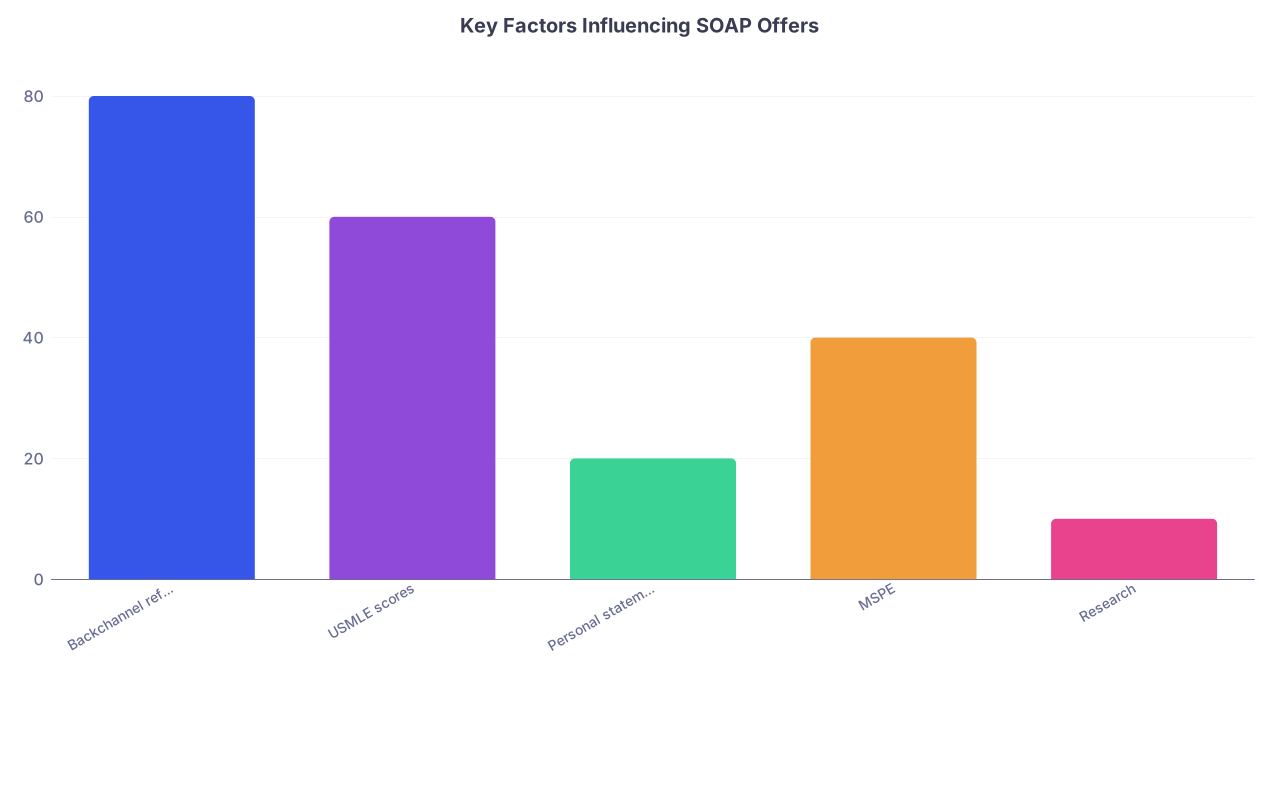
| Category | Value |
|---|---|
| Backchannel reference | 80 |
| USMLE scores | 60 |
| Personal statement | 20 |
| MSPE | 40 |
| Research | 10 |
Those numbers aren’t from a paper. They’re from sitting in rooms and hearing what actually gets said. Backchannel impressions routinely override slightly lower scores or less research. Especially in SOAP.
What a Backchannel Reference Actually Looks Like
Let’s be clear what I’m talking about. This isn’t your formal LOR. This is the informal stuff:
- Quick texts between residents at different programs: “Hey, you know this guy from Rutgers? Worth interviewing?”
- PDs calling PD friends: “You had this student on your rank list but didn’t match them. Any red flags?”
- Faculty group chats: “Anyone worked with ___? Would you trust them on nights?”
- Clerkship directors getting pinged: “We have their SOAP app. Any concerns? Are they workable?”
These exchanges are brutally concise. The whole thing can run on three sentences:
“Hard worker, bit anxious but teachable, no professionalism issues.”
“Smart but difficult to work with, lots of hand-holding.”
“I’d take them.” / “I would not take them.”
You want to know the most lethal phrase I’ve heard?
“I’d be cautious.”
That’s it. Not “terrible,” not “unsafe,” just “cautious.” In SOAP, where there are plenty of other options, “cautious” often = “move on.”
The flip side is powerful too. A simple:
“Great on our service, very reliable, zero drama.”
can push an average-looking application to the top of the pile when time is short.
Who Actually Gets Called About You
Here’s the part people get wrong. Backchannel references aren’t random. There’s a hierarchy of who gets listened to.
Programs usually go to:
Their own alumni at your school or hospital.
PGY-3 at Program A texts their old classmate now a chief resident at your med school’s hospital. That’s probably the most common scenario. Residents talk. A lot.Clerkship directors and program coordinators.
PDs love calling people who see patterns: “Is this student an outlier or consistent with what I see on paper?” The clerkship director who remembers you never signed your notes? Yeah, that can come back.Faculty who know each other from conferences, committees, or fellowships.
“Hey, you’re at ___, right? One of your grads applied to us in SOAP. What do you think?”Your home program’s PD or APD.
If you’re SOAPing into the same specialty as your home program, their PD will sometimes be asked off-record: “Why didn’t you rank them higher? Anything I should know?”
Notice who’s not high on that list: the attending who liked you once on a subspecialty elective and wrote a glowing letter six months ago but never hears from anyone. They can help you with the formal side, but in SOAP, it’s the people connected to your school and the people your target program actually knows who matter most.

How Informal References Shape SOAP Outcomes
Let me walk you through how it plays out during that week.
PD opens the SOAP pool. They filter by:
- School type
- US/IMG status
- Pass/fail history
- Specialty switchers
- Visa needs
They end up with maybe 60–100 names for 2–3 spots. Still way too many.
They’ll glance at MSPEs and letters, sure, but they’re trying to decide who’s even worth calling. This is where the backchannel hits.
Scenario I’ve seen more than once:
- Two similar candidates: both US MD, both Step 2 in the 230s, decent MSPE.
- One has a backchannel text: “Solid, worked hard, no drama, would absolutely re-take.”
- The other is a black box; no one knows them, no one has heard of them, or worse, their school has a reputation for sugarcoating evaluations.
Who gets called first? Every single time: the one with the informal vouch.
A slightly uglier reality: sometimes one candidate has a quiet backchannel against them.
“We had some concerns about professionalism.”
“A lot of absences. Not unsafe, but unreliable.”
“Strong test taker, poor team player.”
Almost none of that is fully spelled out in formal documents. But if a PD hears that in SOAP, they don’t need proof. They just move you down the pile. There are 50 other applications. Why burn a slot on risk?
When Backchannel Overrides Your Paper Application
I’ve watched a program choose a candidate with lower scores and a gap year over someone more “polished” on paper because of a backchannel.
The decision-making dialogue sounded like this:
“This guy has a 247 but I’m getting ‘difficult to work with’ from people I trust.”
“This other one has a 229 but my friend at their school says they’re a machine—dependable, no complaints, will stay late without whining.”
“We’re short on nights coverage. Take the reliable one.”
SOAP is a survival move for programs, too. They think: “Who can hit the ground running and not cause trouble?” Backchannel references answer that better than any personal statement.
How to Position Yourself Before SOAP Ever Happens
You don’t “build” a backchannel during SOAP week. That’s the biggest misunderstanding. The dice are already loaded by then.
You build it months or years earlier by the way you behave on rotations, the way you handle conflict, and the relationships you maintain.
Here’s what consistently feeds positive backchannel about a student:
You show up prepared and on time. Not just to impress attendings, but because residents notice—and residents talk.
You don’t trash talk other students, nurses, or services. That stuff travels faster than you think.
You recover cleanly from mistakes. When you screw something up, you own it and fix it. People remember that far more than the error.
You treat coordinators, office staff, and schedulers like actual human beings. You’d be shocked how many times I’ve heard a PD open with, “Our coordinator said they were rude on the phone. Hard pass.”
You maintain adult relationships with at least one or two people who can actually get called about you: your sub-I attending, a clerkship director, a residency PD at your home institution.
If SOAP is even a remote possibility for you, your primary goal in clinical years should be this: make sure that if someone texts, “Do you know this person?” the answer is, “Yes, and I’d take them.”
Strategic Moves Once You Know You’re Headed for SOAP
By the time you’re in SOAP, you can’t rewrite your entire backchannel, but you can work it.
1. Quietly activate your network
You’re not going to email 50 programs begging them to call your friend. That looks desperate and often backfires. But you can:
- Reach out to a mentor you trust and say, “I’m going through SOAP for ___ specialty. If you happen to know any PDs or faculty who might see my app, I’d be grateful if you could let them know I’m a hard worker and would be a good fit.”
- Contact residents you know at specific programs and say, “I applied to your program through SOAP. If your PD or chief asks about me, I’d really appreciate any positive word.”
That’s it. Short, clean, and you stop talking. Anything more starts to feel like pressure.
2. Be extremely careful with your tone
If you sound bitter, entitled, or like a victim in these communications, people will not go to bat for you.
A mentor is much more likely to stick their neck out for the student who says, “This year didn’t go how I hoped, but I’m ready to work anywhere that gives me a chance,” than the one who says, “I should have matched at a mid-tier academic program, this is ridiculous.”
Backchannel isn’t just about competence. It’s about whether you’re easy to advocate for.
3. Clean up any lingering damage
If you had a known issue—leave of absence, professionalism concern, failed exam—and you’ve worked with someone at your school to address it, make sure they are prepared to speak well of you off-record.
PDs love a story like: “They struggled early, had a remediation, and came back much stronger. No issues since. I’d take them.” That reads as growth, not risk.

| Step | Description |
|---|---|
| Step 1 | Student performance |
| Step 2 | Faculty impression |
| Step 3 | Resident impression |
| Step 4 | School reputation |
| Step 5 | Backchannel call or text |
| Step 6 | PD informal impression |
| Step 7 | SOAP interview offer |
| Step 8 | Rank for SOAP offer |
How Programs Use the Backchannel Against You (Quietly)
Not all backchannel is positive. The ugly truth is that once your name gets circulated informally as “a problem,” it’s very hard to undo in the compressed timeline of SOAP.
I’ve seen it happen this way:
- Student had a public meltdown on a rotation, or a very tense conflict with nursing or another student.
- It didn’t rise to the level of official dismissal or a giant red mark in the MSPE, but everyone in that department remembers.
- During SOAP, when that student’s name appears at a nearby program: “Didn’t they have issues?”
- One vague comment: “Yeah, there were some professionalism concerns.”
- Outcome: application quietly dropped.
No email to you. No explanation. Just silence.
Another version: your home program’s PD didn’t rank you highly and other PDs notice. They may call and ask:
“I see you had them and didn’t match them. Are we missing anything?”
“They were okay, just not our top group.”
Translation in SOAP: “We have other options.”
That’s “damned with faint praise” in action. In SOAP, “okay” isn’t enough to overcome other candidates who have folks saying, “I’d be thrilled to train this person.”
Concrete Ways to Strengthen Your Backchannel Now
If you’re still in M3 or early M4 and even slightly worried you’ll end up in SOAP, here’s where to focus. No fluff.
Treat every sub-I and AI as if the attending could be called by a PD you’ve never met. Because they might. The metric isn’t nailing every pimp question; it’s: “Would I put this person on my team at 2 a.m.?”
Build at least two strong relationships at your home institution:
- One with teaching power (clerkship or course director, sub-I supervising attending)
- One with structural power (APD, PD, dean’s office advisor)
Don’t disappear after the rotation. A short follow-up email months later with your update keeps you in their mental file. People speak more strongly about students they actually remember.
Avoid burning bridges on the way out. That passive-aggressive eval you wrote on a resident? The email you fired off complaining about an attending? The snarky comment about the program on social media? All of that can boomerang by SOAP.
If you know you’re a “late bloomer” or had early issues, make sure someone in a position of authority at your school can say, “They improved dramatically,” and mean it.
My Candid Opinion on Backchannel Ethics
You might be thinking: this sounds unfair. It is. But it’s also reality.
Programs are making high-stakes decisions under insane time pressure. They do not have time to run a full investigation on every candidate. So they rely on trust and shortcuts.
Is it fair that a stronger personal connection can outweigh a slightly better board score? Probably not. Does it happen every cycle? Absolutely.
I’ve sat in meetings where someone suggested interviewing an applicant purely because, “She’s from my med school, our PD there says she’s excellent.” No one in the room pulled her MSPE first. That came later.
If you try to fight this reality by pretending it doesn’t exist, you lose. Your move is to understand how the system actually behaves and then operate strategically inside it, without lying or gaming.
The line you don’t cross: asking for people to misrepresent you. The line you should cross regularly: reminding people who like you that you’re out there, and that their honest positive word can change your trajectory.
FAQ: The Backchannel & SOAP
1. Can I directly ask an attending or PD to “put in a word” for me during SOAP?
You can, but it has to be done tactfully. Better phrasing: “If any programs reach out to you about me, I’d be very grateful for your support.” That signals you’re not asking them to cold-call anyone, just to speak honestly if contacted. Some mentors will proactively reach out on your behalf—but that should be their idea, not your demand.
2. How do I know if my school or program will speak well of me off the record?
You don’t know perfectly, but you can infer. If your clerkship and sub-I evals were consistently strong, and you had good relationships with residents and faculty, you’re probably fine. If you had a remediation or major conflict, you should explicitly discuss it with a trusted advisor or director and ask, “How do you think programs will perceive me?” Their reaction will tell you a lot.
3. I had a rough rotation where one attending disliked me. Will that sink my SOAP chances?
One isolated bad rotation rarely kills you, unless it escalated into formal professionalism action or everyone heard about it. What matters more is the pattern. If most people see you as reliable and teachable, a single negative voice is diluted. The risk goes up if that attending is heavily networked in your specialty or is the person PDs tend to call.
4. I’m an IMG without a “home” program in my specialty. Do I even have a backchannel?
You have less institutional backchannel, yes. But you’re not helpless. Any US rotations you’ve done, any observerships, any research mentors in the US—those are your nodes. You should be deliberate about maintaining contact and asking if they’d be open to speaking on your behalf if contacted. Also, residents who graduated from your school and are now in US programs can be surprisingly influential.
5. If I screwed up earlier in med school, can a strong recent backchannel overcome that in SOAP?
Sometimes, yes. PDs are much more comfortable with “growth curves” than you’d think, especially in SOAP where they’re looking for someone hungry and resilient. If someone trusted can say, “They had issues early, addressed them, and have been rock solid for the last year,” that narrative can absolutely beat out a bland but forgettable candidate. The key is that your recent behavior has to genuinely match that story.
If you remember nothing else: SOAP is where relationships, reputation, and quiet side conversations often matter more than an extra 10 points on Step 2. Build the kind of track record that makes people comfortable saying, “I’d take them,” and you’ll be shocked how often doors open when you need them most.