
The fastest way to sink your SOAP chances is not a bad interview. It’s sloppy letters and a broken CV.
You do not have time to learn this the hard way during SOAP week. Programs are filtering hundreds of panicked applications in hours. They are looking for reasons to exclude you, not gently coach you through.
I’m going to walk you through the letter of recommendation and CV mistakes that quietly kill applications during SOAP—and how to fix them before that window opens.
The Ugly Truth About SOAP: Programs Are Ruthless Triage Machines
During the regular Match, programs skim. During SOAP, they slash.
Here’s the part people underestimate: in SOAP, faculty and coordinators are tired, behind, and under pressure to fill spots quickly with the least-risk applicants. That means:
- Any sign of disorganization = “This will be a problem intern.”
- Any whiff of dishonesty or padding = “Nope.”
- Any big mismatch between LORs and CV = “Something is off. Pass.”
They are not going to email you for clarification. They are not going to carefully interpret your “context.” They are going to click “Do not consider” and move on.
So you must ruthlessly eliminate the mistakes that give them excuses.
LOR Landmines That Blow Up Your SOAP Chances
Letters of recommendation are not optional fluff in SOAP. They are one of the few ways a program can rapidly differentiate between 30 very similar applicants.
1. Recycling Generic Letters That Don’t Fit SOAP Reality
Big mistake: you blindly reuse the same letters you used in the main Match… even though your target specialties and story have changed.
I keep seeing this pattern:
- You applied to competitive specialty X originally (say Derm, Ortho, ENT).
- You went unmatched.
- During SOAP you target IM, FM, Psych, Peds.
- Your strongest letter? “To the Dermatology Selection Committee…”
On a SOAP review, that reads as:
- You’re not actually invested in this specialty.
- You’re just falling back here.
- Your home mentors don’t care enough to update a letter.
How to avoid this:
- Before Match week, identify 2–3 letters that are:
- Specialty-neutral or easily adaptable
- From people who actually know you and your clinical work
- Ask letter writers before Match Day:
- “If I need to enter SOAP, can I ask you for a version of this letter addressed to [Internal Medicine / Family Medicine / etc.]?”
- “Would you be willing to edit the header and maybe add a line related to my suitability for IM/FM/Psych/etc. if needed?”
- Prioritize:
- Department chair or clerkship director in core clinical fields
- Sub-I attendings who saw your day-to-day work
- Program directors who can speak to your reliability and teachability
Do not wait until Tuesday afternoon of SOAP to try to track down a letter writer who is on service, in the OR, or on vacation. That letter will not arrive. Or it will be rushed garbage.
2. Letters That Quietly Trash You (Red-Flag Language)
Most weak SOAP applicants imagine their letters are glowing. Many are not. I have read dozens of “supportive” letters that quietly said: “Do not rank this person.”
Red-flag phrases programs instantly recognize:
- “Did fine” / “performed adequately”
- “Met expectations for level of training”
- “With continued supervision and guidance, I believe they will develop into a good physician”
- “Pleasant to work with” (and that’s it)
- Overemphasis on “punctual,” “polite,” “kind” with zero mention of:
- Clinical reasoning
- Work ethic
- Reliability
- Ownership of patient care
In SOAP, this reads as:
- Minimum effort. Possible professionalism or performance issues.
- No one willing to stick their neck out for you.
How to avoid this:
You can’t demand content, but you can protect yourself.
- Ask the right people:
- “Would you feel comfortable writing me a strong, supportive letter for residency (and potentially SOAP if needed)?”
- If they hesitate, waffle, or say something vague like “I can write you a letter,” consider that a soft no.
- If allowed at your institution, waive your right to see the letter (programs expect that), but pay attention to:
- How well the writer knows you
- How long you worked with them (2 weeks vs. 8 weeks is different)
- Whether they supervised your actual clinical care
And if you already suspect you have a weak or “meh” letter in ERAS? Do not rely on it as your anchor letter in SOAP. Try to get one clearly strong letter in the target specialty or in a core rotation with obvious heavy clinical work.
3. Mismatched Story: Letters That Don’t Line Up With Your CV
A big SOAP killer: your letters describe one version of you, your CV describes another, and your application looks incoherent.
Examples I’ve actually seen:
CV: Almost no psychiatry exposure beyond a 4-week core
Letter: “They are deeply committed to a career in psychiatry, as evidenced by their work in our psych department for years.”
Program: “Where? I do not see it.”CV: Multiple remediation, leaves of absence, or Step failures
Letters: All sunshine and zero context.
Program: “Why is no one explaining this? What are they hiding?”CV: Heavy research, 5 gap years, no recent US clinical experience
Letters: From preclinical professors and one PI who hasn’t seen the applicant clinically in years
Program: “I have no idea who this person is as a clinician right now.”
How to avoid this:
- Before SOAP, read your own:
- MSPE
- Personal statement
- LOR themes (if you’re allowed to know them conceptually)
- CV entries
You want:
- Coherence: same person, same trajectory, same story.
- Alignment: your stated SOAP specialty interests match what people say about you, or at least don’t contradict it.
If you’re pivoting specialties in SOAP (very common), you must:
- Adjust your personal statement for that specialty.
- Highlight in the CV:
- Any rotations, electives, shadowing, or work experiences relevant to that field.
- Ask at least one letter writer to mention:
- Traits that translate well to that new specialty (e.g., thoroughness and communication for FM/IM, patience and longitudinal thinking for Psych, etc.)
4. Outdated or Mis-Addressed Letters That Scream “Last-Minute”
SOAP moves fast. Programs assume you knew SOAP was a risk. So when they see:
- Letters addressed:
- “To the General Surgery Selection Committee” in an FM SOAP submission.
- Or to another institution altogether.
- Letters dated 2–3 years ago.
- Letters from preclinical years.
This tells them:
- You didn’t plan.
- Your mentors aren’t current.
- No one has evaluated you clinically in a while.
How to avoid this:
- Ask for broadly addressed letters:
- “To the Residency Selection Committee”
- If your letter is older than 18–24 months and you’ve done significant clinical work since:
- Try to get one updated letter that reflects your current abilities.
- For IM/FM/Peds/Psych SOAP:
- A recent core or sub-I letter is gold.
- A specialty letter from your dream but failed specialty (Plastics, Ortho) with no mention of foundational skills? Much weaker.
CV Mistakes That Make You Look Disorganized—or Dishonest
Your ERAS CV during SOAP is not just a list. It’s a character assessment. Programs are asking:
- Can this person accurately report facts?
- Are they trying to inflate or spin?
- Are they sloppy?
You’d be shocked how many people fail that very basic test.
1. Sloppy, Inconsistent, or Incomplete Entries
You think no one notices that your dates don’t line up? They do. Especially in SOAP, when gaps and weird timelines jump off the page because people are scanning for risk.
Common self-sabotaging errors:
- Overlapping experiences that are impossible:
- “Full-time research” and “40 hours/week scribe” at the same time, in different cities.
- Changing titles over time in an obvious inflation:
- “Volunteer” becomes “Coordinator” becomes “Director” of the same thing.
- Months or years that don’t line up with transcript or MSPE.
How to avoid this:
- Sit down before Match week and do a brutal CV audit:
- Check all dates.
- Make sure hours/week are plausible.
- Make sure you’re using consistent job titles across:
- CV
- Personal statement
- Any LOR mentions
Ask yourself, honestly:
- “If someone called this hospital, lab, or PI, would they describe my involvement the same way I wrote it?”
If not, fix it.
2. Obvious Padding and Exaggeration
SOAP programs are specifically wary of applicants who:
- Over-list micro-activities:
- 20 different “experiences” that were each 5 hours of volunteering.
- Turn coursework into “research.”
- Turn passive club attendance into “leadership.”
- Label every abstract or poster as “publication.”
This looks desperate and immature.
How to avoid this:
Use a simple internal test:
- If an attending or PD read this, would they nod or frown?
Be especially careful with:
- “Publications”: only list things actually accepted / published, clearly labeled.
- “Manuscripts in preparation”: this is almost always fluff. If you keep it, be modest.
- Leadership roles: if you were just an active member, say that.
Better to have:
- 6–10 honest, solid experiences
than - 25 obviously padded, exaggerated ones.
3. Ignoring Red Flags Instead of Strategically Owning Them
Programs see everything:
- Attempt counts
- Gaps
- LOAs
- Course failures
Huge mistake: you pretend the red flags don’t exist. Your CV tries to skip the time, or your entries are vague to hide the gap.
In SOAP this is fatal. You already did not match. They are hyper-focused on risk.
How to avoid this:
- Make the timeline clean and honest:
- If you took a leave: label the dates.
- If you repeated a year: the transcript/MSPE will show it anyway.
- Then support it with:
- A focused, honest personal statement that briefly addresses major issues.
- LORs (if possible) that speak to your current reliability and performance, not just your personality.
Programs are not allergic to imperfection. They’re allergic to uncertainty and concealment.
4. Not Updating CV for SOAP-Specific Strategy
Another subtle but deadly mistake: you keep the exact same CV emphasis as your original application, even though you’re targeting a very different tier or type of programs in SOAP.
Examples:
- Original: IMG aiming Neurology / Radiology. CV heavily emphasizes research, MRI physics, bench lab work.
SOAP: Applying to IM and FM community programs that mainly care about:- Clinical skills
- Patient communication
- Reliability
But your ERAS entries still read like:
- “Investigated radiologic correlates of XYZ…”
- “Developed algorithm for imaging segmentation…”
Almost no mention of:
- Continuity clinic
- Teamwork
- Working with underserved
- Real patient care responsibilities
How to avoid this:
You cannot rewrite your life, but you can reframe it.
Before SOAP, revise ERAS entries to emphasize:
- Clinical duties over technical stuff:
- “Managed panel of X patients per clinic session”
- “Participated in overnight call, responsible for admission H&Ps and cross-coverage.”
- Human-facing skills:
- “Counseled patients on medication adherence and lifestyle changes.”
- “Coordinated care with social work and nursing for discharge planning.”
Same experience. Different emphasis. Programs notice.
Deadly Disconnects: When LOR and CV Tell Different Stories
The surest way to freak out a SOAP reviewer? Have letters and CV that obviously don’t match.
Let me show you how programs quickly compare:
| What Letter Says | What CV Shows | Program Reaction |
|---|---|---|
| “Worked closely for 6 months on service” | Rotation listed for 4 weeks | “Which is true?” |
| “Lead author on important project” | Listed as 3rd author, no details | “Inflating? Dishonest?” |
| “Deep interest in psychiatry over years” | One 4-week psych rotation, nothing else | “Story does not add up” |
| “Remediated but now very reliable” | No remediation or gap listed anywhere | “What else is hidden?” |
| “Strongest student this year” | Mediocre clinical grades on MSPE | “Is this just hyperbole?” |
Programs are not dumb. They do a quick consistency check:
- Does the timeline match?
- Do the roles line up (author order, position title, setting)?
- Does the level of enthusiasm in letters fit the performance in MSPE and grades?
If anything smells off, SOAP applicants get silently discarded.
How to avoid this:
- Before SOAP, literally sit with:
- Your CV entries
- The basics of what your letter writers could truthfully say about your involvement
- Ask yourself:
- “If my letter writer said I was heavily involved for 6 months, does my CV reflect that depth, or did I under-describe it earlier?”
- Update descriptions (not dates) so that:
- The scope of your involvement matches what mentors might reasonably describe.
Timing Mistakes in SOAP: When You Move Too Late
There’s a special category of mistakes uniquely brutal in SOAP: timing errors. You don’t just need good materials; you need them ready before the fire starts.
1. Waiting Until SOAP Week to Fix Everything
The fantasy:
“I’ll see if I match. If I don’t, I’ll just tweak my personal statement, maybe update a CV entry or two, email a letter writer, and I’ll be fine.”
Reality in SOAP week:
- You’re sleep-deprived and emotionally wrecked.
- You’re on the phone with deans, trying to figure out a strategy.
- You’re scrambling to pick target specialties and program lists.
- You do not have bandwidth for thoughtful rewriting.
So what happens?
- You make rushed, error-filled edits.
- You send contradictory personal statements.
- You miss obvious typos or mis-coded experiences.
- You paste the wrong specialty name into a program’s SOAP application.
How to avoid this:
By late January / early February, if you have any real concern about matching:
Prepare:
- A SOAP-appropriate CV (clean, checked, and saved).
- At least one alternate personal statement (e.g., more primary-care oriented or more generalist).
- A short document listing your:
- Red flags
- Context/explanation
- Plan for improvement
Talk to your dean’s office or advisor before Match week:
- Ask what letter and document changes are realistically possible if SOAP happens.
- Confirm logistics (who uploads, how quickly, any internal deadlines).
You want options on Monday of Match week, not chaos.
2. Not Having Any SOAP-Appropriate Letter Ready
Big mistake I keep seeing: all letters locked to your original specialty.
Examples:
- 3 Ortho letters, all addressed to Orthopedic Surgery, from surgeons who only talk about your surgical interest.
- No letter from core IM/FM attendings, even though you scored well and did fine.
On SOAP day, you’re applying to IM and FM spots with nothing but “This student is passionate about a career in orthopedic surgery…”
Programs read it and think:
- “They will leave us as soon as they can reapply to Ortho.”
- “We’re just their safety net.”
How to avoid this:
Months before Match:
- Get at least one letter from:
- IM
- FM
- Or another core rotation PD/attending who can speak to your overall clinical skills.
- Ask them to:
- Keep the letter specialty-neutral or open enough to be used for primary care-type SOAP.
- Store this:
“General letter from IM/FM/Chief/PD in ERAS, ready to be assigned to SOAP applications if needed.”
Visual: How Reviewers Actually Spend Time on You in SOAP
Here’s how your limited “attention budget” looks when a PD or faculty clicks into your application during SOAP:
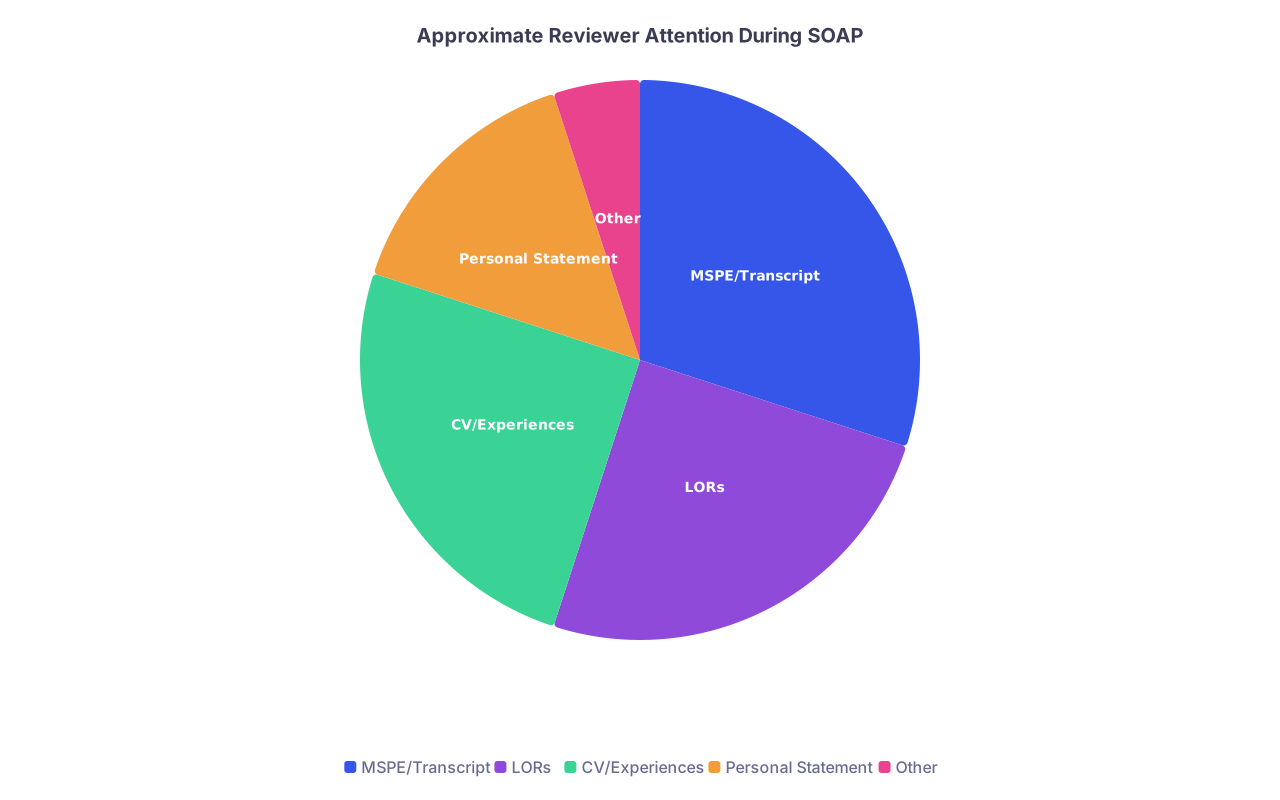
| Category | Value |
|---|---|
| MSPE/Transcript | 30 |
| LORs | 25 |
| CV/Experiences | 25 |
| Personal Statement | 15 |
| Other | 5 |
Notice:
- CV and LORs together are about half the attention.
- If those are broken, your personal statement will not save you.
Process Snapshot: What You Should Have Ready Before SOAP
Here’s the streamlined version of what you need in place before Match week if SOAP is even a possibility:

| Step | Description |
|---|---|
| Step 1 | Now - Pre Match |
| Step 2 | Audit CV for Accuracy |
| Step 3 | Identify Red Flags |
| Step 4 | Prepare Context Statement |
| Step 5 | Secure 1-2 General LORs |
| Step 6 | Confirm Upload Logistics |
| Step 7 | Draft SOAP Personal Statement Variant |
| Step 8 | Review for Specialty Shift |
| Step 9 | Meet With Dean or Advisor |
| Step 10 | Final Pre SOAP Packet Ready |
This is what applicants who survive SOAP without burning out do. They treat it like disaster preparedness. Hope you do not need it. Be ready if you do.
FAQ: LOR and CV in SOAP
1. Should I remove a weak letter before SOAP if I suspect it’s hurting me?
If you have at least 2 other letters that are decent and more aligned with your SOAP specialties, yes, consider not assigning the suspected weak letter to SOAP programs. You can’t delete the letter from ERAS once it’s uploaded, but you control which letters each program sees. A lukewarm or subtly negative letter can absolutely sabotage you more than having one fewer letter.
2. How many changes to my CV are safe to make between Match submission and SOAP?
Substantive content invention is never safe. But you can and should:
- Correct dates, typos, and obvious inaccuracies.
- Clarify roles and responsibilities in existing entries.
- Reorder or slightly reframe descriptions to better reflect your clinical strengths.
Keep changes honest and explainable. If a PD asked, “You updated this since the fall—what changed?” you should have a straightforward answer.
3. I’m switching specialties for SOAP. Is it dishonest to reuse my old CV and just change my personal statement?
No, but it’s lazy—and risky. Reusing the same CV is fine if:
- It’s already accurate.
- It emphasizes transferable skills relevant to the SOAP specialty.
But if your whole CV screams “I only cared about Derm/ENT/Neurosurgery,” programs in IM/FM/Peds/Psych will assume you are just passing through. You do not need to fabricate new experiences, but you should rephrase existing entries to highlight the parts that matter for the new field.
Key takeaways:
- Weak, mismatched, or outdated letters and CV entries are silent SOAP killers. Programs will not tell you; they will just move on.
- You must fix inconsistency, padding, and specialty misalignment before SOAP—especially if there’s any chance you might not match.
- Honest, coherent, specialty-appropriate LORs and a clean, accurate CV will not magically guarantee a SOAP spot—but messy ones will absolutely cost you interviews you might otherwise have earned.