
The fastest way to get quietly blacklisted during SOAP is to behave like a desperate amateur on calls and Zooms. Programs remember this. And they talk.
You are not just fighting for a spot. You are fighting against every red flag you accidentally wave in front of a tired PD or coordinator who has 50 other applicants queued up. One bad interaction can kill an otherwise salvageable application.
Let me walk you through the behaviors that get people mentally “no-ranked” within 30 seconds—and how to avoid joining that list.
1. Sounding Desperate, Entitled, or Both
The single biggest SOAP mistake: letting your panic leak into your voice and words.
Program directors during SOAP are already suspicious. They know:
- You did not match.
- They have very limited time.
- Many applicants are emotional, scattered, and not thinking clearly.
So when you come in hot with desperation or entitlement, it confirms their worst expectations.
Common red-flag phrases that sink you
Do not say these. I have heard versions of each, and they are instant turnoffs:
- “I will take anything—I just need a position.”
- “I do not really know much about your program, but I am very interested.”
- “If you rank me, I guarantee I will work harder than anyone.”
- “I was surprised I did not match. My scores are actually pretty strong.”
- “I applied to everything available—what are your hours like?”
- “Do you think I will get in if I talk to you today?”
Why they are bad:
- Desperation makes you look unstable and short-sighted.
- Entitlement makes you look difficult to work with.
- Self-pity makes you look like a problem, not a solution.
Instead, you want:
- Calm.
- Specific interest.
- Professional composure.
How to sound like a professional, not a panicked applicant
Before SOAP starts, script and rehearse a 20–30 second “anchor answer”:
- Who you are.
- Why this specialty.
- Why their program type (community vs academic, location, patient population).
- One concrete strength.
Example (customize this, do not copy it verbatim):
“My name is [Name]. I graduated from [School] in 2024, completed core clerkships in [City], and have been consistently drawn to [Specialty] because of [specific reason]. I am particularly interested in programs like yours that emphasize [X: underserved care / strong procedural training / high-volume community experience]. I bring strong clinical evaluations, reliability, and a track record of working well on busy services.”
Notice the tone:
- Confident but not bragging.
- Interested but not groveling.
- No reference to failure or “I will take anything.”
If your first 20 seconds sound frantic, rambling, or apologetic, you have already lost them.
2. Being Technically Unprepared on Zoom (It Screams Disorganized)
You would be surprised how many candidates destroy their chances before they say a single substantive word—purely through avoidable Zoom chaos.
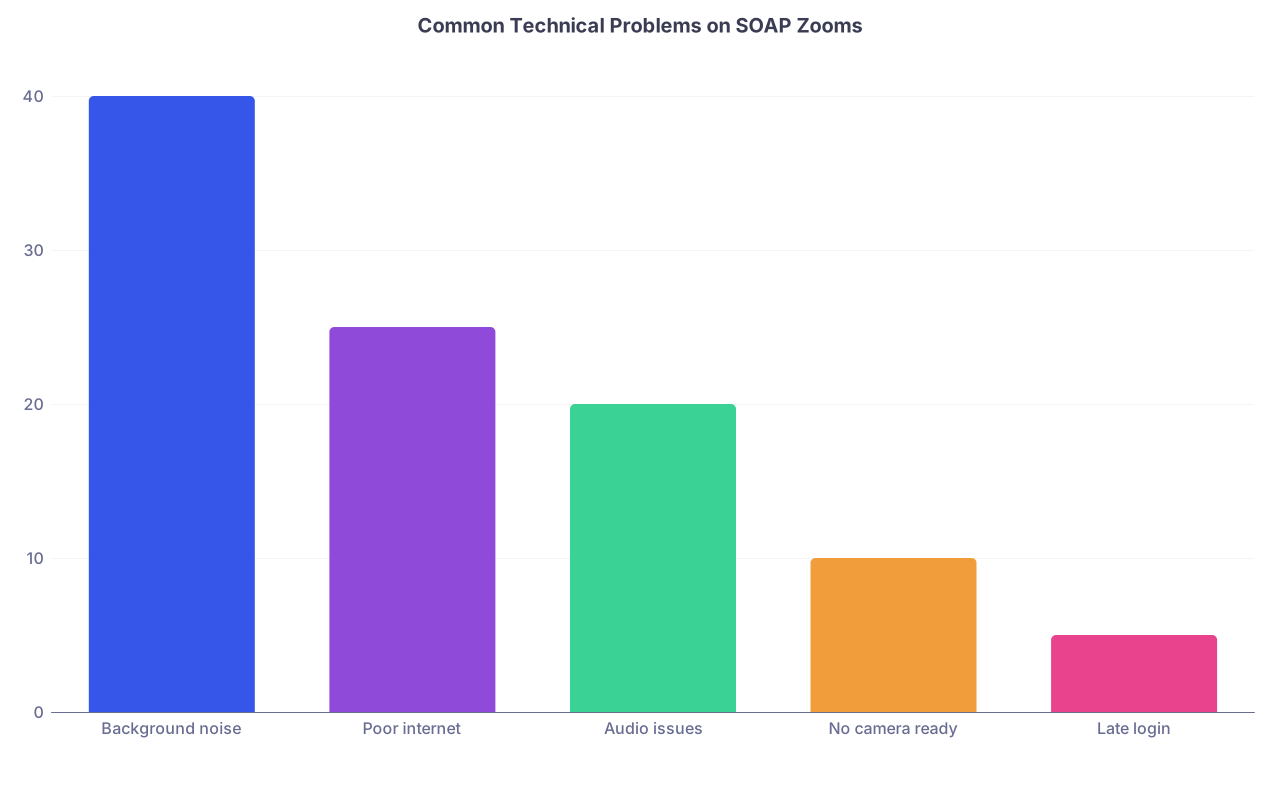
| Category | Value |
|---|---|
| Background noise | 40 |
| Poor internet | 25 |
| Audio issues | 20 |
| No camera ready | 10 |
| Late login | 5 |
These are not cute “relatable” glitches during SOAP. They are warning signs that you will be a headache on call.
Technical red flags that instantly downgrade you
- Joining late or exactly at the second the meeting starts.
- Asking, “Can you hear me?” three times in the first minute.
- Camera at an angle showing your ceiling, your bed, or half your face.
- Loud background noise: roommates, TV, traffic, children yelling.
- Horrible lighting: face in total shadow, backlit window, grainy image.
- Low battery warnings beeping mid-call.
- Constant “You’re frozen” or “You’re cutting out” moments.
Programs interpret this as:
- Poor planning.
- Poor professionalism.
- Poor adaptation to reality (SOAP is high stakes; you did not treat it that way).
Minimum non-negotiables before SOAP starts
You must do these before the frenzy begins:
Test your tech with a friend
Not a single one-minute test. A real 20–30 minute mock call with:- Zoom or the actual platform they use.
- Video on.
- Mic tested (no echo, no buzzing, not too quiet).
Control the environment
- Plain or neutral background.
- Door closed.
- Everyone in your home warned about your schedule.
- Phone on silent; notifications off on computer.
Backup plan
- Phone number ready if video fails.
- Program phone number or email handy.
- Laptop plugged in; no “my battery is dying.”
You do not get points for “doing your best under tough conditions.” You get judged on results under stress, because that is residency.
3. Acting Too Casual or Too Formal (Yes, Both Can Be Red Flags)
SOAP calls are not full interviews, but they are absolutely interviews. Programs use them to spot risk.
Two opposite but equally problematic behaviors:
Too casual: treating it like a friendly check-in
Red-flag behaviors:
- Answering the phone with “Hey, what’s up” or “Hello?” with confusion.
- Using slang: “Yeah, for sure,” “That’s chill,” “No worries, man.”
- Laughing nervously and filling silence with chatter.
- Wearing a hoodie, T-shirt, or scrubs top that looks like pajamas on Zoom.
- Sitting slouched on a couch or lying on a bed.
This says:
- Poor boundaries.
- Poor situational awareness.
- Immaturity.
Too formal: robotic, scripted, or defensive
Red-flag behaviors:
- Over-worshipping the program: “It would be the greatest honor of my life…”
- Giving 3-minute monologues for simple questions.
- Sounding like you are reading from a Word document.
- Never smiling, never relaxing even slightly.
- Overexplaining why you did not match when they did not even ask.
This says:
- Difficult to talk to.
- Possibly hiding something.
- Hard to imagine on rounds with real humans.
You need the middle ground:
- Professional but human.
- Prepared but flexible.
- Respectful but not groveling.
4. Mishandling Questions About Not Matching or Gaps
Programs are not stupid. They know you are in SOAP for a reason. Trying to dodge this reality or emotionally dump on them about it is a huge mistake.
The worst ways to answer “Why do you think you did not match?”
I have actually heard variations of all of these:
- “I think the Match is broken; a lot of people did not match.”
- “I do not really know; my application is strong, and my advisors were shocked.”
- “I honestly think I was unlucky.”
- “Some of the programs I applied to were biased against IMGs / DOs / my school.”
- “I had a bad test day; the exam does not reflect my clinical skills.”
- “My school did not support me properly.”
These are red flags for:
- Externalization of blame.
- Lack of insight.
- Lack of ownership.
How to answer without raising more suspicion
You must:
- Acknowledge.
- Own.
- Pivot.
Example structure:
Brief acknowledgment (1–2 sentences, maximum)
“I focused heavily on [X specialty], which is highly competitive this year, and my Step scores were solid but not exceptional for that pool.”Ownership + insight
“Looking back, my application list was not balanced enough, and I could have broadened earlier.”Concrete growth / action
“Since then, I have [completed X electives / strengthened my clinical evaluations / worked closely with mentors to refine my goals], and I am confident I can contribute strongly in a [specialty]-focused program like yours.”
Keep it under 45–60 seconds. If you talk for 3 minutes, you sound defensive and unstable.
5. Oversharing, Trauma-Dumping, or Getting Emotional on the Call
SOAP is not your therapy session. It is brutal, but you cannot treat programs like emotional support.
Red flags:
- Crying on the call or visibly breaking down on Zoom.
- Saying things like “This week has been the worst of my life.”
- Describing family crises in graphic detail.
- Sharing mental health diagnoses unprompted in an attempt to “explain” your trajectory.
- Mentioning relationship issues, financial disasters, or roommate drama.
Programs worry about:
- Your ability to function under ongoing stress.
- Your reliability on night float, ICU, or ED.
- Needing to constantly manage your emotions.
How to handle emotion without scaring them off
You are allowed to be human. You are not allowed to be unstable.
Some guardrails:
- If you feel yourself choking up, pause, breathe, and say, “Excuse me one moment.” Then regain composure.
- Practice your answers aloud until they feel boring. If you cry every time you say them, you will cry on the call.
- Keep personal hardship references brief and purposeful:
- “I faced some personal challenges during that period, but I addressed them and have been stable and fully functional since [time frame].”
Do not recite your trauma timeline. That might help a therapist. It does not help a program director.
6. Asking the Wrong Questions (or Asking No Questions)
What you ask tells them as much as how you answer.
Two big mistakes here:
1. Asking selfish or lazy questions
Red-flag questions:
- “How much vacation do you give?” (as your first or only question)
- “How much moonlighting is there?” during SOAP for PGY-1.
- “What is your board pass rate?” when it is prominently on their website.
- “How competitive is your fellowship placement?” when you are clearly in SOAP emergency mode.
- “Do you think I am likely to get an offer?”
These signal:
- Poor priorities.
- Lack of preparation.
- Thinly veiled desperation.
2. Asking zero questions
The silent “No, I do not have any questions” at the end is also terrible.
It communicates:
- Low interest.
- Low initiative.
- Possible burnout.
Safe, focused questions you can reuse
Have 2–3 intelligent, short questions ready that:
- Show you understand the program context.
- Relate to resident experience and development.
- Are not answered on page one of their website.
Examples:
- “How would you describe the type of resident who thrives in your program?”
- “For interns starting from a non-home institution, what support structures help them integrate quickly?”
- “In the last couple of years, are there any changes you have made to the program that you are particularly proud of?”
That is enough. You are not trying to run a full interview; you are trying not to wave red flags.
7. Fumbling Logistics, Time Zones, and Follow-Up
Another silent killer: looking logistically chaotic.

| Step | Description |
|---|---|
| Step 1 | Get SOAP List |
| Step 2 | Identify Target Programs |
| Step 3 | Research Basics |
| Step 4 | Prepare Scripts |
| Step 5 | Test Tech Setup |
| Step 6 | Block Quiet Time Slots |
| Step 7 | Take Calls and Zooms |
| Step 8 | Document Notes After Each |
Common mistakes:
- Missing calls because you forgot to turn your ringer on.
- Not recognizing the number and sending it to voicemail.
- Double-booking yourself for overlapping Zooms.
- Showing up flustered because you were on another call that ran long—and telling them that.
- Mixing up programs or specialties on the phone.
This is how people look like walking risk.
Simple systems to avoid looking like chaos
Before SOAP:
- Turn on Do Not Disturb except for calls from “everyone” (not just contacts).
- Use a physical notebook or a simple spreadsheet with:
- Program name
- Specialty
- Location
- Time of contact / interview
- Key notes
- Write the program name in front of you for each call so you do not mix it up.
And if you miss a call?
- Return it quickly.
- Own it simply.
- “I apologize for missing your call earlier; I was on another required call. I am available now if it is still convenient, or I am happy to schedule a specific time.”
No elaborate stories. No excuses. Just clean.
8. Coming Across as Directionless or “Anything Will Do”
In SOAP, flexibility is good. Being aimless is not.
Red-flag statements:
- “Honestly, I would be happy with any specialty at this point.”
- “I applied to everything available.”
- “I am open to anything clinical.”
- “I was originally interested in [completely different specialty], but I can switch.”
Programs hear:
- “I will leave if given the chance to switch specialties.”
- “I do not actually care about this field.”
- “I am just trying to survive, and you are a stepping stone.”
How to express flexibility without sounding opportunistic
You can be honest about changing course, but it must be:
- Thoughtful.
- Grounded in experience.
- Oriented toward this specialty.
Example:
“I initially pursued [Specialty A] and did not match. Reflecting on my rotations, I realized that the aspects I loved most—[patient continuity / acute management / procedures]—are also core to [Specialty B]. I have had strong experiences in [relevant rotations], and I am committed to building a career in [Specialty B].”
You have to make them believe:
- If they invest in you, you will stay.
- You have at least a coherent narrative for being there.
9. Ignoring Nonverbal Red Flags on Zoom
Programs are watching more than your words. They are reading your face, posture, and tiny reactions.
Red-flag nonverbals:
- Eye-rolling or subtle grimacing when certain topics come up (call schedule, location, etc.).
- Looking off-screen constantly, clearly reading or being distracted.
- Typing loudly while they are speaking.
- Leaning way back, arms crossed, expression flat or irritated.
- Nodding excessively in a way that looks fake or mechanical.
You do not need to act like a TV anchor. You do need:
- Attentive posture.
- Normal eye contact (looking mostly at the camera/screen).
- Occasional small nods or verbal cues (“Yes,” “I see,” “Thank you”).
If you are not sure, record yourself in a mock Zoom and watch it. Painful, yes. But better than discovering your “neutral listening face” looks like contempt.
10. Failing to Prepare Even a Minimal Program-Specific Pitch
No, you will not have time to do deep research on every SOAP program. Yes, it still looks bad if you clearly know nothing.
Big mistake:
- Saying, “I do not know much about your program; can you tell me about it?”
Translation: “I carpet-bombed ERAS and did zero prep.”
You need a small, fast research system for each likely call:
- Confirm: community vs academic.
- Location and major hospital site.
- Any obvious focus: underserved, rural, high-volume, trauma, etc.
| Item | Why It Matters |
|---|---|
| Location/region | Signals you are realistic |
| Type (academic/community) | Helps align your pitch |
| Size of program | Shows awareness of environment |
| Any clear focus | Lets you mention fit |
| Affiliated hospital | Useful for conversation |
Your goal is not encyclopedic knowledge. Your goal is to avoid sounding like they are just another slot.
FAQ: SOAP Calls and Zoom Red Flags
1. Is it a red flag to admit I am in SOAP because of Step failures or low scores?
Not if you handle it correctly. The red flag is not low scores; it is lack of insight and defensiveness. Briefly acknowledge the objective reality (“My Step score was below the average for my target specialty”), own your role, then pivot to concrete improvements and strengths. Do not argue with the score, blame the exam, or launch into a five-minute saga.
2. How formal should my clothing be on SOAP Zooms or video calls?
Wear what you would wear to a normal residency interview: at least business-casual with a jacket or neat top. No hoodies, no wrinkled T-shirts, no scrub tops that look like you rolled out of bed. Overly formal (full suit and tie in a tiny apartment) is fine if you are comfortable; underdressed is not fine. The mistake to avoid is looking like you did not respect the interaction enough to prepare.
3. Is it a red flag to say I am open to preliminary or transitional spots if I originally wanted categorical?
Not if you frame it well. The red flag is acting like you see the spot as a throwaway year. Say you are committed to delivering full effort wherever you match and emphasize what you hope to learn and contribute in that year. Never imply you will check out early because you “really” want something else.
4. Should I send thank-you emails after SOAP calls or Zooms, or can that look desperate?
A brief, clean thank-you is fine and not a red flag. The mistake is sending long, pleading messages or multiple follow-ups. One short note per program—“Thank you for speaking with me; I appreciated learning about X and would be excited to contribute to your team”—is enough. Do not chase them, do not ask for updates, and do not restate your entire application.
Open a blank document right now and write your 30-second introduction, your 60-second “why I did not match” answer, and two smart questions you can ask any program. Then say them out loud, on camera, until you no longer sound like someone in crisis.