
It’s Monday of Match Week. 10:59 AM ET. You’re sitting with your phone on the NRMP page, knowing in one minute you find out if you matched. The email hits.
“Dear Applicant, we are sorry to inform you…”
Your stomach drops. By noon, you’re in the SOAP portal, staring at a list of unfilled programs, trying not to throw up.
Here’s the part nobody tells you: program directors started talking about SOAP candidates days ago. Some have a short list ready. Some already know which of you they’ll take a chance on and which files they won’t even click.
I’ve sat in those rooms. Heard the comments. Watched PDs scroll past strong applicants and latch onto others you’d never predict on paper.
Let me walk you through what really happens—and what they’re actually looking for when they pick SOAP candidates.
How SOAP Really Looks From the Program Side
Forget the polished NRMP description. Behind the scenes, SOAP for programs is controlled chaos.
They get a firehose of applications in a tiny time window. A mid-tier IM program can see 300–600 SOAP apps for maybe 4–10 spots. FM, psych, prelim medicine, TY—same story. A busy PD has clinic, residents melting down on the floors, admin meetings, and now this mess to manage.
So what do they do?
They triage. Fast. They’re not reading your application the way they did in regular season. They’re speed-scanning for green flags and hard red flags.
And they lean hard on three things:
| Priority Area | Weight in SOAP | Speed of Evaluation |
|---|---|---|
| Red flag screening | Very High | Seconds |
| Fit & trainability | High | 1–3 minutes |
| Logistics (visas, gaps) | High | Seconds–1 minute |
| Scores/academics | Moderate | 1–2 minutes |
| Personal story | Low–Moderate | If still in the running |
That’s the brutal reality. If you want to win in SOAP, you stop pretending this is a holistic, leisurely review. It is not. You optimize for what PDs can actually see and decide on in under three minutes.
The First Pass: Who Gets Auto-Dropped in SOAP
This part’s ugly but you need to hear it.
On day one of SOAP, a lot of PDs start with one simple goal: eliminate risk. They know they’re signing people they’ve never met in person, under time pressure, and they’re stuck with you for a year (or three).
So they go hunting for red flags. And they’re ruthless.
Here’s what really gets people dropped on first pass:
Unexplained gaps
One PD’s exact words: “If I can’t figure out where you were for 18 months, I’m not wasting time in SOAP to find out.”A 1–2 year gap with no explanation in your application text? You’re done at many programs. If that gap is clearly and succinctly addressed in your experiences or personal statement (“took official LOA for family illness; returned and passed all subsequent clerkships”), you might survive.
Multiple exam failures with no upward trend
One fail? Many will at least keep skimming. Two fails? They start getting jumpy. Multiple fails with no convincing recovery? Most programs will pass unless they’re desperate or know you from somewhere.Unclear degree / training status
If your ERAS profile makes it even slightly confusing whether you actually graduated, completed clerkships, or what your current status is—many PDs are not going to stop and decode it. They move on to the next file.Obvious professionalism issues
Anything that sounds like you were removed from a program, had major professionalism write-ups, or were let go from a prior residency? There are programs that will still talk to you, but they want a crystal-clear story and usually some backchannel reassurance.
Here’s the part nobody says out loud: in SOAP, clarity is currency. If there’s any question mark about you, and five other candidates look straightforward, the PD is going to take the easy wins.
So your job, going into SOAP, is to make your application read like this: “No drama. Trainable. Understands their situation. Will show up and work.”
What PDs Actually Scan First in Your SOAP Application
Everyone loves to fantasize that program directors are poring over your personal statement and letters.
During SOAP? No. They’re hitting the obvious panels first.
From what I’ve seen in multiple specialties (IM, FM, psych, prelim/TY), the order looks roughly like this:
US vs IMG and visa status
They filter. They search. They use quick filters in ERAS to slice the applicant pool.
Not because they hate anyone. Because it saves time.
A community IM program with no visa sponsorship simply doesn’t have the bandwidth in SOAP to think, “Well maybe we can figure out a way to get this J-1 approved.” They sort by “No Visa Needed” and move forward.Medical school and year of graduation
They’re asking: Are you reasonably recent? Are you at risk of knowledge decay?Graduation >5 years ago with no clinical work? Many will pause or skip.
Graduation >5 years but active clinical practice abroad, or recent USCE? Better.Step 2 CK (or COMLEX Level 2) performance
In SOAP, Step 2 often matters more than Step 1 (especially now that Step 1 is pass/fail). PDs look at:- Did you pass?
- Is the score somewhere near what they’re used to taking?
- If you had a Step 1 issue, did you bounce back here?
Geographic and connection clues
They comb quickly for:- Any clinical rotations near them
- Family in the area
- Address that’s not 1,000 miles away with no explanation
They want to know: Are you going to be miserable and leave, or do you have some roots that mean you’ll stay?
Clerkship / rotation comments
A lot of PDs completely skip the medical school transcript GPA nonsense and go straight for narrative comments. Anywhere they see:- “Hardworking, reliable, team player”
- “Excellent with patients and nursing staff”
They perk up.
Letters of recommendation, but selectively
They’re not reading all three letters line by line. They’re scanning the signers and the first few lines. Is it a generic “To whom it may concern, this is a good student”? Or does it read like someone actually knows you and is vouching for your work ethic?
If you understand that this is the reality, your strategy changes. You stop obsessing over flowery prose and start making sure your application telegraphs three core things:
You’re safe.
You’re trainable.
You won’t be a headache.
The Secret Ranking: What Matters Most in SOAP (From the PD Chair)
Let me show you how a lot of them are implicitly ranking criteria during SOAP. They won’t say it like this on their website, but this is how they behave.
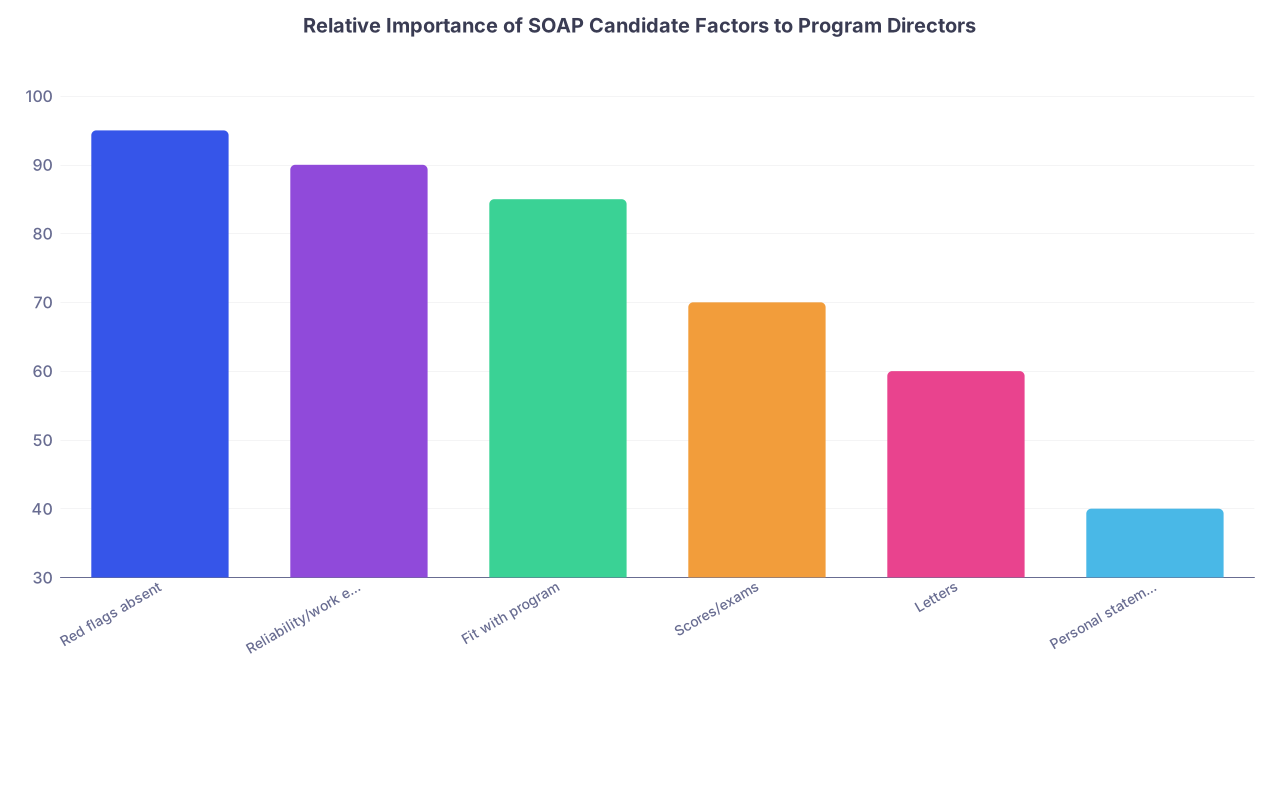
| Category | Value |
|---|---|
| Red flags absent | 95 |
| Reliability/work ethic | 90 |
| Fit with program | 85 |
| Scores/exams | 70 |
| Letters | 60 |
| Personal statement | 40 |
Notice something? Scores are not at the top. They’re on the list, but they don’t beat “Will this person show up, do the work, and not blow up my program?”
That’s the unspoken SOAP bias.
If you’re decent on paper and come across as serious, grounded, and flexible, you can absolutely beat someone with slightly higher scores who reads as entitled, scattered, or risky.
How PDs Really Think About Different SOAP Profiles
Let me walk through a few real-world types and how they look to PDs during SOAP.
1. The “Decent Stats, No Match” US MD/DO
This is the golden SOAP archetype. PDs love you, even if they’re suspicious of why you didn’t match.
You’re a US grad. You passed exams. You were close enough to get interviews. When we see you in SOAP, the question is: “What went wrong?”
They’ll look for:
- Over-aspiring (all top programs, no safeties)
- Competitive specialty attempt (derm, ortho, ENT, rad onc)
- Geographic inflexibility
If they can explain your failure to match as a strategy error rather than a you problem, they’re fine with you.
2. The “Took a Big Swing” Applicant (e.g., applied ortho, now SOAPing into prelim/TY/IM)
These candidates get a lot more sympathy than you’d think. A surprising number of PDs respect the gamble.
What they look for:
- Strong or at least decent Step 2/Level 2
- No professionalism issues
- A personal statement that calmly explains the pivot without sounding resentful
What they do not want is someone who radiates “I’m too good for your program, I just need a holding pen for a year.” If you give even a hint of that, you’re done.
3. The IMG with Solid Stats in SOAP
Here’s the harsh truth: once you’re in SOAP as an IMG, you’re climbing a steeper hill, especially without prior US clinical experience or with older YOG.
But. There are PDs who actively look for strong IMGs in SOAP because they know you’ll be grateful and work like hell.
They look for:
- Clear explanation of gaps or long time since graduation
- Strong Step scores, especially Step 2
- USCE with good narrative comments
- Clear geographic/visa feasibility
If you’re an IMG in SOAP, most PDs are thinking: “If I take this person, are they going to pass boards and handle the workload?” You must answer that question with your record and how you present yourself.
What Program Directors Listen For in SOAP Calls
Yes, SOAP is supposed to limit direct contact. No, that’s not how it always works.
Phone calls happen. Webex/Zoom chats happen. Quick “informational” emails happen.
When PDs, APDs, or chief residents get you on the phone, they’re not looking to be dazzled by your brilliance. They’re doing a risk scan in real time.
They are listening for:
Stability and groundedness
If you sound frantic, angry, or self-pitying, they back away. Everyone knows SOAP week can break people. The PD’s question is: are you still emotionally functional enough to show up July 1 and work?Ownership, not excuses
If you’re asked why you didn’t match, the best answer sounds like this:
“I applied [X specialty/program tier/geography], in retrospect my strategy was too narrow. I had [Y number] of interviews but did not match. I’ve reflected on it, gotten feedback, and am fully committed to succeeding in [their specialty] if given the opportunity.”
Not: “The system is broken, I was robbed, my dean screwed me.” PDs hear that and immediately picture future headaches.Understanding of the specialty and program
Translation: Did you even read about us? Or are you shotgun calling every open slot? If you can drop one or two specific program features you genuinely care about, you move up in their mind.Humility plus confidence
There’s a fine line. You want to project: “I know I can do this work. I’m not above it. I’ll show up.” What kills people is either arrogance (“I was aiming much higher, but I guess this will do”) or total collapse (“I don’t know what happened, I’m so lost”).

| Step | Description |
|---|---|
| Step 1 | PD receives SOAP list |
| Step 2 | Shortlist by files |
| Step 3 | Call top candidates |
| Step 4 | Rank higher |
| Step 5 | Drop or rank low |
| Step 6 | Phone impression |
Those ten minutes on the phone can absolutely move you from middle of the pack to “offer if available.”
The Quiet Power of “Fit” in SOAP
Fit is one of those abused words that usually means nothing.
During SOAP, it means something very specific.
Program directors are asking: “Does this person match the work culture we already have?”
A small community FM program with a tight-knit resident group does not want someone who screams “academic superstar who thinks this is beneath them.” A county IM program with heavy volume does not want someone who seems fragile and obsessed with work-life balance on day one.
They’re listening and reading for:
- Do you understand what kind of hospital this is?
- Are you okay working with limited resources, or high volume, or underserved populations?
- Do your experiences show any history of surviving tough environments?
If they train mostly local, blue-collar, first-gen residents, and you come across as aloof, they’ll pass, even if your scores are higher.
If they’re an academic powerhouse and you only talk about “close-knit family feeling” with zero talk of research or academia, they’ll question your fit too.
You don’t need to fake anything. You do need to show you actually understand the environment you’re asking to enter.
How Much Do Scores and Research Actually Matter in SOAP?
Let me cut through the fantasies.
Scores:
- Passing is mandatory.
- Higher helps, especially if they’re worried about board pass rates.
- But in SOAP, high scores alone will not rescue you if your story is confusing, your attitude is off, or your application screams “flight risk.”
Research:
- Impresses academic programs a bit.
- Basically irrelevant for many community programs during SOAP.
I’ve watched PDs literally say: “Yeah, impressive research, but I don’t need a researcher. I need someone who can cover nights without disappearing.”
The hierarchy in SOAP is more like:
- Are you safe to take?
- Are you going to work hard and not implode?
- Can you pass boards?
- Will you stay?
- Everything else, including your poster at some national conference.
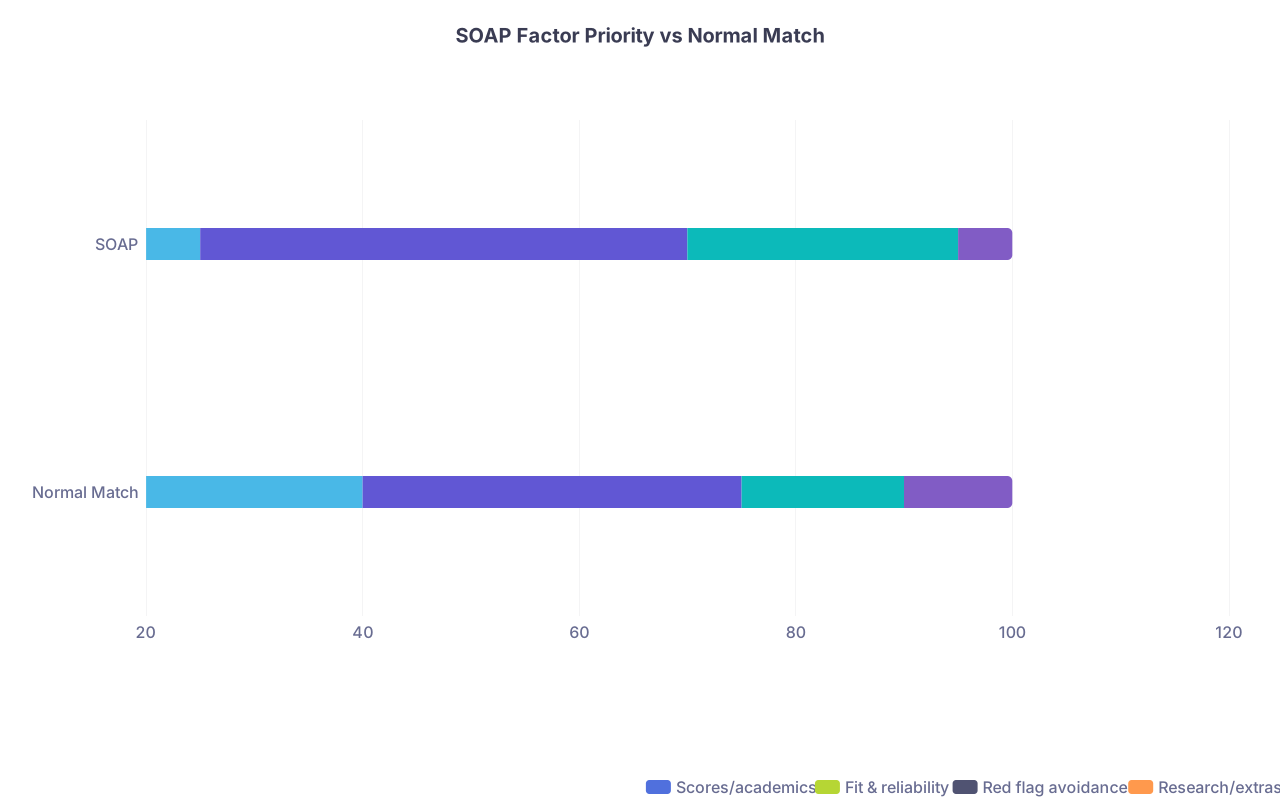
| Category | Scores/academics | Fit & reliability | Red flag avoidance | Research/extras |
|---|---|---|---|---|
| Normal Match | 40 | 35 | 15 | 10 |
| SOAP | 25 | 45 | 25 | 5 |
SOAP amplifies character and risk assessment, and shrinks the value of polish and extras.
What You Should Actually Project as a SOAP Candidate
If you want the PD version of the “ideal SOAP candidate,” here it is.
They want someone who:
- Knows they’re in a tough spot—but isn’t broken by it.
- Owns their path without self-pity.
- Understands the specialty and program level they’re applying to.
- Signals: “I will show up. I will do the scut. I will not be your 3 AM disaster story.”
I’ve watched PDs take a chance on a candidate with a Step 1 fail who spoke clearly, owned their mistakes, had good Step 2, and sounded like they’d run through a wall for the team.
I’ve also watched them drop candidates with near-260s because the attitude on a quick call was toxic.
In SOAP, how you come across under pressure is itself a data point.
If you can present yourself as calm, coachable, and already thinking about how to contribute—while everyone else is spiraling—you stand out.
Quick Reality Checks by Specialty (SOAP Edition)
I’m not going to list every specialty, but here are a few patterns I’ve seen again and again.
| Specialty | SOAP Spots Typical | PD Attitude in SOAP |
|---|---|---|
| Internal Med | Many | Practical, volume-focused |
| Family Med | Many | Emphasis on commitment |
| Psychiatry | Some | Wary of red flags, stability |
| Prelim/TY | Many | Workhorse, low drama |
| Surgery Categorical | Few | Extremely selective |
Internal Medicine (community programs): They want reliable workers who can handle volume and pass boards. Scores matter, but not more than work ethic and stability.
Family Medicine: They care a lot about whether you actually want FM or are just using them as a parachute. If they smell that you’ll try to leave after a year, you drop down their list.
Psychiatry: They are very sensitive to mental health and professionalism flags. They see more troubled applicants than most. If your story around any LOA or difficulties is opaque, they worry.
Prelim/TY: They know they’re a revolving door. They want people who can handle brutal schedules without exploding. Ownership and resilience beat fancy stats.
A Brief Timeline: How Fast PDs Actually Move in SOAP
To give you a sense of pace:
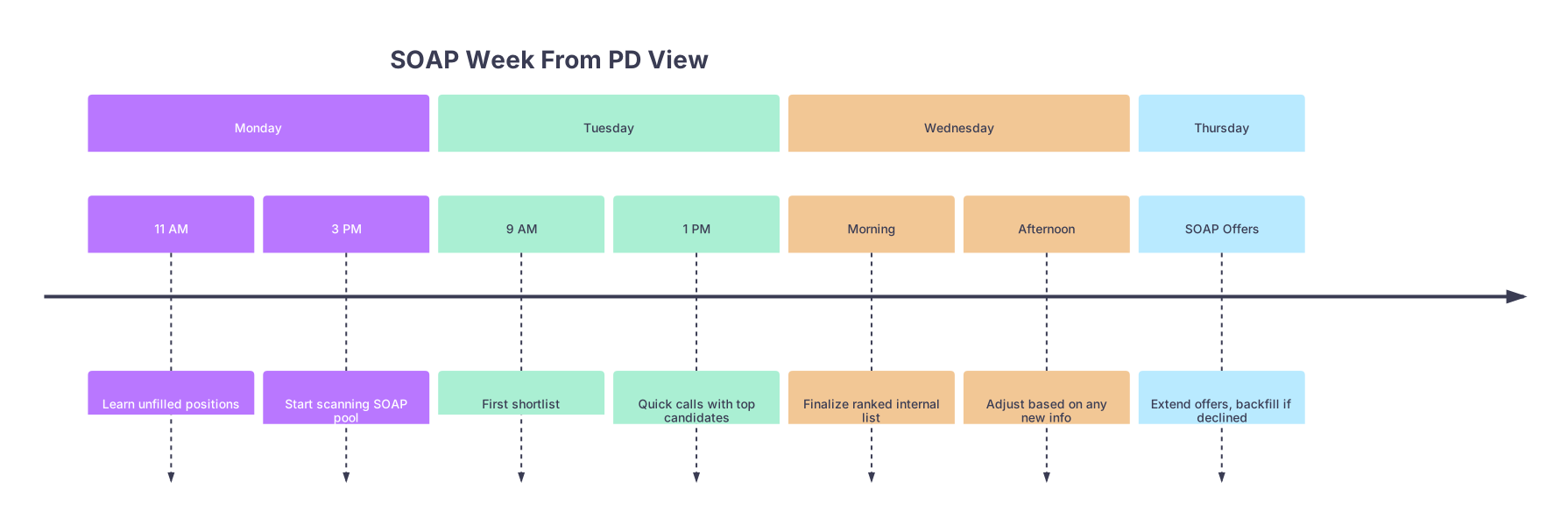
| Period | Event |
|---|---|
| Monday - 11 AM | Learn unfilled positions |
| Monday - 3 PM | Start scanning SOAP pool |
| Tuesday - 9 AM | First shortlist |
| Tuesday - 1 PM | Quick calls with top candidates |
| Wednesday - Morning | Finalize ranked internal list |
| Wednesday - Afternoon | Adjust based on any new info |
| Thursday - SOAP Offers | Extend offers, backfill if declined |
They’re not running a months-long, data-driven selection. They’re making high-stakes, fast decisions with incomplete information.
Your job is to be the easiest “yes” on their screen.
Key Takeaways
- Program directors in SOAP are not hunting for the “best” paper applicant. They’re hunting for the safest, most reliable, least risky trainee they can reasonably trust.
- Red flags, gaps, and attitude will sink you faster than a mediocre score ever will. If your story is clean, clear, and grounded, you’re already ahead of most of the pool.
- In every interaction—your written app, any calls, any emails—you want to project one thing: “I understand where I am. I’m ready to work. If you pick me, you will not regret it.”