The Unspoken Rules of Calling Programs During SOAP Week
It’s Monday of SOAP week. You’ve just opened the List. Your specialty column is full of “0” under “Positions Filled.” Your phone is in your hand. Your dean told you, “You can reach out to programs.” Your group chat is blowing up with rumors: “Call now.” “Don’t call.” “Only email.” “Have your advisor call.”
You stare at the program’s main number, thumb hovering, and you’re thinking:
“What do I say? Who do I even ask for? Am I going to annoy them and kill my chances?”
Let me tell you what actually happens on the other side of that phone line—and how people really get noticed during SOAP.
What Program Directors Are Doing While You’re Panicking
Before we talk about calling, you need to understand what’s going on inside programs during SOAP. Otherwise you’re playing a game without knowing the rules.
Here’s the reality most people do not tell you.
On Monday morning, when the SOAP-eligible list goes live, program leadership is not sitting around waiting for your call. They’re:
- Pulling reports from ERAS
- Filtering by Step 2 / COMLEX 2 scores, visa status, red flags
- Checking school reputation and prior residents from those schools
- Emailing each other frantic lists like, “Here are 40 we could live with—can you skim?”
In many programs, the PD doesn’t even touch the phone that day. Calls go to:
- The program coordinator
- Some poor chief resident posted at a desk with a half-updated spreadsheet
- A junior faculty member who drew the short straw
And here’s the part you really need burned into your brain:
By the time you are thinking of calling, many programs already know 70–80% of the people they plan to offer SOAP interviews to.
Not always. But often.
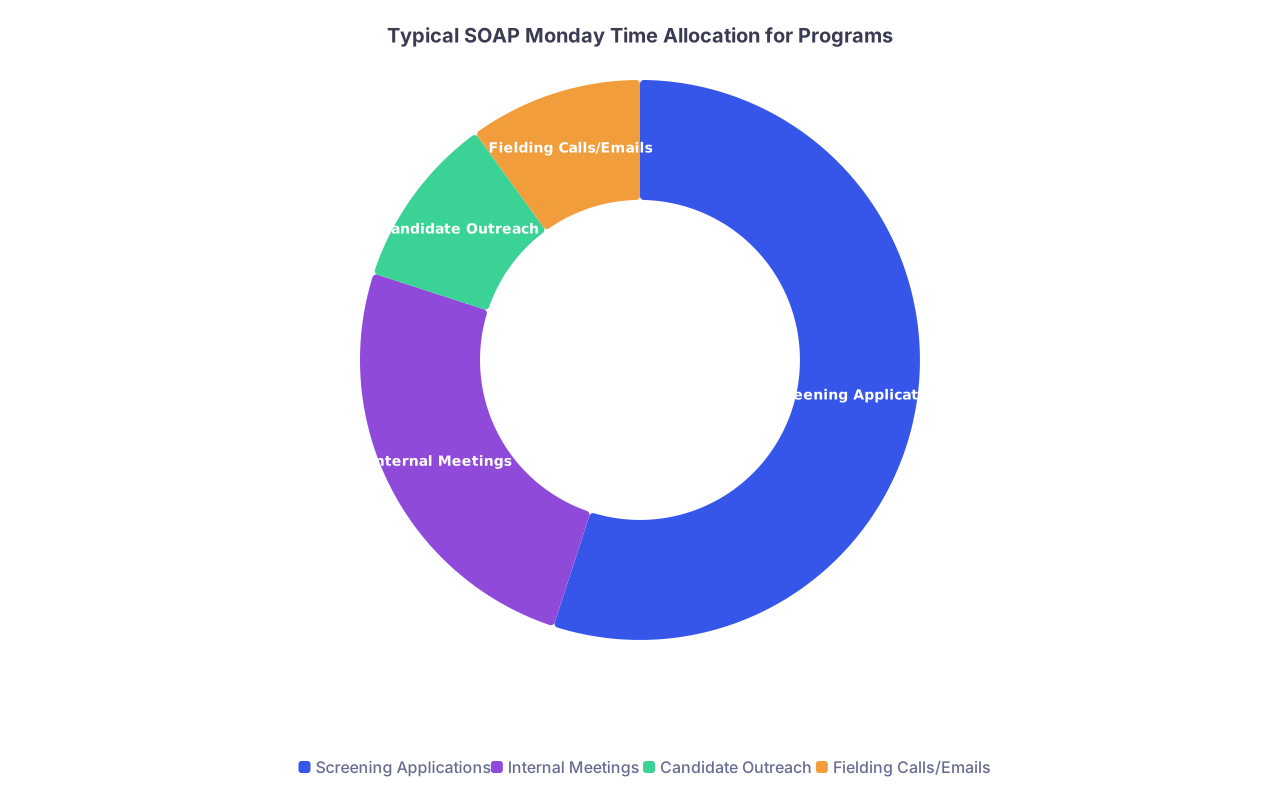
| Category | Value |
|---|---|
| Screening Applications | 55 |
| Internal Meetings | 25 |
| Candidate Outreach | 10 |
| Fielding Calls/Emails | 10 |
So if you call with some generic “Hi, I’m very interested in your program,” that doesn’t move the needle. You become background noise.
The unspoken rule: The call is not a primary strategy. It’s an amplifier for an application that’s already in their consideration pile—or a Hail Mary that sometimes works if you play it exactly right.
Should You Even Call? The Brutal Answer
Let me be direct: not everyone should be calling programs. Some of you will help yourselves. Some of you will quietly bury your chances.
You should strongly consider calling if:
- You’re a borderline candidate who meets their published filters (Step 2, graduation year, visa)
- You have a real, defensible connection to the region/hospital/system
- You already applied to that specialty in ERAS (primary or backup)
- Your advisor or PD is also willing to advocate for you
You probably should not be cold calling every program if:
- You don’t meet their basic requirements
- You’re switching into this specialty during SOAP with zero signal of interest in your original ERAS application
- You have a major red flag you can’t explain in 1–2 clean sentences
- You’re so emotionally flooded that you’re going to sound desperate or disorganized on the phone
Here’s what many faculty will never say out loud:
A disorganized, rambling SOAP call can poison a decent paper application. I’ve watched it happen. Candidate looked okay in ERAS. Then they called three times, left messy voicemails, had no idea what they wanted to say when the coordinator finally picked up. They got moved from “maybe” to “absolutely not” in 10 seconds.
The unspoken rule: If you’re going to call, you must sound like someone they could dump on a night float shift tomorrow and not worry about.
Who To Call, When To Call, and Who Should Call For You
Let’s go inside the building for a second.
When that main program number rings during SOAP, here’s what happens:
Sometimes:
The coordinator answers, half buried in spreadsheets, and thinks, “Please don’t be another student asking if we got their application.”
Sometimes:
The call dumps to a hospital operator who has absolutely no idea what SOAP is and transfers you to GME, who then forwards you to a generic voicemail.
Very rarely:
You magically catch the PD or APD at their desk. Do not count on this.
So, what’s your target?
- First choice: Program coordinator (PC)
- Second choice: Program director (PD) or associate PD
- Third choice: Chief resident, if they’re explicitly listed as a contact
The coordinator is the gatekeeper. I’ve seen PCs single-handedly push someone into the “invite” column because the candidate sounded composed, polite, and actually knew something about the program.
Timing: When your call doesn’t get you blacklisted
On SOAP Monday:
- Early morning (right after lists drop): chaos
- Late morning: still chaos, but more structured
- Early afternoon: many programs have initial shortlists
- Late afternoon: some have already sent out all their interview invitations
The sweet spot, if you’re going to call on Monday, is usually late morning to early afternoon. Early enough that they might still be building their list, late enough that they’ve looked at applications and can actually find you in the system.
On Tuesday:
This is often better for calls. Many programs are confirming interviews, still looking for alternates, or realizing their initial list is weaker than they’d like.
The unspoken rule: Monday morning is for getting on their radar via ERAS and targeted emails. Calls are often more effective Monday afternoon or Tuesday when they have actual time to register who you are.

| Step | Description |
|---|---|
| Step 1 | SOAP List Released |
| Step 2 | Submit/Confirm Applications |
| Step 3 | Targeted Emails to Programs |
| Step 4 | Advisor/PD Advocacy |
| Step 5 | Candidate Calls Program |
| Step 6 | No Direct Contact |
| Step 7 | Possible Interview Offer |
| Step 8 | Program Priority? |
Who should make the call?
Here’s one of the biggest “nobody tells you this” truths:
A call from you is helpful.
A call from your dean, PD, or a known faculty name is often 10x more powerful.
Programs absolutely track this. I’ve sat in SOAP rooms where someone says, “Hey, Dr. X from Y school called about this student—can we bump them into the interview pool?” It happens constantly.
But. And this is important.
If your only plan is, “My dean will call all 25 unfilled programs,” that’s not advocacy. That’s spam. Programs can smell the mass email / mass phone tree stuff.
Best case: One or two well-targeted advocacy calls from someone who can say something specific about you. “We’d trust them with our own patients.” “They took care of their sick parent while in school and still performed.” That gets attention.
The unspoken rule: Your own call + one strong advocate call beats 10 generic “please consider my student” calls every single time.
What To Say: The Script That Doesn’t Sound Scripted
You get the coordinator on the phone. This is your 60–90 seconds. If you turn this into a five-minute life story, you’re done.
Think of your call as three clean moves:
- Who you are
- Why you’re calling them specifically
- What you want them to actually do
Here’s the skeleton that works, adapted to sound human:
“Hi, my name is [Name]. I’m a fourth-year at [School], NRMP ID [ID]. I submitted a SOAP application to your [Specialty] program this morning. I was hoping to briefly express my strong interest and see if there’s any additional information I can provide.”
Pause. Let them respond.
If they say, “We’re still reviewing”:
You pivot to your 20–30 second pitch:
“I understand, thank you. I just wanted to mention that I [one or two concrete strengths that matter to their program—extensive community experience, strong Step 2, prior rotation in their hospital system, ties to the area]. I’d be very excited for the chance to interview if you feel I could be a fit.”
If they say, “We’ll be in touch via ERAS if we’re interested”:
You don’t push. You close gracefully:
“Of course, I appreciate your time during a busy week. If you need anything else from me, I’ll respond immediately via ERAS or email. Thank you again.”
What you do not do:
- Beg: “I will do anything for a spot.”
- Over-explain: “I didn’t match because…” (unless directly asked, and even then keep it surgical)
- Argue: “But my scores are actually above your average…”
- Ask them to break rules: “Can you just tell me if I’ll get an interview?”
The unspoken rule: Your goal is not to convince them; it’s to plant a very simple idea—“competent, low-drama, genuinely interested”—in the mind of the one person who might walk into the PD’s office later and say, “Hey, this one sounded good on the phone.”
Tailoring the Call: Different For Community vs Academic, Categorical vs Prelim
Not all programs view SOAP calls the same way. If you treat Mass General and a 6-person community hospital in the Midwest as identical targets, you’re going to sound clueless.
| Program Type | Likely View of Calls | Best Use of Call |
|---|---|---|
| Big-name academic | Mildly annoyed if excessive | Only if strong tie or faculty advocate |
| Mid-size university | Neutral to mildly positive | Brief interest + highlight key strengths |
| Community categorical | Often positive if respectful | Emphasize reliability and local ties |
| Prelim medicine/surgery | Mixed; high volume of callers | Very concise, stress work ethic |
| Newer/unfilled often | Usually receptive | Clear interest, commitment to stay |
Academic powerhouses
They’re getting 300+ SOAP applications for a handful of spots. They do not need more noise. Calls here rarely help unless:
- You rotated there
- You have a well-known faculty member calling for you
- You’re correcting something concrete (wrong email, uploaded transcript late, etc.)
If you’re calling these places just because “it’d be nice to be there,” you’re doing it for your anxiety, not your application.
Community-heavy, frequently unfilled programs
These are the ones where a well-executed call can matter.
Programs that struggle to fill every year are very sensitive to one thing:
Who is actually going to show up in July, work hard, and not bail?
If you are from that region, have family nearby, or can credibly say, “I’m planning to stay in this area long-term,” and you sound grounded on the phone—the coordinator will remember you.
The unspoken rule: SOAP is where programs that usually feel ignored finally get to be choosy. Showing them that you actually see and want them can tip decisions.
How Calls Interact With Emails and ERAS Filters
Let’s clear something up: if your ERAS application isn’t in their SOAP queue, your call is basically shouting into a void. A few might say, “Okay, we’ll look you up,” but most are sifting within the ERAS pool.
Your sequence should look more like this:
- Make sure you’ve actually applied to that program via SOAP.
- Send a short, targeted email to the program’s listed contact or coordinator.
- Then, if warranted, place a brief, professional call.
Here’s the behind-the-scenes piece: a lot of coordinators manage their mental list around people they’ve seen more than once that day.
Email + call + maybe your dean’s email = “This name looks familiar.”
That familiarity is sometimes enough to bump someone from the 3rd round of review into the 1st or 2nd.
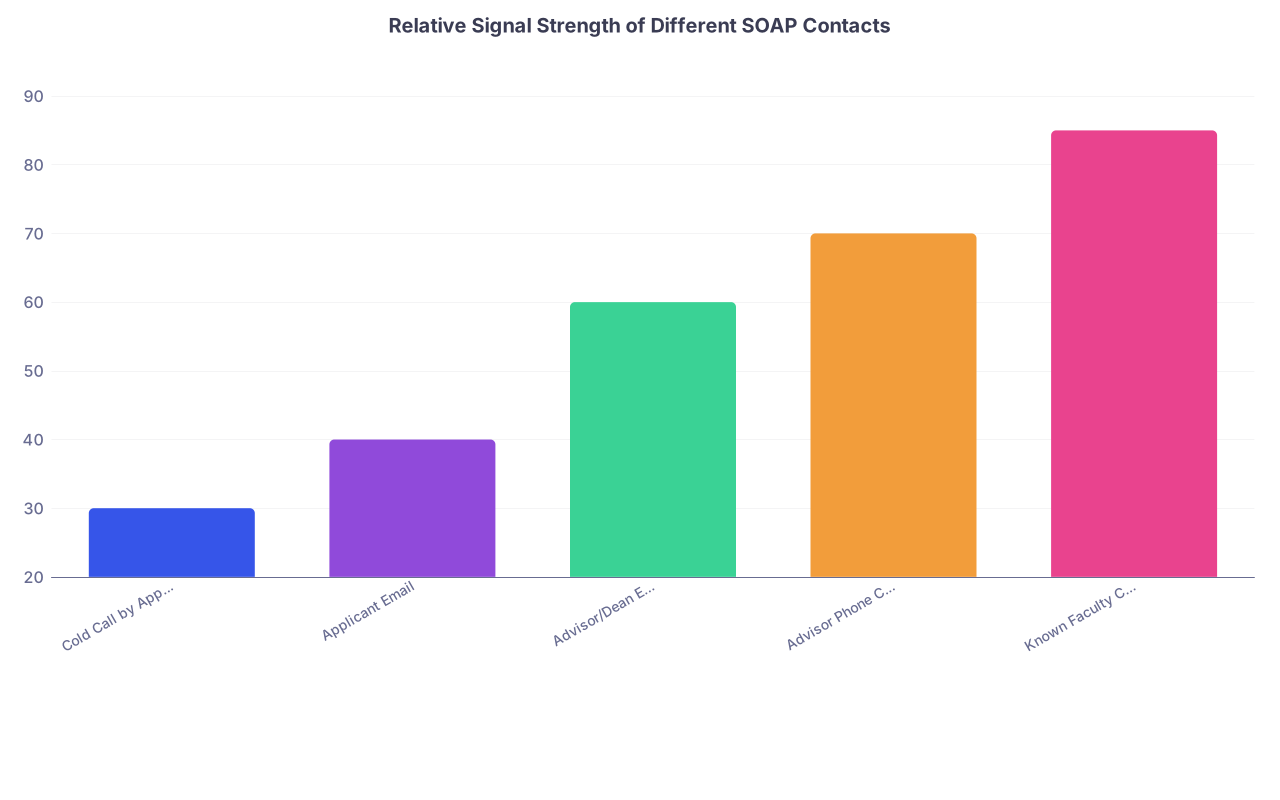
| Category | Value |
|---|---|
| Cold Call by Applicant | 30 |
| Applicant Email | 40 |
| Advisor/Dean Email | 60 |
| Advisor Phone Call | 70 |
| Known Faculty Call | 85 |
Also—filters.
Many programs set hard filters in ERAS during SOAP:
- Below X on Step 2: auto-screened out
- Graduation > 3–5 years ago: auto-screened out
- Requires US citizen/GC: auto-screened out
Your call will not magically override these at most places. There are exceptions when a faculty member with real history with the program pushes, but don’t bank on it.
The unspoken rule: Calling doesn’t beat filters. It only helps within the group that already passed them.
Red Flags, Failures, and “Do I Bring It Up?”
Here’s the quiet fear: “If I call, do I have to explain my failure, my leave, my low score?”
Short answer: No, not unless they ask. And even when they do, keep it sharp and controlled.
If they say, “I see you had a Step failure—what happened?” you don’t give a soap opera. You give three pieces, clean:
- Brief cause, without drama.
- Concrete correction.
- Evidence of performance since.
Example:
“I had a Step 1 failure in my second year during a family health crisis. I adjusted by changing my study approach, working closely with our learning specialist, and when I retook it, I passed comfortably on the first retry. Since then, I’ve passed Step 2 on the first attempt and honored my last two core rotations.”
What you never do is argue with the exam, blame everyone around you, or minimize it. Ownership, correction, move on.
The unspoken rule: Programs are less scared of your failure than of your inability to talk about it like an adult.
The Quiet Ways You Can Shoot Yourself in the Foot
You want the ugly truths. Here they are.
Things that have gotten students quietly blacklisted during SOAP:
- Calling the same program three times in one day “to check in”
- Having a parent call the program “just to advocate”
- Sending a mass email with all programs CC’d instead of BCC’d
- Arguing with the coordinator when told, “We’re not doing phone updates”
- Crying on the phone in a way that the coordinator felt was manipulative rather than just human
I’m not telling you to be a robot. People cry during SOAP. People are devastated. Some coordinators are kind and will sit with that for a minute.
But remember the thought in the person’s head on the other end:
“Can I see this person as a resident at 2 a.m. in my ICU?”
If the answer starts shifting toward “high maintenance,” your chances plummet.
The unspoken rule: Professionalism under stress is the single strongest non-quantitative signal you’re sending this week. Every interaction either builds or erodes that.

A Realistic Calling Strategy That Doesn’t Make You Look Desperate
Let me give you a structure that I’ve seen work for students who ended SOAP with positions—sometimes at places that looked unattainable on Monday morning.
Step 1 – Triage your list
Do not shotgun call all 40 programs that have your specialty. Rank them by:
- Fit (scores, graduation year, visa status)
- Genuine interest
- Any connection (school, region, prior contact, rotation)
Your energy is limited. So is the programs’ patience.
Step 2 – Lock your story
Before you touch the phone, write down:
- One sentence on who you are
- One sentence on why you’re a good fit for this program
- One sentence on why you’re interested in this program
- One sentence gracefully closing the call
Rehearse it out loud a couple of times. Not to sound robotic, but to avoid rambling when your adrenaline spikes.
Step 3 – Sequence: Email + call + advocate
For your top tier programs:
- Early Monday: ERAS + brief tailored email
- Late Monday/Tuesday: One professional call
- Parallel: Ask your dean/PD to place 1–3 targeted advocacy calls, not 20 generic ones
For your second tier:
- ERAS + brief email, maybe no call unless you have real ties/strength for them
For the rest:
- ERAS only; anything more is stress theater, not strategy
What Happens If No One Picks Up?
Because this is common: you call, it goes to voicemail, or it’s a generic line.
Leaving a voicemail is fine if, and only if, you can keep it under 30 seconds and not sound frantic.
Something like:
“Hello, this is [Name], a fourth-year at [School], NRMP ID [ID]. I’ve submitted a SOAP application to your [Specialty] program and wanted to briefly express my strong interest. I know you’re extremely busy, so there’s no need to call back—I’ll be watching ERAS and email closely. Thank you for your time.”
Then hang up. No call-back request. No callback number recited three times. They can see your number if they desperately want it.
The unspoken rule: Long voicemails get deleted halfway. Short ones sometimes get scribbled on a notepad and mentioned in passing.
How Programs Actually Decide After Your Call
Let’s lift the curtain on the final piece.
In many programs, SOAP interview lists are made in a room with:
- PD
- APD(s)
- Coordinator
- Occasionally a chief or senior resident
Somebody runs a list of all SOAP-eligible applicants who passed filters. People skim. Names get thrown into tiers.
Then you’ll hear things like:
- “This one—our coordinator said they called and sounded strong.”
- “Our alumni from X school emailed about this student.”
- “This person has family here and said they’re definitely coming if offered.”
- “Someone from their school called for them; they say this student is one of their best.”
And yes, also:
- “This one called three times; seemed kind of scattered. Let’s skip.”
Your call is a data point. Not the main one, but not irrelevant either. When the stack of “maybes” is 40 deep and they need 10 names, being a calm, professional human voice that someone in the room remembers tips those edges.

Final Thought
Right now it feels like every word, every email, every phone call could make or break your career. It will not. It might influence where you start. It will not decide who you become.
SOAP exposes something programs care about but rarely say out loud: how you behave when things are not going your way. Calling programs is not about proving you’re desperate. It is about proving you’re steady.
Years from now, you won’t remember the exact wording of that voicemail or whether you called at 10:15 or 2:30. You’ll remember whether, in one of the most stressful weeks of your life, you carried yourself like the doctor you were training to be. That’s what really stays with you—and, quietly, it’s what stays with the people on the other end of the line too.