
The fastest way to kill your SOAP chances is not your Step score. It’s a sloppy, desperate email that makes a program director hit delete in three seconds flat.
You’re in SOAP. Emotions are high. Time is short. Your inbox is chaos. That’s exactly when people send the worst emails of their lives. And program directors remember them.
Let me walk you through the phrases and patterns that quietly (and sometimes loudly) turn PDs off. If you avoid these, you’re already ahead of half the people panicking through SOAP.
The Desperation Traps That Instantly Red-Flag You
SOAP emails that reek of desperation don’t make PDs feel sympathy. They make them worry you’ll be a problem resident.
Here are the worst offenders.
1. “This is my last chance / only hope / I have nowhere else to go”
You think you’re being honest and vulnerable. What PDs hear is: “If this doesn’t work out, I might completely fall apart.”
Phrases to avoid:
- “This is my last hope to become a doctor.”
- “I have no other options.”
- “If I don’t Match this cycle, I don’t know what I’ll do.”
Why PDs hate this:
- They’re evaluating whether you can handle stress. SOAP is a pressure cooker; residency is 3–7 years of more of the same.
- You’re making your problem their burden. No PD wants to feel responsible for your emotional survival.
- It shifts the focus from what you offer to how much you’re suffering. That’s not a good trade.
Better alternative:
- “I would be grateful for the opportunity to be considered for your program and am fully committed to working hard if given the chance.”
Calm. Stable. No emotional hostage-taking.
2. “I will do anything”
I’ve seen this line more than once:
- “I will do anything to Match at your program.”
- “I’m willing to do anything you ask if you rank me.”
This lands badly for two reasons:
- It sounds unprofessional and vaguely transactional.
- It hints at poor boundaries and poor judgment.
Residency training absolutely requires flexibility and sacrifice, but you don’t bribe your way in with martyrdom.
Better:
- “I am highly motivated to contribute to your team and am prepared to work hard to meet the demands of your program.”
That sounds like a colleague, not a supplicant.

Entitlement Phrases That Make PDs Bristle
Some SOAP emails swing in the opposite direction: not desperate, but entitled. PDs loathe this even more.
3. “I deserve a spot because…”
No. Just no.
Common versions:
- “I deserve a chance despite my scores.”
- “I worked so hard, I deserve to be a resident this year.”
- “Given my background, I believe I deserve a position in your program.”
What PDs hear:
- “I don’t really understand how competitive this process is.”
- “I think my effort obligates you.”
Residency spots aren’t rewards for effort. They’re risk-managed investments. PDs are choosing employees they’ll work with at 2 a.m. in a full ED, not handing out gold stars.
Better:
- “I hope to be considered for your program because…” followed by concrete strengths, not emotions.
4. “I know I’m a perfect fit for your program”
You might think this sounds confident and targeted. In SOAP, it usually sounds lazy and generic, because everyone writes it.
Worst versions:
- “Your program is my top choice and I know I’m a perfect fit.”
- “I believe I’m the ideal candidate for your residency.”
PDs have a question they ask themselves while skimming: “Based on what?” If you don’t give specifics, it’s empty flattery.
The problem isn’t the idea of “fit.” It’s saying you’re a perfect fit with no evidence.
Better:
- “Your strong emphasis on X and Y aligns with my experiences in Z.”
- “I’m particularly interested in your [specific clinic, track, or feature] because…”
Demonstrate fit. Don’t declare it.
Fatal Content Mistakes: What You Put In That Should Never Be There
Some candidates torpedo themselves by including topics that don’t belong anywhere near a SOAP email.
5. Oversharing personal crises as justification
You can acknowledge context. You must avoid turning your email into a trauma dump.
Examples I’ve seen way too often:
- “My fiancé left me before Step 1 and I fell into a depression…”
- “My family has been unsupportive and that affected my motivation…”
- “I was going through a difficult breakup during med school…”
PDs are not your therapist. And you have about 10–20 seconds of attention before they move on.
What’s the real damage?
- You raise concerns about emotional stability and boundaries.
- You invite the PD to judge your coping mechanisms rather than your competence.
- It looks like excuse-making, even if your pain is real.
If there’s major context that’s truly relevant (illness, death in family, etc.), keep it minimal, factual, and tied directly to specific performance, not your entire application.
Better:
- “During my third year, a family health issue affected my performance on Step 1. Since then, I’ve demonstrated improvement by [specific metric: Step 2 score, shelf exams, clinical evaluations].”
Short. Controlled. Outcome-focused.
6. Talking about other programs or specialties
Do not, under any circumstance, write:
- “I had originally applied to Dermatology but am now interested in Internal Medicine…”
- “I am emailing several programs in different specialties…”
- “Your program is one of many I’m considering during SOAP…”
They know you’re applying broadly. SOAP is chaotic for everyone. But you don’t need to rub it in.
Why this is fatal:
- It screams “backup plan,” which is fine in reality but terrible in writing.
- It suggests your interest in their specialty or program is shallow and recent.
- It lowers your perceived commitment compared to the person who sounds all-in.
Better:
- Focus solely on them. Their specialty. Their program. Your experiences that tie into it.
- Leave other programs and specialties completely out of the email.
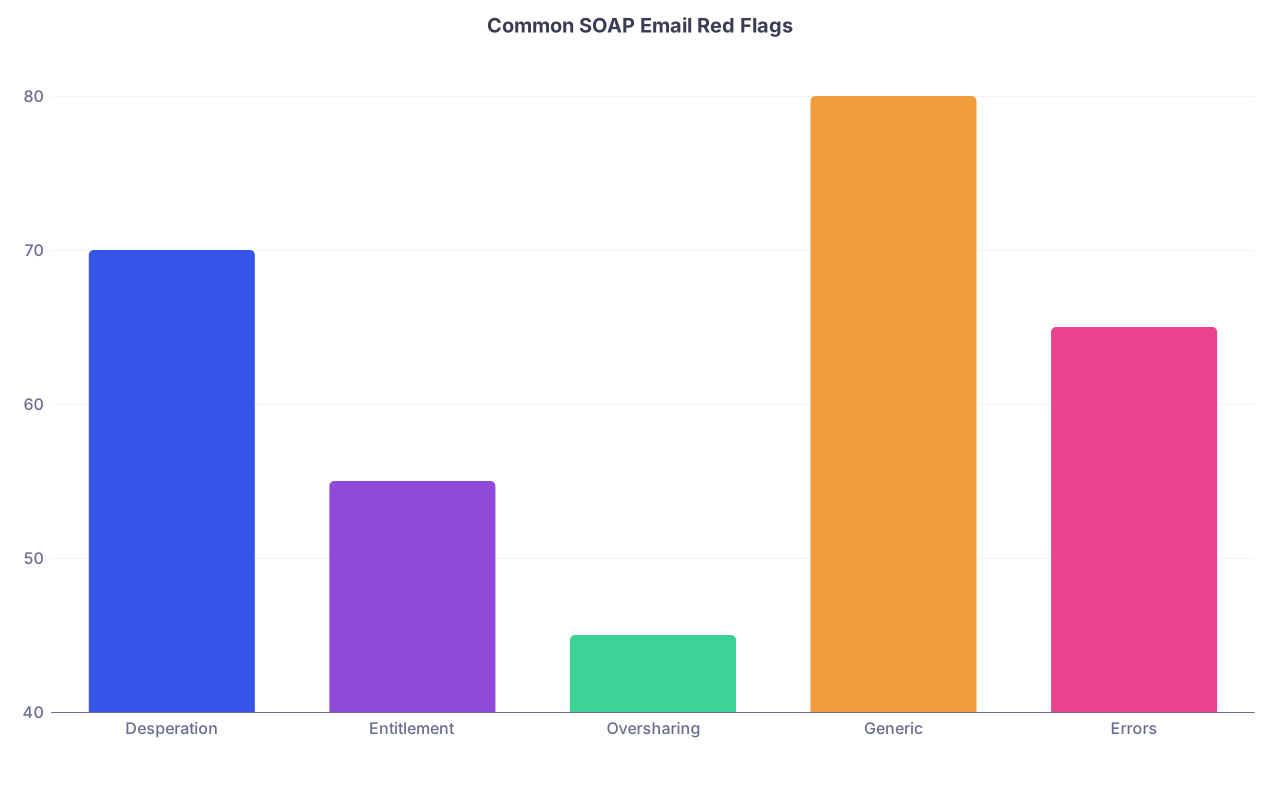
| Category | Value |
|---|---|
| Desperation | 70 |
| Entitlement | 55 |
| Oversharing | 45 |
| Generic | 80 |
| Errors | 65 |
Language That Makes You Sound Generic, Lazy, or Mass-Sent
PDs are reading dozens, sometimes hundreds, of emails in a tight window. They develop radar for copy-paste nonsense.
7. “Dear Program Director,” with zero specifics
If your salutation is “Dear Program Director,” and the rest of the email could be sent to any program in ERAS without changing a word, you’ve already lost ground.
Yes, you may not know the PD’s name. That’s fine. But you need at least:
- The program name
- The specialty
- One or two real details that show you know where you’re applying
Worst offender:
- “Dear Program Director, I am very interested in your outstanding residency and believe it aligns with my goals.”
That line or some variation is in half the SOAP inbox.
Better:
- “Dear Program Director, I am writing to express my interest in the [Program Name] Internal Medicine residency.”
Then immediately follow with something specific and real.
8. Overused buzzwords with no substance
These words are not inherently bad. But if your email is 80% “passionate, hardworking, team player, leader, dedicated, compassionate” and 0% specifics, you sound like everyone else.
Problem phrases:
- “I am a passionate and dedicated medical graduate.”
- “I am a strong team player and excellent communicator.”
- “I have always wanted to be a doctor since I was young.”
PDs skim and think: “So does everyone else. Next.”
Fix it with one sentence:
- Replace generic adjectives with short, concrete examples.
Compare:
- Weak: “I am a strong team player.”
- Stronger: “In my medicine sub-I, my senior resident commented on my reliability with cross-cover notes and follow-up calls, which built my confidence as a team member.”
One sentence with a real scenario beats five adjectives.

Tone Problems: Too Casual, Too Aggressive, or Too Familiar
Your tone is half the message. Many applicants blow this without realizing.
9. Overly casual language and texting style
You’re not emailing a friend. You’re asking to be hired.
Things that look terrible:
- “Hi there,” / “Hey!” / “Hello!” with no name.
- Missing capitalization or punctuation.
- Abbreviations like “u,” “btw,” “thx,” “pls.”
- Emojis. Any emoji. Yes, even “🙂”.
This sounds obvious, but I’ve seen SMS-level writing go into SOAP emails word-for-word from phones.
If you must email from your phone, at least:
- Reread once for caps and punctuation.
- Delete “Sent from my iPhone” and definitely delete anything like “Sorry for any typos—on mobile.” That just advertises carelessness.
Better:
- “Dear Program Director,” with full sentences, proper capitalization, and no texting slang.
10. Aggressive or defensive explanations
SOAP is not the place to litigate your past or argue with the system.
Phrases that scream “problem applicant”:
- “Despite being unfairly failed by my attending…”
- “I believe my school did not support me adequately…”
- “My previous failures do not reflect my true abilities and were due to [long list of factors].”
- “I would like to clarify several misunderstandings in my MSPE.”
When you sound combative or defensive in a short email, PDs imagine what you’ll be like when someone critiques your note or gives you a marginal evaluation.
Better:
- “I faced some challenges earlier in my training, including [very brief phrase], but I’ve worked hard to address them and have since [concrete improvement].”
You take responsibility, show growth, then move on.
11. Over-familiar flattery
No, you’re not “honored and humbled” to email them. Not in SOAP. They know this is a mass outreach season for you.
Cringeworthy lines:
- “It would be my greatest honor to serve under your leadership.”
- “I have always dreamed of training at your prestigious institution.”
- “Your program is world-renowned and I am truly humbled to contact you.”
This kind of flattery is especially off-putting if your email clearly went to twenty programs in the same hour.
Better:
- “I am particularly interested in your program’s focus on [X], and I would be grateful for the opportunity to be considered.”
Respectful, not obsequious.
| Situation | Avoid This Phrase | Use This Instead |
|---|---|---|
| Explaining urgency | "This is my last hope." | "I would be grateful to be considered." |
| Describing willingness to work | "I will do anything." | "I am prepared to work hard and contribute." |
| Stating fit | "I am a perfect fit for your program." | "Your focus on X aligns with my experience in Y." |
| Addressing past struggles | "I was treated unfairly by my school." | "I faced challenges but have since improved by Z." |
| Expressing interest | "Your prestigious, world-renowned program." | "I am interested in your [specific track/feature]." |
Structural Mistakes: How You Package the Email Matters
The content might be decent, but the way you structure it can still turn PDs off in seconds.
12. The wall-of-text paragraph
Many SOAP emails arrive as one giant, unbroken block of text. Eight to ten lines, no spacing, no structure.
That tells PDs:
- You didn’t respect their time.
- You probably don’t write clear notes either.
- Skimming you will be painful.
In SOAP, pain = delete.
Your email should be:
- 3–5 short paragraphs, 2–3 sentences each.
- Easy to skim on a laptop screen or phone.
A clean structure:
- Short intro + who you are.
- One paragraph on your connection to the specialty/program + key strengths.
- One sentence acknowledging any big red flag (if needed) with how you’ve improved.
- Polite closing with contact info.
13. Attachments without explanation or relevance
Do not attach:
- Unlabeled PDFs with “updated CV FINAL FINAL.pdf”.
- Extra letters of recommendation nobody asked for.
- Ten research abstracts in separate files.
If you attach anything, it should almost always be:
- Your updated CV, clearly named: “LastName_FirstName_CV.pdf”.
- Maybe an updated USMLE transcript if something changed dramatically.
And then you reference it once:
- “I have attached my updated CV for your convenience.”
No more, no less. Let them look if they want.
14. Bloated signature or missing basics
Two opposite extremes both look bad:
- No signature beyond your first name.
- A five-line inspirational quote, ten social media links, and three logos.
Your SOAP email signature should be boring and complete:
- Full name
- Degree (e.g., MD, DO, MBBS)
- Medical school and graduation year
- Email, phone number
- ERAS AAMC ID (if applicable)
That’s it. Anything more is noise.

| Step | Description |
|---|---|
| Step 1 | Draft core email |
| Step 2 | Remove red flag phrases |
| Step 3 | Add program specific details |
| Step 4 | Check tone and length |
| Step 5 | Proofread for errors |
| Step 6 | Send to selected programs |
The Silent Killers: Typos, Copy-Paste Fails, and Bad Timing
Sometimes it’s not what you say, but what your sloppiness says about you.
15. Copy-paste name and program mistakes
Nothing screams “mass email” like:
- “Dear Dr. Smith,” in an email to Dr. Patel.
- “I am very interested in the Family Medicine program,” sent to an Internal Medicine program.
- Mentioning the wrong hospital or city.
PDs notice. And they do not feel forgiving in SOAP.
This is where people blow it at 2 a.m. after their 37th email.
Avoid this by:
- Creating a base template.
- Customizing:
- Program name
- Specialty
- One specific detail
- Then double-checking those THREE ITEMS before sending.
If you only proofread anything, proofread:
- The salutation,
- The specialty mentioned,
- The program/hospital name.
16. Sloppy spelling and grammar
No one demands a Pulitzer Prize. But glaring errors signal either:
- Lack of attention to detail.
- Rushing without care.
- Weak communication skills.
All red flags for a resident.
Common killers:
- “Residancy” / “residency programme” in US-based programs (unless that’s your normal spelling and consistent).
- Mixing up “Internal Medicine” and “Internal Medecine.”
- Sentences like: “I am interested your program and think can be asset.”
Run your text through a spell-checker. Read it out loud once. If that’s “too much work,” you’re telling them everything they need to know.
17. Repeated follow-up emails in a short span
One polite follow-up after a reasonable time can be fine. But in SOAP, time is compressed, and some people panic.
The worst behavior:
- Email at 9:00 a.m.
- Follow up at 11:00 a.m.
- Another at 3:00 p.m. “just checking if you received my previous emails…”
You move from “persistent” to “needy and intrusive” very fast.
Guideline:
- In SOAP, one initial email.
- If ABSOLUTELY necessary, one brief follow-up the next day or so.
- Then stop. No guilt-tripping about “I hope I’m not being overlooked.”
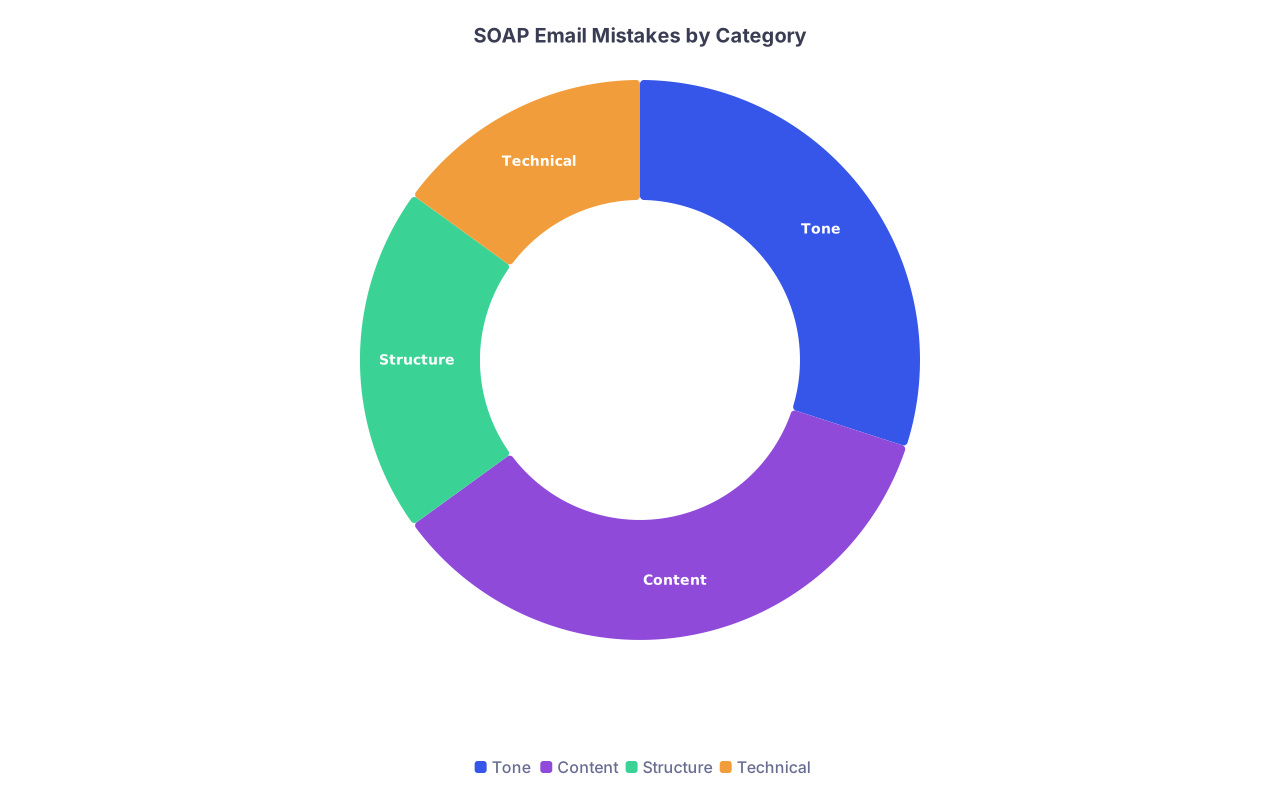
| Category | Value |
|---|---|
| Tone | 30 |
| Content | 35 |
| Structure | 20 |
| Technical | 15 |
A Simple, Safe SOAP Email Skeleton (Without the Landmines)
To make this concrete, here’s a stripped-down structure that avoids most fatal errors. Do NOT copy it verbatim; adapt in your own words. But use it as a safety rail.
Intro (2–3 lines):
- Who you are
- What you’re applying to
- Why you’re writing now
Example: “I am an MD graduate from [School, Year], currently participating in SOAP and applying to [Specialty]. I am writing to express my sincere interest in the [Program Name] residency and to request consideration for any available positions.”
Middle (4–6 lines total, in 2 paragraphs):
- One paragraph: key strengths, specific experiences relevant to that specialty/program.
- Optional brief paragraph: concise mention of any big red flag + evidence of improvement.
Example snippet: “During my clinical years, I particularly enjoyed my rotations in [specialty], where I [brief concrete example]. My attendings consistently commented on [one or two specific strengths: reliability, communication, follow-through]. I am especially drawn to your program’s focus on [specific clinic/track/feature].”
“If you must address a concern: “I had some difficulty early in my training, which contributed to [specific outcome, e.g., a lower Step 1 score]. Since then, I have [Step 2 score, strong clerkship evaluations, sub-I performance] that I believe better reflect my current abilities.”
Closing (1–2 lines):
- Gratitude
- Contact info reference
Example: “Thank you very much for your time and consideration. I have attached my updated CV and would be happy to provide any additional information. I can be reached at [phone] or [email].”
Signature with full info.
This won’t win a literature prize. It will not, however, blow up your chances with one careless sentence. That’s the point.

One Last Thing: Your Next SOAP Email Can Still Be Saved
You don’t control the competitiveness of your specialty. You don’t control how many spots are open. You do control whether your email makes you look desperate, entitled, or sloppy.
The biggest mistakes are usually:
- Emotional hostage-taking (“you’re my only hope”).
- Declared perfection without evidence (“I’m a perfect fit”).
- Oversharing and blaming.
- Generic, obviously mass-sent copy.
- Tone that screams “problem” in three sentences.
Your job is not to write a “perfect” email. Your job is to avoid getting instantly filtered into the mental “no” pile.
Do this right now:
Open your SOAP email draft and highlight every sentence that contains “hope,” “perfect fit,” “deserve,” or a long explanation of your struggles. Delete or rewrite those lines so they are factual, specific, and calm. Then check the greeting, the program name, and the specialty one more time before you press send.