The SOAP email that gets read first is almost never the “best written.” It’s the one that fits the program director’s hidden checklist in the first three seconds.
Let me tell you what actually happens on the other side of that inbox.
During SOAP, most program directors and coordinators are drowning. They’re on Zoom with GME, answering texts from the chair, fielding angry calls from the hospital about unfilled night float, and staring at a list of 60–200 emails that all look identical: “Interest in your SOAP position.” Anyone telling you they “carefully review every message” is giving you the brochure version.
They skim. They sort. They click what looks safest and most relevant. Everything else gets pushed to “later” (which usually means never).
Your job is not to write a beautiful email. Your job is to make your email look like the lowest-risk, highest-yield click in that chaos.
Let’s break down how that actually works.
What Program Directors Are Really Doing During SOAP
Here’s the unpolished version.
On Monday, everyone panics because they have unfilled slots. By Tuesday morning, they’re less panicked and more irritated. By Wednesday, they’re exhausted and just want plug-and-play residents who will not create problems.
So when your email appears, here’s what really guides their eyes:
- Can this person legally and practically start here in July?
- Are they at least in the ballpark for our usual standards?
- Do they already understand what this program is and still want it?
- Are they likely to be a professionalism problem?
That’s it. It’s not poetry. It’s risk management.
You’re not competing to be the “best candidate on ERAS.” You’re competing to be the safest and clearest choice in a 30-second screenshot.
And yes—email structure, subject line, timing, and tiny details make the difference between “opened now” and “buried forever.”
The Subject Line: Where Most People Blow It
Most applicants write subject lines like this:
“Interest in SOAP Position”
“SOAP Applicant – Internal Medicine”
“Unmatched Applicant Seeking Opportunity”
These get read last, if at all. I’ve watched PDs scroll right past ten of these in a row.
Here’s what makes a subject line jump out in a SOAP inbox: specificity, relevance, and minimal effort for the reader.
Use the program’s exact name. Use the specialty. Use your status. And, when appropriate, use a hook that matches their pain point.
Something like:
“SOAP – Categorical IM Applicant – US Grad – Step 2 CK 243 – Available July 1”
or
“SOAP – PGY1 Transfer Eligible – FM – Prior US Clinical Experience”
or for prelims:
“SOAP – Prelim Surgery – US MD – Step 1 Pass, Step 2 CK 250 – Strong ICU + OR Evaluations”
Notice the pattern:
- Start with “SOAP” so it’s clearly about the scramble.
- Name the level and specialty they’re filling (categorical IM, FM, prelim surgery).
- Briefly tag your biggest “green flags” (US grad, eligible to start, decent Step scores, prior experience).
You are pre-answering their first mental questions without making them click.
Bad subject lines force work:
- “Dear Program Director” (this is an email, not a letter)
- “Interest in your program” (too generic)
- “SOAP Applicant” (useless—so is everyone emailing them)
If a coordinator is sorting 100+ emails, which subject line do you think they click first?
The one that looks like: “This is likely someone we can actually put into this open slot without headaches.”
Timing: The Quiet Advantage Nobody Talks About
Here’s the dirty truth about SOAP timing.
Program directors and coordinators are most engaged with email:
- Right after the SOAP list releases
- Right after they finish their quick ERAS filter
- In short bursts between internal meetings and ranking discussions
I’ve watched this in real time. There’s a flurry of clicking in the first 60–90 minutes after applicants appear in ERAS. Then attention fragments.
If your email hits their inbox:
- Before they can even see you in ERAS → usually ignored or buried by the time they’re actually screening
- Twelve hours later → they’ve probably already created a “short list” and are now just filling in backups
The sweet spot?
Within 1–2 hours after they can actually see your application in ERAS and have started browsing.
And yes, they notice timestamps. Not consciously as “this person is punctual,” but practically: emails that appear while they’re actively at the computer get read more. Emails that arrive at 11:57 PM often get swept into the “later pile,” which often means “never.”
Do not mass-blast at random times. You want your message landing while they’re actually working the SOAP problem.
The Sender Line: Name, School, And What It Signals
You probably think the “From” field doesn’t matter. It does.
When a PD’s Gmail or institutional Outlook previews an inbox, they see three things at a glance:
- Sender name
- Subject line
- First 1–2 lines of the message
If your sender name shows up as “jdoe123” or “John,” you’ve already shaved off 5% of your chances. Nobody wants to decode who you are.
Set it to:
“First Last, MD Candidate” or “First Last, DO” or simply “First Last.”
Why? Because when they see:
From: Sarah Patel, MD
Subject: SOAP – Categorical IM Applicant – US Grad – CK 241 – Available July 1
That looks like a real, organized person. Not noise.
Little things like this do not get you the spot. But they get you opened first. And in SOAP, getting opened first is half the battle.
The First Two Lines: Hidden Preview Real Estate
This is the part almost nobody leverages. Those first two lines that show up in the inbox preview before they even click.
Program directors see something like:
From: John Smith
Subject: SOAP – Prelim IM – US MD – CK 235 – Available July 1
Preview: Dear Program Director, My name is John Smith and I am writing to express my…
By the third time they see that same boring first line, their brain tunes out.
Now compare:
Preview: US MD, graduated 2024, SOAP-eligible for Categorical IM. On your ERAS list as…
Instant relevance. You’re saving them time. You’re telling them: “You don’t need to dig through ERAS first. I’m what you’re looking for.”
Your opening line should not be a Victorian letter greeting. It should be a fast, clean identifier.
For example:
“US MD 2024 graduate, SOAP-eligible for Categorical Internal Medicine, with strong inpatient evaluations and full July availability.”
Then you can say “Dear Dr. ___ and Selection Committee,” etc. But hook them in the preview first.
What Content Actually Gets Skimmed (And What Gets Ignored)
Let me be blunt: nobody in SOAP is reading your full personal narrative in that email. They skim for key data points to decide if you’re worth pulling up on ERAS or inviting to a quick phone/Zoom.
Here’s what PDs and coordinators actually look for when they skim the body:
- Are you eligible (visa, graduation year, passed Step exams, can start July)?
- Are you within a reasonable academic range for this program?
- Do you seem to understand what type of program this is?
- Do you sound like a grown-up or like a train wreck?
That’s it.
So your email should be structured almost like a stripped-down one-page CV around those questions. Short, direct, easy to mine for data.
Something like:
- One tight identifier sentence (who you are, what you want, that you’re SOAP-eligible and see them on your list).
- 2–3 short, clean sentences pulling out your strongest match-aligned features (US grad/IMG with USCE, Step 2 CK xx, relevant rotations, language skills if useful).
- 1–2 sentences showing you know who they are and why you’d fit (geography, community, type of training, size, specific feature that matters).
- One sentence: “I’m happy to speak anytime at [phone] and respond quickly by email/text.”
Most of you write five paragraphs when three targeted, dense paragraphs outperform.
The worst offender? Copy-paste “I have always been passionate about internal medicine…” ramble that could be sent to any of 150 programs. PDs have a supernatural sense for generic fluff. They tune it out.
Hidden Preferences You Don’t See in Any Official Advice
This is what program people won’t say out loud at pre-med panels.
1. They Prefer People Who Look Easy to Onboard
They’re not just looking for “good.” They’re looking for “plug-and-play.” During SOAP they’re mentally asking:
- Do I need to fight with GME or legal to onboard this person?
- Are there visa or licensing issues?
- Are they an older grad with complications?
If you’re an IMG who already has ECFMG certification, say it clearly. If you don’t need visa sponsorship, say it clearly. If you’re licensed somewhere already, that is gold—include it.
Those phrases move you up the mental queue faster than “enthusiastic” and “passionate” ever will.
2. Geography and Ties Matter More Than You Think
Program directors are sick of getting burned by SOAP residents who show up miserable because they never wanted to be in that city.
If you have any real tie to the area—family, med school, undergrad, grew up there, spouse’s job—put that high in the email. Not buried in paragraph four.
“I grew up in Ohio and completed undergrad at OSU; I’m eager to train and remain in the Midwest long term.”
That signals: less flight risk, less attitude, more likely to stick for all years.
3. They’re Biased Toward People Who Sound Stable
Nobody says this in the brochure, but I’ve heard PDs say variations of this under their breath:
- “I don’t want another drama case.”
- “I need someone who will show up and do the work, not collapse.”
Your email tone matters. If you overshare about unmatched trauma, unfairness, or bitterness, they get spooked.
You can acknowledge being unmatched once, neutrally. Then pivot to what you did since: research, a prelim year, extra rotations, Step 2 improvement, etc. That’s what they want to see—recovery, not victimhood.
The ERAS–Email Connection: Why Some Get Called Even With A Mediocre Email
One more behind-the-scenes point: the email rarely lives alone.
Coordinators often do this:
- Run a quick ERAS filter (US MD/DO first, then IMG with certain thresholds).
- Open the “short list” in ERAS.
- Glance at emails only from that pool.
So your primary job is still to be filter-friendly on ERAS: updated Step 2 CK, clean photo, concise experiences. But the email determines order and urgency.
I’ve seen PDs say: “This one emailed me specifically and mentioned our county hospital. Let’s call them first.” Another applicant with similar stats but a generic email got reviewed later in the day—after several interview spots were already filled.
In SOAP, time is a resource. The email that makes their life easier gets used to plug the gap sooner.
A Simple Anatomy Of A High-Yield SOAP Email
Here’s a concrete example that hits the real preferences. Don’t copy this verbatim—programs can smell templates—but use the structure.
Subject:
SOAP – Categorical IM Applicant – US DO 2024 – CK 241 – Available July 1
Body (condensed):
US DO 2024 graduate, SOAP-eligible for Categorical Internal Medicine, currently listed with your program in ERAS.
I’m very interested in training at [Program Name] because of your strong inpatient volume at [Hospital Name] and exposure to underserved patients in [region]. I completed my core IM rotations at [Hospital/System], with strong evaluations in ward and night float settings. My Step 2 CK is 241, and I have passed all COMLEX and USMLE Step 1 equivalents on the first attempt.
I have family in [City/Region] and plan to remain in this area long term. I do not require visa sponsorship and can start on July 1. My ERAS application includes recent letters from inpatient IM faculty and a sub-I at [similar hospital type].
I’d be grateful for consideration for any SOAP interview opportunities. I’m available immediately by phone at [xxx-xxx-xxxx] or email and can respond quickly to any requests.
Sincerely,
[Name], DO
AAMC ID: XXXXXXX
Short. Dense. Easy to mine for answers. That gets read before someone who spent 700 words on their “journey to medicine.”
A Quick Reality Check: What You Can’t Control
You can do everything right and still get ignored because:
- They already filled the slot from an internal candidate or prelim.
- Their chair insists on US MD only.
- Their GME office blocks certain visa categories.
- Your grad year is too old for their policy.
That’s not your fault. But if your emails are generic, slow, and fluffy, then the part that is your fault will bury you.
Your aim is simple:
When that overworked PD or coordinator looks at their inbox, your subject line, preview, and first sentences should scream:
“I’m ready. I’m realistic. I know who you are. You can probably say yes to me without a fight.”
Those are the SOAP emails that get read first. And in this game, “first” very often becomes “yes.”
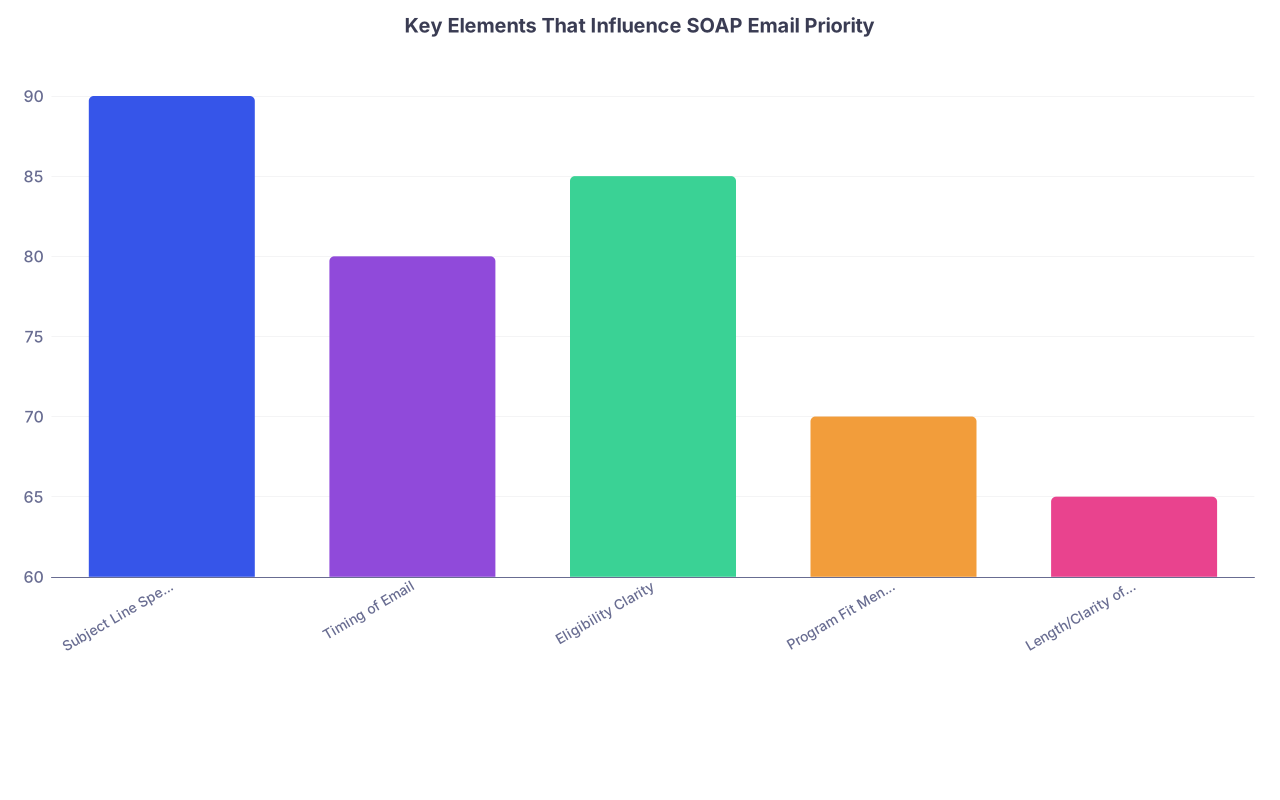
| Category | Value |
|---|---|
| Subject Line Specificity | 90 |
| Timing of Email | 80 |
| Eligibility Clarity | 85 |
| Program Fit Mentioned | 70 |
| Length/Clarity of Message | 65 |
Comparing Weak vs Strong SOAP Emails
Let’s be blunt and contrast what PDs actually see.
| Feature | Weak SOAP Email | Strong SOAP Email |
|---|---|---|
| Subject line | “SOAP Applicant” | “SOAP – Categorical IM – US MD 2024 – CK 238” |
| First line preview | “Dear Program Director, my name is…” | “US MD 2024, SOAP-eligible for Categorical IM…” |
| Eligibility clarity | Buried or missing | Stated within first 1–2 sentences |
| Program-specific fit | Generic “your esteemed program” | Names city, hospital type, or specific program fit |
| Length & density | 5–7 long paragraphs, narrative heavy | 2–3 short paragraphs, data-dense |
Guess which one gets opened during a chaotic afternoon SOAP session.

| Step | Description |
|---|---|
| Step 1 | New SOAP Emails Arrive |
| Step 2 | Open Now |
| Step 3 | Open Later |
| Step 4 | Skim Quickly or Skip |
| Step 5 | Flag for PD Review |
| Step 6 | Archive |
| Step 7 | Offer Interview |
| Step 8 | Hold as Backup |
| Step 9 | Coordinator Sorting |
| Step 10 | Meets Basic Criteria |
| Step 11 | Time Available |

FAQ: SOAP Email Secrets
1. Should I email every program on my SOAP list or only my top choices?
Email the programs where you’re at least reasonably aligned with their usual profile: geography, type (community vs academic), and competitiveness. Blasting everyone with the same generic note just dilutes your effort and annoys people. Targeted, tailored emails to 15–30 realistic options beat a copied paragraph sent to 70.
2. Is it okay to mention my Step failures or red flags in the email?
Do not lead with your wounds. The email is not the place to litigate your history. Acknowledge major issues only if they directly affect eligibility (“I have since passed Step 2 CK and am fully ECFMG certified”). Let the ERAS application and interview handle the nuance. The email’s job is to get you in the door, not confess everything.
3. Can I reuse the same SOAP email for multiple programs?
You can reuse a core skeleton, but you should customize: program name, city/region, and at least one reason you fit that program (county hospital, community focus, specific population, etc.). Programs absolutely notice when you send the same bland paragraph to everyone. Those read like spam and slide to the bottom of the stack.
4. How long is too long for a SOAP email?
If your email spills past about 250–300 words, you’re probably wasting space. Three tight, well-constructed paragraphs beat a saga. During SOAP, nobody is reading your life story in an email window. They’re scanning for: who you are, whether they can actually hire you, and why you want them. Anything beyond that is self-indulgence.
Years from now, you will not remember every word you typed in a cramped apartment during SOAP week. You will remember whether you acted like someone waiting to be rescued, or like a colleague stepping up to solve a problem for a stressed program director. Write your emails like the second person. That’s who gets read first.