
What happens when a program director reads the exact same SOAP message you just sent to five other programs?
Let me be blunt: they usually toss it.
In the Supplemental Offer and Acceptance Program (SOAP), copy‑paste messages might feel efficient. They feel “safe.” You send the same polished paragraph about your “strong interest in your program” to 30 places and hope something sticks.
This is how people quietly kill their chances during the most desperate week of their medical career.
SOAP is where programs are drowning in applicants and have almost no time. A generic, obviously recycled message is not neutral; it is a red flag. It screams three things:
- You did not care enough to look at us.
- You do not really want to be here.
- You are just spamming every open position.
And once you look like spam in SOAP, you are done.
Let’s walk through the most common SOAP messaging mistakes, why copy‑paste backfires so badly, and how to write short, targeted messages that actually help you instead of hurting you.
The Ugly Reality of SOAP Messaging That Students Misjudge
Here is the mistake: you assume SOAP messages are read the way personal statements are read. They are not.
During SOAP:
- Programs are scrambling to fill spots.
- PDs and coordinators are skimming, not studying.
- Many programs receive hundreds of applications within hours.
- They need fast filters: board scores, school, geography, and yes—signals of genuine interest.
Copy‑paste messages fail as a signal.
I have seen this in real time: a PD opens ERAS, reads three messages in a row that all say “I am extremely interested in your esteemed program” with zero program‑specific details, and then stops even clicking the “Messages” tab. Too much fluff. No signal.
The assumption that “any message is better than no message” is wrong. A bad message—especially a lazy one—can actively damage you.
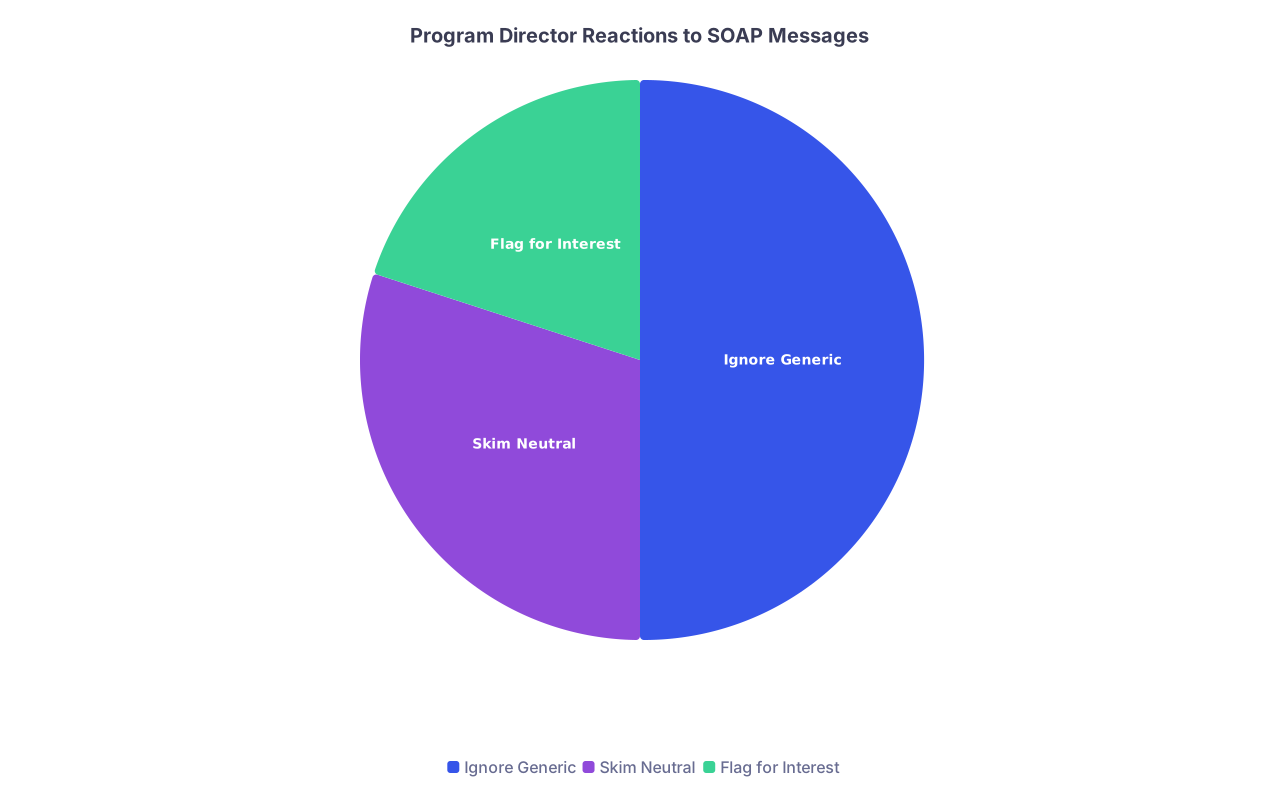
| Category | Value |
|---|---|
| Ignore Generic | 50 |
| Skim Neutral | 30 |
| Flag for Interest | 20 |
Half of generic messages are ignored outright. You cannot afford to be in that pile.
The Biggest Copy‑Paste SOAP Message Mistakes
Let’s get specific. These are the errors I see every year.
1. Sending the Same Paragraph to Every Program
The classic disaster:
“I am very interested in your esteemed Internal Medicine residency program. I believe my strong work ethic, passion for patient care, and commitment to lifelong learning make me an excellent fit for your institution. I would be honored to train at your program.”
Looks fine on your screen. Dies in the wild.
Why it backfires:
- Zero program‑specific detail. Could be sent to anywhere from a community program in Ohio to a university program in California.
- Reads like ChatGPT circa 2022 or a recycled personal statement line.
- Everyone else is writing the same thing. There is nothing memorable here.
Programs are not naïve. They can spot template language instantly. When they see the same paragraph from multiple applicants, it blurs into noise.
2. Copy‑Pasting and Forgetting to Change the Program Name
This is fatal.
“Dear [Program Director Name], I am very interested in the Family Medicine Program at Mercy Hospital of Buffalo” … sent to a program in Texas.
I have watched faculty literally screenshot these and send them to the group chat. Not in a good way.
Consequence: You look careless, inattentive, and not truly interested. In SOAP, where there may be 100+ qualified applicants for a handful of unfilled spots, that is enough to push you off the list.
3. Overly Long, Emotional “Life Story” Messages
SOAP week is a crisis for you. It is not a therapy session for the program.
Copy‑pasted paragraphs about how devastated you are, how hard you worked, and how much you “deserve a chance to prove yourself” get skimmed at best, eye‑rolled at worst.
Common offenders:
- “Ever since I was a child, I dreamed of becoming a physician…”
- “This week has been very emotionally difficult, but I remain hopeful…”
- “I know my scores are not the strongest, but if you just gave me one chance…”
Programs have pity for you as a human, but their job is not to rescue you personally. Their job is to fill residency positions with people who will safely care for patients, work well in their system, and not implode under stress.
Your message must show that, not just your emotional state.
4. Generic Strengths With No Evidence
Another copy‑paste classic:
- “I am a hard worker.”
- “I am a team player.”
- “I have strong communication skills.”
- “I am passionate about your specialty.”
Everyone says this. None of it differentiates you. And when a PD sees this same wording 30 times, it stops meaning anything.
If you paste these cliché lines across all messages, you look unoriginal and unself‑aware.
5. Ignoring Fit: Sending the Same Message Across Different Specialties
I have seen applicants in SOAP applying to:
- Categorical Internal Medicine
- Preliminary Surgery
- Transitional Year
- Family Medicine
All with almost the exact same message about their “strong commitment to Internal Medicine as a career.” Sent to a TY. Or a surgery prelim.
Programs do not like being obviously Plan D. They especially do not like feeling like you are lying to them about your goals.
Copy‑pasting across specialties exposes that quickly.
What Program Directors Actually Look For in SOAP Messages
You do not need poetry. You need clarity and proof you thought about them.
Most PDs and coordinators scanning SOAP messages are looking for a few things:
- Do you understand what this program actually is? (Community vs academic, specialty, location, size.)
- Are you geographically realistic? (Do you have a tie or at least a plausible reason to be in this area?)
- Do you have any specific connection to this program or institution?
- Do you acknowledge any obvious red flag briefly and maturely, without drama?
- Do you sound like someone who will show up, work hard, and not cause chaos?
That is it. They do not need your autobiography. They need a two‑thirds‑of-a‑screen‑length proof of life.

A Better Framework: Short, Targeted, and Real
You cannot fully individualize 40 messages in SOAP. You also cannot copy‑paste blindly. The answer is a hybrid.
Think: customizable template with required specific edits for each program.
Here is a structure that works and does not sound obviously generated or generic.
1. Subject / Opening Line That Signals You Know Where You Are Applying
Bad: “To whom it may concern, I am very interested in your program.”
Better:
“Dear Dr. Patel and the [University of Louisville Internal Medicine] Residency Team,”
or, if you do not know the PD name:
“Dear [XYZ Medical Center Family Medicine Residency Program],”
You at least prove you know the program name and specialty.
2. One Sentence on Who You Are
One or two concise facts. Not your whole CV.
“I am a 2024 graduate of Ross University with strong clinical evaluations, currently participating in SOAP for Internal Medicine positions.”
Clear. Contextual. Honest.
3. Two Sentences on Why This Program
This is where copy‑paste kills you when you skip it.
You need something real. Not fake flattery pulled from every website.
Examples of usable specifics:
- Location/ties: “I grew up in Ohio and my family is in Cleveland, so I am committed to staying in this region long-term.”
- Program features: “Your strong emphasis on outpatient continuity clinic and serving a diverse immigrant population aligns with my prior work in community health.”
- Training structure: “The 3+1 scheduling model you use fits the way I learn and allows me to focus fully on each rotation.”
Notice the pattern: specific, plausible, grounded in reality.
4. One Sentence on Your Value or Differentiator
This is where people dump buzzwords. Do not.
Give 1–2 concrete strengths relevant to residency:
“My evaluations consistently highlight reliability, strong work ethic, and calm performance during high‑acuity situations such as night float and ICU.”
or
“I have extensive hands-on experience in underserved settings and am comfortable managing complex, resource-limited patients.”
Evidence, not adjectives.
5. Brief Acknowledgment of Red Flag (If Necessary)
If you have a major issue—Step failure, gap year, previous non‑match—you can briefly show insight without whining.
Wrong:
“I know my Step 1 failure may make you doubt me, but I have grown so much from this and deserve a chance.”
Better:
“While I had an early Step 1 failure, I passed on my second attempt and improved to a 241 on Step 2, which better reflects my current knowledge and work habits.”
Own it, show improvement, move on.
6. Close With Clear, Simple Interest
No begging. No drama.
“I would be grateful for consideration and would be excited to train at your program. Thank you for your time.”
Done.
How to Avoid the Copy‑Paste Trap Without Burning All Your Time
You are exhausted in SOAP week. You do not have 45 minutes per message. So you need a system.
Here is a realistic approach that prevents the worst mistakes and keeps your messages credible.
Build a Base Template—But With Required Blanks
Write one core template, but force yourself to fill in key program‑specific parts.
For example:
Dear [Program / PD Name],
I am a [year] graduate of [school], currently participating in SOAP for [specialty] positions.
I am particularly interested in your program because [specific reason 1 related to program], and [specific reason 2 related to geography / training / mission].
I believe I would fit well with your residency based on [1–2 concrete strengths or experiences]. [Optional 1 sentence about improvement if you have a major red flag].
I would be grateful for your consideration and would be excited to train at [program name].
Sincerely,
[Name, AAMC ID, contact info]
Those bracketed sections must be different for each program. If you copy‑paste the whole thing and only change the greeting, you are back in spam territory.
| Component | Reuse Across Programs | Customize for Each Program |
|---|---|---|
| Your basic intro (school/year) | Yes | No |
| Program / PD name | No | Yes |
| Specialty wording | Mostly | Yes for mixed specialties |
| Program-specific reasons | No | Yes |
| Geographic ties | Sometimes | Yes when relevant |
| Red flag explanation line | Yes | Only minor tweaks |
Keep a Quick‑Reference Sheet Open
Before SOAP starts, make a one‑page document with:
- List of regions where you have ties (family, med school, undergrad, partner).
- A few concrete experiences you can plug in (community clinic, research in X, leadership in Y).
- Short, prewritten one‑liners about your main strengths based on evals.
Then, when you write messages, you can plug in accurate, specific lines quickly without reinventing the wheel.
Spend 2–3 Minutes Per Program, Not 20
You are not writing a grant proposal. You are signaling.
A realistic workflow:
- Open program’s overview or website for 30–60 seconds.
- Identify one or two real things: location, clinic type, schedule model, mission statement you actually align with.
- Insert into your template.
- Double‑check program name and specialty before sending. Slowly.
If you are sending 40+ applications, that is still brutal. But it is manageable. And it keeps you out of the “obvious mass‑spam” bucket.
Hidden SOAP Messaging Traps People Forget About
There are a few more ways candidates sabotage themselves that are not just about copy‑pasting text.
Overusing AI‑Generated Sounding Language
Programs are not stupid. When your message reads like a PR press release—“unwavering dedication to compassionate, patient‑centered care”—it smells artificial.
One or two polished phrases are fine. A wall of sterile, generic buzzwords looks like you did exactly what you are thinking about doing right now: pasted something from an AI or from a friend.
You want clean, human, slightly imperfect language. Not a brochure.
Inconsistent Goals Across Messages
If one program sees you say, “I am fully committed to a career in Family Medicine” and another program in IM sees “I am fully committed to Internal Medicine,” you better hope no one is cross‑reading.
In SOAP, it happens less than in the main match, but it still happens. Faculty talk. Advisors compare notes. People forward messages.
You can be flexible without lying:
“I am pursuing Internal Medicine positions but am also strongly interested in categorical Family Medicine programs given my commitment to primary care.”
Honest. Flexible. Not contradictory.
Time‑Stamp Chaos: Sending Messages Too Late
Do not wait until Thursday afternoon to start sending thoughtful messages. Program lists and shortlists often form frighteningly early in SOAP.
You want your messages in while PDs and coordinators are still building their “maybe” pile.
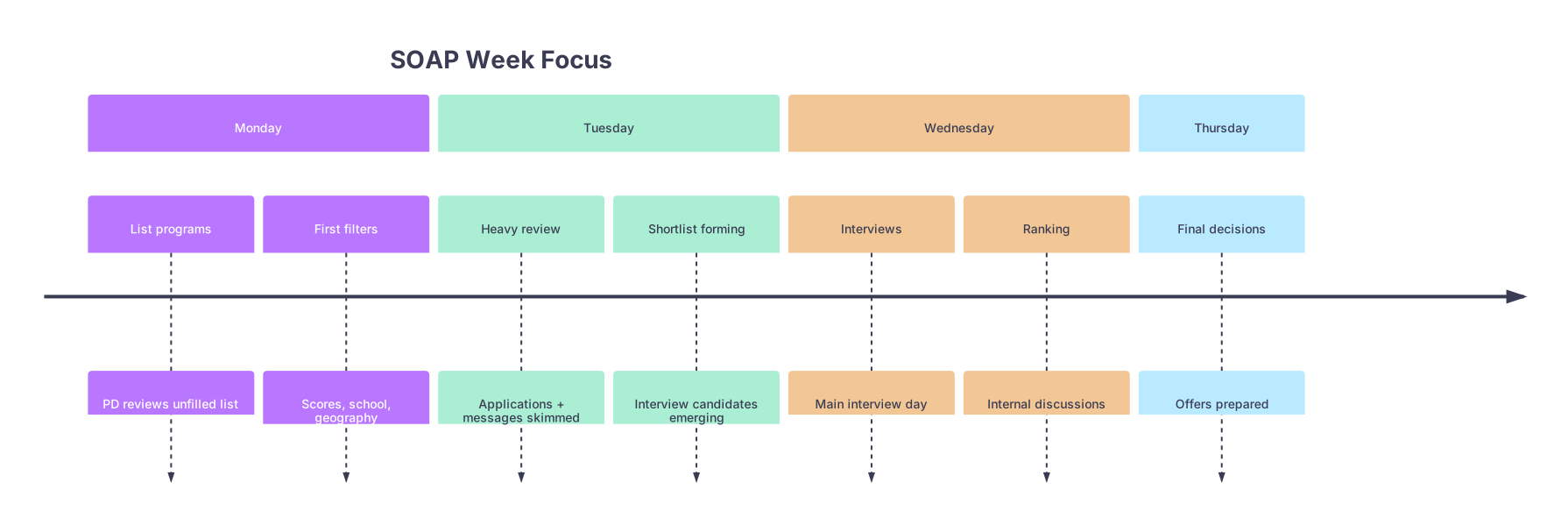
| Period | Event |
|---|---|
| Monday - List programs | PD reviews unfilled list |
| Monday - First filters | Scores, school, geography |
| Tuesday - Heavy review | Applications + messages skimmed |
| Tuesday - Shortlist forming | Interview candidates emerging |
| Wednesday - Interviews | Main interview day |
| Wednesday - Ranking | Internal discussions |
| Thursday - Final decisions | Offers prepared |
If you send your first thoughtful message Wednesday night, you are basically whispering at a closed door.
Concrete Examples: Bad vs Better SOAP Messages
Let us fix one.
Bad (Copy‑Paste, Generic)
Dear Program Director,
I am writing to express my sincere interest in your esteemed Internal Medicine residency program. I am a hardworking and dedicated medical graduate who is passionate about patient care and lifelong learning. I know that I would be an excellent fit for your program and I would be honored to have the opportunity to train with you.
Sincerely,
A. Applicant
You could send that to 150 programs. Which is exactly the problem.
Better (Short, Targeted, Reusable Core)
Dear Dr. Nguyen and the Valley Medical Center Internal Medicine Residency Team,
I am a 2024 graduate of St. George’s University currently participating in SOAP for Internal Medicine positions.
I am particularly interested in your program because of your strong focus on community‑based inpatient training and continuity clinic in a diverse, underserved population. I grew up in the Pacific Northwest and hope to practice in this region long term, so your location and patient population are an excellent fit for my goals.
My clinical evaluations consistently describe me as reliable, hard‑working, and calm on busy inpatient services, including night float and ICU. Although I had an early Step 1 failure, I passed on my second attempt and improved to a 244 on Step 2, which better reflects my current capabilities.
I would be grateful for your consideration and would be excited to train at Valley Medical Center.
Sincerely,
A. Applicant, AAMC #######
Still reusable. But not lazy. Not obviously spam.
Quick Self‑Check Before Sending Any SOAP Message
If you remember nothing else, use this 30‑second filter before you hit send:

Ask yourself:
- If I accidentally sent this to the wrong program, would it still mostly make sense?
If yes, it is too generic. - Is there at least one specific, true thing about this program or location in here?
If no, fix that. - Could I read this out loud to a PD without cringing or sounding desperate?
If no, tone it down. - Did I double‑check the program name, specialty, and PD name (if used)?
If no, you are begging for an avoidable disaster.
Two Things to Remember
- Copy‑paste SOAP messages are not neutral. They brand you as generic, inattentive, or desperate. Programs are drowning in similar messages; yours needs honest, specific signals of fit to avoid the trash pile.
- Short, targeted messages with a reusable core and genuinely customized details will always beat long, emotional, or obviously templated paragraphs. You do not need perfection. You need clarity, accuracy, and proof that you actually looked at where you are applying.