Faculty advocacy in SOAP is the most underused weapon in the entire Match process.
Everyone obsesses over ERAS, interview season, and rank lists. Then Monday of Match Week hits, you see “We are sorry…” and your brain melts. What most students do not realize is that, behind the scenes, the next 72 hours are a messy phone-and-email war run by faculty, PDs, and coordinators. And some students have people fighting for them. Others do not.
Let me walk you through what really happens in SOAP—and how to make sure you’re in the first group.
What Actually Happens Behind the Curtain During SOAP
Forget the official NRMP diagrams for a minute. Here’s what’s really going on in faculty offices.
Monday at 10:59 a.m. Eastern, the list drops. Every school’s deans and student affairs folks see who’s unmatched. There’s a quick huddle. Then the whisper networks light up.
By the time you’ve finished crying in your car, faculty at your school are already doing three things:
- Sorting you into quiet tiers.
- Matching your profile against the unfilled list.
- Deciding who they’ll go to bat for when they start calling and emailing.
If you think this is purely “fair” and “systematic,” you’re naive. It’s political, human, and a little chaotic.
The off-the-record triage
Behind closed doors, the conversation sounds like this:
- “Okay, who is a must-place? Who can absolutely function Day 1?”
- “Who burned bridges? Any professionalism issues?”
- “Who can pivot to prelim IM or TY without imploding?”
They’re not just looking at your CV. They’re remembering your attitude on rotations, how you handled criticism, whether you freaked out on call, whether you ghosted emails.
Then they quietly sort students into buckets (never written, but very real):
- “We will push hard for them.”
- “We will help if we can.”
- “We’ll sign LORs and that’s it.”
- “We’re not attaching our name to this one.”
That’s the part nobody tells you when they say “We support all our students equally.” They don’t. They never have.
How Faculty Actually Advocate in SOAP
You need to understand the mechanics, or you’ll have no idea where your leverage points are.
There are four main channels where faculty advocacy matters:
- Direct calls and emails to PDs.
- Internal ranking of their own SOAP applicants.
- Real-time feedback on where to apply.
- Damage control for red flags.
Let’s break them down.
1. The “I’ve got a student for you” calls
Program directors are drowning during SOAP. Hundreds of applications flood in for a handful of spots in a matter of hours. PDs don’t have the time—or frankly the patience—to thoroughly read every application.
What cuts through that noise? A familiar name.
A PD will open an email or answer a call if it’s from:
- A former co-resident.
- A PD they’ve served with on a committee.
- A well-known faculty member in the specialty.
- A department chair with a reputation for not wasting people’s time.
Those conversations are short and blunt. I’ve sat in rooms while these calls happen:
“Hey, we’ve got an unmatched applicant. US grad. Decent scores, strong clinically, going for IM but willing to do prelim or TY. No professionalism issues. Interested in your region. Can you take a look if they apply?”
Or:
“She rotated with us, but we’re full. Good worker, zero drama, wants FM. I’d vouch for her. Any chance you’re filling your last spot?”
Is this a guarantee? No. But it moves you from applicant #147 to “the one Dr. X called about.” That’s huge.

| Step | Description |
|---|---|
| Step 1 | Unmatched Student |
| Step 2 | Home Faculty Advocate |
| Step 3 | Call to PD |
| Step 4 | Email to PD |
| Step 5 | Internal Discussion at School |
| Step 6 | PD Reviews Application |
| Step 7 | SOAP Interview |
| Step 8 | No Offer |
| Step 9 | Invite? |
2. Internal ranking: who gets pushed first
Your school may have ten unmatched students and only the bandwidth to actively push three or four. That sounds harsh, but it’s reality.
They’ll look at the unfilled list, then decide:
- “These two are perfect for unfilled FM/IM.”
- “This one is flexible enough for TY/prelim.”
- “This one is going to need a bridge year or research; not competitive right now.”
Those “priority” students get:
- Their PDFs sent directly to programs with a personal note.
- Their names dropped in every call that’s even remotely relevant.
- Real-time messages like, “Apply now to X, they’re looking, I just talked to them.”
The others? Maybe a generic email blast. Maybe just standard advising.
You want to be in the first group. We’ll get to how.
3. Steering you to the right targets
SOAP is not the moment for your dreams. It’s the moment for landing somewhere safe and solid so you can build again.
The smartest faculty advocates are brutally honest on Monday and Tuesday:
- “No, you’re not getting categorical surgery through SOAP. Apply IM, TY, prelim.”
- “Stop aiming for California; you need to apply broadly to the Midwest and South.”
- “Don’t waste an application on that malignant program. Try these instead.”
When they know a PD or have inside info, they’ll say, “Apply to Program Y. I know them—they’ll consider your profile.”
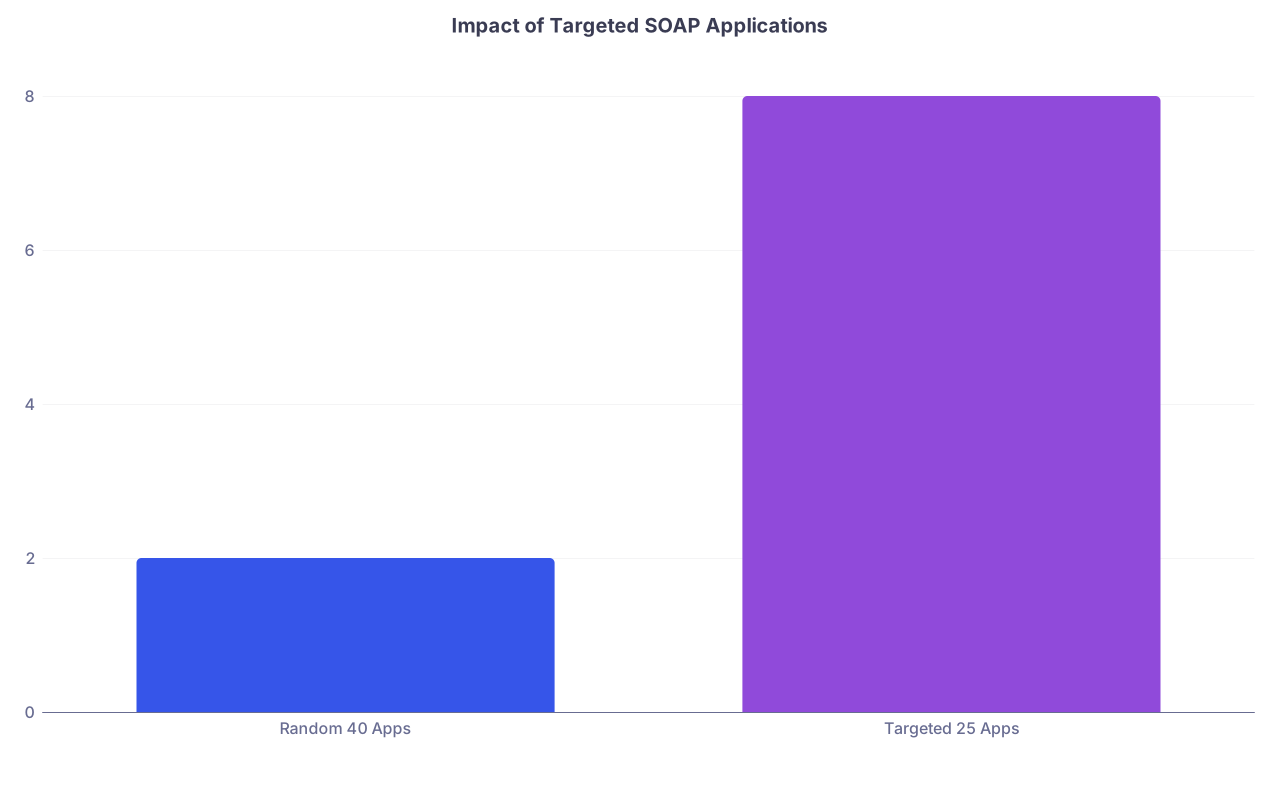
That kind of intel can be the difference between 40 useless applications and 25 carefully targeted ones that actually get read.
| Category | Value |
|---|---|
| Random 40 Apps | 2 |
| Targeted 25 Apps | 8 |
(Those numbers are roughly what I’ve seen: generic broad blasts get a couple of bites; coordinated applications with faculty backing get significantly more.)
4. Quiet damage control
If you’ve got a red flag—Step failure, professionalism note, leave of absence—your faculty advocate can frame it before a PD makes their own assumptions.
Conversations like:
“She had a Step 1 failure second year, family crisis, but she turned it around—Step 2 was 240, she’s been rock solid clinically.”
Or:
“Yes, he had a remediation in surgery, but honestly that was more personality clash with a malignant site director. He’s been excellent since.”
PDs are risk-averse. A trusted voice saying, “This is not a problem student,” matters a lot more than whatever polished sentence you put into your SOAP personal statement.
Who Actually Gets Advocated For (and Who Doesn’t)
Here’s the part that stings: advocacy in SOAP is mostly decided months or years before you ever hit submit on ERAS.
Faculty are human. They remember:
- Who showed up prepared.
- Who was teachable.
- Who treated nurses and staff with respect.
- Who didn’t whine on rounds.
- Who responded like an adult when given critical feedback.
Those students get put on the “I will make calls for you” list.
Then there are the others:
- The student who argued every evaluation.
- The one who was chronically late, then defensive.
- The one who trashed the program on social media.
- The one who ghosted emails about concerns.
Nobody’s going to sabotage them. But very few people will burn capital to place them.

Harsh but true: your reputation is your lifeboat
On Monday of Match Week, your Step score is not what people talk about in closed meetings. They talk about:
- “Can I safely put my name on this person?”
- “Will they embarrass me at that program?”
- “If this blows up, will it come back on our school?”
This is why the consistently professional, low-drama student often gets more help than the brilliant but arrogant one.
How to Set Yourself Up Before SOAP Ever Happens
You don’t plan to SOAP. Nobody does. That’s not an excuse to ignore it.
The students who get the strongest support in SOAP did three things well before Match Week.
1. They cultivated at least one real faculty ally
Not the “they recognize me in the hallway” level. I mean:
- Someone who’s seen you work for more than a day.
- Someone you’ve met with at least a few times.
- Someone who knows your backstory and your goals.
- Someone you didn’t only show up to when you needed a letter.
This might be:
- A clerkship director who liked your work ethic.
- An APD who supervised your sub-I.
- A research mentor who actually saw you follow through.
You want one person who, when your name shows up on the unmatched list, says, “I’ll help them. I know this student.”
2. They didn’t disappear after interview season
Too many students go totally radio-silent between January and March. Then on Monday at 11:05 a.m., they’re frantically emailing people they haven’t talked to in months.
Better approach:
- Periodic, low-key updates to your key faculty: “Just wanted to thank you again for your support, I finished interviews at X, Y, Z and feel good about how things went.”
- Letting them know if there were any concerns (like low interview numbers) before Match week.
Why? Because when they see you’re unmatched, they’ll already know the context and won’t waste time asking, “Wait, what happened?”
3. They showed emotional maturity long before crisis
Faculty remember how you handled setbacks:
- A bad grade.
- A difficult attending.
- A harsh evaluation.
If your pattern was: meltdown, blame, argument, escalation—you’ve already trained them to think you fall apart under pressure.
If instead your pattern was:
- “That hurt, but I get where they’re coming from.”
- “Here’s what I’m doing differently moving forward.”
- “Thank you for advocating for me anyway.”
Then when SOAP comes, they’ll assume you can handle a fast-moving, stressful process—and that if they put their name on you, you won’t blow up at a program.
What To Do The Moment You Don’t Match
Let’s talk about the acute phase. The 24–48 hours where you can massively increase or decrease the help you get.
1. Control your first reaction with faculty
You’re going to feel gutted. Totally normal. But you need to be strategic in who sees what.
Crying in your advisor’s office? Fine. Sobbing uncontrollably on speakerphone with three deans and two coordinators listening? Less fine.
Your initial email or message should look something like:
“I saw the result this morning. I’m devastated, but I’m ready to work on SOAP and do whatever is needed. When can we meet to plan next steps?”
That tells them you’re functional. That matters.
| Approach Type | Example |
|---|---|
| Strong | Brief email requesting meeting, expresses disappointment but readiness to work |
| Neutral | Short message: 'I did not match. What should I do?' |
| Weak | Long, emotional email blaming programs or the system |
2. Get into the “we can fight for you” category fast
When you meet with your dean or advisor Monday:
- Be honest but not self-pitying.
- Own any weaknesses without spiraling.
- Make clear you’re flexible on geography and type of position (categorical vs prelim/TY) if that’s true.
A faculty member is far more likely to call a PD on behalf of someone who says:
“I’m disappointed but I want to be in training this July. I’m open to prelim IM, TY, community programs, and I’ll work my tail off once I’m there.”
Than someone who says:
“I only want categorical neurology in these three cities, and I’m not willing to consider anything else.”
SOAP is not your bargaining phase. It’s your survival phase.
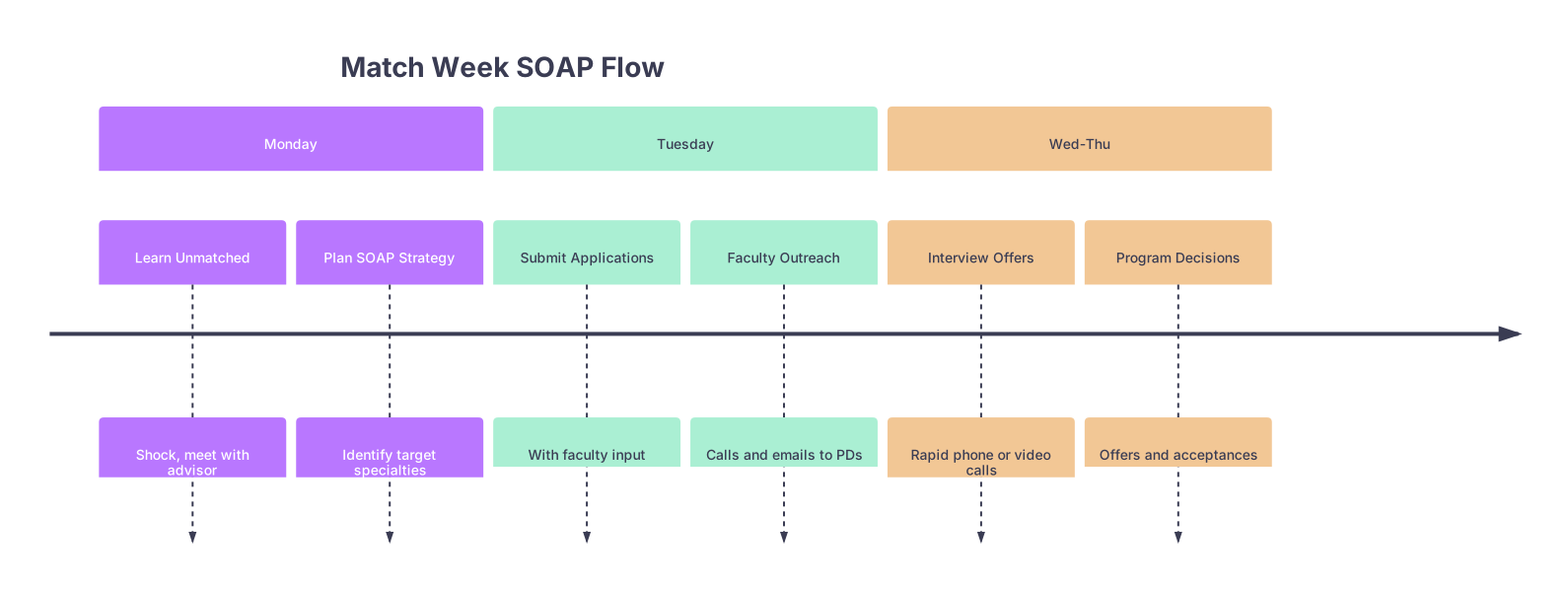
| Period | Event |
|---|---|
| Monday - Learn Unmatched | Shock, meet with advisor |
| Monday - Plan SOAP Strategy | Identify target specialties |
| Tuesday - Submit Applications | With faculty input |
| Tuesday - Faculty Outreach | Calls and emails to PDs |
| Wed-Thu - Interview Offers | Rapid phone or video calls |
| Wed-Thu - Program Decisions | Offers and acceptances |
3. Explicitly ask for advocacy—without sounding entitled
You’re allowed to say it. In fact, you should.
Try language like:
- “If you feel comfortable, would you be willing to reach out to any programs or colleagues you know that might be a good fit for me?”
- “Are there programs where your call might help get my application looked at? I’d be very grateful for any advocacy you can provide.”
Notice the wording:
- “If you feel comfortable” gives them an out.
- “Might be a good fit” shows you aren’t asking them to misrepresent you.
- “Any advocacy” does not demand a minimum effort.
That keeps the relationship clean while making it crystal clear you want and value their help.
How To Make It Easy For Faculty To Help You (This Part Most People Screw Up)
Faculty are overwhelmed during SOAP. Clinics, residents, meetings, plus a firehose of emails and calls. If you want them to help you, remove friction.
1. Package your info cleanly
Have ready, and preferably send in one organized email:
- A short, 1–2 paragraph SOAP-specific summary of your story and goals.
- Your updated CV.
- Your ERAS application PDF.
- Any brief explanation of red flags with your framing.
Do not send 12 scattered emails with random attachments and “oops forgot this” messages. That chaos makes you look disorganized and is an extra hurdle before they can call anyone.
2. Give them a realistic target list
If they ask, “Where are you applying?” don’t say, “Everywhere.” That’s useless.
Send a concise list of:
- Core specialties you’re SOAPing into.
- A few programs or regions where a call would be most helpful.
- Confirmation you’re open to community and less “prestigious” places if needed.
Remember, many of the open SOAP spots are not at big-name academic centers. If your ego can’t handle that, faculty will pick up on it and be less motivated to pitch you.

3. Don’t micromanage their advocacy
You are not in a position to script every email they send.
Do not send: “Can you please write this exactly: ‘She is the best student I have seen in 10 years…’”
Instead: “If you’re able to reach out, I’d be grateful for any way you feel is appropriate to describe my strengths and fit.”
Trust that if they agreed to call, they know what to say. They speak PD-to-PD. Different language, different priorities, different vibe.
Red Flags and How Faculty Really Discuss Them
Let’s be blunt. Red flags do not vanish in SOAP. They get magnified. PDs are filling spots in a rush and are terrified of bringing in a problem resident.
Your strategy is not to hide red flags. That almost never works. Your strategy is to give your faculty honest framing they can use.
Common red flags and what faculty actually need from you
Step failure.
You should say plainly:“Yes, I failed Step 1 (or Step 2) on the first attempt. I regrouped, changed my study plan, and improved to [score]. On rotations I’ve had no concerns with medical knowledge or reliability.”
That gives them a clean story: struggle → adjustment → improvement.
Leave of absence / extended time.
Provide a one-liner they can use:“I had a personal/family/health issue, took a formal leave, then returned and completed my clerkships without further interruption.”
PDs want to know: is this ongoing? Or resolved?
Professionalism or rotation issues.
You need to own it:“I had a professionalism concern in third year related to [brief description]. I met with [role], completed the remediation, and have had no similar issues since. I’m much more aware now of [lesson].”
That gives faculty something defensible to say, instead of hand-waving.
What they do not want is you minimizing everything and insisting you were a pure victim. Even if you were partially wronged, show some accountability. Otherwise they won’t stick their neck out.
If Your Faculty Won’t Advocate: What You Still Can Do
Sometimes you’re at a school with weak support. Or you’ve burned bridges. Or your main advocate just left the institution. It happens.
You still have moves.
Find any faculty who likes your work, even if not in your target specialty.
A solid call from a respected internist on your behalf to an FM or IM program is better than nothing. Reputation carries across fields more than students think.Leverage away rotations.
If you did an away and did well, reach out to that site’s faculty:“I realize this is last minute, but I wanted to let you know I did not match. If you know of any programs with open spots where you think I might be a good fit, I’d be extremely grateful for any advice or advocacy.”
Some will politely decline. Some will remember you and help.
Use your residents.
If you have resident mentors, they sometimes have surprising access. Many PDs actually listen to their senior residents’ impressions of students.A resident texting their PD: “Hey, that student from X school was excellent, we should look at their app” is not crazy. I’ve seen it happen.
FAQs
1. Should I personally email PDs during SOAP or let my faculty do all the outreach?
You should do both—strategically. You absolutely can email PDs yourself, but keep it short, professional, and targeted to programs where you’re a realistic fit. Meanwhile, your faculty advocate should be doing parallel outreach on your behalf. The best-case setup is: your application is in, your brief email is in their inbox, and then your faculty’s name pops up in the PD’s inbox or caller ID reinforcing that you’re worth a serious look.
2. What if my main advocate is out of town or not responding quickly during SOAP?
This happens more than schools admit. Faculty have conferences, vacations, clinical duties. If your primary person is slow to respond, escalate politely but quickly: loop in the clerkship director, student affairs dean, or any other faculty who knows you. Do not just wait. Write a concise message saying you’re unmatched, you’re working on SOAP, and asking who is available to help with outreach in your specialty. The school has an obligation to provide someone; sometimes you have to force the issue a bit.
3. How do I know if someone is actually advocating for me or just saying nice words?
You usually won’t see every email or hear every call, but you can infer effort from behavior. If they’re asking for your CV, ERAS PDF, specific program list, and clarifying your red flags and preferences—that’s a good sign they’re about to contact people. If instead they only offer generic reassurance and never ask for any concrete information, their “support” is probably limited to internal paperwork. You can push this gently by asking, “If you feel comfortable contacting any colleagues on my behalf, is there anything else you need from me to make that easier?”
Key points: faculty advocacy in SOAP is real, powerful, and mostly pre-decided by your long-term behavior; you must make it easy for busy faculty to go to bat for you with clean info and mature communication; and during the chaos of Match Week, flexibility and professionalism dramatically increase how hard people are willing to fight for you.