You are staring at your phone. It is Monday afternoon of SOAP week, your name did not show up on the Match list, and now you are scrolling through unfilled programs like you are shopping for oxygen. You keep thinking: “Should I call them? What do I say? Do I sound needy? Or rude? Or both?”
This is where people quietly wreck themselves.
Not because they are bad candidates. Because they sound desperate, scattered, and unprofessional on the phone during SOAP. And programs remember that far more clearly than your Step score.
Let me walk you through the mistakes I have watched applicants make over and over. The stuff that makes PDs roll their eyes, mute the phone, and write “No” in the margin before you even finish your sentence.
Your job this week is simple: avoid those landmines.
The First, Fatal Error: Calling With No Strategy
You pick a random number from the SOAP list and just hit “Call.” No script. No notes. No idea who answers. You hope “I’ll just be myself” will carry you.
That is how you end up rambling, contradicting your ERAS application, or worse, not even remembering which program you are talking to.
Programs are flooded. During SOAP, many get dozens to hundreds of contacts in a few hours. If you sound like chaos, you get mentally filed under “problem.”
The mistakes under this umbrella:
- Calling without knowing your own story in 1–2 sentences
- Not having your ACGME ID, ERAS ID, or basic info handy
- Not knowing anything specific about that program
- Not even being sure if you actually applied to them in ERAS
If you cannot answer, “Why are you interested in our program?” in 15 seconds, do not call. You are not ready.
Instead, before you dial anyone:
- Make a short list of realistic targets (by specialty and geography).
- For each, write:
- Program name and location
- 1–2 specific reasons you fit there
- One big concern in your application and your clean, non-defensive sentence to address it
- Draft a 15–20 second opening line. Out loud. Not in your head.
You do not get points for spontaneity in SOAP. You get points for clarity and control.
Sounding Desperate: The Clingy, Over‑Eager Caller
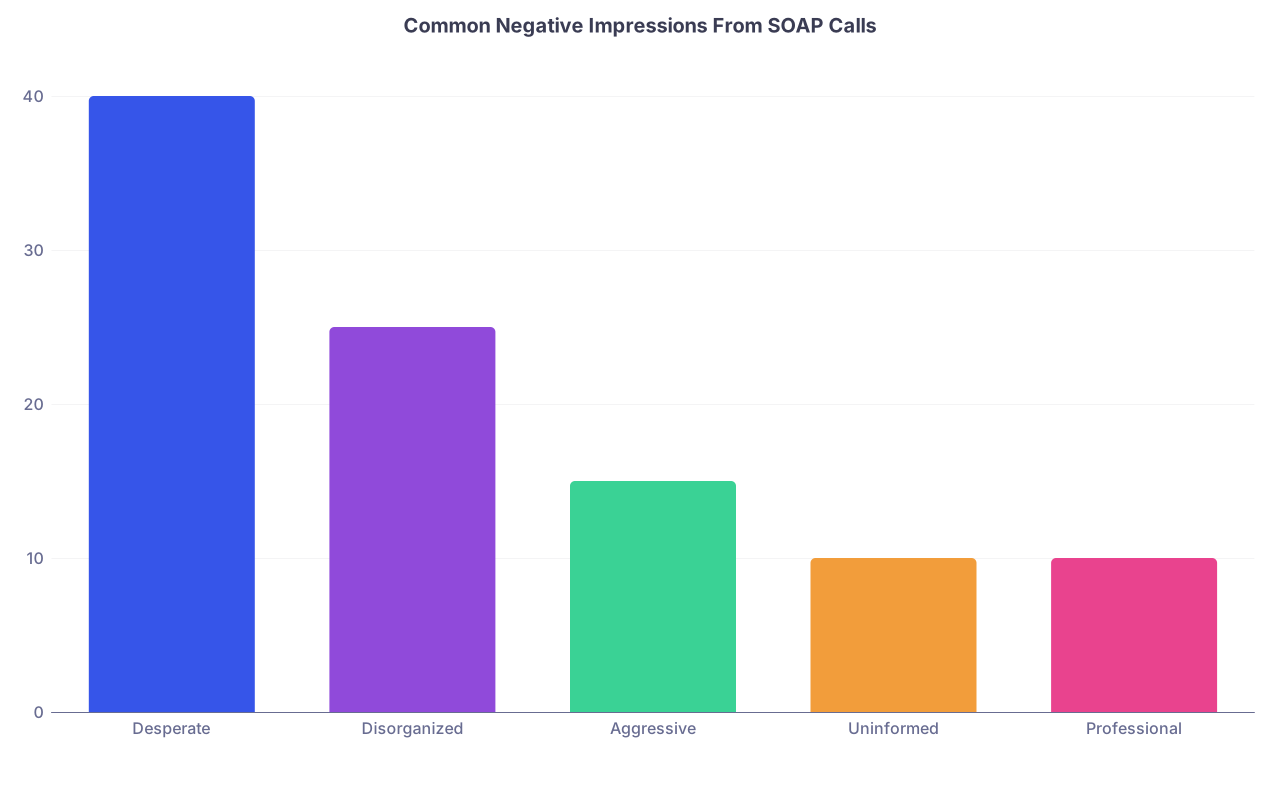
| Category | Value |
|---|---|
| Desperate | 40 |
| Disorganized | 25 |
| Aggressive | 15 |
| Uninformed | 10 |
| Professional | 10 |
This is the one that kills good candidates.
You feel panicked, and it leaks into your voice. You overshare. You start justifying your whole career to a random coordinator. You beg.
Programs do not want desperate. They want resilient and composed.
Red‑flag phrases that scream desperation:
- “I will do anything, I just really need a spot.”
- “This is my dream program” (when you clearly sent 35 identical emails)
- “If you give me a chance, I promise I won’t let you down.”
- “I have nowhere else to go.”
- “You are my top choice” (to every place you call)
You are not talking to your therapist. You are talking to someone who has to trust you with their patients at 3 a.m.
A more composed version:
“Hello, my name is Dr. [Name], AAMC ID [X]. I applied to your program in ERAS for SOAP. I’m very interested in [program name], particularly because of [specific reason]. I wanted to briefly express my interest and see if there is anything else I can provide.”
Calm. Direct. You sound like a colleague, not a drowning person grabbing at the closest branch.
The Emotional Overshare Trap
Another way desperation leaks out is oversharing your emotional state or personal hardship on the phone:
- “I just feel so lost right now.”
- “My family is depending on me; I don’t know what I’ll do if I don’t match.”
- “I had so many interviews; I don’t know what went wrong.”
They may feel bad for you. That does not mean they want to work with you for three years.
If you need to refer to hardship (failed exam, leave of absence, illness), keep it structured:
“I had a setback with Step 1 in my third year after a family health issue. Since then, I passed Step 2 with [score], completed [X] sub‑I, and received strong feedback on my clinical performance.”
Facts. Growth. Outcome. Not a therapy session.
The “Spray and Pray” Caller: Too Many Contacts, Zero Substance
If you sound like you just called 40 places in a row with the same generic line, you will be ignored.
Programs can spot this instantly:
- You mispronounce the program name.
- You clearly do not know where the program is located.
- You say you are “very interested in internal medicine” to a family medicine program.
- You ask, “What specialties do you offer?” during SOAP. Yes, people actually do this.
That is lazy, and it reads as disrespectful. Like they are just a checkbox on your desperation tour.
Instead, for each program, you need one or two specific, honest points:
- “I grew up in [state], and I am looking to practice here long term. Your program’s emphasis on community clinics aligns with the work I did at [clinic].”
- “I am particularly interested in your strong critical care exposure. The ICU rotation structure on your website stands out compared to other programs.”
You are not giving a TED talk. Two targeted lines are enough.
If you cannot find anything specific after 3–4 minutes of looking at their website, that is your sign: you probably should not call them.
Calling the Wrong People at the Wrong Time
There are better and worse ways to reach a program. People ignore this and then wonder why no one responds.
Common timing / contact mistakes:
- Calling repeatedly during the first hour of SOAP rounds when they are drowning in ERAS reviews
- Calling the main hospital number and asking for “whoever runs the residency”
- Calling after business hours and leaving a 3‑minute voicemail essay
- Calling the PD’s personal cell if you somehow found it online (yes, some do this; no, it does not help you)
You want to avoid coming across as intrusive or oblivious to how busy they are.
Safer pattern:
- Primary: Short, clear email to the program coordinator and generic residency email address.
- Secondary (if you truly have something additive to say): A single, brief phone call during business hours, ideally between SOAP offer rounds, not during them.
And if you leave a voicemail? It should not be your entire autobiography.
“Hello, this is Dr. [Name], AAMC ID [X]. I applied to your [specialty] program in ERAS for SOAP. I’m very interested in your program and would be grateful if my application could be reviewed. I can be reached at [number] or via email at [email]. Thank you.”
That is it. Under 30 seconds. Anything longer and they will delete it halfway through.
Turning the Call Into an Interview You Were Not Offered
A huge, underappreciated mistake: you start treating a quick contact call like an unscheduled interview and talk yourself into a corner.
You call to “express interest,” then suddenly you are:
- Explaining every red flag in your file
- Re‑hashing each clerkship with “honors”
- Launching into long answers about your “five‑year plan”
- Asking them to review your file live on the phone
This feels needy and boundary‑blind. They did not invite you for an interview. They picked up the phone to handle logistics or quickly acknowledge your interest.
Your goal is not to convince them verbally. Your goal is:
- To get them to actually open and consider your ERAS file
- To lodge your name in their mind in a positive, professional way
Nothing more. Nothing less.
If they start asking questions, answer clearly, but keep things tight:
Coordinator: “Can you tell me briefly about your interest in our program?”
You: “Yes, of course. I am interested in [specialty] because [1 sentence]. Your program stands out because of [1–2 program‑specific points]. I think my background in [X] and strong clinical evaluations in [Y] align well with that.”
If they push into red‑flag territory (“Can you tell me about your Step 1 fail?”), you answer honestly, concisely, and end with growth and current readiness. Then stop talking. Do not fill silence with nervous chatter.
Being Pushy or Entitled: The “Why Not Me?” Caller
There is a special category of calls that instantly kill your chances. The applicant believes they are just “advocating for themselves.” They sound like trouble.
Here is what that looks like:
- “I was surprised not to receive an interview from you the first time. My scores are above your average.”
- “Can you tell me why my application has not been reviewed yet?”
- “I have other programs interested in me; I just wanted to see where I stand with you.”
- “Are you going to offer me a position in this round?”
Programs do not owe you explanations. SOAP is not the time to negotiate.
Entitlement is a huge red flag. Nobody wants an intern who will question every schedule decision or evaluation with the same energy.
Your tone must be: respectful, humble, but not groveling.
Wrong: “What more do I need to do to convince you?”
Right: “I know you are very busy. I appreciate any consideration you can give my application.”
Wrong: “Can you tell me my chances?”
Right: “I understand you cannot discuss specific decisions. I mainly wanted to make sure my interest is clear and that you have everything you need from me.”
You are showing insight. You respect the process. That alone differentiates you more than you think.
Overselling Yourself So Hard You Look Dishonest
In panic mode, people start exaggerating. Or they subtly reframe their record into something it is not. Programs see right through it.
Common over‑selling missteps:
- Calling a “Pass” school with “Outstanding” comments an “Honors” rotation
- Presenting a single abstract as “extensive research experience”
- Claiming deep interest in a specialty you barely touched in med school
- Suddenly “lifelong commitment to primary care” after three years aiming for Derm
If what you say on the phone does not match ERAS, you are done. Even small discrepancies create distrust.
You do not need to pretend to be a superstar. SOAP is full of people with imperfect records. Own where you are strong:
“I had some early academic bumps with [brief reason], but my clinical performance has been consistent, and my faculty have trusted me with a lot of responsibility on the wards. I am confident I can function well as an intern.”
Or:
“I am newer to [specialty] than some applicants, but my sub‑internship in [X] confirmed this is where I want to be. I have strong evaluations and am eager to grow quickly.”
Honest. Grounded. That reads much better than fake hero narratives.
Asking the Wrong Questions That Make You Look Clueless
There are questions you never ask during SOAP calls. Not because they are evil, but because they telegraph that your priorities are out of step with reality.
You have extremely limited time and one chance to leave an impression. Using it on these topics is a mistake:
- Salary details (“What is the starting PGY‑1 salary?”)
- Vacation length
- Moonlighting opportunities
- Exact call schedule and “how malignant is your program?”
- “Is your program considered competitive?” (Yes, people ask versions of this.)
You are in SOAP. The basic question is: can you get a job and not be miserable. Not: can you optimize your vacation.
Safe question categories if they open the floor:
- “Are there particular qualities you value in SOAP applicants?”
- “Is there any additional information or documentation that would be helpful from my side?”
- “Do you accept applicants who require visas?” (if applicable and not clear online)
- “Do you take candidates with [Step status]?” (if your situation is unusual)
Better yet, if you already know the program well, you might not need to ask anything. You can simply restate interest and thank them for their time.
Ignoring How You Sound: Tone, Diction, and Pace
Programs are not only hearing your words. They are hearing how you would sound at 3 a.m. calling a consultant or giving a handoff.
Common audio‑level mistakes:
- Speaking so fast they can barely follow you
- Sounding like you are about to cry
- Being weirdly casual: “Hey, yeah, what’s up, I’m calling about your SOAP spot.”
- Mumbling your name and AAMC ID
- Taking the call from a loud coffee shop or while driving
If they struggle to understand you on the phone now, they will worry about you talking to nurses, attendings, and patients.
You do not need to sound like a news anchor. You do need to sound like someone who can communicate under stress.
Practice out loud. Record yourself saying:
“Hello, my name is Dr. [Name]. I am calling regarding your [specialty] residency program. I applied through ERAS in the SOAP process. I was hoping to briefly express my interest and ensure you have everything needed from me.”
Play it back. If you sound rushed, slurred, flat, or overly emotional, fix it before you call anyone real.
Forgetting That Calls Are Optional — and Often Overrated
Here is the part no one says out loud: Many programs barely use phone calls in SOAP decisions. They live in ERAS. They look at:
- Scores
- Clerkship grades
- Letters
- Red flags
Calls mainly matter in two situations:
- They are on the fence and your call tips them slightly positive
- You make such a bad impression that they cross you off
| Situation | Likely Effect of Calling |
|---|---|
| Strong file, neutral call | Mildly positive |
| Strong file, terrible call | Strongly negative |
| Borderline file, strong call | Moderately positive |
| Weak file, excellent call | Slightly positive |
| Weak file, needy/pushy call | Very negative |
So the worst mistake is not “failing to call every program.”
The worst mistake is making calls that actively damage you.
If calls make you spiral, or you cannot control your tone, you may do less harm by focusing on:
- Tight, clean, error‑free emails
- Having your documents and responses ready for any official contact
- Preparing for actual SOAP offers and potential quick interviews
Do not force calls just because your classmate said, “You have to call everyone.” You do not. And sounding desperate will hurt you more than silence.
A Concrete Example: Desperate vs Controlled Call
Let me put it side by side.

Desperate version:
“Hi, um, my name is [Name]. I did not match and I am really hoping to find any position. I saw your program is unfilled and I just really, really want to be considered. I will work super hard and do anything you need. I had some issues with Step 1, but it is only because my family was going through a lot and I was so stressed. I really deserve a chance. Can you tell me what my chances are or if you can interview me?”
Controlled version:
“Hello, my name is Dr. [Name], AAMC ID [X]. I applied to your [specialty] residency program through SOAP today. I completed medical school at [School], and I am very interested in your program, especially your strong outpatient focus and community clinics. I wanted to briefly express my interest and make sure you have everything needed from me. I understand you are very busy, but I would be grateful for any consideration of my application.”
If they say, “Thank you, we will review applications through ERAS,” you answer:
“Thank you for your time. I appreciate it. Have a good day.”
Done. You left a professional footprint. You did not bleed all over the floor.
How to Prepare in 30–45 Minutes So You Do Not Sound Desperate
One last protective checklist before you start dialing:

| Step | Description |
|---|---|
| Step 1 | Start |
| Step 2 | Identify target programs |
| Step 3 | Review each website 3 to 5 minutes |
| Step 4 | Write 1 to 2 fit reasons per program |
| Step 5 | Draft 20 second intro script |
| Step 6 | Practice out loud 3 times |
| Step 7 | Prepare AAMC ID and notes |
| Step 8 | Send concise email if appropriate |
| Step 9 | Make 1 brief call if valuable |
| Step 10 | Accept outcome and move on |
Do these before you touch the keypad:
- List 5–15 realistic programs from the SOAP list (by specialty, visa status, geography).
- Spend 3–5 minutes on each website. Note one real thing that fits you.
- Write your 20‑second intro and your 1‑sentence explanation for any major red flag.
- Practice speaking them. Yes, out loud. Not in your head.
- Decide: which programs get an email only, which might get one short call.
- Set a hard rule: one contact per program (maybe two if email + call). No repeated nagging.
And if you are too emotionally raw to sound like a functioning adult on the phone? Skip the calls. Focus on what you can control without self‑sabotage.

Final Takeaways
Keep three things burned into your brain:
- Desperation leaks through your voice and words. Your job is to sound steady, not needy.
- One clean, concise, respectful contact beats ten frantic, repetitive, or pushy calls.
- If a call will make you unravel, do not make it. In SOAP, the wrong phone call can hurt you more than silence.