It’s Monday of Match Week. 11:58 a.m. Eastern.
You’re sitting there with NRMP open, heart pounding, watching the clock grind toward noon. You already know you didn’t match. You’ve run through all five stages of grief since 10 a.m. You’re telling yourself, “SOAP is still a path. I just need one program to see my potential.”
Let me tell you what is happening on the other side of the screen while you’re refreshing OASIS and ERAS like it’s a reflex.
Because SOAP offers are not some mysterious algorithm. They’re a messy, political, time-pressured, human-driven scramble. And the people making decisions are tired, biased, under pressure, and working with far less information than you think.
You want an edge in SOAP? You need to understand what’s actually going on in that conference room.
What Programs Are Doing Before You Ever Click “Apply”
By the time you see the SOAP list at noon on Monday, most serious programs are already three steps ahead of you.
Here’s the uncomfortable truth: many programs start planning for SOAP weeks in advance, especially in competitive specialties or weaker community programs that chronically underfill.
They won’t say this out loud, but they do it every single year.
The Pre-SOAP Reality
A typical internal medicine, peds, psych, or prelim program director in late February:
- They’ve run internal projections: “If we interview 120, we’ll probably fill 90–95%.”
- They know their “at risk” spots — prelims, community tracks, new programs, weaker reputations.
- They’ve already mentally sorted applicants into:
- “People we’d be thrilled to get in the Match”
- “People we’d only consider in SOAP”
- “No way, even in SOAP”
By Friday before Match Week, at many places, you’ll see a draft SOAP plan sitting in a shared drive or an email thread:
- A template SOAP preference list Excel file
- Columns for Step scores, school, red flags, visa status, notes like: “Strong interview, no rank,” “Late app,” “Good but quiet,” “Failed Step 1 – improved Step 2.”
You think they’re starting from scratch on Monday? They’re not. They’re refining a list that’s been stewing for a while.
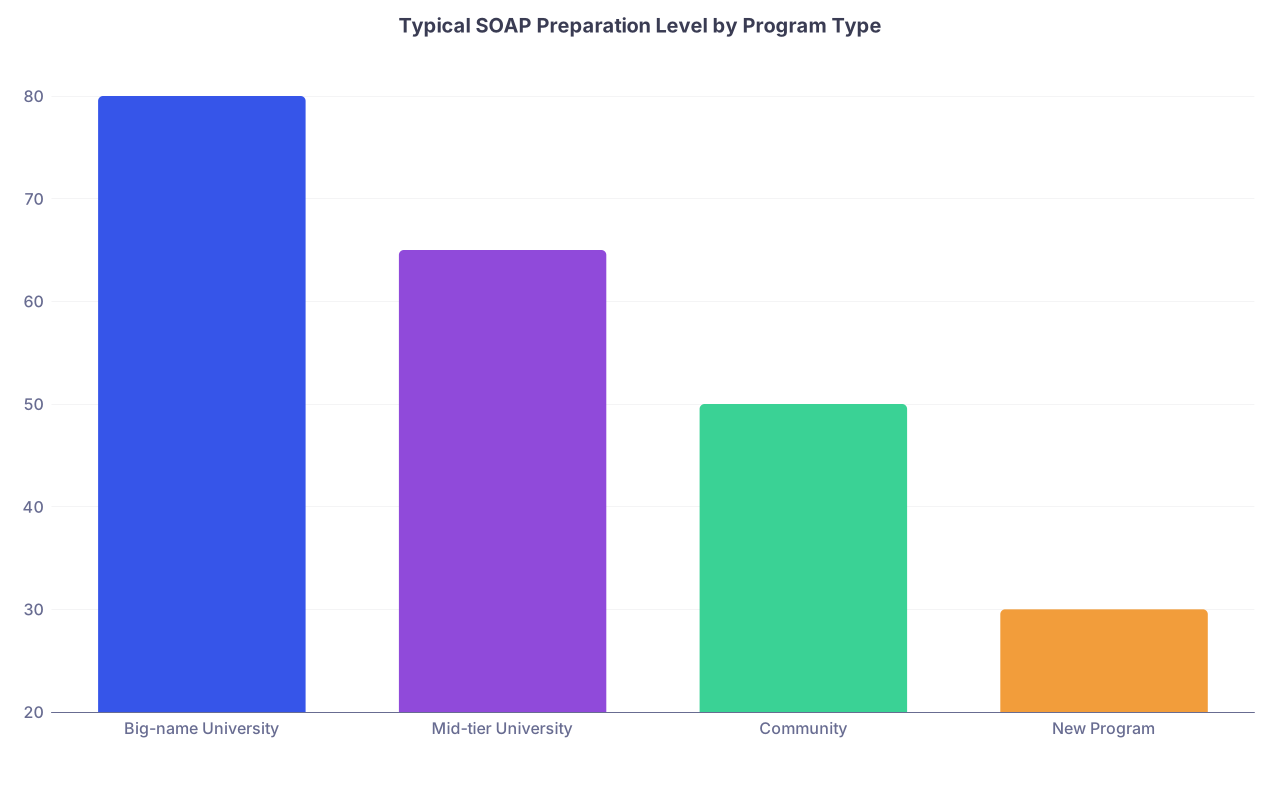
| Category | Value |
|---|---|
| Big-name University | 80 |
| Mid-tier University | 65 |
| Community | 50 |
| New Program | 30 |
Interpretation: that’s roughly the percent of programs in each category I’ve seen actually prepare a SOAP plan before Monday. The academic heavyweights plan the most; the brand-new programs are usually chaos.
How Programs Actually Read Your SOAP Application
Let’s kill a fantasy right now: no one is reading your 4-page personal statement during SOAP. Almost no one.
On Monday afternoon, a program that just learned they have 4 unfilled spots might get 200–600 SOAP applications within the first couple of hours. Sometimes more, especially IM, FM, and prelims.
The people doing the first pass are usually:
- PD (Program Director)
- APD(s)
- Chief residents
- Occasionally a super-motivated coordinator who knows the previous years’ problem residents better than anyone
Here’s what they actually look at in that first 10–20 second scan per file:
School + graduation year
- US MD recent grad vs US DO vs FMG/IMG vs older grad.
- Older grad (more than 3–5 years out)? You start behind unless you’ve got active US clinical work.
Step/COMLEX scores & fails
- Yes, even with Step 1 pass/fail, they still look at raw performance where visible, Step 2 CK, and COMLEX conversions mentally.
- Any failure is a big flag. Not necessarily fatal, but it moves you into the “only if we have no better options” bucket for many programs.
Visa status
- If the hospital will not sponsor visas? You’re out in 1 second. Doesn’t matter how strong you are. I’ve watched PDs literally say, “We don’t do visas — skip.”
Red flags quickly scanned in the MSPE / transcript
- LOA, professionalism comments, remediation, repeated courses, failed clerkships.
- If there’s smoke, they assume there’s fire unless they’re really desperate.
Geography & connection
- Any tie to their region/state.
- If they’re in Ohio and you’re from Ohio, did med school in Ohio, have family in Ohio — that matters. They’re trying to predict who will actually stay and not bolt.
Prior interest / name recognition
- They remember people who rotated there, did an away, or emailed them earlier in the season.
- If a faculty says: “Oh, I remember her, she rotated with us — great worker,” you just jumped ahead of 300 people.
What they basically do is rapid triage:
- Definite “No” in < 5 seconds
- “Maybe” in 10–20 seconds
- “We should interview this one” after a slightly deeper look
Your beautifully crafted narrative? At best, they skim the first two lines to see if you’re coherent.
The Closed-Door Meeting: How the SOAP Short List Takes Shape
Now let’s walk into that conference room.
It’s Monday afternoon. The PD has the list of unfilled positions. They’ve pulled applications into some internal system or just a giant spreadsheet. Everyone’s tired and a little annoyed this even happened.
Someone shares their screen. Usually it’s an ugly table of names and scores.

What actually drives the conversation?
1. Panic + Reputation
First, there’s a reputational hit to not filling in the main Match. Nobody wants to still have open spots after SOAP. The department chair might already be emailing the PD: “What happened?”
So the mandate is: “Fill all spots. But don’t destroy our program doing it.”
They will not tell you that. But it’s the algorithm in their head.
2. Safe vs. Risky Picks
In these meetings you’ll hear phrases like:
- “We got burned last year taking someone with a Step 1 fail.”
- “No more older grads who haven’t done anything clinical in 3 years.”
- “I do not want another resident who disappears on nights and doesn’t answer pages.”
They’re looking at your name and assigning you a risk profile. Not medical risk. Management risk.
If they think: “This person will show up, work hard, pass boards, not create drama,” you’re in the safe pool. If you have any extra complexity — red flags, visa, older grad, career change, big gaps — you go in the “risky” pool.
The trick? Strong LORs and verifiable recent clinical work can push a “risky” person back toward the safe side.
3. Internal Candidates Get First Dibs
Here’s a truth that stings: if the program has an unmatched home student or a prelim they already know, you are automatically behind them.
I’ve sat in meetings where a PD says:
“We have two of our own MS4s in SOAP for IM. We’re taking them. Period. Build the rest of the list after that.”
Home students or known quantities are “low risk” emotionally. The PD already knows their work ethic and personality. That’s gold in SOAP.
So if you’re an external SOAP applicant, you’re competing for what’s left after internal obligations are filled.
The Anatomy of a SOAP Rank List (Yes, Programs Rank Too)
People forget: SOAP has its own mini-match system. Programs submit preference lists; applicants submit preferences by applying to programs and responding to offers in rounds. There’s structure behind the chaos.
Typically, a program will:
- Create a long list of everyone they’d even consider. Maybe 80–150 names for 3–4 spots.
- Chop off the bottom ~50% for deal-breakers (visa issues, multiple fails, terrible MSPE language, no recent clinical work, graduation 10+ years ago).
- Argue over the top 20–40 and create an ordered list.
How do they order? It’s not elegant. It’s fast and rough:
- Top bucket: previously interviewed applicants they liked but didn’t rank high enough or ran out of spots for.
- Next bucket: strong paper apps (good scores, recent grad, no red flags, some connection).
- Last bucket: backups — people they’d take if everything else collapses.
Then somewhere on that list there’s always one or two “pet projects”:
- “This is the IMG I’ve been emailing with, I really like her.”
- “He did observerships with us, very solid, I want him somewhere on the list.”
Do they sometimes push those people up higher than they deserve? Absolutely. Relationships matter.
The Phone Calls: Quiet Backchanneling During SOAP
You think no one talks during SOAP? That’s cute.
Even though there are strict NRMP rules about offers, there’s plenty of backchannel communication that doesn’t explicitly say, “We will rank you here,” but effectively does.
You’ll see things like:
- “We’re very interested and would be happy to have you here.”
- “If we offer you a spot, could you commit to accepting quickly?”
- “Would you still be interested in us if something came through in [other specialty]?”
On the faculty side, I’ve seen PDs calling:
- Other PDs: “You know this student? Are they a problem?”
- Clerkship directors: “Tell me off the record, is this someone we should avoid?”
- Community attendings: “I saw you wrote a letter. Is this really a strong candidate or just ‘nice’?”
If you think your letters don’t generate extra behind-the-scenes commentary in SOAP, you’re wrong. This is when faculty say what they really think — away from the formal language of the MSPE.
Round-by-Round: Why You Didn’t Get That SOAP Offer
The part that drives applicants crazy: you apply, you hear nothing, then suddenly everything is over. It feels random.
It’s not random. It’s mechanical and hierarchical.
Here’s how it often plays out internally:
In the first round, programs shoot their shot on their top candidates. Their goal: lock in the best people they never imagined they could get during the main Match.
They will often be conservative: they’d rather undershoot and miss a couple in round 1 than “waste” top slots on people who might decline.
So if you’re:
- US MD with strong scores who surprisingly went unmatched
- Formerly interviewed at that program
- A strong DO with great clinical comments and a clean record
- IMG but with excellent scores, recent US clinical experience, and strong US letters
You get first-round attention.
If you’re in the middle-of-the-pack group — okay scores, some concerns, not local, no prior connection — you’re the second- or third-round insurance policy.

| Step | Description |
|---|---|
| Step 1 | Unfilled Spots Identified |
| Step 2 | Create Candidate Buckets |
| Step 3 | Top Priority List |
| Step 4 | Paper Review |
| Step 5 | Low Priority or Reject |
| Step 6 | Middle Priority List |
| Step 7 | Round 1 Offers |
| Step 8 | Round 2 or 3 Offers |
| Step 9 | Only If Desperate |
| Step 10 | Previously Interviewed? |
| Step 11 | Any Red Flags? |
Notice something important here: a lot of middle candidates never get seen deeply. They’re on the spreadsheet but never in the actual conversation. They’re numerical filler.
The Real Selection Criteria Nobody Puts on Their Website
If you read program websites, you’d think they pick SOAP candidates based on “holistic review” and “commitment to our mission.”
Let me translate that into reality.
What Actually Pushes You Up the List
Known quantity over unknown quantity
- Rotated there? Audition elective? Even a legit, non-spammy email chain with the PD or coordinator from earlier in the season? That can save you.
Clean professionalism record
- No “concerns about professionalism” lines in your MSPE.
- No nasty subtext like “requires more oversight than peers,” which every PD reads as “difficult personality.”
Recent, hands-on clinical work
- Especially for IMGs, older grads, or people switching careers. If you haven’t touched a patient in 2–3 years, that terrifies them.
Signal you will stay
- Ties to region, family nearby, previous training close by. They don’t want someone who’s going to be miserable or leave.
No extra administrative headaches
- Visa complexity, licensing nightmares, language barriers, need for extra remediation. SOAP is rushed; they want smooth onboarding.
The Harsh Hidden Filters
Let me be blunt about patterns I’ve watched PDs use in SOAP when they feel they have enough applicants:
- Older graduates (>5–7 years from med school) with no clear, strong, recent clinical work → usually auto-demoted.
- Multiple Step/COMLEX failures → often only considered in last rounds or not at all.
- No US clinical experience for IMGs in core specialties → tough sell unless they are absolutely drowning for applicants.
- Questionable professionalism in MSPE → huge red flag. PDs hate drama more than they love high scores.
Does every program use these exact filters? No. But this is the mental sorting you’re up against.
What You Can Actually Do During SOAP To Influence This
You cannot rewrite your MSPE at 2 p.m. on SOAP Monday. Your Step scores are what they are. You’re not rebuilding your whole profile in 48 hours.
But you’re not powerless either.
1. Craft a Targeted, Ruthless Application Strategy
The worst SOAP move I see? People throwing applications at every open program in every specialty.
You think “more is better.” PDs see it and think: “This person has no idea what they want and is likely to leave.”
Be focused. If you’re going for IM, your application should look like you care about IM. Same for FM, psych, peds, prelim surgery, whatever.
If you must apply across specialties, at least make each personal statement specialty-appropriate, even if it’s short. SOAP readers are skimming, but they will notice if you’re obviously copy-pasting “I’ve always loved primary care” into a surgery prelim slot.
2. Leverage Any Real Connection — Quietly but Directly
This is when you use your network, and yes, this absolutely sways decisions.
- Email attendings who like you: “I went unmatched and am in SOAP. I am targeting [X programs]. If you know anyone there and would feel comfortable sending a brief note on my behalf, I’d be very grateful.”
- Ask clerkship directors: “Would you be willing to reach out to [Program X PD], even with a one-liner, while I’m in SOAP?”
I’ve watched PDs move someone up 10–15 spots on the preference list because a colleague they trust sent a 2-sentence email saying, “This candidate is legit. We’d be happy to have them here.”
That happens.
3. Be Instantly Reachable and Decisive
Programs are under time pressure. If they offer you a SOAP interview (phone or video), they want quick responses, clear communication, and no drama.
If they call and you don’t respond for 4 hours because you were “taking a break,” you just told them something about how you’ll respond to pages.
During SOAP:
- Your phone should be charged, audible, and near you at all times.
- Email notifications on.
- Voice mailbox empty and professional. No “Hey it’s ya boy, leave a message” nonsense.
If you get an offer in a round, you have very limited time to decide. Hesitation kills you. Programs can see if you’re sitting on an offer. If they get the vibe you’re treating them as a backup, they may move you down in subsequent rounds if the system allows renewed offers.
After the Smoke Clears: Why You Did or Didn’t Get a SOAP Spot
When Wednesday ends and the final SOAP rounds close, programs will do a postmortem. You’re not in the room for that either.
PDs will say things like:
- “We got lucky, grabbed a US MD who surprisingly didn’t match.”
- “We had to reach for a couple of IMGs, but they actually look solid.”
- Or, the nightmare: “We still didn’t fill. Now we’re scrambling outside of SOAP.”
If you didn’t get a position, understand this: many rejections were not about you being a “bad” applicant. They were about risk, familiarity, and timing.
You lost to:
- A known home student
- Someone with a cleaner record
- Someone who had a direct line to a faculty member
It hurts, but it’s the truth.
Key Strategic Takeaways For SOAP
You want to play this game like someone who’s seen the script. Here’s the distillation:
- Programs are terrified of risk in SOAP. Make your file look as low-drama, clinically ready, and reliable as possible.
- Known beats unknown. Any legitimate connection — rotations, emails, faculty advocacy — can move you up their list.
- Your behavior during SOAP (availability, focus, decisiveness) is part of your evaluation, even if nobody writes it down.