
The fastest way to fail in SOAP is to treat it like a rushed afterthought instead of a ruthless strategy exercise.
You do not lose in SOAP because you are “unlucky.” You lose because of predictable, repeated ranking mistakes that programs count on applicants making.
Let me walk you through the landmines before you step on them.
1. Treating Your SOAP List Like Your Main Match List
This is the most expensive mistake: using “Match logic” in a SOAP world.
In the Main Match, you can afford to swing for a few fences. In SOAP, you cannot. SOAP is not the place for pride, “dream programs,” or magical thinking.
In SOAP, your goal is simple:
Secure an accredited, acceptable position that keeps your career alive.
Not: “Redeem my ego from Monday’s email.”
Big errors I see here:
Ranking only “prestige” programs that are unfilled for ugly reasons
- If a well-known academic program is unfilled, that’s a red flag. Sometimes it’s benign (new positions), but often:
- Toxic culture
- Disorganized leadership
- Historically abusive schedules
- Ranking 5 of these as your entire list because “the name is strong” is how you end up unmatched again.
- If a well-known academic program is unfilled, that’s a red flag. Sometimes it’s benign (new positions), but often:
Building a short list because you’re “better than that”
- I’ve seen US MDs with failed Main Matches rank 4–6 SOAP programs.
Quote: “I don’t want to end up somewhere terrible.” - They end up with nowhere instead. That is always worse.
- I’ve seen US MDs with failed Main Matches rank 4–6 SOAP programs.
Copy‑pasting your Main Match preferences
- SOAP requires a different mindset:
- Main Match: “Where would I like to train?”
- SOAP: “Where am I most likely to secure a safe, trainable spot I can live with?”
- SOAP requires a different mindset:
If you do not change your framework from “preference first” to “probability first,” your SOAP rank list will be a vanity project instead of a rescue plan.
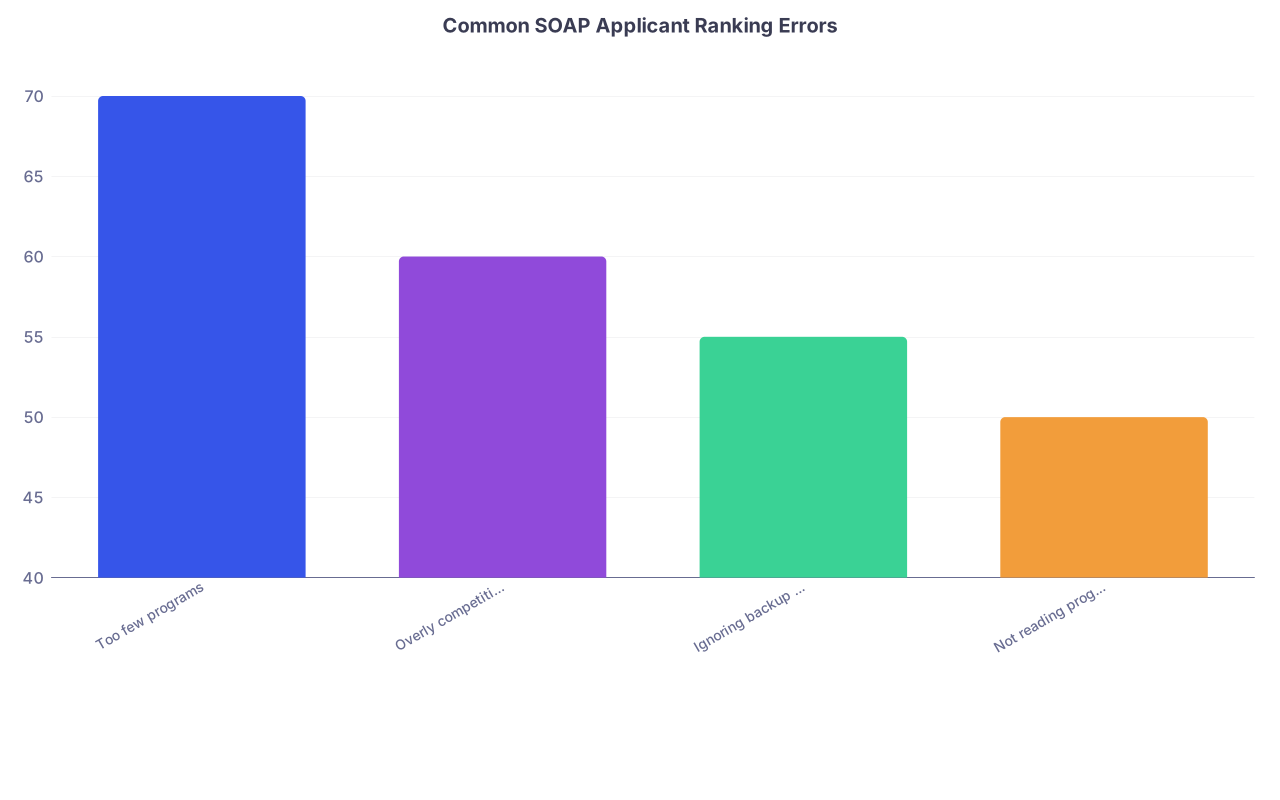
| Category | Value |
|---|---|
| Too few programs | 70 |
| Overly competitive choices | 60 |
| Ignoring backup specialties | 55 |
| Not reading program details | 50 |
2. Ranking Too Few Programs – The False Confidence Trap
If there’s one mistake that haunts people for years, it’s this: a painfully short SOAP list.
You get 25 programs per SOAP round in most specialties. People use… 6. Or 8. Then cry on Thursday.
Why it happens:
- “I don’t want to seem desperate”
Programs don’t see how many you applied to in SOAP. They see your individual application. They’re not counting. - “I’m sure I’ll get one of these top ones”
No, you are not “sure.” You’re in SOAP. The entire game is uncertainty. - “I don’t want to end up in a place I hate”
Understandable. But refusing to rank acceptable, less desirable programs is how you end up with nothing at all.
Here’s the part people misunderstand:
You are not obligated to rank every program you apply to.
But failing to apply broadly because you assume you’ll get interviews is reckless.
The safer approach:
- Apply widely to all programs that meet your minimum standards.
- After interviews (or contact), rank only those you’d genuinely be willing to attend.
- But that list should still be long. Very long, if you’re a reapplicant, IMG, or coming from a weaker academic background.
If your final SOAP rank list has fewer than 10 programs and you’re not a US MD with strong Step scores and unique experience, you are playing with fire.
3. Ignoring Program Fill Probability and Competitiveness
Another career-killer: treating all SOAP spots as equal.
They are not.
Some openings are:
- New, well-funded positions with strong interest → will fill instantly
- In very desirable cities → hundreds of applications within minutes
- In historically competitive specialties (even at weaker programs)
You can’t just rank based on what looks good on paper.
You need to think about fill probability:
- How attractive is this location?
- How competitive is this specialty overall?
- How “friendly” is this program likely to be to your profile (US MD/DO vs AMG/FM IMG, scores, attempts, gaps)?
If you’re a borderline candidate and you stack your list with:
- Big coastal cities
- Name‑brand institutions
- Highly desirable lifestyle programs (Derm prelims, cush prelim medicine in NY/CA, etc.)
…you’re building a fantasy list, not a SOAP list.
Even in SOAP, there’s a competitiveness gradient. Respect it.
| Category | High-Risk SOAP Choices | Safer SOAP Choices |
|---|---|---|
| Location | NYC, LA, SF, Boston | Mid-sized cities, Midwest, South, non-coastal |
| Program Type | Big-name academic flagships | Community, regional academic |
| Specialty | EM, Radiology, Anesth at top centers | IM, FM, Peds, transitional where available |
| Spot Type | Single unfilled PGY-2 in hot specialty | Multiple categorical or prelim PGY-1 positions |
You do not rank only “reach” SOAP programs when your file already failed in the Main Match. That’s delusional.
4. Failing to Separate “Dealbreakers” from “Preferences”
A lot of otherwise smart applicants sabotage their SOAP strategy by treating mild discomforts like dealbreakers.
Conversations I’ve actually heard:
- “I didn’t rank that program because the city is ugly.”
- “I don’t want to go there; it’s too cold.”
- “The call schedule looked rough.”
Let me be blunt:
During SOAP, you’re not choosing a vacation. You’re choosing whether your medical degree leads to a license or to a wall decoration.
You must clearly define, before you rank:
- Non‑negotiable dealbreakers (medical, safety, legal, true abuse)
- Strong preferences (location, type of hospital, schedule)
- Nice‑to‑haves (research, fellowships, big city)
Don’t make this mistake: treating every discomfort as disqualifying. In SOAP, the bar is:
“Can I survive here and graduate as a competent, board‑eligible physician without sacrificing my health or safety?”
Anything above that is bonus. Not a requirement.

5. Not Aligning Rank List With Your Actual Application Story
Here’s a subtle but devastating mistake: ranking programs that don’t match your application narrative.
Example:
- Your personal statement: “My passion is primary care in underserved rural communities.”
- Your experiences: Free clinic, community projects, rural rotations.
- Your SOAP list: 10 urban prelim surgery spots and 2 transitional years in big cities.
You think programs don’t notice the disconnect? They do.
- Does this applicant even want what we offer?
- Does their story align with our population, setting, and specialty?
- Or are we just a warm body slot for them?
When your rank list ignores your own story, you:
- Spread yourself thin across programs where your fit looks bad
- Fail to concentrate your efforts where your narrative is strongest
- Increase the chance that every PD thinks, “They’re not really into what we do”
If your entire CV and letters scream primary care, don’t build a SOAP list that’s 90% prelim surgery and ICU-heavy programs. You’re fighting your own file.
6. Overvaluing One Shiny Feature (Location, Name, or Lifestyle)
Another common trap: letting one attractive feature override every red flag.
The usual shiny objects:
- “But it’s in California/New York.”
- “It’s a big‑name university.”
- “The schedule looks light and there’s no overnight call.”
Then you ignore:
- Terrible board pass rates
- Reputation for malignant culture
- Residents leaving mid‑year
- Zero documentation of educational structure
During SOAP, you cannot fully vet everything. But you can avoid the glaring mistakes:
Do not rank a program highly just because:
- It’s in your hometown
- Your partner lives nearby
- You recognize the name
- A friend said “it’s chill” without details
Fast way to think about it:
A slightly less desirable city + solid, structured program
beats
glamorous city + chaos, no teaching, chronic understaffing.
Yes, even in SOAP. You don’t save your career by burning out in a disaster program you picked for the zip code.
7. Ignoring Backup Specialty Logic
This one hurts people quietly.
You went all‑in on a competitive field (Derm, Ortho, EM, Radiology, etc.). You did not match. Now it’s SOAP.
Your options:
- Try for SOAP spots in the same competitive specialty (usually very few + ultra competitive)
- Or diversify into:
- Prelim Medicine / Surgery
- Transitional year
- Categorical IM/FM/Peds/Psych (where available)
The mistake:
Ranking only your original specialty when your application clearly failed there once already.
If you:
- Struggled on exams
- Have no home program
- Have weak letters or limited research
…and you still only rank radiology or EM SOAP positions because “that’s my dream,” you are prioritizing fantasy over outcome.
Better play (if you truly want that competitive field long-term):
- Secure:
- A strong prelim year (IM or surgery), or
- A categorical in a more accessible specialty you can live with
- Reassess after:
- Better letters
- US experience
- Improved Step/board performance (where applicable)
You can’t subspecialize later if you never get licensed at all. SOAP is about staying in the game.

| Step | Description |
|---|---|
| Step 1 | Unmatched after Main Match |
| Step 2 | Add backup specialties |
| Step 3 | Mix original and backup |
| Step 4 | Focus on original |
| Step 5 | Target IM, FM, Peds, Psych, prelim or TY |
| Step 6 | Build long, realistic rank list |
| Step 7 | Original specialty realistic in SOAP |
8. Last-Minute, Sleep-Deprived Ranking Decisions
SOAP week is chaotic. People underestimate how much that chaos wrecks their judgment.
Common disaster pattern:
- Monday: Shock and grief from not matching.
- Tuesday: Frantic application submissions.
- Wednesday: Non‑stop calls/interviews.
- Wednesday night: Exhausted, emotional, building your rank list half‑awake.
That’s when people:
- Forget to rank programs that actually liked them
- Leave off safer backups because of transient emotions
- Overreact to one minor negative comment in an interview
- Panic-rank a place high because the PD sounded “really nice”
You can’t fully eliminate the chaos, but you can reduce the damage:
Before SOAP even starts:
- Define your absolute no criteria
- Define your minimum acceptable criteria
- Decide:
- How far you’re willing to move
- What specialties you’ll accept in SOAP
- Where prelim/TY vs categorical sits in your priority stack
Then, during SOAP:
- Stick to the framework under stress
- Ask: “Does this rank order maximize my chance of an acceptable outcome, not my ego?”
Think of your pre‑SOAP self as the sober version of you protecting your future from your panicked SOAP‑week self.
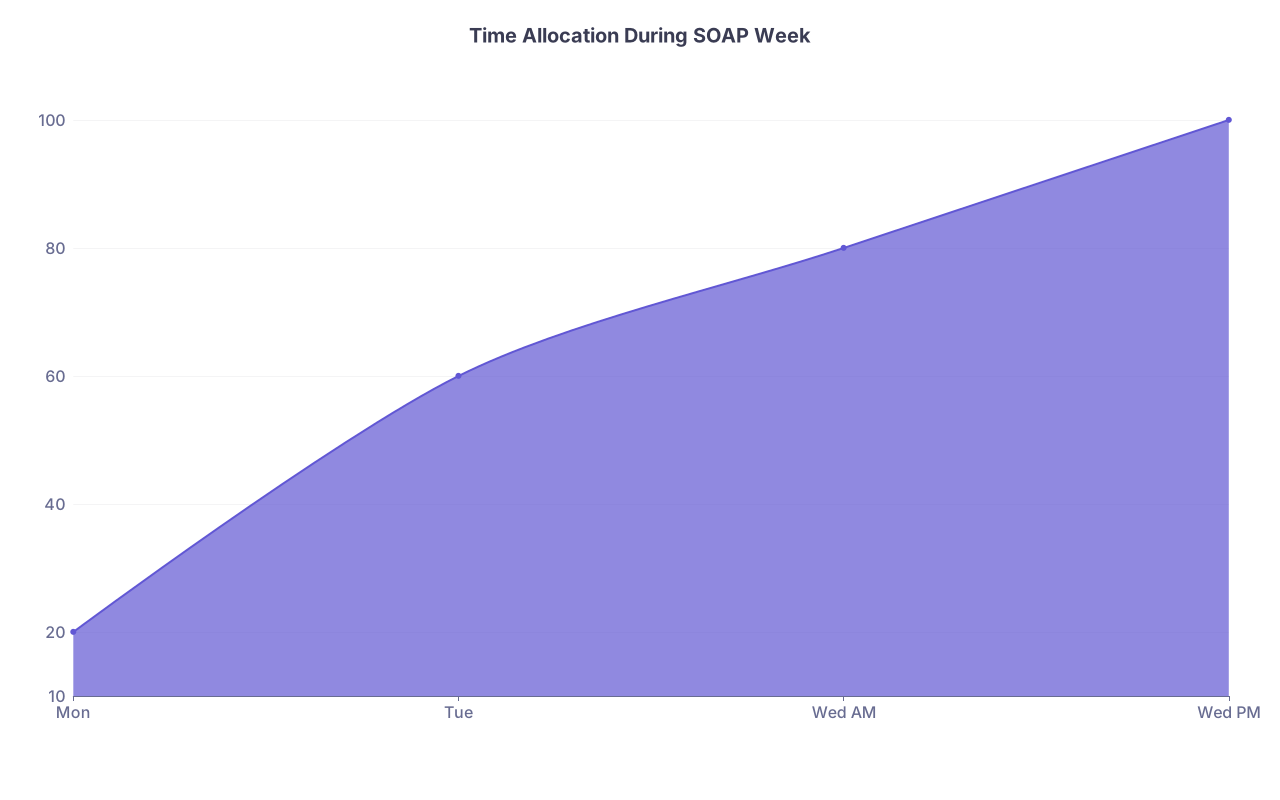
| Category | Value |
|---|---|
| Mon | 20 |
| Tue | 60 |
| Wed AM | 80 |
| Wed PM | 100 |
9. Not Updating Ranks Based on Real Interest From Programs
Some applicants create a rank list on Tuesday and barely touch it, even as new information comes in.
They ignore:
- Programs that:
- Call multiple times
- Express genuine enthusiasm
- Ask follow‑up questions showing real interest
- Versus programs that:
- Are clearly non‑committal
- Barely remember who you are
- Sound like they’re talking to 80 people in the same script
No, SOAP is not “offer‑based” like the pre‑2013 scramble days. It’s still a match algorithm.
But being realistic about where you’re actually in contention is just smart.
If a program:
- Reached out more than once
- Asked specific questions about your application
- Told you, “We’d be happy to have you here”
You should not rank five other programs higher solely because “they’re in better locations” when those other programs barely engaged with you.
Balance, of course. Don’t rank a clearly malignant program #1 just because they called twice. But when deciding between broadly similar options, weigh actual interest.
Silent programs are not “secretly in love with your application.” If they don’t show interest, assume you’re not at the top of their list.

10. Disorganized Information = Disorganized Ranking
Last mistake that quietly wrecks people:
You simply can’t keep track of what you learned about each program.
So you:
- Confuse two similar-sounding community hospitals
- Forget which one had the abusive call schedule
- Misremember who offered strong mentorship and who didn’t
- Rank based on vague feelings instead of specific facts
By Wednesday evening, everything blurs. You’re exhausted, and all programs start to sound the same.
You avoid this by being methodical from the start:
Simple system (not fancy, just effective):
- Spreadsheet or notepad with:
- Program name + code
- Location
- Specialty / PGY level
- Pros (specific: board pass rates, resident vibe, PD engagement)
- Cons (specific: call schedule, location issues, reputation)
- Interest signals (number of contacts, tone of interactions)
- Final gut score (1–10)
When you build your rank list, you’re not guessing. You’re reviewing your own notes while relatively clear-headed.
Disorganization doesn’t just add stress. It directly leads to garbage ranking decisions.
FAQ: Ranking Strategy in SOAP
1. Should I ever rank a program I really do not want, just to increase my chances of matching?
No. Do not rank a program you would genuinely rather not attend at all. If you know you’d be miserable, unsafe, or unable to complete training there, leave it off. But don’t confuse “not perfect” with “unacceptable.” Many applicants weaponize this rule to justify ranking only 3 programs. That’s how they end up unmatched.
2. How many programs should I realistically rank in SOAP?
If you’re anything other than a strong US MD with stellar scores and no red flags, aim to use most or all of your available slots (commonly 25 per round). You don’t have to rank every program you applied to, but a list under ~10 is risky for most SOAP applicants. More is safer, as long as they meet your minimum standards.
3. Is it a mistake to rank prelim spots above categorical positions?
It can be. If your goal is long‑term stability and you already struggled to match once, a categorical position in a less desired specialty may be more secure than a prelim year in your dream specialty’s orbit. Prelim years end. Then you’re back in the cycle. Only rank prelims above categoricals if you have a clear, realistic plan and strong re-application prospects.
4. How much should location matter in my SOAP ranking?
Location is not irrelevant, but in SOAP it’s secondary to:
- Accreditation and board-eligibility
- Program stability and training quality
- Your ability to function and survive for 3+ years
It’s a mistake to let city preference drop safer, more stable programs down your list, especially when you’re already coming off a non‑match.
5. Do programs see how I rank them in SOAP?
No. Just like the Main Match, programs don’t see how you rank them. They submit their list; you submit yours; NRMP runs the algorithm. So basing your ranks on “I don’t want them to think I’m desperate” is pure self-sabotage. Your job is to rank programs in the order you most want to end up, balancing desirability with realistic chances.
Remember:
- SOAP is about survival and trajectory, not ego repair. Rank like you understand the stakes.
- Long, realistic, probability-aware lists beat short, pride-driven fantasies.
- Your future license depends less on the name on your badge and more on whether you smartly avoided these ranking mistakes when it mattered.