The fastest way to disappear in SOAP is to look like everyone else.
You cannot afford that. Not in a 72-hour firestorm where programs are sorting hundreds of “urgent” applications while also running their normal clinical lives. They are not gently reading every line. They are skimming for reasons to ignore you.
Let me walk you through the 10 SOAP mistakes that get you filtered out before anyone gives you a chance—and exactly how to avoid each one.
1. Recycling Your Failed ERAS Strategy
If your initial ERAS strategy did not get you a match, copying and pasting it into SOAP is not “efficient.” It is self-sabotage.
I see this constantly:
- Same generic personal statement
- Same program list logic
- Same rosy, non-specific explanation for red flags
- Same unattainable specialty choices
SOAP is not “ERAS round 2.” It is a different game with different priorities.
Programs in SOAP are asking:
- Can this person start safely on July 1?
- Are they realistic and self-aware?
- Will they be stable and low-drama as an intern?
You make a big mistake when you:
- Keep applying to ultra-competitive specialties (derm, plastics, ENT, ortho) with the same weak application
- Ignore categorical IM/FM prelim opportunities because you are “waiting for the right fit”
- Do not reframe your narrative to address why you are in SOAP and why you are ready now
What to do instead: Strip your strategy down in three steps:
- Admit what failed.
- Targeted too high? Under-applied to community programs? Ignored red flags? Name it on paper.
- Refocus on realistic fields.
- Internal medicine, family medicine, pediatrics, psych, prelim/transitional year. Harsh but true: if you are in SOAP, ego has to leave the room.
- Rewrite your core message:
- “I learned from this setback, I am ready to work, I understand the reality of intern year, and here is proof.”
If you do not change the strategy, you will not change the outcome. Programs can smell ERAS copy-paste from a mile away.
2. Ignoring Program Filters and Wasting Slots
SOAP is about precision, not volume. The lazy mistake is “apply everywhere, someone will bite.” That is how you burn all 45 SOAP slots on programs that would never touch your file.
Programs are brutal with filters in SOAP:
- USMLE/COMLEX score cutoffs
- Graduation year limits
- Visa status exclusion
- No prior attempts / no failures policies
If you do not match their basic criteria, you are dead on arrival.
| Filter Type | Typical Threshold / Rule |
|---|---|
| USMLE Step 1 | Pass on first attempt required |
| USMLE Step 2 | Cutoff 220–230 for many IM/FM |
| Grad Year | Within 3–5 years of graduation |
| Visa | J-1 only or no visa sponsorship |
| Attempts | No more than 1–2 exam failures |
Here is the trap: in SOAP, panic overrides judgment. You see any open position and click. You do not read the fine print. Then you sit there wondering why nothing is happening.
What to do instead: Before you apply, for every single program:
- Read their published criteria (from their website and the NRMP/ERAS listing).
- Verify:
- Visa policy vs your status
- Graduation year limits
- Pass/fail and attempt language (especially around Step 2)
- Apply only if you can reasonably clear the minimum bar.
You are not trying to be “lucky.” You are trying to be eligible.
3. A Generic, Bland SOAP Personal Statement
“Thank you for considering my application to your esteemed program…”
Stop. That line alone gets you mentally tossed into the “same as everyone else” pile.
The biggest SOAP writing mistake: using a vague, polished essay that never addresses the elephant in the room—you are in SOAP.
Programs are not reading to be inspired. They are scanning for:
- Risk
- Drama
- Delusion
- Lack of insight
You lose them when you:
- Pretend SOAP did not happen
- Blame “competition” without any self-reflection
- Over-sell passion and under-sell reliability and resilience
- Use clichéd patient stories instead of specific evidence of being ready to work
How to fix it: In SOAP, your statement should be:
- Short (3–5 tight paragraphs, ~500–700 words)
- Clear about your situation without self-pity
- Focused on readiness for intern duties
A safer structure:
- One concise paragraph on who you are (school, core interests, what kind of physician you are becoming).
- One paragraph briefly and honestly addressing why you are in SOAP:
- “I initially applied broadly in X and Y, however I did not receive a position this cycle. My application is affected by [brief, factual issue]. Since then I have [specific steps taken] and I am now fully prepared for an intern role.”
- One or two paragraphs proving you can do the job:
- Specific sub-I performance, call responsibilities, feedback from attendings.
- One paragraph on why this field / kind of program fits your skill set and values.
Do not over-explain the failure. Acknowledge it. Then pivot quickly to what you have done since.
4. Failing to Own Your Red Flags Directly
Nothing gets an application ignored faster than a file screaming “something is off” with zero explanation.
Common red flags that must be addressed:
- Multiple Step/COMLEX failures
- Leave of absence
- Extended graduation time
- Disciplinary action / professionalism concerns
- Failed rotations, remediation
What most SOAP applicants do:
- Pretend it did not happen
- Hide behind vague phrases like “unexpected personal challenges”
- Write three paragraphs of context and zero paragraphs of accountability
Program directors are not dumb. They talk like this behind closed doors:
- “If they cannot explain this now, how will they handle an intern mistake?”
- “I do not have time to dig through this drama.”
Better approach: “Clean ownership”
Short, factual, and accountable. For example:
“I failed Step 1 on my first attempt due to poor study planning and underestimating the exam. I re-evaluated my approach, completed a structured study program, and passed on my second attempt with [score]. Since then I have passed Step 2 on the first attempt and performed strongly on inpatient rotations, where my clinical reasoning and reliability were consistently praised.”
Key points:
- Say what happened plainly.
- Take responsibility.
- Show corrective action and sustained improvement.
- Then stop. Do not write a tragedy monologue.
If you force programs to guess what went wrong, they will assume the worst and move on.
5. Chasing Prestige Instead of Stability
SOAP is not the time to chase your dream city, your dream brand name, or your dream lifestyle.
The dangerous mindset:
- “I will only apply to big academic centers.”
- “I do not want to be in a small town.”
- “I will hold out for X specialty because it is what I always wanted.”
Meanwhile:
- Community programs with solid training and good board pass rates sit with unfilled spots.
- You end the week with nothing.
I have watched people turn down strong prelim or categorical IM offers in SOAP because they were “hoping psych might call.” It is painful later when they are scrambling for research years and reapplication plans that never quite work.
You must reframe the goal: SOAP goal = secure a legitimate, ACGME-accredited position where you can safely train and build a career.
For many of you:
- A solid categorical IM/FM/Peds/Psych spot is a win.
- A strong prelim year in medicine or surgery at a real program is much better than “no match and another year lost.”
Stop filtering programs by:
- City glamour
- Name recognition
- Perceived prestige from your classmates’ opinions
Filter by:
- ACGME accreditation
- Board pass rates
- How alumni do in fellowships or jobs
- Evidence the program will not abuse you or sink on accreditation review
SOAP punishes pride. Be strategic, not sentimental.
6. Sloppy, Rushed Document Updates
The adrenaline during SOAP is real. You log into ERAS, see the timer, and start smashing keys.
That is how you end up with:
- Mismatched dates on experiences
- Typos in your new personal statement
- Wrong specialty mentioned (“internal medicine” in a psych application)
- Uploading the wrong letter file (yes, this happens more than you think)
Programs read carelessness as a proxy for how you will chart, prescribe, and sign orders.
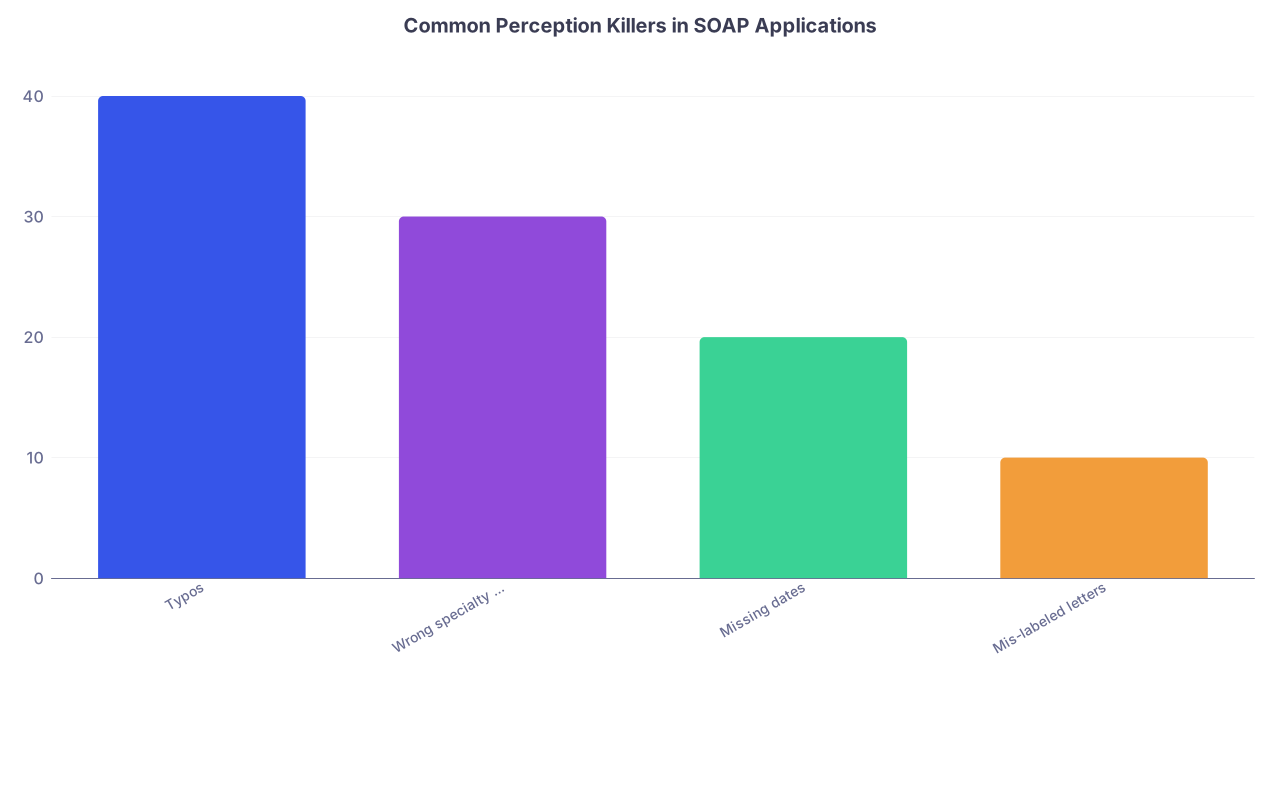
| Category | Value |
|---|---|
| Typos | 40 |
| Wrong specialty named | 30 |
| Missing dates | 20 |
| Mis-labeled letters | 10 |
If they see basic errors under time pressure, they assume:
- Poor attention to detail
- Higher risk for unsafe behavior on the wards
- Lack of respect for the process
Non-negotiable safeguards:
- Use a checklist:
- Updated CV
- Updated experiences (with accurate dates)
- Polished SOAP-specific personal statement
- Correct letters by specialty
- Have one trusted person read your statement aloud once. If they stumble, fix it.
- Search your personal statement for the wrong specialty name before uploading. Always.
You are being evaluated as an almost-physician. Show that you operate like one even under stress.
7. Terrible Communication and Phone Etiquette
You can lose offers in SOAP without ever knowing it. The common way? You handle communication like a distracted student instead of a near-colleague.
Programs have limited time. They will not chase you.
Red flag behaviors:
- Not answering calls from unknown numbers during SOAP
- Letting voicemails sit for hours
- Casual or sloppy email replies (“Hey, yeah I’m free whenever”)
- Unprofessional voicemail greetings (“Yo, it’s Mike, leave it”)
Programs notice. Some will literally move to the next candidate if:
- Your voicemail is full
- Your callback takes too long
- Your tone is disinterested or chaotic
Fix this before SOAP opens:
- Set a professional voicemail:
- “Hello, you’ve reached Dr. [Last Name]. I am unable to come to the phone. Please leave your name, number, and a brief message. I will return your call as soon as possible.”
- Keep your phone charged, on loud, and near you at all times during SOAP.
- Respond to all missed calls and voicemails promptly and professionally.
- Use formal email structure: greeting, body, signature with your full name, degree, AAMC ID.
You are being judged not just on your file, but on how you behave under pressure. Sloppy communication screams “future problem.”
8. Unprepared, Rambling SOAP Interviews
SOAP interviews are compressed, blunt, and fast. There is very little patience for disorganized answers.
The mistake: treating these like casual check-ins instead of high-stakes, condensed residency interviews.
Common failures:
- Cannot answer “Why this specialty now?” without stumbling
- Over-sharing emotional details about not matching
- Blaming prior programs, deans, or the system
- Giving five-minute monologues for simple questions
- Having zero specific questions about the program
Programs are trying to answer one major question: “Will this person be safe, workable, and not a nightmare to supervise at 3 a.m.?”
If you sound scattered, bitter, or unrealistic, they move on.
Bare minimum prep: Have tight, rehearsed answers (not robotic, just clean) for:
- “Tell me about yourself.”
- “Can you explain why you are in SOAP?”
- “Why [this specialty]?”
- “What have you been doing this year?”
- “What are your biggest weaknesses or areas you are working on?”
- “Why are you interested in our program specifically?”
And for the “SOAP question” itself, something like:
“I did not match in the main phase, largely because [brief factual reason]. Since then I have [concrete steps: more clinical work, studying, improved Step 2, etc]. SOAP gives me the opportunity to bring what I have learned and commit fully to a program where I can work hard, keep learning, and serve patients safely.”
Then stop. Do not start crying on Zoom. Do not spiral into your full emotional processing of the last year. Save that for therapy or friends, not PDs with 40 calls to make.
9. Being Rigid About Specialty or Geography
One of the most painful patterns in SOAP is watching people cling to rigid preferences while the clock runs out.
Variations of this:
- “I will only do psych, I refuse to apply to IM or FM.”
- “I will not leave this state because of my partner / family.”
- “I do not want prelim, only categorical.”
Sometimes, those boundaries are non-negotiable. Family illness, visa realities, children in school—real things. But often, it is fear or ego dressed up as necessity.
Meanwhile:
- You pass on 20+ realistic options that could launch your career.
- You convince yourself next year will be easier. It usually is not.
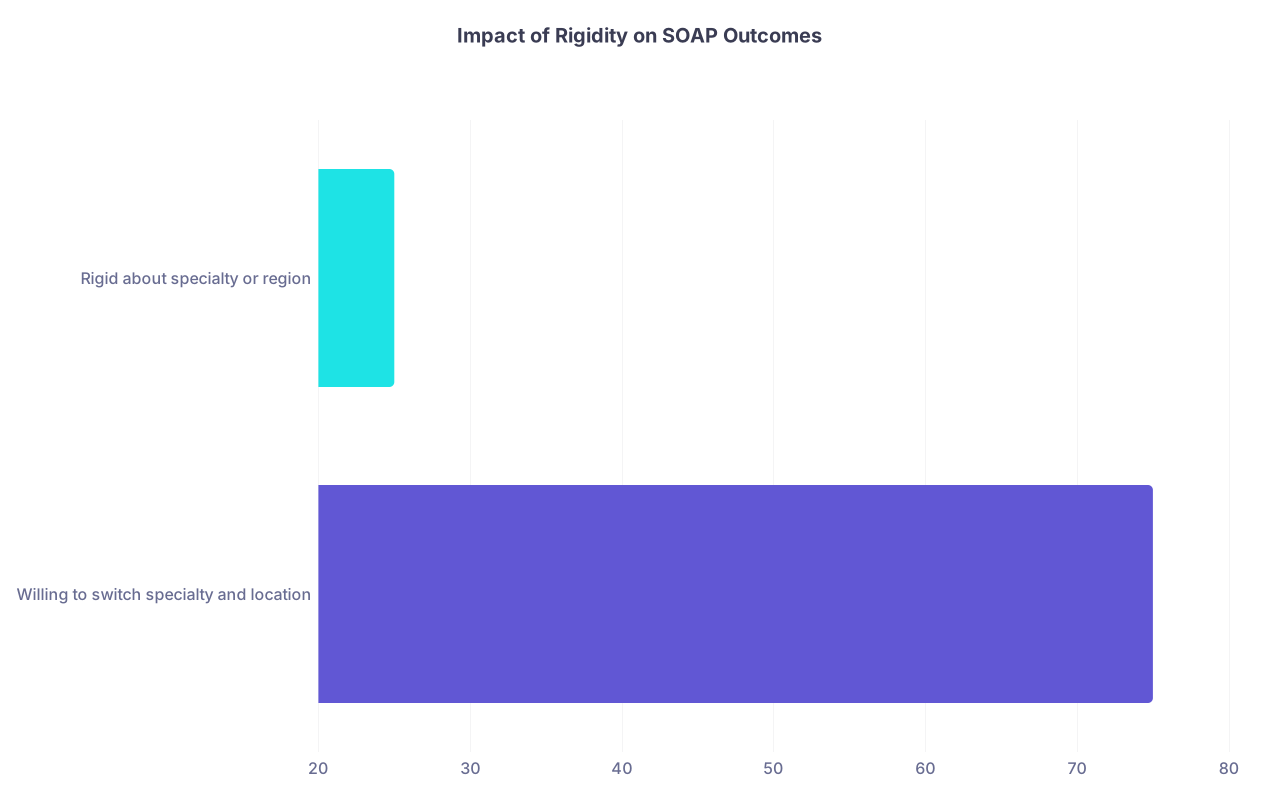
| Category | Value |
|---|---|
| Willing to switch specialty and location | 75 |
| Rigid about specialty or region | 25 |
(Those numbers are not from a randomized trial. They are from years of watching who ends up signing contracts on Friday vs who is back in the same spot next cycle.)
You need a Plan A, B, and C:
- Plan A: Target specialty and wide geographic net, including less popular locations.
- Plan B: Alternate specialty you would accept and can justify (IM → FM, FM → Psych, etc.).
- Plan C: Prelim / transitional positions you would accept as a stepping stone.
If you box yourself into one narrow path, SOAP will steamroll you. More flexibility = more shots at a real role.
10. Zero Contingency Plan if SOAP Fails
The final mistake is also the quietest: assuming SOAP will save you, with no serious plan for what happens if it does not.
Programs feel this, by the way. When they ask, “What would you do if you do not secure a position this year?” and you have nothing coherent, they hear:
- No long-term thinking
- No resilience strategy
- Panic energy
You are not jinxing yourself by planning. You are acting like a professional.
You need a real, written Plan D: Potential components:
- Research position with a credible PI in a relevant specialty
- Dedicated, structured Step 2/3/COMLEX Level prep if scores are your weakness
- Meaningful clinical experience (scribing alone rarely cuts it)
- Addressing gaps: professionalism course, remediation, language skills, etc.
- Clear target specialties for reapplication that match your record
Your answer in interviews can be brief: “If I do not obtain a position this cycle, my plan is to continue strengthening my application by [specific actions]. However, my goal is to contribute as an intern this year, and I am fully ready to do that.”
SOAP is 4 days. Your career is 40 years. Programs want to see that you are thinking beyond Thursday at noon.

| Step | Description |
|---|---|
| Step 1 | Unmatched after main Match |
| Step 2 | Audit ERAS strategy |
| Step 3 | Identify realistic specialties |
| Step 4 | Check program filters carefully |
| Step 5 | Update CV and statement for SOAP |
| Step 6 | Prepare concise red flag explanations |
| Step 7 | Set up professional communication |
| Step 8 | Rehearse focused SOAP interview answers |
| Step 9 | Submit targeted SOAP applications |
| Step 10 | Evaluate and accept best fit |
| Step 11 | Activate post SOAP Plan D |
| Step 12 | Receive offers? |
FAQ: SOAP Application Mistakes
1. Should I write different personal statements for different SOAP specialties?
Yes, if you are applying to more than one specialty, you need at least slightly tailored statements. The mistake is sending an IM-focused statement to a psych or FM program. You do not need wildly different essays, but you must:
- Name the correct specialty
- Align your skills and interests with that field
- Avoid obviously contradictory claims (“I have always only wanted surgery” in an IM application)
2. Are prelim positions in SOAP “giving up” on a categorical spot?
No. The real mistake is treating prelim offers as inferior by default. A strong prelim IM or surgery year:
- Keeps you clinically active
- Gives you US-based evaluations and letters
- Demonstrates you can function at intern level That can significantly strengthen your next application for a categorical spot if you use the year wisely. Prelim is a bridge, not a sentence.
3. How many SOAP programs should I apply to?
Do not obsess over the raw number. Obsess over fit and eligibility. That said:
- Most applicants should use a large portion of their 45 slots.
- The mistake is either spraying all 45 at unrealistic programs or using only 10–15 out of fear. Your target: enough applications to a broad but realistic set of programs where you clearly meet filters and can truthfully explain your interest.
Open your ERAS documents right now and do a brutal audit: what, exactly, are you changing for SOAP compared to your failed main Match strategy? If the answer is “almost nothing,” you are setting yourself up to be ignored again. Fix that today, before the clock starts.