
It’s Monday of SOAP week, 11:58 a.m. Eastern. You’re staring at your screen, finger hovering over refresh, waiting for the unfilled list to drop. You’ve told yourself, “If I can just get my application in front of the program director, I’ve got a shot.”
Let me stop you right there.
At most programs, especially in the busy, mid-tier ones that actually fill a lot of SOAP spots, your application is not going straight to the PD. It’s going through a gatekeeper. Usually a coordinator. Sometimes a chief. Occasionally a fellow, an APD, or a mix of all three. But there is a triage layer, and it’s often brutal and fast.
You want to know what really happens in that first pass? What they actually click, what they ignore, and why some people get a call within two hours while others never hear a word?
That’s what we’re doing here.
The Reality: Coordinators, Not PDs, Do the First Cut
Let me be blunt: most program directors don’t have the bandwidth or patience to read 300 SOAP applications line-by-line in 24–48 hours. Some try. Most fail. So they offload.
Behind the scenes, the workflow at many places looks like this:

| Step | Description |
|---|---|
| Step 1 | ERAS SOAP Pool |
| Step 2 | Coordinator Review |
| Step 3 | Reject or Ignore |
| Step 4 | Shortlist |
| Step 5 | Chief or APD Review |
| Step 6 | PD Final List |
| Step 7 | Interview or Offer |
| Step 8 | Meets Basic Filters |
Nobody advertises this on the program website. But I’ve sat in offices where two coordinators and a chief resident huddled around screens, blowing through applications in 15–20 second bursts, deciding who even makes it to the PD’s inbox.
Their job in SOAP is not to “holistically review” everyone. Their job is to rapidly identify “safe” candidates the PD would plausibly sign off on. They’re risk filters.
So if you’re optimizing your SOAP strategy around “impressing the PD,” you’re already missing the first battlefield.
You have to survive the coordinator first.
How They Actually Screen: The First 15–30 Seconds
Here’s what coordinators really do when that flood of SOAP applications hits.
They don’t start by opening your personal statement. They don’t scrutinize your volunteer hours. They don’t care (yet) that you tutored underserved kids in high school.
They start from the list view. And they scan.
Think of it like an airport security line. They’re not doing deep interrogation on everyone. They’re glancing for obvious red flags and pulling out the people who “look okay” to send forward.
Most coordinators I’ve watched use a routine that looks roughly like this, often in this exact order:
- Filter by citizenship/visa (if the program has limitations)
- Check prior training status (re-applicant, prior resident, prelim TY, etc.)
- Look at medical school (US MD, US DO, IMG)
- Check graduation year (how far out from med school)
- Quick look at Step/COMLEX scores + failure history
- Click into a subset for deeper review: flags, experiences, LOR headers, PS opener
All of that in under a minute per “maybe” candidate. Often 10–20 seconds on the obvious no’s.
They’re not being cruel. They’re racing the clock.
During SOAP, timelines compress. Programs often want their short list by the end of the first afternoon. Unfilled spots have institutional pressure attached. Nobody wants to explain to the chair why they didn’t fill.
So coordinators make quick, conservative choices. Safe, rule-following, CYA choices.
The Quiet Filters: What Gets You Auto-Dropped
There are a handful of things that get people silently filtered out before the PD ever sees them. None of this appears on the website. But you’ll see the pattern if you sit in enough offices.
| Filter Type | Typical Cutoff / Reaction |
|---|---|
| Graduation Year | >5–7 years since graduation often cut |
| Step 1/2 CK | Multiple fails = near auto-reject |
| Visa Status | No visa support → all visa-needing out |
| Prior Residency | Terminated residents = high risk |
| Specialty Switch | Some programs avoid serial switchers |
Now the details.
1. Year of Graduation
A lot of programs have an unofficial “max years since graduation” rule—often 3, 5, or 7 years. They’ll never say this out loud in a formal way, because legally and publicly it’s messy, but I’ve watched coordinators sort by graduation year, scroll, and say:
“Okay, let’s focus on 2019 and later unless we’re desperate.”
If you’re:
- US grad, 1–3 years out: usually fine
- 4–7 years out: depends on specialty, program, and what you’ve been doing
7 years out: you’re relying on a PD willing to go against the grain
If you’re older and still get looks, it’s almost always because your recent clinical activity and US experience are obvious and strong right up front.
2. Step/COMLEX Scores and Failures
Even with Step 1 pass/fail, failures still sting. In SOAP, they sting more.
Here’s what typically happens:
Coordinator opens the score section. Eyes go immediately to:
- Any “Fail” entries
- Step 2 CK and/or COMLEX Level 2 scores
- Pattern: multiple attempts, large gaps, big downward trends
Two scenarios I see all the time:
Someone with a Step 1 fail, but clean Step 2 CK with a solid score and recent clinical activity → often still gets forwarded, especially in SOAP.
Someone with multiple Step failures, late graduation year, no strong US clinical recency → quietly cut, no matter how heartfelt the personal statement.
They’re thinking: “Will my PD have to explain this at a CCC or to the GME office? Will this person pass boards? Will they become a metric problem?”
If your file screams “maybe trouble with exams,” you need something crystal-clear and recent that screams “not anymore.”
3. Visa and Citizenship Status
This is the cruelest and most opaque part.
If the institution doesn’t sponsor visas? Every IMG needing sponsorship is dead on arrival, no matter how strong. Coordinator applies a filter, they disappear. The PD never even hears your name.
If they do sponsor but only J-1, they might still soft-prioritize:
- US citizens/green cards
- IMGs who don’t need sponsorship
- Then everyone else
During standard Match, some programs stretch. During SOAP, a lot of them play it safe. They worry about delays, bureaucracy, paperwork, contract timing.
This is also where “we’ll consider IMGs” on the website becomes “we only really looked at US grads” on SOAP day.
4. Prior Residency and Problem Files
Coordinators have long memories. If you withdrew, resigned, or were let go from another residency and it’s in your file? Expect them to pull that up instantly.
I’ve heard actual lines like:
“Didn’t we see this person last year?”
“Is this the one who left the surgery program after a month?”
“Check the PD comments from last time.”
If your record shows:
- Prior residency termination
- Professionalism issues
- Big unexplained gaps, especially post-residency start
You are not getting through the coordinator layer without an explicit, coherent explanation that’s impossible to miss. Buried nuance on page 6 of a personal statement doesn’t cut it.
What Makes Them Stop Scrolling and Actually Open Your File
Now let’s talk about the flipside: what makes a coordinator slow down, click, and say, “Let me send this one to the PD.”
There’s a pattern here too.
1. Clear Fit With Program Needs
Coordinators know their PDs. They’ve seen who actually gets ranked, who thrives, who flames out. They also know what the program is short on this year.
A few examples:
- A community internal medicine program that loves DOs with strong Step 2 and lots of hands-on US rotations
- A surgery program that’s been burned by low-board residents and now quietly wants 240+ Step 2 for SOAP
- A peds program that really likes home-state grads or people with ties to the region
If your app checks those “we like these people” boxes in the header view, you’re already ahead.
This is why those “Signal fit” elements matter more than people realize:
- Med school in the same region
- Rotations at nearby hospitals
- Mentioning the city or system in your PS (yes, some coordinators actually search for their city name in PS text)
They’re not doing academic detective work. They’re scanning for alignment and absence of obvious risk.
2. Simple, Clean, Boring Story
Boring is underrated.
If the file looks like this:
- US grad 2023
- No failures
- Reasonable scores
- Recent clinical activity
- No unexplained gaps
The coordinator thinks: “Safe. PD won’t yell at me for sending this.”
If you’re in SOAP, that “boringly safe” look is gold. Overcomplicated stories with multiple restarts, unexplained location jumps, or scattered experiences are harder to sell fast.
3. Strong, Recognizable Letters and Experience Headers
Here’s the part nobody tells you: many coordinators don’t actually open each LOR fully on first triage. They read the headers.
They’ll look at:
- Who wrote it (“Program Director, XYZ Residency”; “Chair, Department of Medicine, State University”)
- Where it’s from (big university hospital vs unknown clinic)
- The role (PD vs “Attending Physician” vs “Clinical Instructor”)
A SOAP candidate with:
- 2–3 letters from US academic hospitals
- At least one from a program director or clerkship director
Will usually feel “safer” than someone with:
- Three clinic letters from “Internal Medicine Physician” at small private offices
- No PD-level references at all
So if you have any letter that sounds like: “Program Director, Department of…” — that needs to be prominent.
What They Actually Click Inside the Application
Once you pass the quick scan, what gets opened next is fairly consistent.
The order I’ve seen most often:
- Scores (already discussed)
- Personal Statement – quick skim, especially top paragraph
- Experiences – just the headings and most recent entries
- LOR list – who they’re from, where, and how many
- MSPE if time allows (for US grads)
They’re not doing a dissertation defense. They’re trying to answer a few fast questions:
- Is this person reasonably safe on paper?
- Does their story make sense?
- Do I feel queasy sending this to the PD?
If the answer to that last question is “no,” you get forwarded.
How To Make Your SOAP Application Survive Coordinator Triage
Now the part you actually care about: how to play the game they’re really playing.
1. Write for Skimmers, Not Ideal Readers
Your SOAP application has to be legible at high speed to someone who’s tired, under pressure, and not invested in your personal growth arc.
That means:
The first 3–4 lines of your personal statement should state your specialty commitment clearly. No long “why I love medicine” intro. Something like:
“I’m applying to categorical internal medicine positions after completing a transitional year, with the clear goal of pursuing a career in hospital-based adult medicine.”
If you’re switching specialties, the first paragraph should make that switch obvious and defensible in plain language, not buried in paragraph three.
Major red flags (Step failures, gaps, prior residency) need a short, calm, direct explanation early. If you leave them guessing, you usually lose.
2. Make Red Flag Explanations Impossible to Miss
I’ve seen strong candidates ignored because the explanation for a Step failure was buried in line 17 of the PS and the coordinator never got that far.
You want something like:
“During my second year of medical school, I failed Step 1 on my first attempt after a period of untreated anxiety and poor study structure. After addressing this with formal treatment and a structured plan, I passed on my second attempt and subsequently scored 240 on Step 2 CK on the first attempt. Since then, I have consistently performed well on standardized exams and in clinical settings.”
Readable. Linear. No melodrama. Gives coordinator language they can use if a PD asks, “What’s the story with this fail?”
Same with gaps:
“Between graduation in 2021 and the present, I have been working as a full-time clinical research coordinator in cardiology at XYZ University Hospital while applying to residency.”
No mystery. No weird silence.
3. Highlight Recent, Relevant Clinical Activity Clearly
For SOAP, recency is huge. Coordinators and PDs are scared of the “rusty” candidate who hasn’t touched real patients in three years.
If you’ve done:
- Observerships
- Externships
- Research with clinical contact
- Telemedicine scribing
- Hospitalist assistant roles
Make sure those experiences are:
- Dated clearly (end date as recent as possible)
- In the top few experiences on your list
- Described with a concise, clinical-feeling summary
Something like: “Full-time inpatient medicine extern, involved in pre-rounding, note-writing, and presenting to attendings under supervision” reads better than “Learned a lot about medicine and teamwork.”
4. Match Your Story to the Specialty You’re SOAPing
If you SOAP into a different specialty from your main cycle, coordinators look for cognitive dissonance.
I’ve watched them say: “Their PS is all about ortho and now they’re SOAPing into FM. Hard no.”
If you’re pivoting:
- Rewrite the personal statement. Do not leave it as your original specialty essay.
- Reframe your experiences in language that matches the new field’s vibe.
- Explicitly acknowledge the shift: “After not matching into general surgery, I took a step back and recognized that what I valued most was longitudinal patient care and continuity, which aligns more with family medicine…”
You don’t need a TED Talk. You need a sane, believable arc that a coordinator isn’t embarrassed to send up the chain.
5. Use Communication Channels Strategically (Without Being a Pest)
Coordinators run the communication machine during SOAP. They manage emails, phone calls, Zoom links, spreadsheets. Some of them keep informal “annoying applicant” lists. Do not get on that list.
Reasonable moves:
- A single, concise email expressing interest in the program after you’ve applied, especially if you have a real tie (geography, prior rotation, alumni connection).
- A short, professional subject line: “SOAP Applicant – [Your Name] – Interest in [Program Name]”.
- Two tight paragraphs max. No life story.
Unreasonable moves:
- Calling multiple times.
- Emailing from multiple addresses.
- CC’ing the chair, PD, APD, and GME office.
- Sending long, emotional essays begging for a chance.
The coordinator has more power over your fate than you realize. Don’t make their life harder.
Specialty-Specific SOAP Triage Nuances
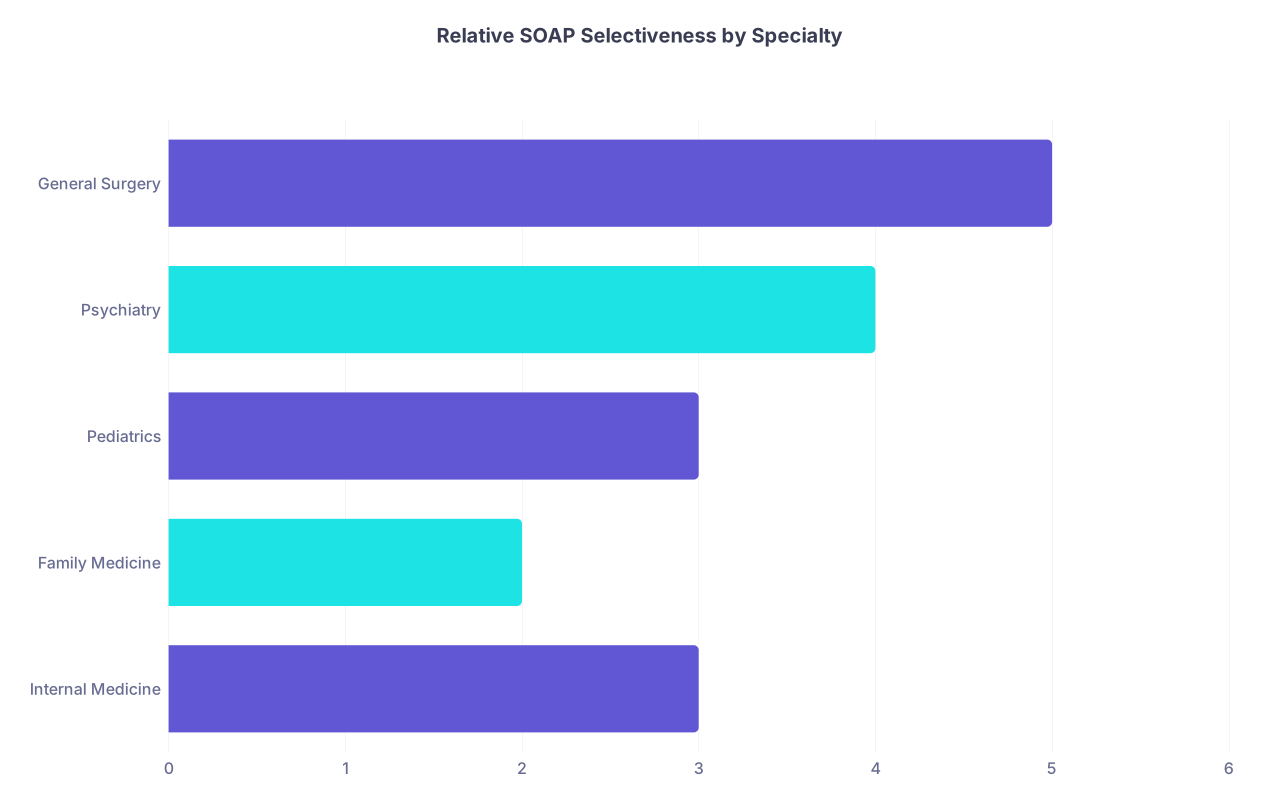
Different specialties behave differently under pressure. A quick snapshot.
| Category | Value |
|---|---|
| Internal Medicine | 3 |
| Family Medicine | 2 |
| Pediatrics | 3 |
| Psychiatry | 4 |
| General Surgery | 5 |
(Scale 1 = most flexible/forgiving in SOAP, 5 = most selective/risk averse.)
Family Medicine: Often the most flexible. Coordinators still screen, but PDs are sometimes more open to “non-traditional” backgrounds if recency and communication are good.
Internal Medicine: Middle-of-the-road. Big range depending on whether it’s university vs community, coastal vs Midwest, etc.
Pediatrics: Often prefers “clean” files, but some programs will take a chance in SOAP for someone who clearly likes kids and has decent Step 2.
Psychiatry: Increasingly competitive. In SOAP, many psych programs become skittish. Strong preference for no major professionalism concerns and decent exam performance.
General Surgery: In SOAP? Ruthless. Fails + weak scores + older YOG? Brutal combination. Coordinators know their PDs will not want to fight about board passage later.
Final Insider Tactics You Can Actually Control
You cannot change your graduation year. You cannot magically erase a Step failure. You cannot rewrite institutional visa policies.
You can:
- Make your story stupidly easy to understand on a fast skim.
- Put your strongest, most recent clinical activity in the spotlight.
- Address red flags directly, early, and calmly.
- Align your written materials with the specialty you’re SOAPing into.
- Avoid irritating the one person (the coordinator) who can bury or boost your file with a couple of clicks.
Remember: coordinators are not your enemy. They’re just operating with too many applications, not enough time, and a PD who will absolutely remember if they send up someone who implodes.
If you make it easy for them to say, “This one looks solid,” you’ve already cleared the first, very real hurdle.