
Last year during SOAP, I watched an unmatched student at 10:30 a.m. on Monday with zero interviews and a dead‑silent inbox. By Wednesday afternoon, he had three offers. The difference wasn’t his application. It was his alumni network—used surgically, not desperately.
Let me walk you through what actually works, what programs say out loud, and what they only admit behind closed doors when the doors are shut and the list is already submitted.
What Programs Really Do During SOAP (And Where Alumni Fit In)
You’ve seen the official NRMP language about SOAP: fairness, structured offers, no backchanneling. Fine. Now let me tell you what really happens in program offices.
On Monday morning, once the SOAP-eligible list is out and applications start pouring in, most program directors are not sitting down to “holistically review 800 ERAS files.” They’re triaging. Fast. Usually in three rough piles:
- Obviously viable
- Maybe
- No chance
And right there, before anyone reads your third LOR, alumni influence starts to matter.
Here’s how the internal conversations actually sound:
“This kid’s from your med school, right?”
“Yeah. Dr. Patel texted me this morning—said she’s solid, just had a bad Step 1 timing.”
“Okay, flag her. We’ll interview.”
Or:
“Another applicant from Midwest State. Anyone know him?”
“Alum from there called yesterday—strong endorsement.”
“Alright, put him in the ‘call if we’re short’ stack.”
They are not “giving you a spot” because of an alum. But alumni often decide who even gets in the room—who moves from the huge anonymous pile to the small “let’s actually talk to this person” group.
And the harsher truth: by the time many students start contacting alumni during SOAP, it’s already too late, badly framed, or both.
So let’s fix that.
How Alumni Actually Help in SOAP (The Real Mechanisms)
Forget the fantasy that an alumnus can “get you in.” That’s how students waste time and annoy people. Instead, understand the specific levers alumni can and do pull during SOAP.
1. Quiet Pre‑Screen Boost
Most common and most powerful. An alum contacts a PD or APD and says, in plain language:
“We have a student in SOAP—name is X, ERAS ID Y. I’ve worked with her directly. She’s reliable, teachable, and we’d be happy to have her here. If you have space to review a few more applications, she’s worth a look.”
This does three things inside the program:
- Flags your application so it isn’t lost in the sludge.
- Softens any red flags that look worse on paper than they are.
- Moves you into the “we should at least interview” bucket—if you’re within their thresholds.
What it does not do: make them ignore deal‑breaker metrics. If their chair said “no one under 220” or “no one without Step 2,” one alum email won’t override that. Multiple trusted alumni plus a reasonable file might bend the line. Once in a while.
2. Context and Damage Control
Programs hate unknown risk. SOAP is chaotic, but the last thing a PD wants is a problem resident they never had time to vet.
Alumni can lower risk by giving context that ERAS never explains well:
- “Yes, there’s a leave of absence. It was for family illness, not professionalism.”
- “That failed shelf was during COVID disruption; on the service she was excellent.”
- “He failed Step 1 on the first try but has been performing solidly on wards; no concern about reliability.”
Behind closed doors, that sort of reassurance often sounds like:
“We don’t have time to dissect every blip. If you trust her, I’m okay interviewing her.”
It’s not magic. But it’s often the difference between “skip” and “call them this afternoon.”
3. Soft Prioritization at the Offer Stage
Once programs submit their preference lists for each SOAP round, it’s locked. Before that, though, they rank their top candidates based on:
- Scores / exams
- Fit (from rushed interviews)
- Gut feeling
- And yes, influence from trusted people
If an alum reaches out to say:
“We’d really love to see her matched somewhere solid. If you end up choosing between her and someone similar, she’ll work hard for you,”
that can move you a few spots up in the internal pecking order.
Not from #25 to #1. But from #7 to #4? That happens more often than you think. And when programs only have three categorical spots, that small nudge can be everything.
4. Sanity Check and Strategy Filter
Some of the most valuable alumni help never touches a program director.
The alumni who actually know SOAP will say things like:
- “Do not waste time on that program; they always fill with home/DO students they already know.”
- “This PD is rigid on scores, but community programs 50 miles away are much more flexible.”
- “Don’t chase university IM; shift some apps to prelim surgery and TY at X, Y, Z.”
That kind of guidance saves you from throwing your limited time and emotional bandwidth at dead ends.
Who to Contact (And Who to Leave Alone)
Most unmatched students spam the wrong people with the wrong messages at the wrong time. Then they conclude “alumni don’t help.”
They’re wrong. Their approach doesn’t help.
You want targeted, strategic outreach.
Your Priority List
Here’s the order that usually yields the best ROI, based on what I’ve seen from both sides of the table.
Clinical faculty from your own med school who actually supervised you
The ones who can truthfully say, “I worked with this student.” Their word carries weight.Recent alumni from your school now in residency, especially in your desired specialty
They’re closer in time to the process, often more motivated to help, and sometimes have direct access to PDs.Well‑connected senior alumni in your specialty
These are the “everyone in the region knows Dr. X” people. If they call a PD, that PD listens.Advisors who sit on your school’s promotions, clinical competency, or residency advising committees
They may not have direct pull with outside programs, but they can help triage who it is worth contacting.Residency coordinators or clerkship directors who are responsive and sympathetic
Not to call PDs for you, but to point you toward alumni who genuinely engage.
Who’s low‑yield:
- Alumni you’ve never spoken to and have zero connection with
- Big‑name researchers you barely know
- Residents in totally unrelated specialties at random programs you’re chasing just because they’re unfilled
I’ve seen students waste half of SOAP writing heartfelt emails to academic cardiologists while missing the assistant professor in community IM who would’ve picked up the phone.
Timing: The SOAP Clock and When Alumni Can Still Help
SOAP time is compressed. If you don’t understand the internal rhythm, you’ll ask for favors at exactly the wrong moment.
Let’s outline the real pace. This will vary by program, but the pattern is similar.
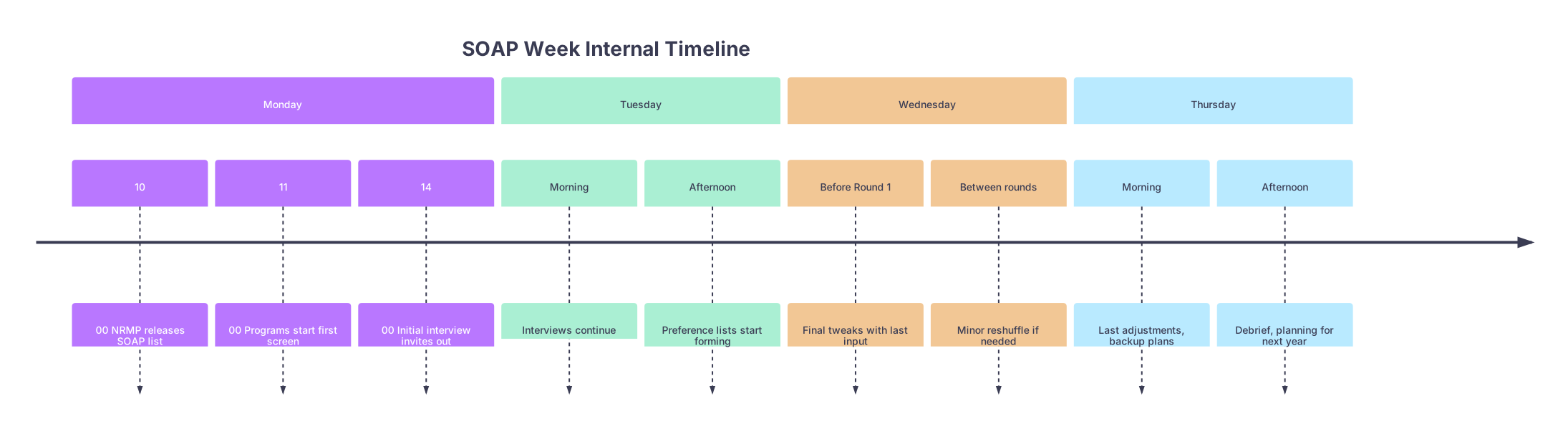
| Period | Event |
|---|---|
| Monday - 10 | 00 NRMP releases SOAP list |
| Monday - 11 | 00 Programs start first screen |
| Monday - 14 | 00 Initial interview invites out |
| Tuesday - Morning | Interviews continue |
| Tuesday - Afternoon | Preference lists start forming |
| Wednesday - Before Round 1 | Final tweaks with last input |
| Wednesday - Between rounds | Minor reshuffle if needed |
| Thursday - Morning | Last adjustments, backup plans |
| Thursday - Afternoon | Debrief, planning for next year |
Now, plug alumni into that.
Best time to activate alumni: 1–3 days before SOAP starts.
You want the introductions and “heads up” done before PDs are drowning in files.
That means:
- Contacting potential alumni helpers the week before Match results
- Having a one‑page PDF or short email blurb about yourself ready to forward
- Clarifying what you’re asking them to do, succinctly
During SOAP itself:
- Monday morning: PDs and coordinators are being crushed. Alumni who are already trusted can sometimes text or email them names to watch for. Cold outreach at this moment? Nearly useless.
- Monday late afternoon/Tuesday: Programs are still forming their call lists and preference orders. Alumni input can still move you into that pool.
- Wednesday: Alumni can sometimes push tiny adjustments within tiers, but if a PD has decided you’re out, you’re out.
- Thursday: Too late for this cycle. But still a smart time to debrief with alumni for future planning if you go unmatched.
How to Approach Alumni Without Sounding Desperate or Clueless
This is where a lot of students blow it. They reach out with a long, anxious essay that boils down to: “Can you get me a job?”
Busy alumni and faculty will not read a 700‑word crisis email during SOAP week. They skim for three things:
- Who are you?
- What’s your situation—concisely?
- What exactly are you asking from me?
Here’s the structure that works.
Initial Email Framework (Before SOAP Starts)
Subject lines that get read look like this:
- “Advice request – MS4 from [Your School], unmatched risk in IM”
- “Quick guidance for SOAP – [Your Name], [School], [Specialty]”
Then something like:
Dear Dr. Smith,
I’m a fourth‑year at [School] interested in Internal Medicine. I worked with Dr. Lee on the wards, and she suggested I reach out to you for guidance as I may be entering SOAP this year.
Brief background:
– Step 1: pass on second attempt; Step 2: 233
– Mostly high passes on IM rotations, strong feedback on wards
– Applied broadly to university and community IM; limited interview offers so farI’m not asking for special treatment—just honest advice on how best to use alumni contacts if I do enter SOAP. If you’re open to a 10–15 minute call this week, I’d really appreciate your perspective.
Thank you for considering this,
[Name]
[School]
[Phone]
Notice what this does:
- Owns the red flag without dwelling on it
- Signals you understand the limits (“not asking for special treatment”)
- Makes a small, specific ask (brief call / advice)
- Makes it easy for them to say yes and later think, “Okay, I’ll float this student’s name if needed”
The Follow‑Up During SOAP
If you do end up SOAPing and they’ve already said they’re willing to help, then you send something short:
Dear Dr. Smith,
I did end up in SOAP. I’ve applied to [X] Internal Medicine and [Y] prelim programs. If you know any PDs or faculty at [Program A], [Program B], or [Region X] who might be open to a brief look at my application, I’d be grateful if you could forward this note and my ERAS ID.
ERAS ID: [######]
Interests: general IM, potentially hospitalist
Strengths faculty have highlighted: solid team player, reliable, good with patients and documentationI understand you may be very busy; any limited support is appreciated.
Thank you again,
[Name]
You’re not begging. You’re giving them a clean script to forward or paraphrase in a quick email or text. That’s what gets used.
What Alumni Should Actually Say to Programs (And How You Can Tee It Up)
You can’t dictate an alum’s exact words, but you can heavily influence it by how you present yourself.
Here’s the kind of message that gets traction when a faculty member or alum reaches out to a PD:
“Hi John,
We have a senior student, [Name], who ended up in SOAP for IM this year. I worked with her on the wards and she did well—professional, good with patients, responsive to feedback.
Her ERAS ID is [######]. She has a prior Step 1 fail but passed on the second attempt and did reasonably on Step 2. If you have any flexibility to take a look at her application for one of your SOAP spots, I think she’d be a safe and hardworking choice.
Completely understand if you’re already full, but wanted to put her on your radar.
Best,
[Alum]”
Look at the elements:
- Clear relationship (“I worked with her”)
- Acknowledges the red flag rather than pretending it’s invisible
- Uses reassuring language PDs latch onto: professional, good with patients, responsive to feedback, safe
- Respects boundaries (“if you have any flexibility” / “understand if you’re already full”)
Your job is to give your alum enough understanding of your profile and your red flags that they can craft something like this without burning their own credibility.
Matching Your Profile to the Right Alumni and Programs
This part is where strategy really separates students who turn SOAP into a lifeline from those who just flail.
Not all alumni help is equal. A mediocre letter from some random alum at a powerhouse university program might be useless. A crisp email from a respected mid‑career attending at a community program can be gold.
Here’s a rough matching guide.
| Applicant Profile | Best Alumni Targets | Best Program Targets |
|---|---|---|
| US MD, low Step, decent clinical | Core clerkship attendings, IM/Peds community faculty | Community IM, TY, prelim |
| US DO, solid scores, fewer interviews | DO alumni in ACGME programs, chiefs | Community and smaller academic |
| IMG, high Step 2, strong research | IMG alumni now in US residencies | IMG-friendly community programs |
| Red flags (fail/LOA) | Faculty who know context well | Programs with history of taking non-traditional paths |
The dirty secret: most PDs aren’t swayed by a name they don’t know. But if they see an email from “that hospitalist at County who always sends us reliable people” or “the APD from State who trained here 10 years ago,” they listen.
So ask alumni very direct questions:
- “Which programs know you personally?”
- “Where have your prior students/residents matched?”
- “Who’s actually likely to pick up the phone or open your email?”
Then concentrate your fire there, not everywhere.
Common Mistakes Students Make with Alumni in SOAP
Let me be blunt. I’ve watched these errors sink perfectly salvageable situations.
Mass‑emailing every alum on a listserve
Looks desperate and generic. Alumni smell copy‑paste a mile away. You need targeted, personal outreach.Hiding the red flag
They’ll find out. Or worse, your alum will get blindsided when a PD says, “You didn’t mention two Step fails.” That alum never helps you—or anyone else like you—again.Asking for the impossible
“Can you get me a spot at your hospital?” screams naivety. Alumni don’t hand out positions; they can open doors and soften skepticism. That’s it.Reaching out too late
If your first email to an alum is Wednesday morning of SOAP, and you’re asking them to call three PDs before Round 2 lists are due, you’ve already missed most of the window.Being vague
“Any help appreciated” is useless. Say what kind of programs you’re targeting, your ERAS ID, and what exact help you’re hoping for.Ignoring school‑level advocacy
Many med schools have deans or advising committees who do organized outreach to programs for their SOAPing students. If you bypass them and run your own rogue campaign, you can create conflicting messages.
How Your Med School Uses Its Network (The Part They Don’t Advertise)
Here’s another behind‑the‑scenes piece: some schools aggressively advocate for their unmatched students during SOAP. Others quietly wash their hands of it.
The strong schools:
- Have a list of key alumni PDs and APDs in each specialty
- Start warning those contacts a week before SOAP: “We may have 2–3 IM candidates; can you keep an extra eye out?”
- Assign each unmatched student a faculty advocate or dean who will email or call selectively on their behalf
- Coordinate messaging so PDs don’t get five contradictory calls about the same student
The weak schools:
- Send a single “good luck” email
- Pull the “we can’t interfere with the process” line as a way to avoid doing hard work
- Blame the student entirely and stay out of it
If your school falls in the second group, you’re going to lean harder on individual alumni. But even in the first group, you should know who is already advocating for you so your alumni outreach is aligned, not redundant.
Ask your dean or advisor directly:
- “Will the school be reaching out to any programs on my behalf?”
- “Who will be doing that, and what will they be saying?”
- “Are there alumni you recommend I contact myself to complement what you’re doing?”
If they dodge, interpret that as a sign: you’ll need to build your own network quickly.
A Simple, Ruthless Alumni Strategy for SOAP
Let me give you a clean blueprint. No fluff.
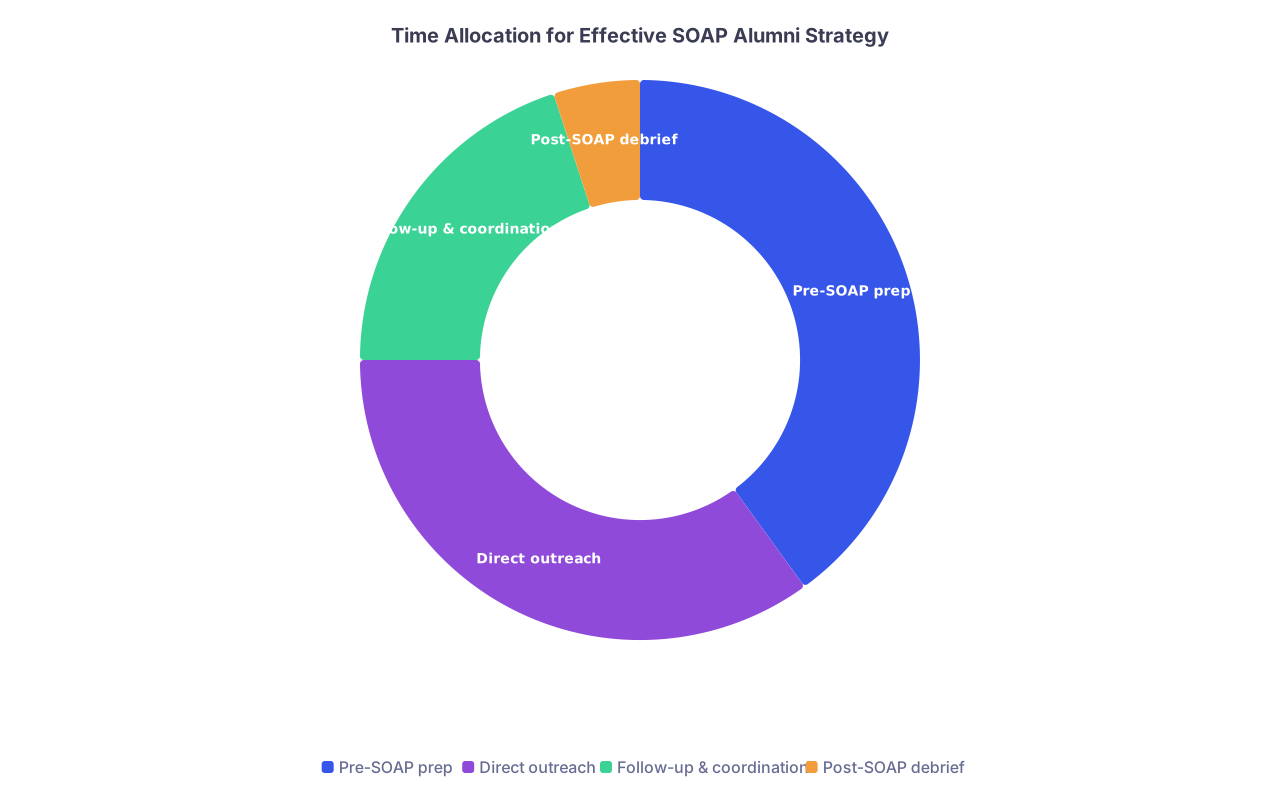
| Category | Value |
|---|---|
| Pre-SOAP prep | 40 |
| Direct outreach | 35 |
| Follow-up & coordination | 20 |
| Post-SOAP debrief | 5 |
Here’s how that breaks down in reality.
1. The week before Match Day
- Identify 5–10 high‑yield potential alumni/faculty contacts.
- Reach out with short, honest emails asking for quick advice and possible future support.
- Prepare a concise “alumni packet”: a short paragraph about you, your ERAS ID, and your target programs/types.
2. Monday–Tuesday of SOAP
- Keep alumni in the loop with one brief update email if they’ve agreed to help.
- Provide a focused list of realistic programs/regions where their word might matter.
- Let them know that even a single email or text to one PD could make a difference.
3. Wednesday–Thursday
- Don’t harass. One more update if something significant changes.
- If you match via SOAP, send a sincere thank you—immediately. If you don’t, still thank them and ask if they’d be willing to advise for the next cycle.
4. After SOAP
- Have a real conversation with at least one helpful alum about long‑term strategy if you remain unmatched.
- Keep that relationship alive; the people who helped you in crisis often remain your best mentors.
You’re walking into SOAP with less leverage than you wanted. Fine. That’s the reality. But you are not powerless—unless you act like it.
Used strategically, alumni won’t magically erase a noncompetitive record. What they will do is give you a fighting chance to be seen as a human being instead of ERAS file #437 in a panicked Monday morning sort.
If you’ve read this far, here’s your next move: make your list of names, draft your first two emails, and line up your pre‑SOAP conversations before the system throws you into the fire. When the clock starts on Monday, you want your alumni already in the game, not just opening your first frantic message.
Once you’ve survived SOAP—one way or another—the next step is learning how to rebuild or redirect your trajectory for the next cycle, using what you’ve learned and who you’ve met. That’s a longer conversation, and we’ll get there. For now, focus on building the quiet army you’ll need in the days ahead.