
The SOAP “war room” decides your fate in about 90 chaotic minutes.
Let me tell you what actually happens in there—and how you can position yourself so your name doesn’t just flash past on a spreadsheet before they move on.
This isn’t the glossy NRMP description. This is how program directors, associate PDs, and coordinators really talk, argue, and rank you when they’re exhausted, short on spots, and have a dean on line two asking if they can “do anything” for a student.
The Setup: What the War Room Really Looks Like
On paper, programs “systematically review SOAP applicants.” In reality, the war room is controlled chaos.
Most places run some variant of this cast:
- Program Director at the head of the table. Final say.
- One or two Associate PDs who actually did most of the pre-SOAP work.
- A couple of core faculty who "know the residents" and want to protect team culture.
- The Program Coordinator, who is the only person who actually understands ERAS and NRMP mechanics.
- Occasionally a chief resident, often pulled in for culture/fit reads: “Would this person survive nights with our seniors?”
The room itself? Usually a big conference room or PD’s office. Blinds half-closed. Coffee everywhere. Half the people haven’t eaten since breakfast. Everyone has a laptop open to ERAS and a shared spreadsheet, plus a printed list that’s already covered in highlighter and scribbles.
The mood is a mix of:
- Embarrassment that the program didn’t fill.
- Panic about getting these positions filled before deadlines.
- Territorial protectiveness over “their” residents.
- Quiet realism: “We’re not getting superstars. We’re trying to avoid disasters.”
That last line? I’ve heard it almost verbatim.

Before the SOAP Window: The Shortlist Is Built Without You
By the time SOAP opens, a lot of decisions are already made. This is where most applicants misunderstand the game.
Programs don’t start from zero on Monday morning. They prep.
In the days before SOAP:
- They pull every historically unmatched candidate they remember liking but not ranking high enough. Those names go into a “call them first” pile.
- They review internal and affiliated students who might not match and quietly flag them. Deans sometimes email PDs: “We’re worried about X, can you keep an eye out?”
- They create a template list of what they’ll absolutely not touch this year: multiple prior SOAP cycles, egregious professionalism issues, very low Step 2 with weak clinicals, etc.
- They decide which of their unfilled spots are “must-fill now” (e.g., categorical PGY-1) versus “we can survive one vacancy for a year.”
So when the SOAP applications hit, they’re not reading them with innocent open minds. They’re sorting people into three buckets almost instantly:
- People they already know or were tipped off about.
- People who look like standard, workable residents.
- People they want to avoid unless they’re absolutely desperate.
And here’s the part nobody tells you: by mid-morning on SOAP Wednesday, bucket #2 is mostly gone.
The First Pass: How Your File Gets Triaged in Seconds
When SOAP lists go live, everything is volume. For some specialties, they’ll see hundreds of applications for a handful of unfilled spots. They do not read every PS. They do not thoughtfully debate every CV.
They scan.
The program coordinator or an APD usually drives the screen-share:
- Step 2 (or COMLEX 2) first.
- US grad vs. IMG.
- Red flags column (repeatedly failed Step, prior match attempt, big gaps).
- Home/region ties, if they track that.
- Any pre-flagged candidates from their own med school or prior rotations.
A real exchange I’ve heard more than once:
“Step 2 is 203?”
“Any explanation?”
“Nope.”
“Next.”
You get about 10 seconds unless something hooks them. That hook can be:
- Their med school or a school they know well.
- A LOR from someone they recognize.
- “Strong home IM rotation; PD comments excellent.”
- A keyword in the personal statement hinting at their program/region.
This is why generic SOAP personal statements are useless. People love to say, “They don’t have time to read them.” Not entirely true. They read selectively.
What really happens is: they skim PS for signal, fast. If it’s a wall of clichés, it gets ignored. If the first few lines feel coherent, honest, and focused, it buys you another 10 seconds.
Inside the War Room: How Debates About You Actually Sound
For candidates who make it beyond the first pass, the tone changes. The PD will go case-by-case only for a fraction of applicants.
The conversation tends to center on four things:
- Can they do the work safely?
- Will they be a problem?
- Are we going to regret this in four months when they’re drowning on nights?
- Does anyone here feel strongly for or against them?
Let me show you how three common categories play out in real time.
1. The Borderline Scores but Solid Clinician
“Step 2 is 215, but all their clerkship comments are ‘hardworking, reliable, loved by nurses.’”
What you’ll hear:
- PD: “Can they pass boards down the line?”
- Faculty: “We can teach for the exam. We cannot teach attitude.”
- Coordinator: “Any past fails?”
- APD: “No, just low. No gaps. Good narrative comments.”
- PD: “Put them on the call list.”
This person benefits enormously from strong, detailed clinical narratives. Those “boring” comments on your MSPE that students ignore? In SOAP, they’re gold.
2. The High Score with a Question Mark
“Step 2 250, but one rotation with professionalism flags and vague remediation.”
What you’ll hear:
- PD: “Tell me about this professionalism thing.”
- APD: “Faculty note: ‘difficulty accepting feedback, friction with team.’”
- Chief: “We already have a couple strong personalities. I don’t want an explosion.”
- PD: “We’re not taking on a project this year. Pass.”
SOAP is not when programs go mission-mode and “save” people with concerning patterns. The war room is conservative. They’d rather leave a spot vacant than bring in someone they think will poison the culture or trigger complaints.
3. The Prior SOAP / Reapplicant
Candidate applied last year, unmatched, now back in SOAP.
What you’ll hear:
- PD: “What changed in a year?”
- APD: “Same Step. A bit more research, nothing clinically new.”
- Faculty: “So we’re getting the same candidate no one picked last year?”
- PD: “Unless we’re desperate at the end, skip.”
If you re-enter SOAP without a clear, documentable upgrade—new strong US clinical experience, much improved Step 2, or serious faculty advocacy—you’re walking in with a massive handicap.
What Data Actually Matters in SOAP (And What Doesn’t)
Let’s be blunt about signal vs noise.
| Factor | Real Impact in SOAP War Room |
|---|---|
| Step 2 / COMLEX 2 score | Very High |
| Recent clinical evaluations | Very High |
| Known faculty advocate | Very High |
| Personal statement | Moderate (when skimmed) |
| Research output | Low (except a few fields) |
| Volunteer/service work | Low to Moderate |
| Fancy school name | Moderate |
In SOAP, programs are not building a “balanced class.” They’re plugging holes fast with the safest, most reliable people they can find.
Scores: They’re not looking for 260s. They’re asking: “Can this person pass future exams and not cripple our board pass rate?”
Clinical performance: They obsess on narrative comments. Words like “struggled,” “required more supervision,” “below the level of peers” are death. Words like “reliability,” “team player,” “mature,” “strong work ethic” make people very comfortable.
Faculty advocacy: A single text or email from a trusted PD or faculty saying, “We know this student; they’ll be solid for you” is worth 100 generic PS lines. I’ve watched PDs bump someone from “maybe later” to “call now” because of one trusted recommendation.
Research: In SOAP, nobody cares that your paper is under review at Some Journal, unless you’re targeting a research-heavy field and they already know you. They’re not building future R01 holders. They’re trying not to blow up the night float schedule.
Personal statement: It does not win spots, but it loses them if:
- It’s riddled with errors.
- It’s delusional or grandiose.
- It ignores obvious red flags without any acknowledgment.
A clean, grounded, brief PS that shows insight can pull you from “maybe” to “let’s interview.”
The Clock: Why Decisions Feel Ruthless
SOAP isn’t a leisurely meeting. It’s time-boxed and rigid. There are offer rounds. There are blackout periods. There’s a very real risk of missing out if they hesitate too long.
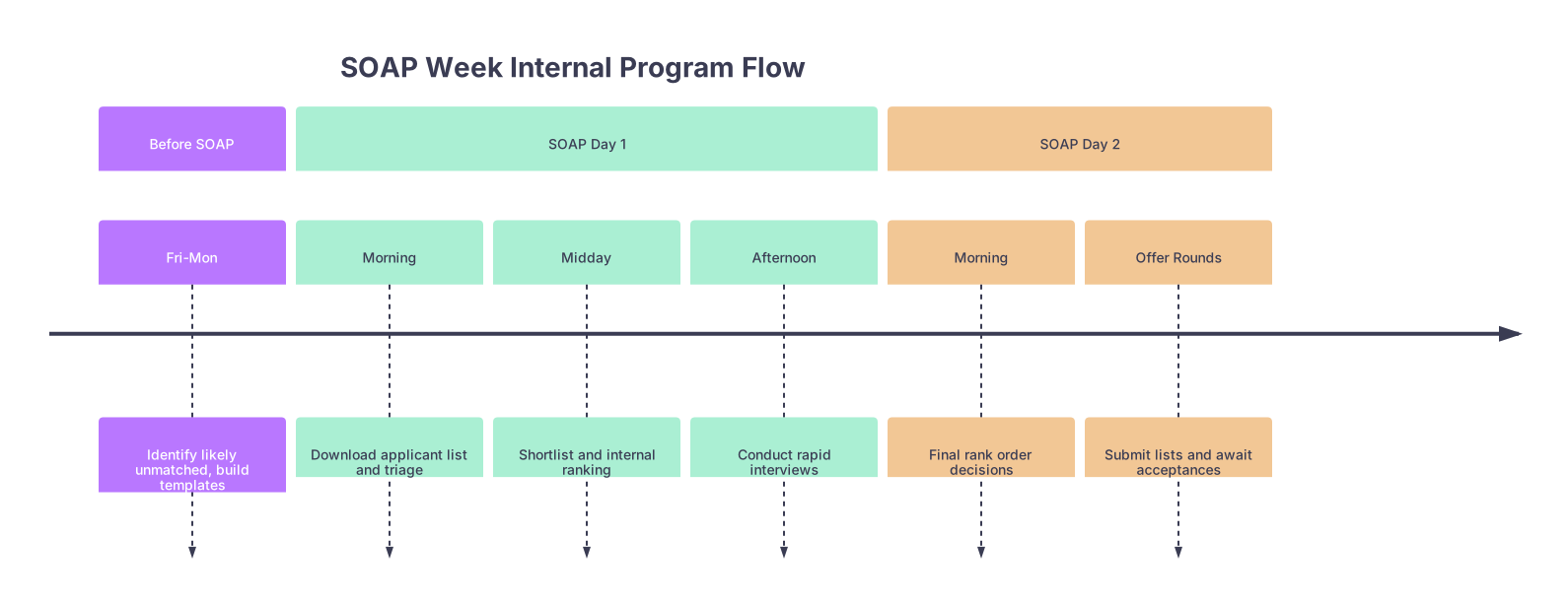
| Period | Event |
|---|---|
| Before SOAP - Fri-Mon | Identify likely unmatched, build templates |
| SOAP Day 1 - Morning | Download applicant list and triage |
| SOAP Day 1 - Midday | Shortlist and internal ranking |
| SOAP Day 1 - Afternoon | Conduct rapid interviews |
| SOAP Day 2 - Morning | Final rank order decisions |
| SOAP Day 2 - Offer Rounds | Submit lists and await acceptances |
During active rounds, here’s what’s going through PDs’ minds:
- “If we don’t submit this list now, we’ll be stuck with leftovers in the next round.”
- “Our top choices may get offers from several places; we need enough depth on the list.”
- “We can’t overreach with only long-shot candidates and end up empty again.”
So your “fit” is sometimes less about you as a person and more about where you fall in risk tolerance at that moment in the day.
I’ve seen programs remove a relatively strong but complicated candidate at the last minute because they were spooked by a single vague line: “Required additional feedback on professionalism standards.” Nobody wanted to unpack that at 3:30 p.m. with a deadline at 4.
The Rapid-Fire SOAP Interview: What They’re Really Testing
If you get a SOAP interview invite, recognize what it actually is: confirmation they’re considering you, not a guarantee of a rank.
Most SOAP interviews are:
- 10–20 minutes.
- Video or phone.
- One to three interviewers.
- Barely structured.
They are checking three things:
Are you normal on the phone/Zoom?
Meaning: can you communicate clearly, seem stable, and not trigger alarm bells.Do you have a coherent story for why you’re in SOAP?
They don’t need a sob story. They need something that shows insight, responsibility, and plan.Would you accept this program if offered?
They don’t want to waste a precious spot on someone ranking them last “just in case.”
Here’s how they talk after you hang up:
- “They’re a little stiff but fine. No red flags.” → Likely to stay in the rank pool.
- “They kept blaming their school and the system.” → Often quietly dropped.
- “When I asked if they’d be happy here, they hedged a lot.” → Lowered on list or removed.
If you’re in SOAP and interviewing, you must sound like you’ll show up, work hard, and not sue them. That’s the bar.
Back-Channeling: The Advocacy You Don’t See
Here’s the part everyone suspects but doesn’t really grasp: yes, behind-the-scenes advocacy happens. A lot.
During SOAP, PDs text and call each other. Deans email. Core faculty from other institutions vouch for people.
Typical scenario:
- You’re an unmatched student at School A.
- Your dean or department chair emails PD at Program B: “We have a student in SOAP, strong clinician, just got squeezed out. Would you be willing to take a look?”
- Program B’s PD replies: “Send me their AAMC ID.”
- That ID gets highlighted in the spreadsheet. When their app pops up, the conversation is immediately friendlier.
This doesn’t guarantee anything. PDs ignore plenty of “favored” candidates if the data is bad. But it absolutely shifts you from “anonymous” to “known quantity.”
If you’re in SOAP or fear you might be, you should already be quietly building that support. Not the week before Match. Months before, ideally.
Strategic Truths: How You Can Actually Influence What Happens in That Room
You can’t control who sits at the table. You can’t slow the clock. But you can shape what your file looks like when it hits the projector.
If You’re Still Pre-Match (but worried)
Here’s what really moves the needle if you end up in SOAP:
- Clinical comments: Fight for detailed, specific evaluations on core rotations, especially in the field you’re targeting. The MSPE narratives are heavily scrutinized.
- Step 2: If your Step 1 is weak or pass/fail, Step 2 is not optional. For SOAP, it’s often the single hardest filter.
- Relationships: Get at least one attending who can honestly say, “I’d trust this person with my patients at 2 a.m.” That’s the voice that matters when PDs are anxious.
- Red flag framing: If you’ve got a fail, leave, or issue, build a coherent, honest narrative now with your dean so it shows up that way in your MSPE and, later, your SOAP PS.
If You’re Already in SOAP
No sugarcoating here. You have limited levers, but they’re real.
Your personal statement:
Ditch the recycled, dreamy “why I chose medicine” essay. In SOAP, write a short, sharp, reality-grounded statement:- Own, briefly, what led you here (without self-immolation).
- Emphasize reliability, teachability, and commitment.
- Signal geography or program type if relevant.
Your communication:
Respond fast. Be ridiculously easy to schedule. Answer your phone. PDs hate chasing people.Your story on interviews:
Have a 30–45 second answer to: “Tell me about your path to SOAP.”
Accept responsibility where appropriate. Show insight. Lay out a forward-looking plan.Your dean’s office:
If there’s anyone who’ll advocate for you to specific programs, now is when that matters. You do not ask programs to “make an exception.” You ask your own faculty to vouch for your work ethic and clinical value.
What They Remember After SOAP Is Over
The day after SOAP, when the dust settles, PDs usually have two thoughts:
- Relief that the slots are filled.
- Anxiety about 1–2 marginal picks.
Nobody looks back thinking, “I wish we’d taken more risks.” They remember the PGY-1 who melted down mid-year, the one who disappeared on nights, the one who blew up at a nurse. Those memories dominate the war room.
So when they look at your file, they’re not picturing best-case you. They’re guarding against worst-case you.
If you want to survive that level of scrutiny, everything in your application has to argue, quietly but clearly: “I will show up, get better, and not make you regret this.”
That’s what wins in SOAP, far more than brilliance or research or lofty mission statements.
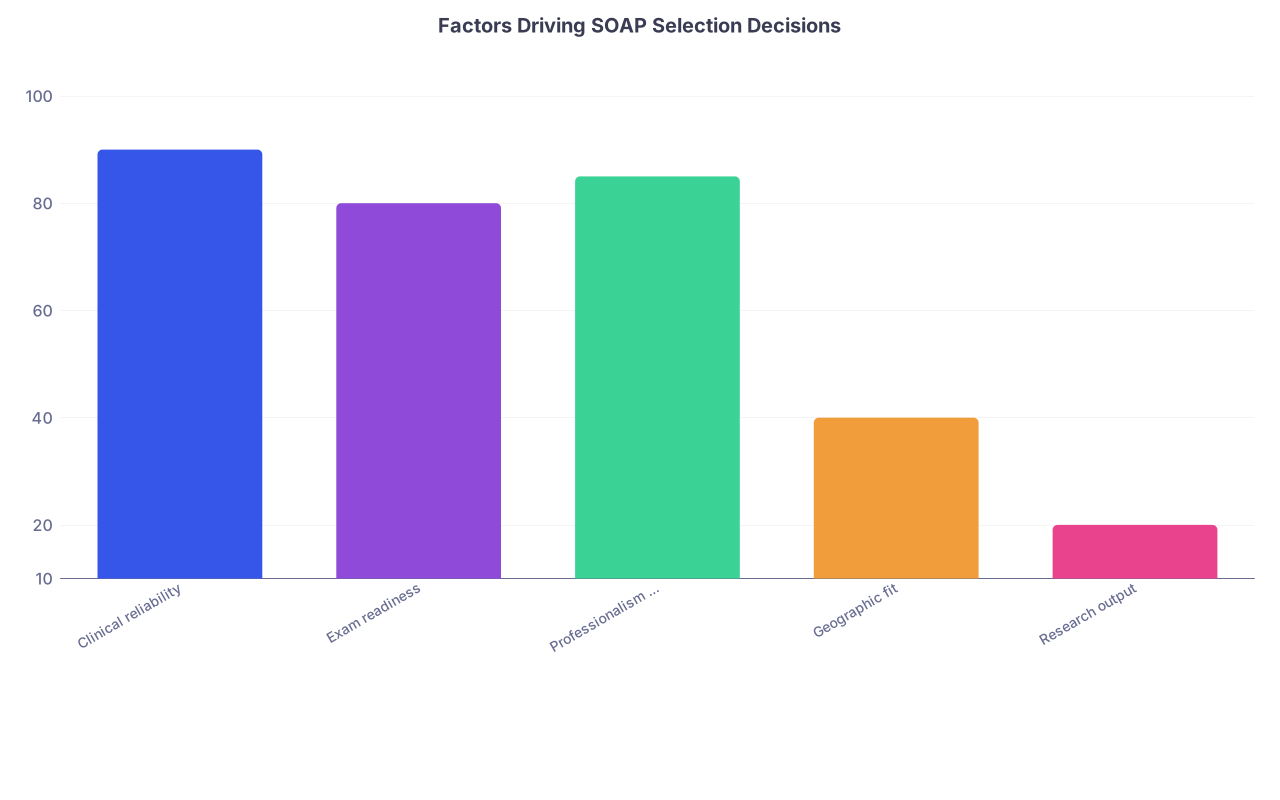
| Category | Value |
|---|---|
| Clinical reliability | 90 |
| Exam readiness | 80 |
| Professionalism record | 85 |
| Geographic fit | 40 |
| Research output | 20 |
Looking Ahead: Your Next Moves
Now you know what really happens when your name shows up on that spreadsheet in a fluorescent-lit conference room.
If you’re pre-Match, you still have time to shape the story they’ll see in SOAP if it comes to that. Strengthen your clinical narrative. Earn advocates. Fix what you can on the exam side.
If you’re already in SOAP territory or staring it down, the mission is narrower but clear: strip away the fluff, own your story, get people who know your work to speak up, and present yourself as the safest, most reliable choice in a stressful, high-risk moment for them.
The war room will always be messy and rushed. But your prep does not have to be.
With this picture in your head, you’re better equipped than most of your peers. The next step is execution—crafting the SOAP PS, prepping the 10‑minute interview, briefing your dean and faculty on how to advocate. That’s where strategy turns into survival. And that, we can tackle next.