The fastest way to get silently cut from a SOAP rank list is not a bad CV. It is a bad digital footprint.
Program directors are not oblivious. They are tired. Overworked. And increasingly ruthless about using anything they can find online to filter applicants during SOAP. Your Instagram, X (Twitter), TikTok, Reddit history, even “private” Facebook groups. If you think they do not look, you are already making the first mistake.
You are in the highest‑risk phase of the Match cycle. SOAP is compressed, stressful, and brutally pragmatic. That is exactly when online missteps get noticed fastest.
Let me walk you through the specific social media mistakes that cost SOAP candidates interviews, ranks, and spots every cycle—and how to avoid being the cautionary tale people whisper about next year.
Why Social Media Matters More During SOAP
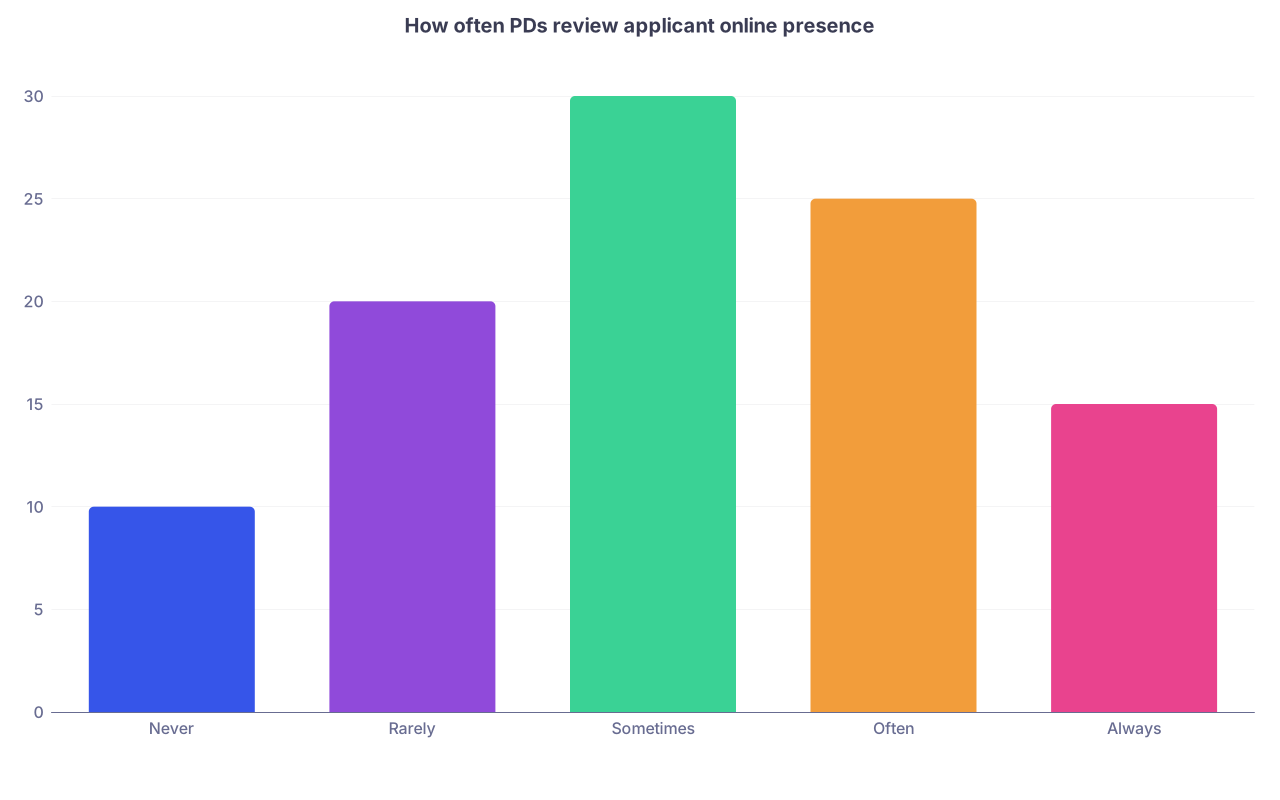
| Category | Value |
|---|---|
| Never | 10 |
| Rarely | 20 |
| Sometimes | 30 |
| Often | 25 |
| Always | 15 |
SOAP is not a leisurely, holistic review. It is triage.
Programs are staring at:
- Hundreds of applications
- Only a few hours to screen and invite
- No time for extensive phone calls or deep-dive references
So what do they do? They look for quick red flags. Anything that lets them say, “Nope, not worth the risk,” and move on.
Social media is:
- Fast to check
- Highly revealing
- Often unfiltered
I have seen this play out:
- PD opens ERAS file. Scores and experiences look acceptable.
- PD pastes applicant name into Google or checks Instagram handle visible on CV or email.
- Two minutes later: “Do not rank.”
You never hear about it. No one emails you saying, “We saw your TikTok mocking nurses and decided to pass.” You just… never get a call. Or you drop on their rank list.
SOAP magnifies this because:
- Programs are extra sensitive to professionalism risk when hiring in a rush
- Many SOAP candidates come from prior red flags (exam failures, gaps, previous non-match)
- PDs are aware SOAP applicants may be under more emotional stress and posting more impulsively
Your job: remove every possible doubt about your judgment.
Mistake #1: “Venting” About the Match or Programs
This is the number one SOAP social media disaster: public or semi‑public venting.
Typical posts that get screenshotted and circulated:
- “These PDs are clueless. I was clearly better than half the people who matched.”
- “Program X was a joke. Residents were miserable. Total malignant trash.”
- “If I do not SOAP this year, I am done playing this rigged game.”
Here is what PDs read between the lines:
- Poor emotional regulation under stress
- Lack of insight and professionalism
- Potential future complainer or problem resident
SOAP programs already assume you are under pressure. They are watching to see who holds it together. Public venting does the opposite.
Avoid this trap by:
Zero public commentary about the Match or SOAP.
No vague tweets. No “subtle” Instagram stories. No cryptic Facebook posts about being “betrayed” or “backstabbed.”Move all emotional processing offline.
Use:- A trusted mentor
- A therapist or counselor
- A private journal
Not a group chat with 40 classmates and two people you barely know.
Assume screenshots are forever.
If you would be uncomfortable with a PD reading it on a projector at morning conference, do not type it. At all.
Mistake #2: Disrespectful Talk About Patients, Nurses, or Colleagues
This one ends careers before they start.
Common problematic content:
- “Admitted the most annoying noncompliant diabetic again smh.”
- “Nurses on night shift are absolutely useless.”
- Making jokes about:
- BMI
- Mental health
- Substance use
- Race, gender, or socioeconomics
PDs see this and immediately think:
- Liability risk
- Culture problem
- Potential HR nightmare
You are not just any social media user. You are trying to enter a profession that demands confidentiality, empathy, and respect.
Red-flag categories PDs notice instantly:
- Any hint of PHI (even “anonymous” details can be enough)
- Screenshots of charts, notes, or hospital screens (even blurred)
- Mocking attendings, nurses, or techs
- Jokes about errors or near misses
If colleagues would not trust you, PDs will not either.
Fix this now:
Delete any post that:
- Mentions patients
- Shows hospital spaces with identifiable contexts
- Complains about specific staff groups or institutions
Stop posting from clinical areas. Full stop.
No boomerang “dance” videos in the OR hall. No TikToks from the nurse’s station. No “call room tour” videos with whiteboards, schedules, or monitors in view.
Mistake #3: Confusing “Private” with Safe

| Step | Description |
|---|---|
| Step 1 | Set profile to private |
| Step 2 | Post careless content |
| Step 3 | Friends screenshot |
| Step 4 | Shared in group chats |
| Step 5 | Reaches resident |
| Step 6 | Forwarded to PD |
The biggest lie people tell themselves: “My account is private. I am fine.”
No, you are not.
Here is what actually happens:
- You post in a “private” group or on a locked account.
- One classmate screenshots and shares with a friend at Program X.
- That friend shows it to a chief resident.
- The chief forwards it to the PD.
- You disappear from their rank list.
I have seen posts from “private” groups get emailed to PDs within 20 minutes. Sometimes with the subject line: “Is this someone we want?”
Places where people falsely feel safe:
- Private Facebook groups for unmatched applicants
- WhatsApp / Telegram groups with big membership
- Reddit accounts they think are anonymous but are linked to other identifying info
- Close friends Instagram stories (those green circles are not a legal shield)
Minimum safety rules:
- Assume every post can end up on a PD’s screen.
- Assume every group larger than 5 people has a leak.
- Never mix:
- Institution names
- PD names
- Faculty names
- Program gossip
with any digital channel you do not fully control.
Mistake #4: Posting Match/Score Numbers That Do Not Match the Application
This one is more subtle, but it unnerves PDs quickly.
Examples:
You tweet: “Crushed Step 2 with a 262, still unmatched. System is broken.”
But your ERAS lists a 250. PDs will wonder which one is false.You post on Reddit: “IMG with 218 / 230 and 4 US LORs” and then your actual ERAS numbers do not line up.
You claim, “clinically strong, multiple honors,” but your transcript tells a different story.
PDs hate one thing more than a mediocre score: dishonesty.
They are not always cross‑referencing every post to every application. But when a resident or faculty member recognizes your handle and says, “Is this the same person who applied here?”—now they look closely. In SOAP, that can end the conversation.
How to avoid this mess:
- Do not post your exact USMLE/COMLEX numbers publicly during the Match cycle.
- Do not “spin” your performance online.
- Do not invent honors, awards, or research to impress random strangers on social media.
If it is not consistent with ERAS, it is a time bomb.
Mistake #5: Overtly Unprofessional Content That Screams “Bad Judgment”
Let us be clear: you are allowed a life. You are allowed to have fun.
The problem is not “you at a bar.” It is pattern and tone.
Things that repeatedly spook PDs:
- Heavy alcohol content plus sloppy/drunk behavior
- Obvious drug use
- Sexual content that crosses from adult personal life into tasteless exhibitionism
- Aggressive or hateful political rants (especially with bigotry or conspiracy themes)
- Gun photos combined with angry, unstable language
One borderline photo will not necessarily ruin you. But several? Combined with lower scores or a prior failure? During SOAP, that is often enough for “pass.”
Think about SOAP from their viewpoint:
- Program has a marginal candidate pool
- They are forced to take more risk than usual academically
- They are trying to reduce risk on professionalism and behavior
So they cut fast if your public profile looks chaotic.
Audit yourself like a PD would:
Scroll your last 2–3 years of public content and ask:
- Do I look impulsive?
- Do I look angry, extreme, or hostile?
- Would this worry me if I were about to make this person my intern?
If you hesitate, hide or delete.
Mistake #6: Attacking Other Applicants, Specialties, or the Profession
You might think you are just being “honest” or “real.” PDs see arrogance and lack of collegiality.
Typical problem posts:
- “FM is just for people who could not match anything else.”
- “Anyone who SOAPs into psych clearly did not care enough to try.”
- “My classmates who matched are mostly idiots with connections.”
You have just signaled:
- Poor teamwork potential
- Disdain for colleagues
- Fragility when you feel overlooked
Residency is built on teams. SOAP programs already worry about whether SOAP candidates will be bitter or resentful. Do not prove them right on the public record.
Mistake #7: Live‑Posting the SOAP Process
During SOAP, your job is to be reachable, composed, and focused. Not narrating the chaos online.
Dangerous live content:
- “No invites so far. This is hell.”
- “Just had the most awkward interview ever with [program name].”
- “Program X sounded desperate on the phone. Red flag.”
Beyond bad optics, here is what you are really doing:
- Telling PDs you cannot keep sensitive processes confidential
- Showing you process stress in a public arena
- Questioning programs by name in real time
This gets around faster than you think. Residents follow hashtags. Med Twitter, med Reddit, and med TikTok are connected ecosystems. SOAP is especially small.
Better approach:
- Do not post anything about SOAP while it is happening.
- After Match week is fully over, you can share a generic “Grateful to have matched in XYZ” type post.
- Never list programs you interviewed with during SOAP until after you are securely in a contract—and honestly, there is no real upside to naming them even then.
Quick Social Media Triage Before SOAP
You need a concrete cleanup plan, not vague “be careful” energy.
| Area | Action |
|---|---|
| Public posts | Delete or archive risky content |
| Account privacy | Lock down non-essential profiles |
| Bios/usernames | Remove edgy or unprofessional |
| Tagged photos | Untag or hide problematic ones |
| Group chats | Mute and stop vent-posting |
Target these first:
Instagram / TikTok
- Archive:
- Heavy drinking / drug‑adjacent videos
- Rants, complaints about training, PDs, or programs
- Anything filmed in a clinical environment
- Archive:
Facebook
- Set older albums to “Only Me” or remove.
- Clean bio and profile picture. No outrageous slogans, no inside jokes that look aggressive out of context.
X (Twitter)
- Search your handle plus words like “hate”, “stupid”, “trash”, “idiot”, “rigged”, “malignant”.
- Delete aggressively.
- If your account is a disaster and heavily political/hostile, consider:
- Making it private
- Renaming and removing identifying info
- Or stopping use during SOAP completely
Reddit
- If you have ever posted stats, school, geography, or other traceable details, assume anonymity is weak.
- Stop posting about programs, interviews, and PDs.
LinkedIn
- This one actually helps you if done properly.
- Make sure:
- Photo is professional
- Headline is neutral (e.g., “MD Graduate seeking Internal Medicine residency”)
- No rants, no angry posts about the system
What PDs Actually Do When They See a Red Flag
This is the part most applicants underestimate.
They do not usually argue about it. They do not email you. They do not give you a chance to explain.
Common real responses:
- “We have enough candidates. Remove them from consideration.”
- “Given their score profile, not worth the risk.”
- “Too many professionalism concerns. Hard pass.”
If you are in SOAP, you are often already on the margin academically or contextually. One more strike on professionalism—especially self‑inflicted and public—is often fatal.
Remember: there is no due process in SOAP decisions. Programs can be as picky or as unfair as they like. You protect yourself by not giving them ammunition.
How to Use Social Media Well During SOAP
Not everything has to be fear and deletion. You can use your online presence strategically—carefully.
Done right, social media can:
- Make you look stable, grounded, and professional
- Show you are more than a USMLE score
- Reduce anxiety for PDs about “who they are getting”
Positive, low‑risk use during SOAP:
- Quiet, respectful updates like:
- “Grateful for mentors who have supported me through this challenging season. Focusing on growth and patient care, whatever comes next.”
- Professional LinkedIn posts about:
- A recent poster or publication
- Volunteer work (HIPAA-safe, no patient details)
- Interest in a specialty framed humbly
What you do not do:
- Beg for positions publicly
- Tag programs asking if they have SOAP spots
- DM PDs on Instagram or X
- Create threads detailing which programs have unfilled spots and your opinions of them
Those moves scream desperation and poor boundaries.
Your Emergency Plan: If You Already Posted Something Dumb
If your stomach dropped while reading this because you know there is problematic content out there, do not freeze.
Here is what to do:
Remove it now.
Deleting is better than leaving it up and hoping no one sees it.Stop posting new content until SOAP is completely over.
No one has ever failed SOAP because they did not tweet enough.Be prepared with a calm, honest explanation (just in case).
If asked during an interview:- Own it briefly
- Show insight
- Emphasize what you have changed
For example:
“I made a frustrated post during a very stressful period that did not reflect the professionalism I expect of myself. I removed it, and since then I have kept my online presence focused on neutral or educational content only.”
No long confessions. No over‑sharing. Just controlled damage control.
The Bottom Line
SOAP is not just about scrambling for open spots. It is about convincing a program, very quickly, that you are a safe, stable, professional human being they will not regret investing in.
Your social media can either:
- Quietly support that impression
- Or loudly destroy it in 30 seconds
You cannot redo your Step score this week. You cannot rewrite your entire CV. But you can control what PDs find when they type your name into a search bar.
Do not lose a SOAP position because of something as stupid and preventable as an angry tweet or a drunk Instagram story from 2019.
FAQ
1. Do programs really look at social media during SOAP when they are so busy?
Yes. Not every PD does, but enough do that you cannot ignore it. Many delegate it to a chief resident or coordinator: “Check their online stuff quickly.” During SOAP, one or two glaring red flags are enough to move on to the next application.
2. Is it safer to delete all my accounts before SOAP?
Not usually necessary, and sometimes suspicious if you have previously linked them in professional contexts. A better strategy is: lock down or archive anything questionable, make remaining content boring and professional, and stop posting during SOAP. Having nothing online is not a problem; having obviously scrubbed chaos can be.
3. Can I ever discuss the Match or SOAP online without hurting my chances?
Yes, but only retrospectively, in measured, reflective ways, and never with specific program names or personal attacks. During active SOAP, the safest move is complete silence about specifics. Process your feelings privately and let your online presence go quiet and neutral until the dust settles.
Open your most-used social media app right now and scroll back six months. Stop at every post and ask, “Would a stressed, risk‑averse PD feel 100% comfortable making me an intern after seeing this?” If the answer is anything less than yes, fix it today.