
It’s Monday of Match Week. Your phone finally stops buzzing. The NRMP email is open in front of you, and it says the thing you were praying it wouldn’t say.
“You did not match to any position.”
You sit there, staring. You know SOAP starts in hours. You know you should be texting your advisor, your mentor, your PD from your home rotation. Instead, you close your email, put your phone face down, and think:
“I can’t tell anyone. I’m too embarrassed. They’re going to think I’m a failure. I caused this. I deserve this.”
So now it’s not just “I didn’t match.” It’s “I didn’t match and I’m going to have to go through SOAP alone because I can’t face them.”
That’s the mental spiral. I know it well.
Let’s walk through how to actually re-engage support when you feel too ashamed to ask for it. Because going solo through SOAP is basically playing the game on the hardest difficulty for no good reason.
What’s Actually Behind the Shame (You’re Not Broken, You’re Human)
You’re not avoiding people because you hate them. You’re avoiding them because you’re trying to protect yourself.
At least three things are usually happening in your head:
You think not matching = moral failure
Not “my application had gaps.”
But “I am defective. I’m the weak link. The statistics finally caught up to me.”You’re rewriting every past interaction
That mentor who said, “You’re a strong candidate”? You’re now convinced they were just being polite. The PD who wrote you a letter? You’re sure they regret it. You replay conversations and add imaginary judgment they never actually said.You’re catastrophizing your future
“If I tell them I didn’t match, they’ll lose respect. If they lose respect, they won’t help. If they don’t help, I’ll bomb SOAP. If I bomb SOAP, my career is over.”
It feels like one disclosure = permanent exile.
Here’s the reality I’ve seen over and over: faculty and advisors are used to SOAP. They know good applicants miss the match every single year for dumb, arbitrary, and sometimes completely random reasons.
The only one who thinks this is some giant moral failure is…you.
And I get it. Medicine trains you to tie your worth to performance. Step scores, clerkship grades, away evals. Every number becomes a referendum on your value as a future physician. So when the big one—Match—doesn’t go your way, your brain just auto-labels it: “You’re the problem.”
But SOAP is a logistics problem, not a worth problem. And logistics problems are fixable. If you let people in.
Why Going Solo in SOAP is So Dangerous (and Unnecessary)
Let me be blunt: trying to do SOAP alone because you feel ashamed is like refusing antibiotics for sepsis because you “don’t want to bother anyone.”
SOAP is awful even with support. Without it, it can become completely unmanageable.
Here’s what you’re up against logistically:
| Task Type | With Support | Alone Under Stress |
|---|---|---|
| Program list review | 1–2 people cross-check quickly | You second-guess everything |
| Document updates | Advisor helps prioritize | You freeze and procrastinate |
| Email/communication | Someone edits and strategizes | You send panicked messages |
| Emotional stability | Others normalize and ground you | Spiral, insomnia, panic |
| Plan B/C discussions | Structured, realistic options | Catastrophic, all-or-nothing |
Without support, you’re more likely to:
- Under-apply because you’re “trying not to seem desperate”
- Over-apply randomly to places that make zero sense
- Miss time-sensitive decisions
- Misinterpret what “unfilled” means for different programs
- Freeze and burn time you don’t have
SOAP is not the week to be proud and stoic. It’s the week to be clingy and tactical.
The shame is loud. But here’s the harsh truth: no program director is going to ask “Did you feel embarrassed?” when they look at your SOAP application.
They’re going to ask: “Is this person prepared, appropriate for our program, and showing insight and maturity?”
And maturity looks like: “I got help.”
How to Re-Engage Support When You Feel Humiliated
You don’t need a perfect, brave, confident script. You need something you can actually send while your stomach’s in knots and your hands are shaking.
Let’s build that.
Step 1: Decide who you’re going to tell first
Don’t start with the scariest person (like your dream specialty PD). Start with the person who:
- Already knows you pretty well
- Has some stake in your success (advisor, student affairs, faculty mentor)
- Has seen other students go through SOAP
If your school has an official “SOAP team,” it’s literally their job to do this. You are not a burden. You’re the case they prepared for.
If you can’t even decide who to start with, pick the least intimidating reasonable option. Not perfect. Just least terrifying.
Step 2: Use a pre-written template so you don’t overthink
Here’s a script you can copy-paste and tweak. Don’t over-edit it to death.
Email/Message Template #1 – Initial Reach-Out
Subject: SOAP Support
Hi Dr. [Name],
I wanted to let you know that I did not match this year. I’m feeling pretty overwhelmed and ashamed right now, but I know I need to move quickly for SOAP.
Would you be willing to help me think through a strategy and next steps? Even a brief call or quick email guidance today would really help.
Thank you for any support you’re able to give.
[Your Name]
Is this vulnerable? Yes. Is it overly dramatic? No. It’s honest and concise.
If that feels like “too much,” here’s an even simpler version:
Template #2 – Minimalist
Hi Dr. [Name],
I didn’t match and I’d really appreciate your help with SOAP planning. Are you available for a quick call today?
Thank you,
[Your Name]
You don’t need to apologize for failing as a human being. You didn’t.
Step 3: Assume they’re more prepared than you are
You’re not the first unmatched student they’ve seen. You’re not even the first one this year. At many schools, they literally have a SOAP playbook and scheduled time blocked off for “students who didn’t match.”
When they respond with something like:
- “Thank you for letting me know. Let’s talk at 2 PM.”
- “I’m so sorry you’re going through this. We’ll make a plan.”
- “You’re not alone in this; we’ll get to work.”
Don’t read between the lines for secret judgment that isn’t there. Take them at their words. They’re in problem-solving mode, not moral-judgment mode.
Handling the Conversation Without Falling Apart
You’re afraid you’ll cry. Or sound stupid. Or forget your own CV.
You might cry. Your voice might shake. You might blank.
You know what faculty who have done this for years think when that happens? “Yep. That’s what a normal human response to this looks like.”
Here’s a rough internal outline to keep you from rambling:
State the facts
- “I didn’t match into [specialty].”
- “I ranked X programs, had Y interviews.”
- “I’m interested in SOAPing into [same specialty / prelim / TY / backup specialty].”
Name your mental state honestly but briefly
- “I’m pretty overwhelmed and honestly embarrassed.”
- “I’m having trouble thinking clearly about next steps.”
Ask for specific help
- “Can you help me identify realistic SOAP targets?”
- “Can you look over my personal statement or ERAS quickly?”
- “What’s been successful for previous unmatched students from our school?”
You don’t need to have your whole life philosophy figured out. This is triage.
If they say something like, “What do you think went wrong?” and it feels like a knife to the chest, you can answer like this:
“I have some guesses—maybe [Step score, competitiveness of list, late application, etc.]—but right now I mostly need help making a strong SOAP plan. I’d really appreciate your guidance on that.”
Translation: Yes, we can autopsy this later. Right now we’re in the OR, not the debrief.
You’re Terrified They’ll Judge You. Here’s What They’re Actually Thinking.
You think they’re thinking:
“Wow, what a disappointment. I misjudged this person.”
What they’re usually actually thinking is closer to:
“Okay, this sucks. How do we salvage this year or set them up for next year?”
Here’s something uncomfortable but true: faculty care about their match stats and their students’ outcomes. Helping you land something is in everyone’s interest.
I’ve literally heard PDs say things like:
- “We’ve had some excellent applicants not match because they aimed too high.”
- “SOAP is messy, but we’ve gotten students into solid programs through it.”
- “This is why we tell them to have backup plans. Now we help them build one.”
Notice what’s not there? “I can’t believe they failed.”
Most of this shame narrative is coming from inside your own head.
If You Think You “Don’t Deserve” Help
This one’s ugly, but very real.
Maybe you’re thinking:
- “I didn’t study hard enough for Step 2. This is my fault.”
- “I ignored people telling me to apply more broadly.”
- “I aimed too high. I was arrogant. Now I should deal with the consequences alone.”
You’re basically sentencing yourself to solitary confinement for a crime that doesn’t require it.
Two things can be true at once:
- You made choices that may have hurt your chances.
- You still deserve help getting out of the hole.
Medicine is full of people who have:
- Failed step exams
- Remediated clerkships
- Gotten terrible evals on away rotations
- Matched on their second try
Those people didn’t “earn” support by being perfect. They got support precisely when they weren’t.
You think support is a reward for success. It’s not. Support is a tool to recover from failure.
Concrete, Tiny Steps You Can Take Today (Even if You’re Frozen)
You don’t need to fix your attitude. You don’t need to feel brave. You just need to take one action that moves you toward support.
Here’s a micro-step sequence that works when your brain is mush:
- Open your email or messaging app. Literally just open it.
- Type the name of ONE person you could reasonably ask for help.
- Paste Template #1 or #2 from above. Don’t rewrite your life story.
- Hit send within 60 seconds. Don’t let yourself “tweak” it endlessly.
- Set a 15-minute timer and make a short list of programs/specialties you’re willing to consider in SOAP. Bring that list to the call.
That’s it. That’s your job for today. Not to find enlightenment. Just to not do this completely alone.
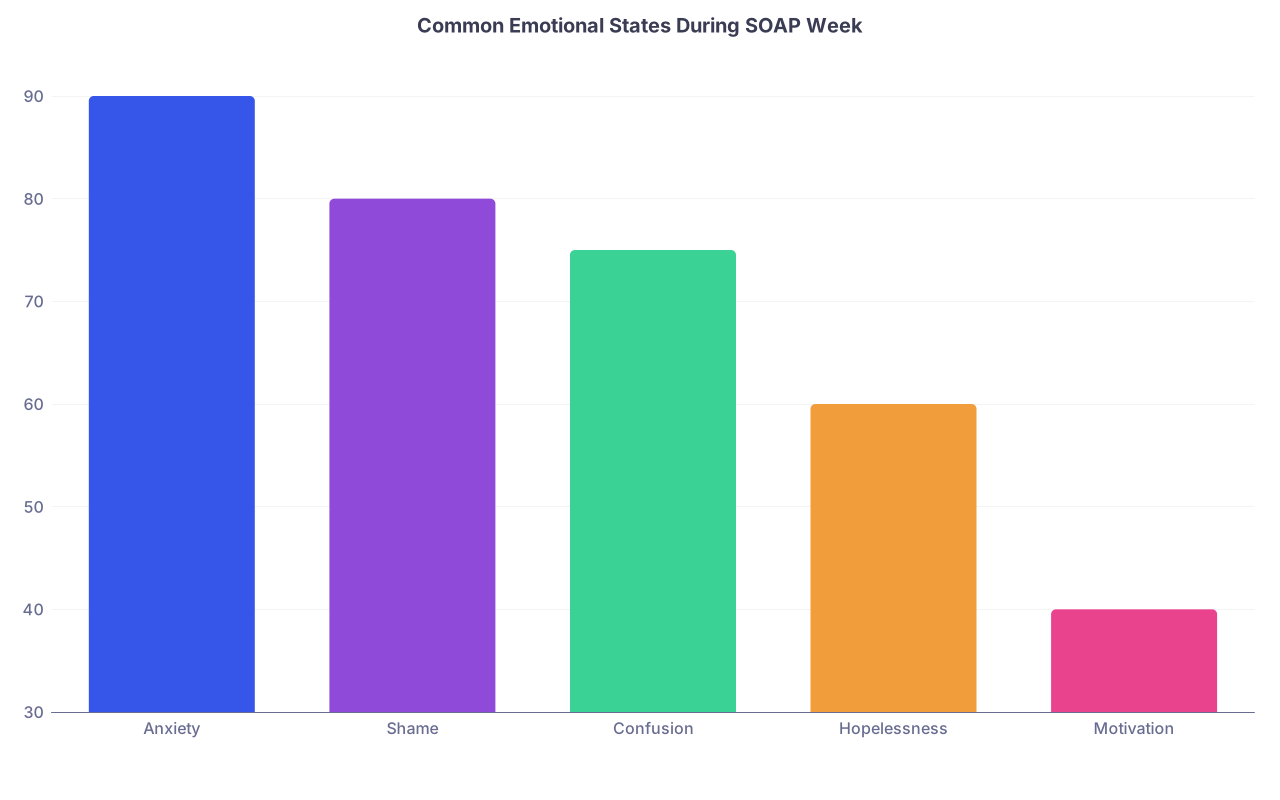
| Category | Value |
|---|---|
| Anxiety | 90 |
| Shame | 80 |
| Confusion | 75 |
| Hopelessness | 60 |
| Motivation | 40 |
FAQ – The Things You’re Probably Too Embarrassed to Ask Out Loud
1. What if my advisor seems disappointed in me?
They might. They’re human. But “disappointed it didn’t work out” is not the same as “disgusted with you as a person.” If you sense disappointment, you can even say:
“I’m disappointed too. Right now I really need help focusing on what we can still do this week.”
Most of them will snap back into professional mode. If they truly treat you like trash, that’s a reflection of them, not you—and it’s a good sign to pull someone else into your support circle.
2. What if I already ignored their earlier advice, and now I feel like I can’t go back?
Own it directly and briefly:
“You warned me this might happen if I didn’t apply more broadly. I didn’t listen, and you were right. I’m sorry. I still really value your guidance now if you’re willing.”
People respond amazingly well to that level of honesty. They feel seen and respected. And most will absolutely still help.
3. Is it better to wait until I “calm down” before reaching out?
No. SOAP is time-sensitive. You can cry on Zoom. You can have puffy eyes on a phone call. No one is grading your composure. Waiting to feel emotionally perfect will just waste precious hours while unfilled spots are disappearing.
Reach out while messy. Let them help you calm down and make a plan at the same time.
4. Should I tell my letter writers and away rotation faculty I didn’t match?
Tell the ones who are most likely to be helpful for SOAP or for a reapplication. You don’t have to send a mass “I failed” email to everyone who ever said hi to you. Start with:
- Your main advisor
- Your home specialty leadership
- Any mentor you trust to be honest and strategic
You can always loop more people in later. You can’t go back and reclaim lost time because you were hiding.
5. What if I don’t want to SOAP into a backup specialty—do I still ask for help?
Yes. Even if your plan is “no SOAP, I’ll reapply,” you still benefit from:
- Honest feedback about your chances next cycle
- Concrete steps for what to do with the coming year (research, prelim, MPH, etc.)
- Connections that might help you strengthen your application
Not SOAPing doesn’t mean not talking. It just changes the strategy conversation.
6. I’m scared asking for help will make me cry harder and feel worse. Is it really worth it?
Yes. You might feel worse for the first 10 minutes because saying things out loud makes them real. But almost every unmatched person I’ve talked to says the same thing: the dread before reaching out was worse than the actual conversation.
And after that first move, you’re no longer alone in your head with catastrophic thoughts. There’s another brain in the room, and that alone lowers the temperature.
Here’s your next step: open your email right now and type the name of one advisor or mentor. Paste the minimalist template. Don’t edit. Don’t overthink. Hit send.
Let them carry some of this weight with you. You’re allowed to stop pretending you can do SOAP alone.