What if SOAP ends and I’m still completely unfilled… then what?
Let’s say the nightmare happens.
Match Week is over. SOAP is done. The email hits: 0 positions filled. Your ERAS shows nothing. Your phone is silent. Everyone else is posting “Matched!” photos in group chats and you’re just… sitting there.
Now what? Is this it? Career over before it even starts?
No. It’s not over. But it does get real. And it gets complicated. And it feels brutally personal even when it isn’t.
I’m going to walk through this like we’re sitting in a call room at 1 a.m. and you just got the news, because that’s what it feels like. I’ll give you actual options, not sugarcoating. And I’ll also say the part no one says out loud: good applicants go unfilled in SOAP every single year.
Not “bad” applicants. Not hopeless ones. Real people who end up residents later.
First 48 hours: what you do right after going unfilled
You’re going to want to either do nothing and hide… or panic-apply to everything you can find. Both extremes are bad.
Here’s what actually matters in the first couple days.

| Step | Description |
|---|---|
| Step 1 | Learn you are unfilled |
| Step 2 | Let yourself react |
| Step 3 | Tell key people |
| Step 4 | Schedule meeting with advisor |
| Step 5 | Collect application data |
| Step 6 | Plan remediation or alternative path |
| Step 7 | Prepare stronger reapply plan |
| Step 8 | Consider switching strategies |
| Step 9 | Main problem? |
1. Let yourself actually feel awful (briefly)
You’re not a robot. Of course you’re devastated. You didn’t just miss a flight; you missed the thing you’ve been building toward for a decade.
Give yourself 24–48 hours where your main job is: don’t do anything irreversible.
That means:
- Don’t email programs angry or desperate.
- Don’t withdraw from school in a rage.
- Don’t decide on a totally new career at 2 a.m.
Eat something. Sleep a little. Tell one or two people you trust, not the whole world. You’re in emotional triage.
2. Pull in your “real” support, not the performative kind
Tell:
- Your dean’s office / student affairs
- A trusted advisor (ideally someone on the residency selection side)
- One or two people in your personal life who won’t judge or “toxic positivity” you
Words you’re terrified to say out loud: “I went completely unfilled.”
Say them anyway. You need people who can advocate for you behind the scenes. And yes, they do that. I’ve seen deans emailing PDs the same day SOAP ends to start thinking about next year.
3. Get the full picture of your application
You can’t fix what you don’t define clearly. Print or pull up:
- ERAS application
- Personal statement(s)
- Letters (at least who wrote them)
- Score reports
- Class rank/MSPE if you have it
- Your list of programs and specialties you applied to
Then ask the blunt question: Where did this actually go off the rails?
Sometimes it’s obvious:
- Failed Step/Level attempt
- Very late application
- Only applied to 15 derm programs with 228 Step 2
- No interview invites at all
Other times it’s fuzzy. That’s when you really need someone who’s sat on a selection committee to look at your stuff and tell you the part no one says to your face.
The big question: Do you reapply, or do something else?
Here’s where your brain starts spiraling: “What if I reapply and don’t match again? What if programs are tracking that I was unfilled? What if I’m wasting a whole year for nothing?”
Valid fears. Let’s break it into actual paths.

1. Reapply next cycle – with a real plan, not just “try again”
Reapplying is the most common path. It’s not a consolation prize; it’s the main route most unfilled applicants take.
But there’s a huge difference between:
- “I’ll just reapply and hope next year goes better” vs.
- “I’m going to fix A, B, and C in a targeted way and apply differently.”
You need to answer three questions clearly:
Am I reapplying to the same specialty?
- If you got some interviews but didn’t match, same specialty might still be realistic with stronger strategy.
- If you got zero interviews in that field, especially a competitive one (derm, plastics, ortho, ENT, etc.), I’d seriously question reapplying to it as your sole or primary specialty.
What will be concretely different about me next cycle? Not vague “I’ll be more mature.” I mean:
- New Step 2 or Level 2 score
- Extra year of research with a known faculty name
- Stronger updated letters
- Dedicated prelim/transitional year that shows you can function clinically
What will be concretely different in how I apply? Things like:
- Number of programs (a lot of us wildly underapply the first time)
- Specialty mix (e.g., IM + FM instead of just one)
- Geographic strategy
- How early your application is complete
If you can’t answer those three, you’re not ready to reapply yet.
2. Take a research / gap year with intention
This can work well, but it’s not a magical fix.
Good research/gap year:
- Directly tied to your target specialty or at least to clinical work
- Gives you:
- Meaningful responsibilities
- Exposure to mentors who actually write detailed letters
- A chance to show reliability, productivity, and growth
- Is with someone who has matched people before and understands what programs want
Bad research/gap year:
- Generic bench research when you want psych
- Minimal supervision / your PI barely knows your name
- One line on your CV that no one cares about
So you want to be asking:
“Will this gap year create new evidence that I can be a strong resident?”
If it won’t, don’t do it just to say you did something.
3. Preliminary year or off-cycle spot (if you can find one)
You’ll hear about people who picked up a PGY-1 prelim IM or surgery spot or an off-cycle position months later.
This happens, but it’s:
- Rare
- Unpredictable
- Very connection-dependent
Strategy if you’re aiming for that:
- Let your dean’s office know you’re interested in any late vacancies
- Email program coordinators/PDs at institutions where you rotated, asking (professionally) to be informed of late openings
- Watch listservs / forums / specialty organizations that sometimes post sudden vacancies
But treat this like a bonus, not your main plan. It’s like fishing: you might catch something, but you can’t plan your whole career assuming you will.
Harsh but necessary: What might have gone wrong (and can be fixed)
It’s easy to just say, “The Match is broken.” Sometimes that’s emotionally helpful but practically useless. You need honest diagnostics.
Here’s a rough breakdown of common causes and what can actually be done:
| Main Issue | Example Scenario | Realistic Next Step |
|---|---|---|
| Scores/academics | Step 1/Level 1 fail, low Step 2 | Dedicated prep + strong Step 2/3 retake |
| Specialty competitiveness | Aiming for derm with few interviews | Switch or dual-apply with less competitive field |
| Application strategy | Applied late, too few programs | Earlier, broader, data-driven reapplication |
| Weak letters/clinical evals | Vague or negative narratives | Extra rotations with stronger letters |
| Red flags / professionalism | Leave of absence, conduct issue | Clear explanation + remediation + advocacy |
None of these are career-ending by themselves. I’ve watched people with failed boards, repeats, even professionalism issues still match eventually. It just wasn’t straightforward or pretty.
Money, visas, and all the ugly logistical stuff
You’re not just worrying about your ego. You’re staring at rent, loans, visas, and your whole life plan exploding.

Loans and finances
Reality:
- Grace periods end.
- Income-based repayment is an option, but you need an income.
- A low-paying research or non-clinical job might be your bridge.
Action steps:
- Call your loan servicer and say: “I didn’t match. What are my options?” They’ve heard this before.
- Talk to financial aid; sometimes they know of institutional roles, fellowships, or extended enrollment options that keep you in deferment.
Don’t disappear and just stop opening emails. That always makes it worse.
International grads and visas
This is brutal, I’m not going to lie.
If you’re an IMG on a visa:
- Your timeline may be tighter.
- You may have to consider going home and reapplying from there.
- Some research positions can sponsor visas; many can’t.
If this is you, you need:
- An immigration lawyer consultation (even a short one)
- To target institutions known for sponsoring IMGs and research visas
- To be very organized about deadlines and documents
How programs actually see someone who went unfilled
You’re imagining some ERAS flag that says “UNMATCHABLE” in red. There is no such tag.
Here’s what PDs actually see:
- You’re a prior-year graduate.
- Your MSPE, transcript, board scores.
- Your new letters, new activities, updated narrative.
Yes, they can often infer you didn’t match previously. But their main question isn’t, “Why didn’t they match?” It’s:
“Do I have enough evidence right now that this person will be a solid resident in my program?”
I’ve heard PDs say all of this about reapplicants:
- “They didn’t match last year but they’ve clearly grown a lot.”
- “Their app is much stronger now; I don’t care about last year.”
- “They keep applying to the same hyper-competitive specialty with no change. That worries me.”
So no, you’re not “blacklisted.” But if your new app looks identical to last year’s? That’s a problem.
You have to show movement. Insight. Change.
Concrete “next 6–12 months” game plans
Let’s put this into actual, lived timelines.
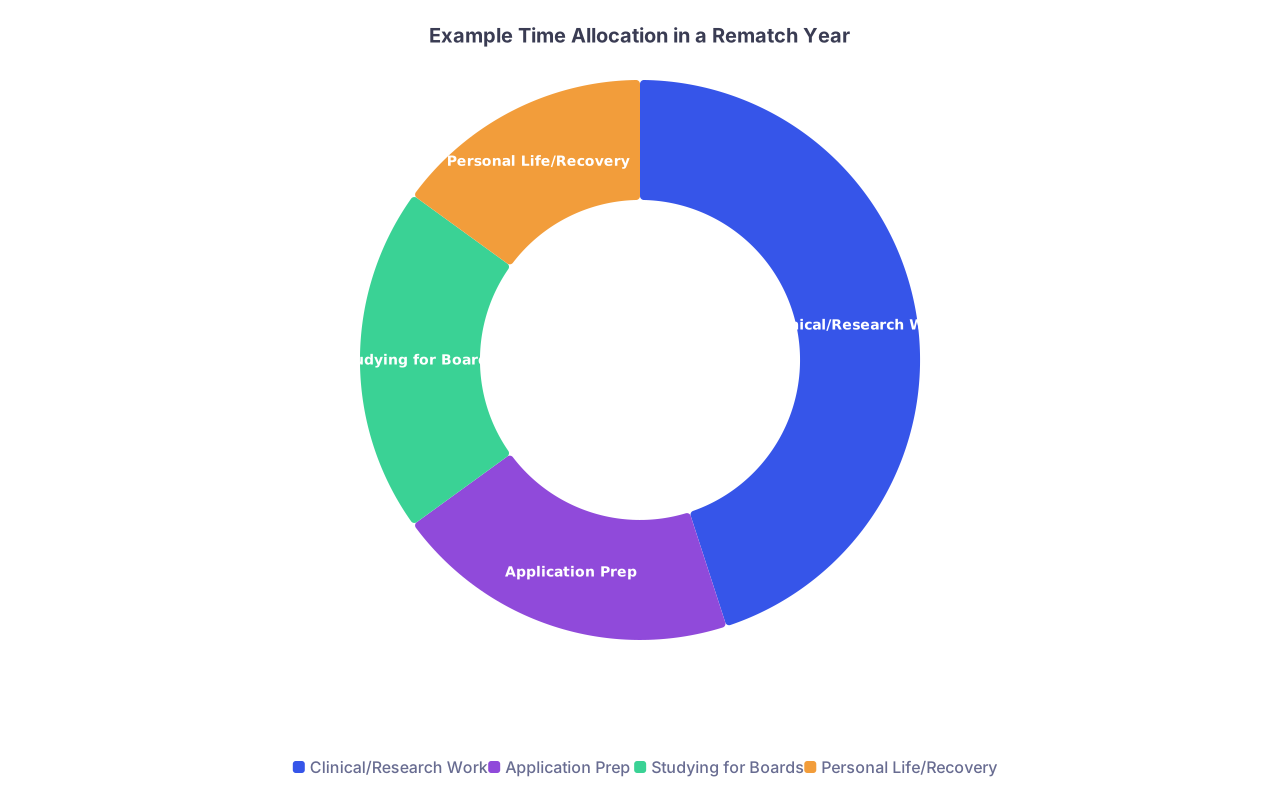
| Category | Value |
|---|---|
| Clinical/Research Work | 45 |
| Application Prep | 20 |
| Studying for Boards | 20 |
| Personal Life/Recovery | 15 |
Scenario A: US grad, unfilled, aiming for IM/FM/psych
Reasonable path:
- Get a research assistant, clinical assistant, or teaching job tied to medicine
- Take Step 3 or Level 3 if advised (not always necessary but can help)
- Do a couple of in-person auditions/observerships where you want to apply
- Massively expand your program list for next year (like 80–120+ if needed)
- Get new letters from this year’s work
Your story next cycle:
“I didn’t match last year, so I spent this year working in a clinical/research role in X, strengthened my skills in Y, and I’m more certain than ever I want to train in Z.”
Scenario B: Aimed for very competitive specialty, went unfilled
This is where a lot of us get stuck in sunk cost fallacy.
You might need to:
- Decide whether you love the field or the idea of the field
- Consider a dual-apply strategy:
- Main focus on a less competitive specialty you’d still be okay living your life in
- Long shot applications to your dream specialty if you must
Sometimes the smartest move is:
“I will train in IM/FM/Path/Psych/etc., and then subspecialize or align my career toward what I loved about the original field.”
That’s not “giving up.” That’s playing a long game.
Scenario C: IMG, no interviews, unfilled in SOAP
This one hurts, I know.
Hard truth: reapplying with the exact same profile will almost always lead to the same result.
You probably need:
- US clinical experience (real, not fake observership mills)
- Strong US letters
- Strategy focused on IMG-friendly programs
- Honest review: are your scores and attempts in the range that’s realistically matchable as an IMG?
I’ve seen IMGs take 1–2 years, work research jobs, get USCE, and then match IM or FM solidly. It’s absolutely possible. But it’s not automatic.
Managing the mental part so this doesn’t break you
You’re not just fixing an application. You’re trying to hold together your identity.
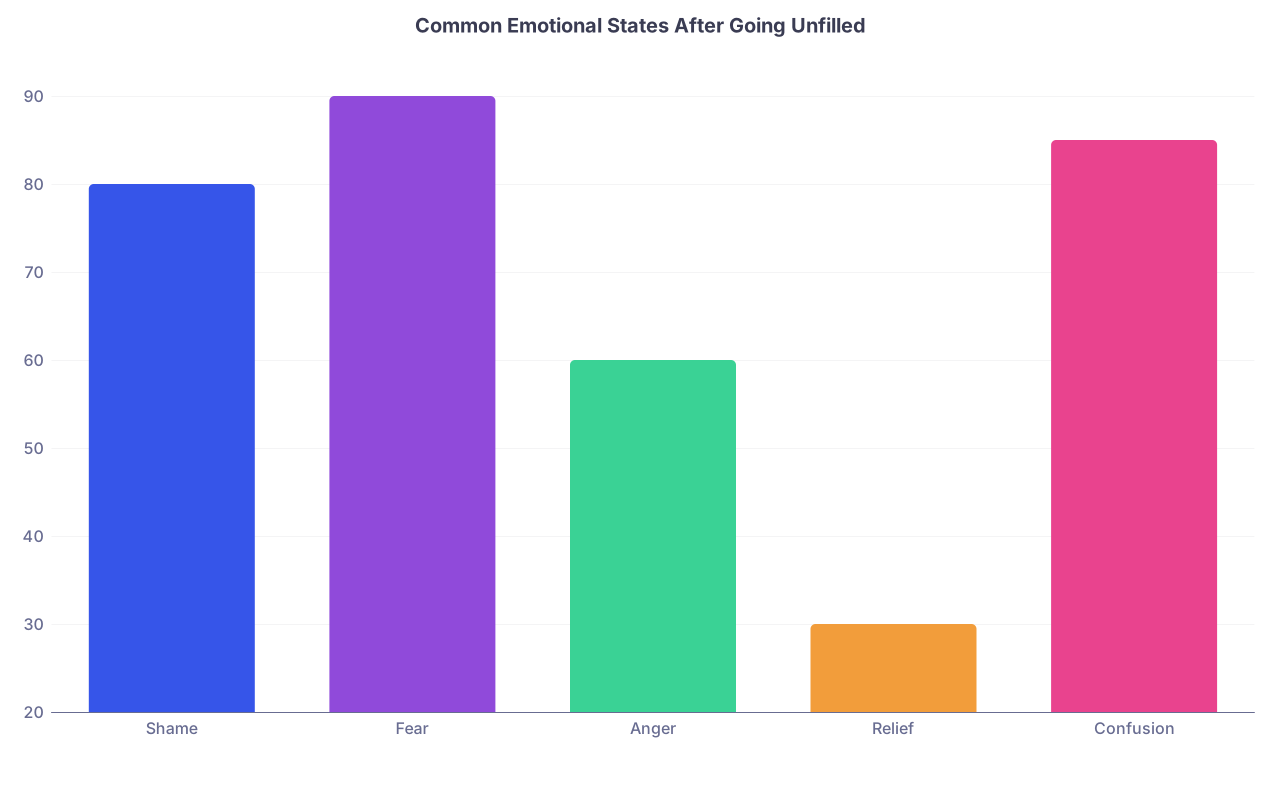
| Category | Value |
|---|---|
| Shame | 80 |
| Fear | 90 |
| Anger | 60 |
| Relief | 30 |
| Confusion | 85 |
Common thoughts:
- “Everyone is moving on without me.”
- “Maybe this is proof I’m not supposed to be a doctor.”
- “I’ve disappointed my family and mentors.”
- “What if this limbo never ends?”
None of these are diagnostic. They’re what your brain does under blunt trauma.
Stuff that actually helps:
- Therapy or counseling (honestly, Match trauma is a real thing; schools know this)
- Clear daily structure if you’re in a gap year
- One or two people you can text, “I saw another Match post and I want to puke,” and they get it
- Limiting social media, especially in March
You don’t have to be relentlessly positive. You just have to stay in the game.
The part nobody tells you: this doesn’t define your end story
One year from now, your life might look completely different:
- You could be a PGY-1 exhausted on nights.
- You could be deep into a research year with an acceptance in hand.
- You could be reapplying with a much stronger app and real confidence this time.
Five years from now, people mostly won’t care which year you matched. They’ll care whether you show up, know your stuff, and don’t make their lives harder.
I’ve watched:
- A student who went unmatched twice end up a stellar FM attending.
- An IMG with a failed Step 1 become a beloved psych chief resident.
- A US grad who didn’t SOAP into anything get an IM spot the next year and crush it.
You only see your story at the worst possible zoom level right now. Microscopic, focused on one awful week. Step back a little.
This feels like the end. It isn’t. It’s a horribly timed, very public detour.
Years from now, you won’t remember every detail of today’s panic. You’ll remember the moment you decided whether this setback was going to define you, or just delay you.
FAQ (Exactly 5 Questions)
1. Does going completely unfilled in SOAP mean I’ll never match?
No. It means you didn’t match this cycle with this version of your application. Plenty of people match in a later cycle after strengthening scores, getting better letters, changing specialties, or fixing application strategy. It’s a red flag only if you come back with essentially the same profile and no growth.
2. Should I reapply to the same specialty or switch?
If you had multiple interviews in that specialty and came close, it might still be realistic with a stronger plan. If you had zero or almost zero interviews, especially in a highly competitive field, you should seriously consider switching or at least dual-applying with a less competitive specialty you can see yourself in. Stubbornly reapplying to a specialty that never gave you a shot is how people lose 2–3 years.
3. Will programs judge me harshly for being a prior-year graduate?
They’ll notice, yes. But most PDs are practical: they care what you’ve done since you didn’t match. If you spent the year in relevant work, improved scores, got strong new letters, and can clearly explain your trajectory, you’re in a much better position than someone who just “waited it out” with no growth.
4. Is taking Step 3 (or Level 3) going to fix my application?
By itself? No. But in some scenarios it helps: US grads or IMGs with borderline Step 1/2 who can prove they can pass a higher-stakes exam. It should be strategically planned, not rushed in desperation. You want a solid pass or strong score that supports your ability to finish boards, not another blemish.
5. What do I actually tell people (family, friends) who ask if I matched?
Keep it simple and controlled: “I didn’t match this year. I’m working with my school/advisors on a plan for next year, and I’ll let you know when there’s news.” You don’t owe anyone your full breakdown or justification. Share details only with people who are genuinely supportive, not just curious spectators in your life.