
It’s Wednesday afternoon of Match Week. Your phone buzzes with a SOAP offer. Your heart rate jumps to 150. You have two hours to accept or decline. You’re staring at the specialty, the location, the program name. Your brain is screaming:
“What if I accept and hate my life?” “What if I decline and end up unmatched?” “What if there’s something better coming next round?” “What if I ruin my entire career in the next 10 minutes?”
You’re not being dramatic. This is exactly how SOAP feels. Panic + pressure + permanent-feeling consequences.
Let’s walk through how to make these calls without destroying yourself with regret later.
First: What’s Actually at Stake (Versus What Your Brain Is Telling You)
Your anxiety is saying: “This decision is forever. No undo. No second chances. One wrong click and you’re trapped.”
Reality is more nuanced.
Here’s the harsh but honest breakdown:
- Accepting a SOAP offer = you are contractually bound for that PGY year.
- Declining all offers and not matching via SOAP = you are likely reapplying next cycle, with a gap year and a big red flag (“previously unmatched”).
Both options are stressful in different ways.
But neither is absolute career death.
I’ve seen:
- People SOAP into prelim medicine, crush it, then match categorical IM, anesthesia, radiology, even derm later.
- People go unmatched in SOAP, regroup, do a research year or prelim, and then match solid categorical spots the next year.
- People accept SOAP spots they weren’t thrilled about and later say, “Honestly, it wasn’t my dream, but it was fine. I’m okay.”
The nightmare scenario your brain is drawing (you accept the “wrong” SOAP spot and your whole life is ruined) is emotionally real. But logically? Overstated.
The real risk is not thinking clearly when the timer is counting down.
The 3 Core Questions You Must Answer Fast
When an offer hits, you don’t have time to do a full “life philosophy” review. You need a simple internal algorithm.
Here’s the one I’d actually use under pressure:
Can I realistically tolerate this specialty for at least 1–3 years?
Not love. Not “dream.” Just tolerate without soul-annihilation.Is this program safe enough and not obviously toxic?
You’re not going to have time for a full investigation, but you can spot some big red flags.Is my realistic alternative better or worse than taking this right now?
Not the fantasy alternative. The actual likely alternative if I say no.
If you can answer:
- Yes
- Yes (or “probably”)
- This is better than my realistic Plan B
…you probably accept.
If you hit:
- No, I truly cannot do this specialty
- Or this program is sending up huge red flags
- And you have a legit Plan B that isn’t delusional
…then declining might be rational, not reckless.
Step 1: Gut-Check the Specialty (Even If It Wasn’t Your Original Plan)
SOAP makes people do mental gymnastics: “Maybe I could actually like pathology? Or psych? Or family med?”
Sometimes that’s flexible thinking. Sometimes it’s panic bargaining.
Here’s the core question, stripped:
“If I got stuck in this specialty long-term, could I build a life I don’t hate?”
Not a perfect life. Just “not hate.”
Ask yourself fast:
- Did I at any point in med school think, “I could see myself kinda liking this” about this specialty?
- Would I rather redo this whole year again (applications, exams, uncertainty, money) than do at least one year in this program?
- Does this specialty fundamentally clash with how I like to work? (e.g., you hate procedures, and this is surgery; you hate outpatient, and this is family medicine-heavy clinic)
If your honest answer is:
- “I never considered it, but I don’t viscerally hate the idea” → still in the game.
- “I would absolutely rather eat glass than spend 60 hours/week doing this” → that’s a serious pause.
Don’t over-romanticize “trying again next year.” Another full year of uncertainty, cost, and risk isn’t magically better than one not-perfect year of residency that keeps doors open.
Step 2: Rapid-Fire Program Safety Check
This is where people panic-scroll Reddit and lose 45 of their 120 minutes.
You do not have time to run a full investigation. You do have time to avoid an obviously awful situation.
Here’s a quick-and-dirty safety screen you can run in 10–15 minutes.
| Check Type | What To Look For |
|---|---|
| ACGME Status | Accredited, not probation |
| Website | List of current residents, normal schedule |
| Reviews | No widespread “horror story” consensus |
| Location | You can physically live there for a year |
Concrete steps:
Search:
Program Name + ACGME- Confirm it’s accredited and not on probation or under major review.
Find the program website:
- Is there an actual current resident list?
- Any sudden massive drop in class size? That can be a red flag.
Quick Google + Reddit search:
- If you see 1–2 bitter comments, that’s normal.
- If you see a pattern of: “chronically malignant, 80+ hours, multiple people left, do not come here” — pay attention.
Check location reality:
- Could you afford to live there?
- Any deal-breakers for you? (visa issues, you’re primary caregiver for someone who cannot move, etc.)
If a program is:
- Accredited
- Has normal-appearing resident classes
- No widespread meltdown reviews
- In a place you can tolerate for one year
…it’s not likely to be a true horror pit. Not guaranteed, but not a disaster-in-progress either.
Step 3: Compare This Offer Against Your Realistic Plan B
This is where people lie to themselves.
Your brain under stress will do this: “I’ll decline this, and then I’ll probably get a categorical IM offer in Round 3. Or worst case, I’ll easily match next year.”
Maybe. But you have to play the probabilities, not the fantasy.
Look at your actual situation:
- Were you completely unmatched or did you just miss your top specialty?
- How many interviews did you have this year?
- Any big red flags on your app (attempts, professionalism issues, low scores, late exams)?
- Are you an IMG/DO with limited geographic flexibility?
If you struggled to get interviews this year, expecting next cycle to magically be better without a big change (research, new score, strong letter, prelim year) is wishful thinking.
Your real Plan B might be:
- A research year with no guaranteed income
- Working as a scribe/MA/tutor while reapplying
- Trying for a prelim-only position next year anyway
- A non-clinical path you’re not actually excited about
VS
- One year of prelim IM or transitional year
- Or SOAPing into a categorical in a less-desired specialty or location
That trade-off isn’t glamorous. But in a lot of cases, taking the SOAP spot is the more stable, lower-risk play.
When Accepting the SOAP Spot Is Probably the Right Move
Let me be blunt. These are common scenarios where I think accepting is almost always the better move:
- You’re completely unmatched and have no backup offers in sight.
- You have a prelim IM or TY offer in a reasonably normal program.
- The specialty isn’t your dream but you don’t actively hate it.
- Your application has real weaknesses that won’t magically resolve in one year.
- You’re an IMG/DO and this was already a tough cycle.
In those cases, taking the SOAP spot:
- Keeps you in the system.
- Gives you US clinical experience and new, fresh letters.
- Buys you time and money while you figure out your next move.
- Looks better to future programs than “sat out an entire year unmatched.”
I’ve seen tons of people rebrand themselves after a SOAP year.
“I SOAPed prelim IM, then matched anesthesia.”
“I SOAPed FM and actually ended up pretty happy, stayed and made a life here.”
Is it perfect? No.
Is it often the least bad option under time pressure? Yes.
When It Might Be Reasonable to Decline (And Not Hate Yourself)
There are situations where saying no is not crazy or irresponsible. Hard, but not crazy.
You might consider declining if:
The specialty is a true non-starter for you
Not “I’m not passionate about it.” More like:- You know you cannot handle psych for deep personal reasons.
- You have severe needle phobia and the spot is super procedural.
- The work fundamentally conflicts with your values or mental health.
The program looks genuinely dangerous or imploding
- Probation + multiple residents suddenly gone + consistent horror-story reputation.
- Location where you literally cannot live (unsafe for you personally, or severe visa/immigration limitations).
You actually have a solid alternative lined up
Not vibes, not “manifesting.” Actual things like:- A confirmed research fellowship with a high-matching mentor in your desired field.
- A prelim or PGY-1 offer coming from outside the Match that you trust.
- Strong signal from a home program that they will take you in a structured, realistic way next year (and they’ve done that before).
Your mental health is at a breaking point
If you’re genuinely at risk of harming yourself or completely collapsing in a demanding residency environment, pushing yourself into a specialty or program you dread might be dangerous.
None of these are easy calls. But they’re not irrational.
How to Decide Under a 2-Hour Timer Without Melting Down
This is the part that actually feels like torture: the countdown.
Here’s how I’d structure that two-hour window.
0–15 minutes: Reality check and basics
- Deep breath. Literally pause for 60 seconds.
- Write down: “Offer: [specialty], [program], [location].”
- Quick ACGME + website + quick search. Confirm it’s legit and not radiating disaster energy.
15–45 minutes: Specialty + life check
- Ask yourself on paper:
- “Can I tolerate this specialty for at least 1–3 years?”
- “Am I okay living in this city for a year?”
- Reality-check Plan B:
- “If I say no, what exactly is my next 12 months going to look like? How am I paying rent? What’s my realistic chance of improving my app enough?”
Write. It. Down. Anxiety in your head is 10x worse than anxiety on paper.
45–75 minutes: Phone a trusted human
- Call:
- A mentor who knows your app.
- A resident you trust.
- A realistic friend (not the one who always says “follow your heart” with no context).
Ask:
- “If you were me, with my stats and this year’s cycle, what would you do?”
- “How bad would it be to reapply from scratch next year?”
You’re not outsourcing your decision, but you’re sanity-checking it.
75–105 minutes: Make the call
At this point:
- You’ve checked safety.
- You’ve examined specialty tolerability.
- You’ve compared against a non-fantasy Plan B.
- You’ve gotten at least one outside perspective.
You won’t feel certain. You probably won’t even feel “good” about it. That’s normal.
You are choosing under constraint. There is no perfect answer. There is only the answer you can live with.
105–120 minutes: Commit and stop re-deciding
Once you click accept or decline, you have to stop the mental loop.
No:
- “What if Round 3 has something better?”
- “What if I waited 10 more minutes?”
That way lies madness.
Your future self will have plenty of time to process and adjust. Your current self needs to function.
Regret: You’re Going to Feel It Either Way
This is the part nobody tells you:
You will almost certainly feel regret no matter what you choose.
- If you accept: “What if I gave up something better?”
- If you decline: “What if that was my only safe shot?”
That doesn’t mean you chose wrong. That’s just what high-stress, high-uncertainty decisions feel like.
What usually matters more long-term:
- How you show up wherever you land.
- How you advocate for yourself once you’re in that program/year.
- What you do with the opportunities that show up next.
SOAP is not a judgment on your worth as a physician. It’s a painful, chaotic system matching flawed human beings to flawed training environments. You can still build a good career out of an imperfect SOAP decision.
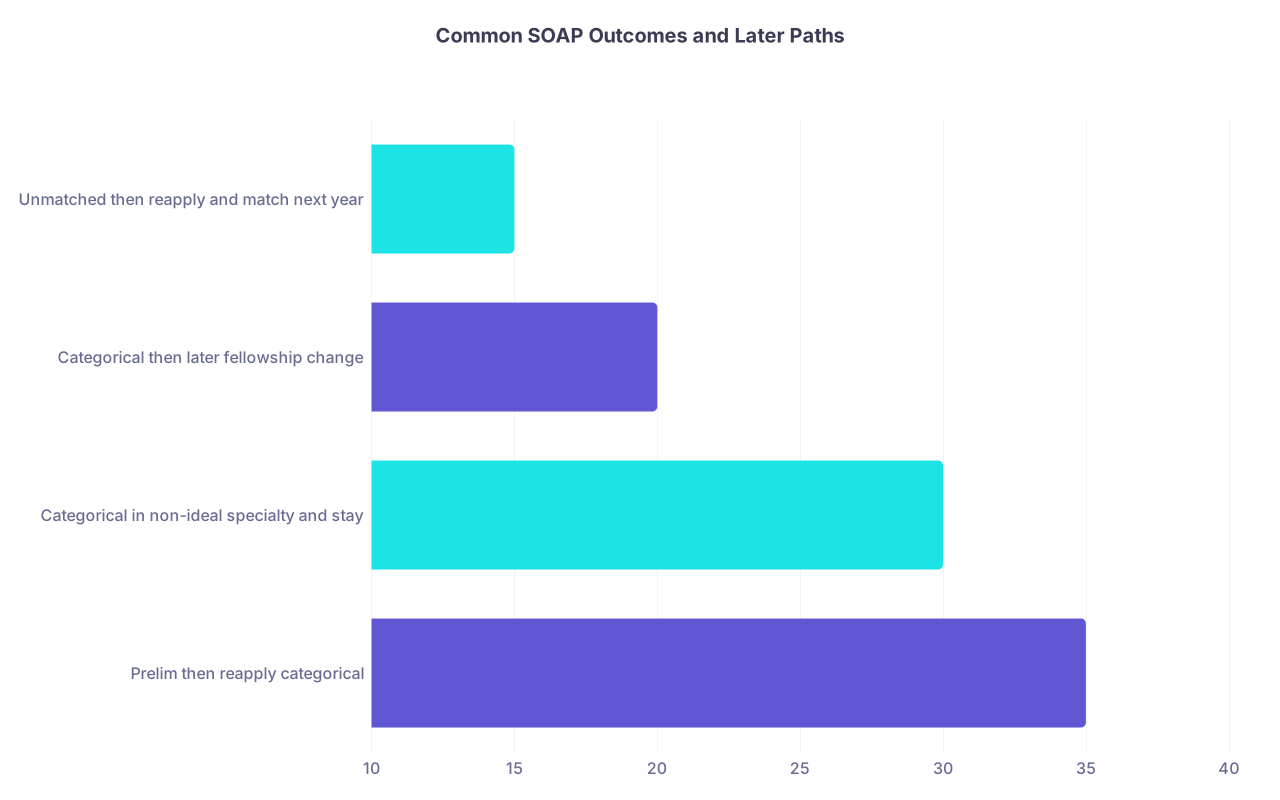
| Category | Value |
|---|---|
| Prelim then reapply categorical | 35 |
| Categorical in non-ideal specialty and stay | 30 |
| Categorical then later fellowship change | 20 |
| Unmatched then reapply and match next year | 15 |
Quick Decision Framework You Can Screenshot
When an offer hits, ask:
- Do I absolutely, genuinely cannot do this specialty — or is it just not my dream?
- Does this program appear reasonably safe and legit, not an obvious disaster?
- Is taking this offer better than my realistic next year if I say no?
- If a close friend in my exact shoes asked me what to do, what would I tell them?
If your honest answers are:
- “I could tolerate it”
- “Seems okay enough”
- “Yeah, this is probably better than another year in limbo”
- And you’d tell your friend to accept
…then you probably already know what you should do.

| Step | Description |
|---|---|
| Step 1 | Receive SOAP Offer |
| Step 2 | Consider Decline and Plan B |
| Step 3 | Accept Offer |
| Step 4 | Discuss with mentor or advisor |
| Step 5 | Can tolerate specialty? |
| Step 6 | Program seems safe? |
| Step 7 | Plan B better than this offer? |
FAQ (Exactly 4 Questions)
1. What if I accept a SOAP spot and then regret it immediately? Am I stuck forever?
You’re contractually committed for that PGY year. Backing out is extremely serious and can burn bridges and hurt your ability to match later. But “regret” doesn’t automatically mean you made a wrong choice; it often just means you’re exhausted and grieving the path you thought you’d have. Many people feel that regret at first and settle once they start working, making friends, and building competence. If things are truly unbearable later, there are rare paths to transfer or reapply, but those are complicated and should be navigated with trusted mentors, not impulsively.
2. Is it better to go unmatched and reapply than to take a SOAP spot in a specialty I didn’t apply to?
Sometimes, but not usually. Reapplying from “unmatched” without new, strong changes to your application is an uphill battle. A SOAP prelim or even categorical in a not-ideal specialty often gives you more leverage later: new letters, US clinical experience, and proof that you can function as a resident. The exception is if the specialty is a true non-starter for you long-term or the program is clearly unsafe. But for many people, “not my dream” is still better than “no residency at all.”
3. Will future programs judge me for SOAPing? Will it hurt my chances later?
Programs mostly care about what you did with the opportunity you had. If you SOAP into a prelim or categorical spot, work hard, get strong letters, and don’t create professionalism problems, plenty of programs will see that as a positive: you showed resilience and functioned in a real residency. Yes, some ultra-competitive fields may raise an eyebrow, but a strong performance in a SOAP spot usually looks better than a blank, unmatched year.
4. How do I handle the shame and embarrassment of SOAPing at all?
You’re not alone. A lot of people sitting in lectures or in your class group chat right now are quietly SOAPing and just not talking about it. Attendings you respect failed Step, remediated rotations, took extra years, or scrambled (old SOAP). Nobody wears it on their badge. You’re allowed to grieve, cry, be angry. But the people who end up okay are the ones who feel all that and still show up for their patients and their work. This week feels like it defines you. It doesn’t. It’s one brutal chapter in a very long book.
Key points:
- There is no perfect SOAP decision, only the best decision you can make with limited time and information.
- Compare each offer to your realistic Plan B, not a fantasy version of next year.
- Most careers survive — and sometimes quietly benefit from — an imperfect SOAP path, as long as you show up and do the work once you’re there.