You’re not wrong for dreading SOAP phone calls. The system is.
Let me be blunt: forcing shell‑shocked unmatched applicants to cold‑call residency programs during the most humiliating week of their lives is a terrible design. It rewards the smooth talkers, not necessarily the best doctors. So if you’re introverted, anxious, or just terrible on the phone? Of course this feels like your nightmare.
But you still have to survive it.
What you need right now isn’t vague “be confident” pep talks. You need someone to tell you exactly what to say, when to say it, and how to not sound like you’re about to cry even if you almost are.
That’s what this is. Scripts, structure, and the emotional hand‑holding nobody has time to give you during SOAP week.
First: You’re Not Pathetic For Being Afraid Of This
If your brain is running through all the worst‑case scenarios, you’re not dramatic. You’re realistic. I’ve heard all of these, verbatim:
- “What if I call and they ask me some off‑the‑wall clinical question and I blank?”
- “What if they’re annoyed and I ruin my chances?”
- “What if they remember me as the weird, awkward one and it torpedoes my rank?”
- “What if everyone else sounds polished and I sound like a premed begging?”
And the sneaky one:
- “Why would they even care that I called? Am I just bothering them?”
Here’s the ugly truth: some programs will be annoyed. Some will ignore you. Some will be kind but non‑committal. A few will actually remember you in a good way.
You’re not calling to magically convert them into guaranteed offers. You’re calling to:
- Show you’re a real human who cares about their program.
- Put your name in their short‑term memory right when they’re building lists.
- Reduce the chance you’re just another anonymous ERAS PDF.
That’s it. That’s the bar. You’re not auditioning for “Best Phone Personality.” You’re trying to move from “nameless applicant #387” to “oh yeah, that was the student who called and seemed very interested.”
Low bar. Achievable, even if your voice shakes.
What Actually Happens When You Call During SOAP
Most people over‑imagine the drama. It’s usually way more boring.
Typical scenarios:
- You get voicemail. You leave a message. That’s it.
- Front desk answers, transfers you, you get voicemail.
- Coordinator answers, talks for 1–3 minutes, then says some version of “we’ll keep you in mind.”
- Very rarely, a PD or APD picks up and has a brief real conversation.
They are not sitting there with a buzzer waiting to “X” you out if you stumble over a word. Half the time, they’re exhausted, drowning in applications, and just trying to be polite.
So you plan for the common paths:
| Scenario | How Often It Happens | What You Need Ready |
|---|---|---|
| Straight to voicemail | Very common | Tight 30–40s script |
| Coordinator + brief chat | Very common | 1–2 minute script |
| Live PD/APD conversation | Less common | 2–3 points + questions |
| Clearly annoyed response | Occasional | Exit line and move on |
You don’t need 10 different versions of yourself. You need one calm, repeatable version you can run on autopilot even while anxious.
Core Strategy For Introverts: Don’t Wing It. Script It.
If you’re introverted, the “just be yourself and let it flow” advice is sabotage. Under this kind of stress, your brain isn’t going to “flow”; it’s going to reboot.
So you build yourself a little “call kit”:
- A simple structure you follow every time
- Short scripts for:
- Voicemail
- Coordinator/staff
- PD/APD live call
- A one‑page “cheat sheet” with program‑specific bullets
You’re not reading a novel out loud. You’re using scaffolding so your brain doesn’t fall apart.
Script 1: Voicemail (Your Most Likely Outcome)
Assume you’ll hit voicemail. That means this is the most important script to have locked down.
Target: 30–40 seconds. Clear. Calm. No rambling.
Here’s a template you can literally copy and adapt:
“Hello Dr. [Last Name] / Hello this is for the [Program Name] internal medicine residency.
My name is [Your Name]. I’m an unmatched applicant participating in the SOAP this week, and I’ve applied to your program.I’m especially interested in [Program Name] because of [1 specific reason: strong outpatient training / your community focus / your categorical program with strong fellowship matches / your emphasis on underserved populations].
I completed my clinical training at [Your Med School], and I’m particularly strong in [1–2 quick points: my inpatient rotations / my sub‑internship in IM / working with diverse patient populations].
I’d be very grateful for consideration for any available positions.
My AAMC ID is [ID] and my phone number is [number].
Thank you for your time.”
You are not trying to dump your entire CV into their voicemail. You’re just dropping: name, status (unmatched in SOAP), something specific about them, your strength, your ID, and a thank you.
Practice this 5–10 times out loud. Record yourself once. Yes, it’s awful hearing your own voice, but it makes the real thing less terrifying.
Script 2: Talking To The Coordinator (Most Common Real Conversation)
If a human being picks up (usually a coordinator or admin), they’re your gatekeeper. They’re also usually very, very tired this week.
Your job is not to impress them with deep insights. Your job is to be respectful, concise, and easy to deal with.
Here’s a simple flow you can follow:
- Opening + who you need
- Brief ID + why you’re calling
- One specific interest point
- Polite close
Example:
“Hi, my name is [Your Name]. I’m an applicant in the SOAP and I applied to your [specialty] program.
I was wondering if there’s a good time or way to express my interest to the program director or coordinator? I want to be respectful of your time.”
They’ll usually either:
- Take a brief message,
- Tell you “we’re not taking calls about SOAP,” or
- Transfer you / give you an email.
If they’re open to a brief message, you can go into a trimmed version of the voicemail script, but shorter:
“Sure, thank you.
I’m [Your Name], AAMC ID [ID]. I completed med school at [School], and I’m especially interested in your program because of [1 specific reason].I’d be very grateful for consideration for any available positions. Is there anything else you need from me?”
Then stop talking. Let them decide how much engagement they want.
If they sound rushed or annoyed, you can bail out gracefully:
“I understand you’re very busy, thank you for taking the time to speak with me today.”
You’re not trying to win them over with charisma. You’re trying to not be the person who keeps them on the phone for 10 minutes.
Script 3: If A PD or APD Actually Picks Up
This is the part that’s living rent‑free in your anxiety brain. The “what if the PD picks up and I panic and blow it.”
So you just pre‑decide what you’ll say.
Structure:
- Greeting + who you are
- One sentence: why you’re calling
- 2–3 bullets: who you are as an applicant
- 1–2 program‑specific reasons you’re interested
- Offer to answer questions
- Thank you and exit
Concrete example:
“Good afternoon Dr. [Last Name], my name is [Your Name]. I’m an applicant in the SOAP and I’ve applied to your [specialty] program.
I wanted to briefly express my strong interest in your program and introduce myself.
I graduated from [School] in [year / expected year], with particular strength in [brief: sub‑I in IM, strong clinical evaluations, etc.]. I’m especially interested in [part of specialty: community‑based internal medicine / primary care / hospital medicine].
I’m drawn to your program because of [specific reasons: your strong training with underserved populations / your robust didactic curriculum / your fellowship match in cardiology / your smaller class size and close mentorship].
I’d be very grateful for consideration for any available positions. I’m happy to answer any questions you might have about my application, or keep this brief since I know this is a busy time.”
Then you shut up. Let them decide.
Possible responses:
- “Thank you, we’ll review all applications through ERAS.” → “Thank you so much for your time and consideration.” End.
- “Can you tell me briefly about your USMLE scores / gaps / red flags?” → Have a 2–3 sentence, already‑rehearsed explanation.
- “Do you have any questions for us?” → Have 1–2 normal questions ready. Nothing dramatic.
Safe questions if your mind blanks:
“Yes, thank you. I was wondering how your residents typically describe the culture of the program?”
or
“Do you have any advice for SOAP applicants who are particularly interested in your program?”
You’re not trying to win the Nobel Prize for Insightful Question Asking. You’re showing you’re thoughtful and not just blasting calls mindlessly.
Handling The Thing You’re Most Afraid Of: Red Flags On The Phone
The horror scenario is always the same: they ask about your “issue” and you freeze.
Low Step score. A fail. A leave of absence. A gap year. An attempt at another specialty that didn’t match.
You can’t control if they bring it up. You can control that you’re not addressing it for the first time live on the phone.
Write a 2–3 sentence explanation now, before you start calling.
Examples:
Step 1 fail:
“I did have a Step 1 failure. At the time I was dealing with [brief mention if appropriate: a health issue / family situation], and I underestimated how much it would affect my studying. I took that as a wake‑up call, adjusted my study strategy significantly, and went on to pass Step 1 and [if true] perform stronger on Step 2 with a [score] that better reflects my abilities.”
Failed a course / remediation:
“I remediated [course/rotation] in my [year]. I struggled initially with [specific: time management in pre‑clinicals / adapting to inpatient workflow], but with faculty support I repeated the material, passed, and since then I’ve [mention later strong clinical evaluations / no further issues].”
Unmatched once before:
“I previously went through the Match in [year] and did not secure a position. Since then, I’ve focused on strengthening my application with [research, USCE, improved Step 2, etc.], and I’m very committed to training in [specialty] and contributing fully from day one.”
Say it out loud enough that it stops sounding like a confession and starts sounding like a professional explanation. Because that’s what it is.
Managing The Emotional Part (So You Don’t Completely Fall Apart)
You’re not a robot. SOAP is brutal. You’re calling strangers to talk about one of the worst weeks of your life.
A few realistic things that help, not the usual “just relax” nonsense:
Write everything down.
Names, ACGME number, 1–2 unique features of each program, your AAMC ID, your core script. When you’re nervous, your working memory collapses. Reading isn’t weakness; it’s survival.Batch your calls.
Don’t try to bulldoze through 30 calls in a row. Do 4–5. Take 10 minutes off. Drink water. Stare at a wall. Then another 4–5.Accept that your voice will shake.
That doesn’t mean you’re doomed. PDs and coordinators know this is a disaster week for applicants. You’re allowed to sound human.Have a post‑call ritual.
Even just: mark the program as “called,” jot 1 line about how it went, stand up, stretch, deep breath. Then next one.Pre‑decide your quitting point.
“I will make calls from [time] to [time], then I stop.” No endless, panicked dialing into the night.
Here’s how a typical block might actually look in practice:

| Step | Description |
|---|---|
| Step 1 | Pick 5 programs |
| Step 2 | Review cheat sheet |
| Step 3 | Call 1 - log outcome |
| Step 4 | Call 2 - log outcome |
| Step 5 | Call 3 - log outcome |
| Step 6 | Call 4 - log outcome |
| Step 7 | Call 5 - log outcome |
| Step 8 | 10 minute break |
No heroics. Just boring, consistent effort.
How Many Programs Should You Call? And When?
You are not calling every program in the SOAP list. That’s spammy and weird.
You prioritize:
- Programs you genuinely would accept if offered
- Places that clearly review SOAP calls (your dean or seniors may know patterns)
- Programs where you have any connection: region, school, alumni, rotation
Rough rule: calling 10–20 programs thoughtfully beats 50 chaotic calls where you barely know who you’re talking to.
Timing wise, you want to stay within normal business hours for their time zone. No 7 pm calls. No 7 am ambush.
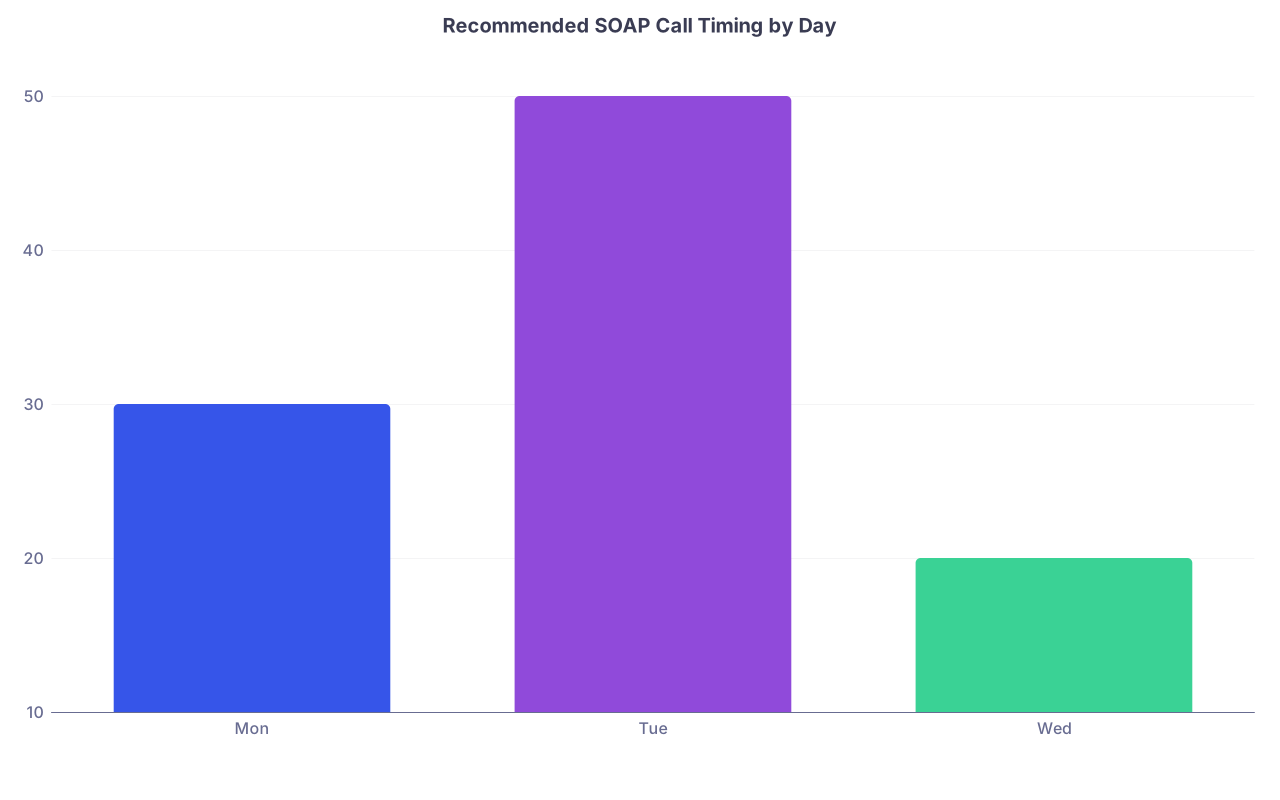
| Category | Value |
|---|---|
| Mon | 30 |
| Tue | 50 |
| Wed | 20 |
Think: Monday/Tuesday for most calls. Wednesday if you need to fill in gaps or follow up lightly if explicitly invited to.
What If You Literally Can’t Bring Yourself To Call?
Then you adapt. You’re not out of the game; you just pick channels that don’t require live talking.
Options:
- Email the coordinator/PD with a short, structured message (basically your voicemail script in text).
- Ask your dean’s office or a mentor to reach out on your behalf, especially where they know faculty.
- Focus more on programs that don’t seem to value calls as heavily (some explicitly say “no calls”).
Is a call slightly better than an email in terms of making you memorable? Often, yes. Is it a thousand times better? No. Programs are still mostly deciding off your application.
If the choice is “no contact at all” vs “solid email,” send the email.
Tiny Details That Calm The Panic-Brain
These seem small, but when you’re melting down, they matter.
- Before each block of calls, write the program name at the top of a sticky note and put it in front of you. It helps prevent the “wait what program is this again?” panic.
- Start the day with 1 “practice” call to a program you’re less desperate about. Don’t open with your absolute top choice.
- Keep a water bottle next to you. Anxiety dries your mouth like crazy.
- Don’t stare at your own face in a Zoom reflection or laptop webcam while calling. Turn that off. It makes you more self‑conscious.
And this sounds dumb, but it works: before the first call, literally say out loud:
“I’m allowed to sound nervous. I’m still a good doctor.”
Because this isn’t an audition for “Who Wants To Be America’s Most Confident Resident.” It’s a broken system you’re surviving.
One More Thing You Won’t Hear Anywhere Else
Some people will not call at all and still match in SOAP.
Some people will call obsessively and still not match.
You are not morally failing if you hate this process.
Your job is to give yourself a shot. That’s it. Not to be perfect. Not to reverse every misstep of the last four years through the sheer power of one voicemail.
If all you can manage is 8–10 solid calls with clear, respectful messages? That’s something. That’s you showing up for yourself under ridiculous pressure.
And honestly, that’s a lot more impressive than sounding slick on the phone.

FAQ (Exactly 6 Questions)
1. Should I say I’m “desperate” or that I’ll “definitely rank them first” if they offer me a SOAP position?
No. Don’t grovel and don’t make absolute promises you can’t technically keep. You can say things like, “I would be genuinely excited to train at your program,” or “I would strongly consider any offer from your program,” but don’t sound like you’ve lost dignity. Professional enthusiasm beats desperation.
2. What if I accidentally say the wrong program name on the call?
It happens. Especially when you’re calling multiple places back‑to‑back. If you catch it immediately, correct yourself: “Sorry, I misspoke—of course I meant [Correct Program Name].” Then keep going. If you realize after you hang up, let it go. Don’t call again to apologize; that just makes it worse. Move on to the next program and tighten your prep.
3. Is it okay to read directly from a script?
Yes, as long as you don’t sound like a hostage video. Glance down, use it as scaffolding, but keep your tone conversational. It’s better to have a script and sound a tiny bit “prepared” than to ramble incoherently because you tried to wing it. Everyone knows this is a high‑stress situation.
4. How many times should I try calling a program if they don’t answer?
Once, maybe twice at different times of day. If you hit voicemail, leave a clean, concise message. Don’t become the person who calls three or four times a day and clogs their phone line. That doesn’t read as “interested”; it reads as “high‑maintenance.” One message can absolutely be enough.
5. What should I do immediately after a really bad call?
First, define “bad.” Usually it feels worse than it was. Either way: stand up, walk away from the desk, drink water, look away from screens for two minutes. Then log it: who you called, what happened, any follow‑up needed. After that, treat it as spent. Don’t punish yourself on a loop. SOAP is already hard enough without you being your own bully.
6. Are programs actually influenced by these calls, or is this all theater?
It varies. Some PDs barely register calls. Others absolutely remember a few applicants: the ones who were clear, respectful, and genuinely interested. Think of it like this: the call probably won’t rescue a deeply weak application, but it can be a tiebreaker “nudge” when they’re choosing among similar candidates. It’s modest leverage, not magic. Still worth using if you can tolerate it.
Key points to keep in your head:
You don’t need to be charming; you need to be clear. Scripts are not cheating; they’re your life raft. And calling 10–20 programs imperfectly is still infinitely better than letting fear talk you into silence.