
What If I Hate My SOAP Program? Planning for Future Transitions
What if you scramble into a SOAP spot… and the minute the adrenaline wears off, your stomach drops and you think, “Oh no. I don’t want this”?
Let me say the part everyone whispers but almost no one says plainly: yes, this happens. People open their SOAP offer, see “Prelim Surgery in a place you’ve never heard of” or “Transitional Year three states away” and feel immediate dread. Or worse: you match into a categorical spot you never really wanted, in a city you hate, in a specialty you’re not sure you can even tolerate.
And your brain instantly jumps to:
Did I just ruin my career? Am I stuck forever? Will every future PD think I’m damaged goods if I try to leave?
Let’s walk through this like an actual person who’s freaking out. Because that’s what you are right now. And you’re allowed.
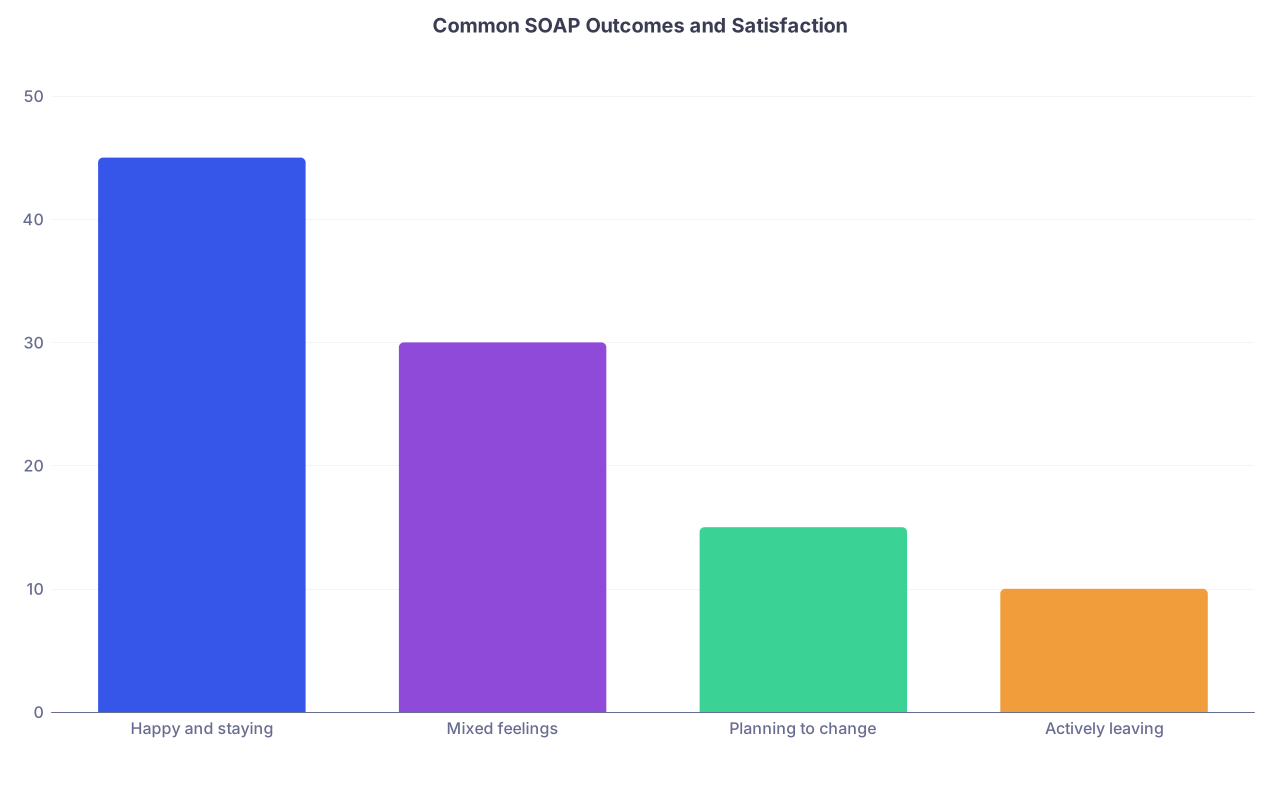
| Category | Value |
|---|---|
| Happy and staying | 45 |
| Mixed feelings | 30 |
| Planning to change | 15 |
| Actively leaving | 10 |
Step One: Are You In Immediate Danger Or Just Miserable?
There’s a big difference between “I hate this” and “this is unsafe”.
You need to figure out which one you’re dealing with, because the options and urgency are not the same.
Red-flag situations
If you’re in a SOAP program and you’re dealing with any of this:
- Systemic bullying, harassment, or discrimination that’s not being addressed
- Consistent duty hour violations with retaliation for reporting
- Being forced to work beyond your competence with no supervision
- Retaliation for asking for help or for patient safety concerns
- Threats, screaming, public humiliation as the norm
That’s not “I hate my program.” That’s “this place may actually harm me or patients.”
If it’s at that level, you need:
- Documentation (emails, screenshots of schedules, written notes of incidents, dates/times, who was present)
- Allies (chiefs, faculty you trust, GME office, maybe your med school dean)
- A plan that might include transferring, taking leave, or—very rarely—walking away
I’ve watched residents stay in truly toxic programs out of fear of “looking like a quitter.” They end up with health problems, failed boards, or serious depression. That doesn’t make you “resilient.” It makes the system abusive.
You are not obligated to destroy yourself for a SOAP program.
The “I hate this but it’s not abusive” bucket
More common scenario:
- You don’t like the city
- You don’t like the specialty (or you’re just not sure)
- The culture is cold, not overtly abusive
- You feel like an outsider
- You’re grieving not matching into your dream field
This is still awful. I know. But it’s a different problem: “How do I survive this year or two and set myself up for a better situation?”
That’s where planning future transitions comes in.

Reality Check: You Are Not Locked Into This For Life
You know how attending gossip goes: “Oh, they left their first program.” Like that automatically means the person is a failure. It’s exaggerated. Jaded. Not the full story.
Here’s the truth: people successfully transition from SOAP programs every single year.
Some leave after an intern year and change specialty.
Some leave a prelim spot to match into a categorical spot.
Some reapply into the same specialty at a better program.
Some use a transitional or prelim year to regroup, pass Step/Level exams, and come back stronger.
Are there risks? Yes. PDs will have questions. You will have to explain your story. Some programs won’t touch transfers. That’s real.
But being miserable and never exploring your options is also a risk: burnout, failure, dropping out later, hating your career long-term.
You’re choosing a hard path either way. You might as well choose the one that gives you a shot at being okay.
Know What You’re Actually Trying To Do
“Hate my SOAP program” is vague. PDs don’t respond well to vague. You need to quietly figure out your actual goal.
Roughly, you fall into one of these paths:
- You’re in a prelim/transitional year and want a categorical spot (same or different specialty).
- You’re in a categorical spot but want a different program in the same specialty.
- You’re in a categorical spot but want to switch specialties.
- You’re honestly not sure yet—you just know this feels wrong, and you want options.
You don’t need to decide today. But you do need to think strategically, because how you move through this year matters.
| Situation | Common Next Move |
|---|---|
| Prelim medicine, wants IM categorical | Reapply ERAS, network with IM PDs |
| Prelim surgery, wants radiology | Complete prelim, reapply as PGY-2 |
| Categorical FM, wants derm | Build research, extend training, reapply |
| Transitional year, undecided | Explore fields, set up electives |
| Categorical unhappy, same specialty | Look for PGY-2+ transfer positions |
How To Use A Program You Dislike To Build An Exit Strategy
This part is going to feel gross, but you have to think like this:
“This program may not be good for me long term, but what can I extract from it that helps my future?”
1. Protect your record like it’s your lifeline
Because it is.
You want:
- A clean professionalism record
- No major performance flags if you can help it
- No failed rotations because you “checked out” emotionally
PDs are paranoid about taking someone who had issues at a prior program. Even unfair or minor ones. So do what you can now to give yourself the cleanest paper trail.
That doesn’t mean being a doormat. It means picking your battles carefully and documenting problems while still showing up reliably.
2. Find at least one faculty ally
You don’t need everyone to love you. You need someone who’s willing to go to bat for you.
Maybe it’s:
- An APD who’s decent and pragmatic
- A senior resident who sees your effort
- The one attending who says, “You’re actually really strong—you seem off, what’s going on?”
You’re looking for the person who might:
- Write you an honest but supportive letter down the line
- Take your side in a borderline evaluation
- Give you straight advice on whether your plan is realistic
That starts with doing good work—even if you’re miserable—and then carefully, carefully being honest:
“I’m really grateful to have this spot. I’m also struggling with whether this is the right long-term fit, and I’m trying to figure out what’s realistic. Could I get your honest feedback on how I’m doing and what options might exist in the future?”
Don’t open with “I hate this program and want to leave.” You’re scared; they’re going to be scared too. Keep it framed as exploring, not badmouthing.
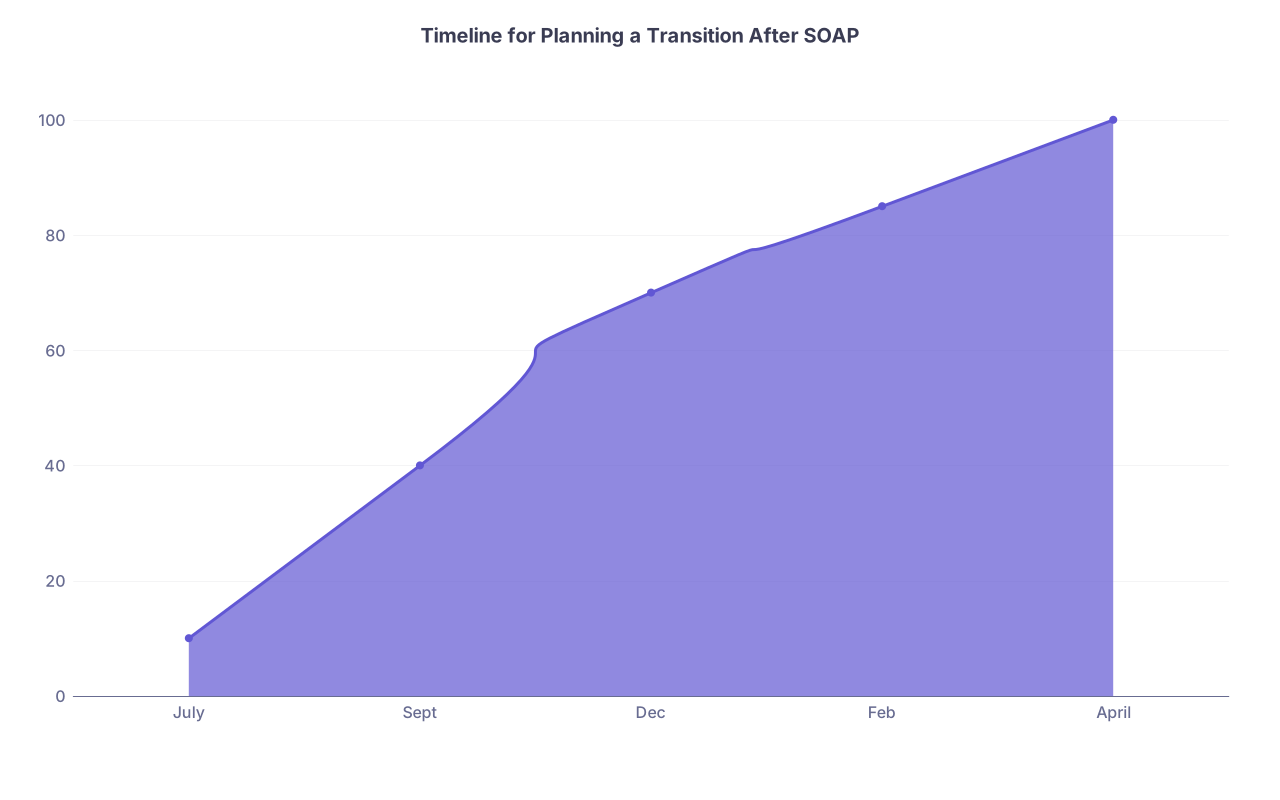
| Category | Value |
|---|---|
| July | 10 |
| Sept | 40 |
| Dec | 70 |
| Feb | 85 |
| April | 100 |
Timing: When Can You Actually Try To Move?
Everyone imagines some dramatic early exit. Realistically, the system is slow and conservative.
Prelim/Transitional year folks
If you’re in a one-year spot:
- Main ERAS reapplication usually happens early fall (September-ish).
- You’ll apply as a PGY-1 with med school + what you have so far from residency.
- Some categorical spots open PGY-1 or PGY-2; many are for the next cycle.
This means:
- From Day 1, your performance matters for letters.
- By 3–4 months in, you should have at least one person who can write something about you as a resident.
You can also quietly look for off-cycle openings: posted on program websites, listservs, or through word-of-mouth.
Categorical residents wanting out
If you’re already in a categorical spot:
- Some specialties have formal transfer pathways and deadlines.
- A lot of transfer opportunities are off-cycle, unadvertised, or word-of-mouth.
You might:
- Stay a full year and apply as a PGY-2.
- Sometimes stay longer to avoid repeating a year, depending on specialty and board rules.
That’s why you can’t just rage-quit. You need your current PD (or at least an APD) to not sabotage you when future programs ask, “So why are they leaving, really?”

| Step | Description |
|---|---|
| Step 1 | Start SOAP Program |
| Step 2 | Document issues |
| Step 3 | Talk to GME or med school |
| Step 4 | Consider transfer or leave |
| Step 5 | Protect evaluations and record |
| Step 6 | Find faculty ally |
| Step 7 | Reapply via ERAS |
| Step 8 | Search transfer spots |
| Step 9 | Use electives and mentors |
| Step 10 | Build letters and experiences |
| Step 11 | Apply and interview |
| Step 12 | Transition or stay |
| Step 13 | Safe but unhappy |
| Step 14 | Unsafe or abusive |
| Step 15 | Clarify goal |
How To Talk About Hating Your Program Without Blowing Yourself Up
This is the part that keeps people paralyzed: “How do I explain wanting to leave without sounding like a problem resident?”
You need a story that’s:
- Honest
- Not trashing your current program
- Focused on fit and future, not drama
Bad version:
“My program is toxic and the PD is insane. They work us to death and don’t care about education.”
Better version:
“I’m grateful for the training I’m receiving, especially in X and Y. Over the year I realized I’m more aligned with Z type of practice and long-term goals that aren’t well supported at my current institution, so I’m hoping to transition to a program that has [concrete thing you’re seeking: more outpatient exposure, stronger research, a different patient population, stronger training in a subspecialty, etc.].”
If it’s truly toxic and someone flat-out asks:
“I did struggle with some aspects of the culture, and I learned I thrive in environments with [describe what you want—supportive mentorship, structured feedback, etc.]. I did my best to stay professional and grow, but I believe I’d do better long-term in a different environment.”
Never—seriously, never—go in guns blazing talking about how bad your current place is. PDs instantly picture you saying that about them someday.
What If You Can’t Leave Right Away?
This is the bleak part. Sometimes you do everything “right” and still don’t get a new spot. Or you realize you need more time to build a competitive application in another specialty.
Then what?
You shift from “escape now” to “how do I minimize long-term damage and build something good out of this?”
That might mean:
- Using electives to explore new fields or do research
- Building relationships outside your department (like radiology, anesthesia, EM, etc.)
- Prioritizing your mental health aggressively—therapy, time off, boundaries
- Reframing this program as “a stepping stone I’m surviving” instead of “my forever home”
I’ve seen people in supposedly “bad” community programs turn themselves into strong candidates through sheer intentionality. They didn’t love their program. But they used it.
Is that fair? No. The whole system’s unfair. But you’re playing the game on the field you’re on, not the one you wish you had.

Mental Health: This Is A Grief Process, Not Just A Career Problem
You didn’t just get “a program you don’t like.” You lost the version of your future you’d been building in your head for years.
That loss is real. And if you don’t confront it, it leaks out as burnout, irritability, “bad attitude” comments on evals, or even self-sabotage.
Give yourself permission to:
- Mourn the specialty you didn’t match into
- Be angry that SOAP felt chaotic and desperate
- Feel embarrassed, ashamed, or “less than” your peers
Then, slowly, you have to move from pure grief to action. Therapy helps. Talking to upper-levels who also SOAPed and survived helps. Talking to your med school dean or career advisor helps.
Don’t try to muscle through this alone and pretend you’re fine. You’re not a robot. This hurts.
Concrete Moves You Can Make In The Next 3 Months
Because abstract reassurance only goes so far.
In the next 90 days, focus on:
- Showing up consistently and avoiding any professionalism flags
- Identifying at least one potential mentor or ally
- Keeping a private document of your experiences—good and bad—for context later
- Reading up on realistic transfer/reapplication options for your desired specialty
- Scheduling at least one conversation with:
- Your med school dean or career advisor, or
- A trusted attending about your long-term doubts
You’re not deciding everything now. You’re gathering information while trying not to burn bridges.

FAQ (Exactly 6 Questions)
1. If I leave my SOAP program, am I basically unemployable?
No. You’re not radioactive by default. But how you leave matters. If you vanish mid-year with no communication, yes—that’s a huge red flag. If you complete a year, maintain professionalism, and have at least one supportive letter, many programs will consider you. You’ll still have to explain the transition, but lots of PDs understand that SOAP isn’t always a perfect match.
2. Should I tell my PD early that I’m thinking about leaving?
Not on Day 1. Build a track record first. If you’re leaning strongly toward reapplying or transferring, you’ll eventually need their cooperation for verification and possibly a letter. Time it after you’ve proven you’re reliable and after you’ve gathered information about what’s possible. And frame it around long-term fit and goals, not “I hate this place.”
3. Is it better to stick it out at a bad program than risk trying to switch?
“Better” depends on the degree of bad. Truly toxic, abusive programs can break you. Staying there just to look “committed” isn’t noble; it’s dangerous. If it’s just not your favorite but tolerable, sometimes staying and building a career there—or finishing and then pivoting later—makes sense. You’re weighing mental health and long-term satisfaction against the real risks and uncertainty of transitioning. It’s not a simple equation.
4. Can I switch specialties after a SOAP year without starting over?
Sometimes. Some of your training might count toward the new specialty, especially if it’s related (prelim medicine to neurology, for example). Other times you’ll have to repeat a PGY-1. Board rules and program policies vary. That’s why you need specialty-specific advice—from PDs, your med school, or residents who’ve actually done it in the fields you’re eyeing.
5. Will future programs judge me because I SOAPed in the first place?
Some will silently judge; others won’t care much. But what matters more is what you did after SOAP. Strong clinical performance, good letters, passing boards, clear growth—that counters a lot of bias. “I SOAPed and then thrived in a difficult situation” is a much stronger story than “I SOAPed and then fought with everyone and left in chaos.”
6. How do I know if I truly hate the specialty vs just being overwhelmed as an intern?
Intern year is miserable for almost everyone. Being exhausted, anxious, and lost is not a reliable sign that you chose the wrong field. Look at the moments when you’re not drowning: do you ever feel curious, fulfilled, or proud of the work itself? Or are the only good moments when you’re as far from the core specialty tasks as possible? Talk to seniors—many will tell you their view of the specialty changed a lot after PGY-1. Don’t make a permanent decision based only on the worst three months of your life.
Two things to hang onto:
- Hating your SOAP program does not mean your career is over. It means you have a harder, more complicated path than you wanted—but there is a path.
- Your job right now isn’t to magically fix everything. It’s to protect your record, find allies, and slowly build yourself an exit ramp—while staying intact enough, mentally and physically, to use it when the time comes.