
Last March, one of my classmates sat in an empty lecture hall refreshing her email while everyone else was at “post-Match brunch.” She’d gone through SOAP, scrambled into a solid program… and still kept whispering, “They’re going to think I’m the reject they got stuck with.”
That’s the part no one posts on Instagram. Not the relief that you matched. The quiet terror that your program director is already disappointed in you.
The ugly fear underneath the question
You’re not really asking, “Will PDs see me as a failure for being in SOAP?”
You’re asking:
- Are they already judging me before I even arrive?
- Am I starting residency with a “loser” label?
- Is everyone going to know I was unmatched?
- Does this ruin fellowship? Academic jobs? Literally everything?
I’ve watched people spiral so hard on this that they can’t even enjoy the fact that they did match. They finally have a spot, and their brain instantly turns it into, “They only took me because they had no choice.”
Let me be blunt about one thing first:
Programs do not SOAP you by accident.
They click “offer” on your name. On purpose. Knowing your file. Knowing you went unmatched.
If they genuinely thought you were a “failure,” you would not be there.
Does that magically erase the shame and anxiety? Of course not. So let’s deal with the actual scenarios instead of the catastrophes your brain is inventing at 2 a.m.
What PDs actually see when they see “SOAP”
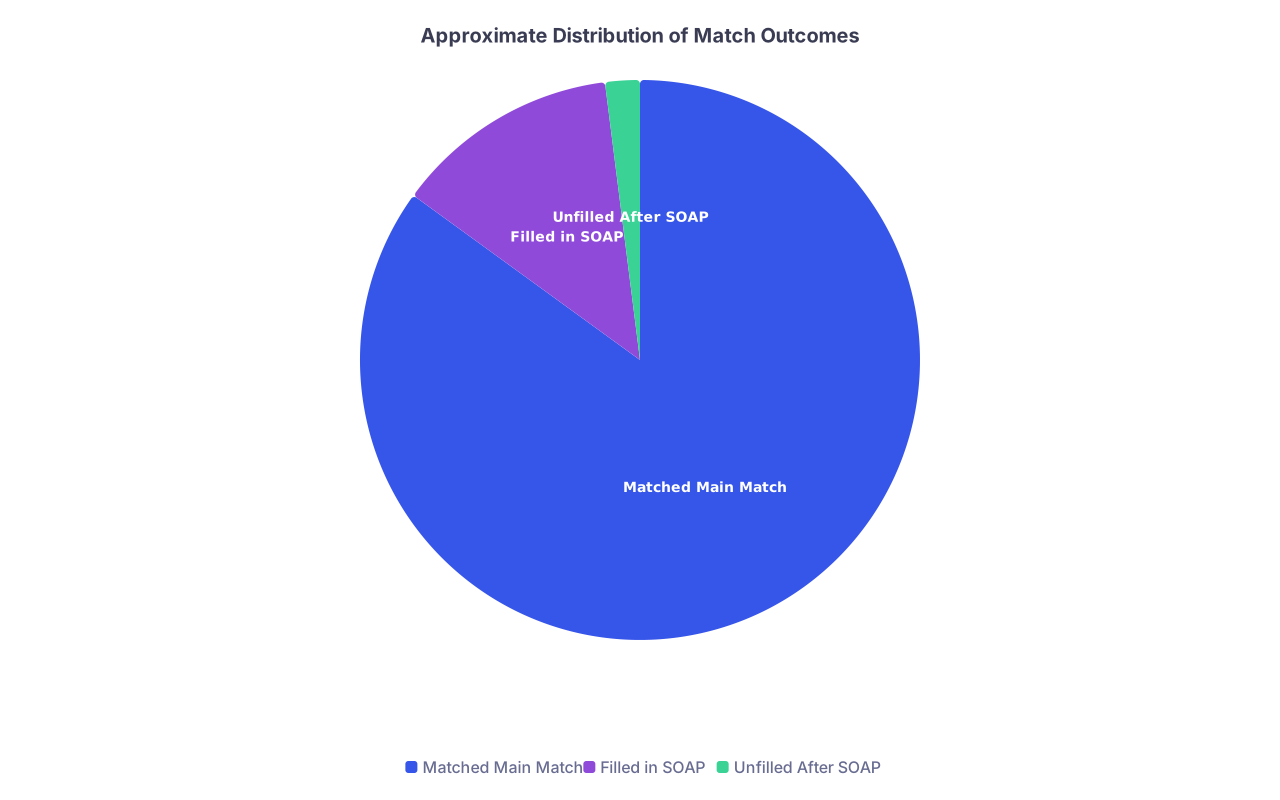
| Category | Value |
|---|---|
| Matched Main Match | 85 |
| Filled in SOAP | 13 |
| Unfilled After SOAP | 2 |
Everyone imagines PDs looking at SOAP applicants like:
“Ah yes, the bottom of the barrel. The leftovers.”
That’s the story you tell yourself when you feel humiliated. It’s not how most PDs actually think.
Here’s what PDs actually see when they look at a SOAP applicant:
You kept going after not matching.
Translation in their heads: “This person can take a hit and still function.” That’s more valuable in residency than a 270 Step 2 and a fragile ego.You were good enough to be ranked by someone originally.
SOAP is full of people who narrowly missed—wrong list strategy, overreached on programs, not enough safety nets, couples match chaos, unfortunate geography, timing, whatever. PDs know this. They see it every single year.You were honest and responsive in SOAP.
They remember who answered the phone, who interviewed well under pressure, who didn’t act like the program was beneath them. That has way more impact than “SOAP vs not SOAP.”You’re filling a real need in their program.
You’re a worker, not a PR ornament. Some PDs actually like that. They know SOAP people usually come in hungry to prove themselves.
The part nobody tells you: some SOAP residents out-perform the “trophy” categorical matched residents. I’ve seen it too many times to call it a coincidence.
The records: what’s actually visible and what isn’t
This is the part my brain obsessed over: “Is SOAP stamped on my forehead? In my file? Will everyone know?”
Short answer: not in the dramatic way your anxiety thinks.
Here’s how it usually breaks down:
| Group | Do they know you SOAPed? |
|---|---|
| Program Director | Yes |
| Associate PD / Chief | Usually yes |
| Other Faculty | Usually no, unless told |
| Co-residents | Only if someone says it |
| Patients | Definitely not |
The formal record:
- PDs know you came through SOAP. That’s obvious from timing and how you were onboarded.
- GME office knows (HR-style knowledge, not a moral judgment).
- Your actual residency file? It has your application, your contract, your evaluations. It does not have a giant blinking red label that says “SOAP LOSER.”
People can piece it together if they care enough:
- Late addition to the class.
- Odd start date sometimes.
- Heard rumors.
But most people just… don’t care that much. Everyone’s too busy thinking about their own boards, kids, sick parents, research, whatever else.
Does it feel like a big deal to you? Absolutely.
Does it occupy even 5% of the average attending’s mental space 6 months later? No.
The worst-case fears (and the actual reality)
Let’s hit the catastrophic thoughts head-on.
Fear #1: “My PD thinks they got stuck with me”
Honestly? No. They accepted you in SOAP. Programs can decline SOAP candidates. They can leave spots unfilled. They don’t have to take you.
SOAP is still selective. It’s rushed and messy, but it’s not random.
Here’s how PDs often see it:
- “We had a gap. We looked at the list. You looked like someone who could do the work.”
- “Your scores were fine, letters were fine; something in your strategy or geography probably screwed you.”
- “You interviewed well under stress. That matters to me.”
You’re imagining them saying: “Well, I guess we’re stuck with this one.”
More often, they’re saying: “Good, we got someone reasonable in this chaos.”
Fear #2: “They’ll never fully respect me”
Respect in residency is earned in a brutally simple way:
Show up, do the work, be teachable, don’t be unsafe, don’t be a jerk.
I’ve watched this play out:
- Categorical PGY-1, matched in main Match, 250+ boards, top med school. Shows up entitled, late on notes, condescending to nurses. Faculty tolerate them. Bare minimum respect.
- SOAP PGY-1, mid-tier everything, had a rough application cycle. Shows up early, asks real questions, owns mistakes, cleans up after themselves, helps their co-interns. Faculty love them. Chiefs choose them for leadership stuff.
After a few months, nobody cares who SOAPed. They care who’s safe to have on call at 3 a.m.
Respect is surprisingly amnesic. It forgets your route in. It remembers how you show up right now.
Fear #3: “This will kill my fellowship chances”
This one is loud. Especially if you’re aiming for competitive stuff.
Harsh truth: fellowship is not a meritocracy based on how you entered residency.
It’s based on what you do during residency.
Fellowship PDs care about:
- Your in-training performance
- Your letters of recommendation
- Any research / projects / teaching you’ve done
- How your PD and faculty talk about you on the phone
You know what they don’t usually ask?
“By the way, did this person get in through SOAP?”
If you’re a strong resident, your PD is not going to sabotage you by volunteering that you SOAPed unless there’s a relevant reason (rare, usually in the context of explaining a gap or move).
I’ve seen SOAP residents:
- Match GI and Cards from community IM programs.
- Get Heme/Onc from mid-tier places.
- Go into competitive fellowships after starting in a less prestigious specialty and switching paths.
Not because PDs “felt bad” for them. Because they showed up, did good work, and built a solid track record.
What you can actually control now (instead of obsessing about SOAP)
You can’t go back and un-SOAP yourself. There’s no alternate timeline where you matched perfectly and arrive with spotless prestige.
So the question becomes: what now?
Here’s what actually moves the needle on how PDs see you.
1. Your first 3–6 months
That window is huge. It’s when people’s narratives about you form.
If your brain is stuck on “They think I’m a failure,” you’re more likely to:
- Overcompensate with fake confidence.
- Hide mistakes out of fear.
- Burn out trying to prove your worth every second.
Flip the script. Think: “I’m a slightly riskier bet on paper; I’m going to make it blindingly obvious they were right to take me.”
That looks like:
- Ask real questions instead of pretending to know.
- Own your misses: “I should’ve done X instead of Y. I’ll fix it this way.”
- Be consistent. Not perfect. Consistent.
2. One honest conversation with your PD
I know. This sounds like your nightmare. But it helps.
Somewhere in the first few months, you can say something like:
“I really appreciate that you took a chance on me through SOAP. I want to be transparent that not matching initially hit me hard, but I’m fully committed to proving you were right to bring me here. If there are any areas where you think I need to improve, I want that feedback early.”
What that does:
- Names the elephant in the room.
- Signals maturity instead of insecurity.
- Turns you from “SOAP file” to “this specific resident who’s trying.”
PDs remember that kind of conversation. In a good way.
3. Make your story about growth, not rescue
At some point, a co-resident is going to say “How was your Match?”
You’ll feel that lurch in your stomach.
You control the frame.
Option A (self-sabotage):
“I actually didn’t match… I had to SOAP… it was awful… I’m still kind of embarrassed about it.”
Option B (honest but not self-destroying):
“I didn’t match initially. SOAP was rough, but I ended up here and it’s been the right fit so far. Honestly, it forced me to figure out how I handle things not going as planned.”
You don’t have to lie. But you also don’t have to hand people a narrative of you as “the failure who barely got in.”
The quiet reality: most of this is in your head
Let me say something blunt that I wish someone had said to me:
You’re obsessing over being in SOAP because you’ve tied your worth to “matching the right way,” not just “becoming a competent, decent doctor.”
Medicine encourages this nonsense. Score worship. Rank list desperation. Instagram “I matched my #1!!” posts. We’re all trained to think the process is a moral evaluation instead of a messy, numbers-heavy lottery with bias and randomness baked in.
PDs, on the other hand, live in the aftermath. They see:
- The golden-child match who flames out.
- The SOAP resident who ends up chief.
- The “average” person who becomes the attending everyone trusts with their own family.
After a while, they just stop worshiping the process as much.
You’re still stuck inside it. That’s why your fear feels way bigger than their judgment.
Very practical, low-drama strategy going forward
If you want a brutally simple “best strategy for SOAP survivors” to not be seen as a failure:
- Accept that they know. Stop acting like you can hide it.
- Decide to over-index on reliability, humility, and growth in PGY-1.
- Ask for feedback early and often—then act on it.
- Build one or two strong mentor relationships where someone can vouch for your trajectory.
- When your story comes up, frame it around resilience, not shame.
None of that is flashy. But it’s how people quietly rewrite their narrative from “SOAP kid” to “one of our strongest residents.”

| Step | Description |
|---|---|
| Step 1 | Unmatched |
| Step 2 | SOAP Offer |
| Step 3 | Start PGY1 |
| Step 4 | Stuck in failure story |
| Step 5 | Trusted resident |
| Step 6 | Strong letters and opportunities |
| Step 7 | How you show up |

If you’re still stuck replaying everything
If right now your brain is looping through:
- “If I’d just applied more broadly…”
- “If I had taken Step earlier…”
- “If I hadn’t ranked that program so high…”
- “If I were smarter, this wouldn’t have happened…”
You’re not alone in that. People replay their Match year like a car crash.
Just don’t drag that version of yourself into residency as if it’s a verdict on your future.
You got hit once. Hard. That doesn’t mean your entire career is built on that moment.
The truth you probably don’t want to hear: a lot of the residents and faculty who seem “above” you now have their own private disasters—failed exams, failed relationships, remediation, probation, near-dismissals. They just got further out from it.
You’re still close to yours. The edges are sharp. That’s why everything feels like it’s about SOAP.
Fast forward three years:
If you do your job, get decent evaluations, and build real relationships with faculty, the sentence becomes:
“She came in through SOAP, but honestly, she’s been one of our best.”
Or even just: “She’s one of our best.” Full stop. The SOAP part drops off.
It doesn’t vanish from history. It just loses its power over the present.

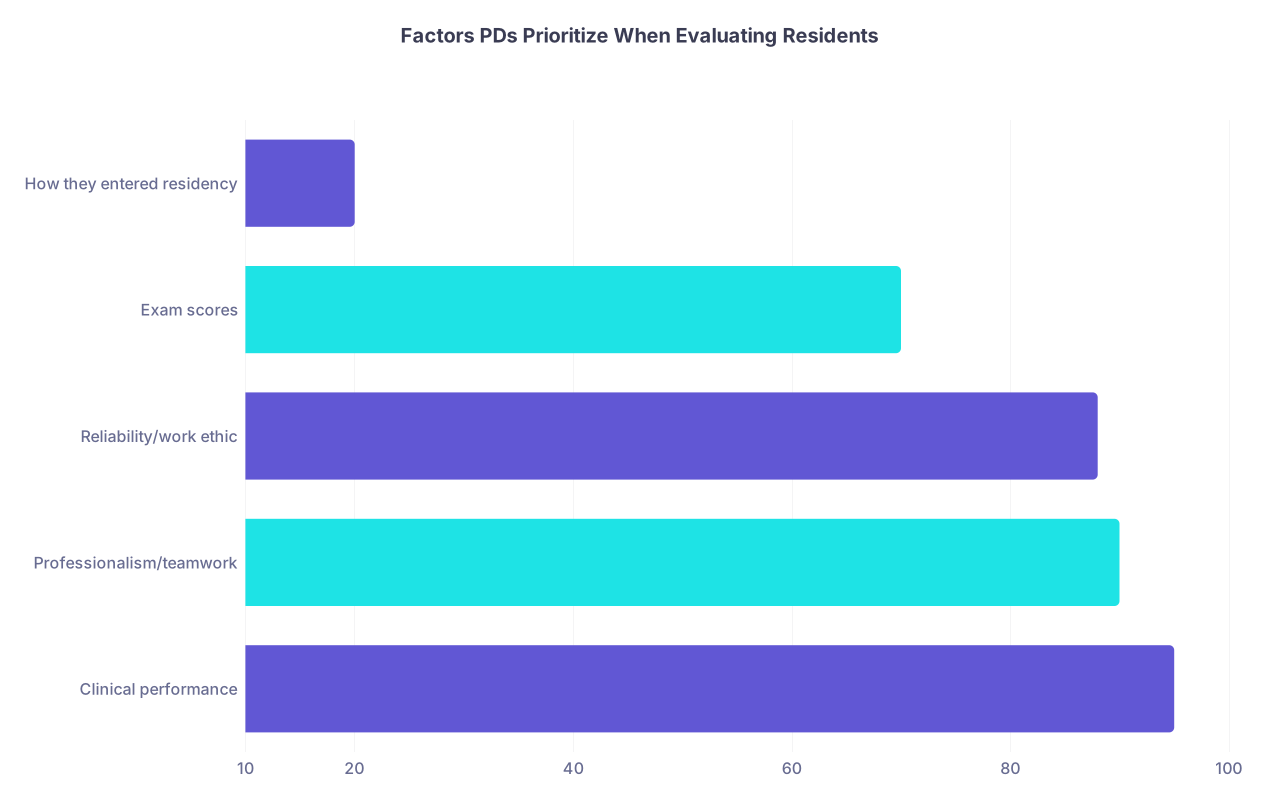
| Category | Value |
|---|---|
| Clinical performance | 95 |
| Professionalism/teamwork | 90 |
| Reliability/work ethic | 88 |
| Exam scores | 70 |
| How they entered residency | 20 |
One day, someone’s going to introduce you as:
“This is Dr. [Your Name], they trained here and they’re fantastic.”
Not:
“This is Dr. [Your Name], SOAP survivor, 202X.”
Years from now, you won’t remember the exact words of the email that told you you were unmatched. You’ll remember the patients, the nights you barely made it, the people who believed in you anyway—and that you kept going when you were absolutely sure everyone saw you as a failure.