Understanding SOAP for Caribbean IMGs Aiming for Diagnostic Radiology
For Caribbean IMGs pursuing diagnostic radiology, the Supplemental Offer and Acceptance Program (SOAP) can feel like the last lifeline in a stressful Match Week. Yet, with focused SOAP preparation, you can transform that anxiety into a clear, structured strategy.
SOAP is not a “second Match.” It is a fast, high‑pressure process that allows unmatched or partially matched applicants to apply to unfilled residency positions. For a Caribbean IMG seeking a radiology residency, especially diagnostic radiology, understanding how SOAP works—and where radiology realistically fits into it—is critical.
Key points to understand:
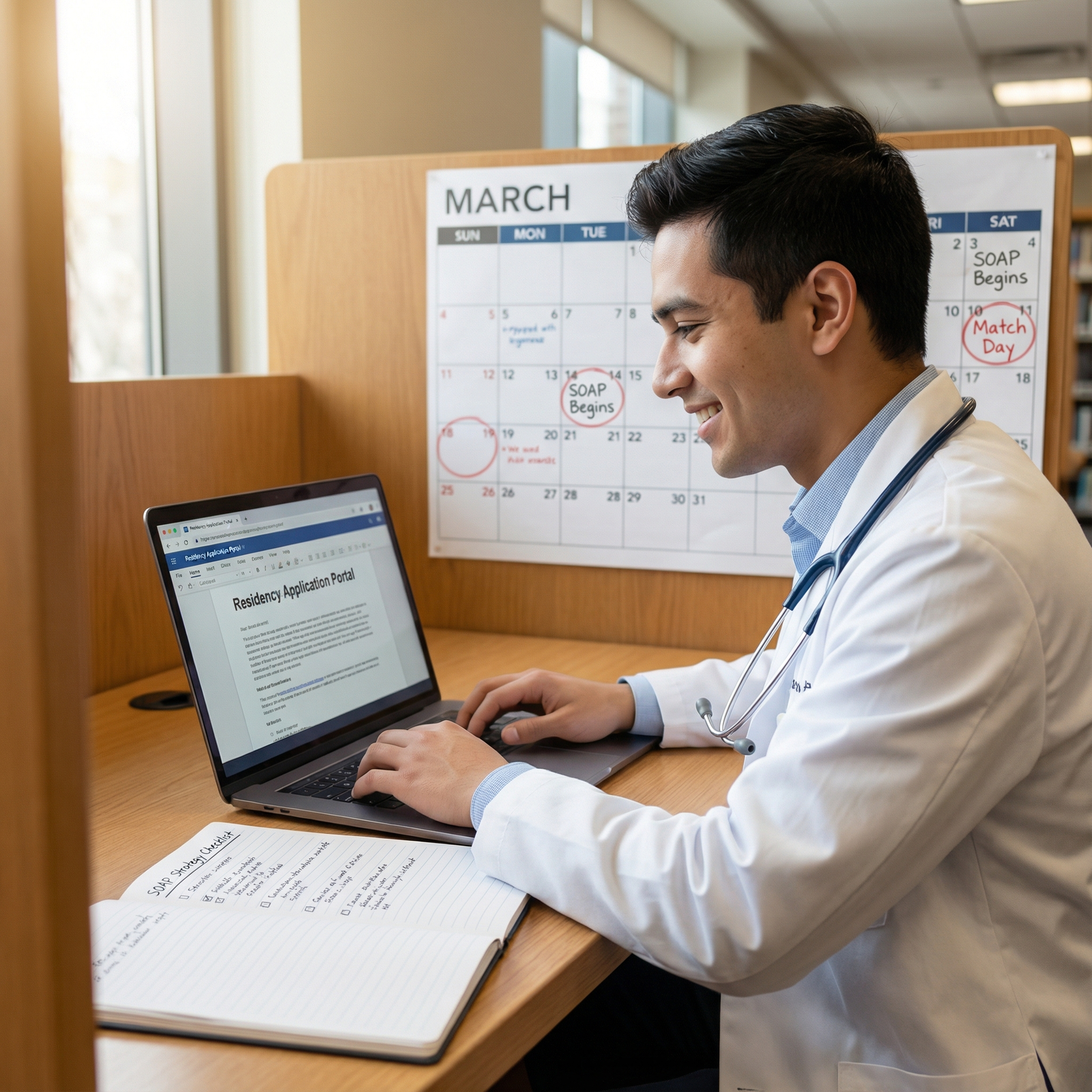
- SOAP timing: SOAP occurs during Match Week (usually Monday–Thursday before Match Day).
- Eligibility: You must be:
- Registered for the NRMP Main Residency Match
- Unmatched or partially matched and
- SOAP-eligible as designated by NRMP (often based on ECFMG certification status for IMGs).
- Application cap: You can apply to up to 45 programs total during SOAP.
- Rounds of offers: Programs submit rank lists; NRMP releases offers in up to four rounds over Wednesday–Thursday. You can accept only one position.
For a Caribbean medical school residency applicant (e.g., SGU, AUC, Ross, Saba), SOAP preparation is especially vital because:
- Caribbean IMGs often face more competition for interview spots and match positions, particularly in competitive fields like diagnostic radiology.
- Your chance to pivot into other specialties during SOAP may strongly affect whether you train in the U.S. at all.
- Structured planning before Match Week greatly reduces panic and improves decision-making under time pressure.
While you may have applied primarily to diagnostic radiology, it is crucial to be realistic: diagnostic radiology match positions very rarely appear in SOAP, and when they do, they are highly competitive. Your SOAP strategy must balance:
- Long-term radiology goals
- Immediate need for a U.S. residency position
- Your academic metrics and visa constraints
The rest of this article will break down SOAP preparation step by step, tailored to a Caribbean IMG with an eye toward radiology.
Assessing Your Radiology Profile Before Match Week
The most important SOAP preparation happens before you know your Match result. As a Caribbean IMG, you should perform a frank assessment of your competitiveness for diagnostic radiology.
1. Analyze Your Application Metrics
Consider how program directors are likely to view your profile:
USMLE scores:
- Step 1: Now pass/fail, but failures or late passes matter.
- Step 2 CK: Competitive diagnostic radiology programs often expect strong scores (traditionally 240+ in the old scoring system). As an IMG, higher scores help offset other disadvantages.
Attempts and gaps:
- Any failed attempts on Step exams?
- Extended time between graduation and application?
- Long gaps without clinical activity?
ECFMG certification status:
- To be SOAP-eligible and ready to start residency, you usually must be ECFMG certified by a specific NRMP deadline.
- Confirm with your school (e.g., SGU, Ross, AUC, Saba) that all documents and verifications are submitted.
Radiology-specific strength:
- Radiology electives or observerships (especially U.S.-based)
- Radiology-related research, abstracts, or posters
- Strong letters of recommendation from radiologists in the U.S.
If your metrics are borderline for diagnostic radiology in the Main Match, it is extremely unlikely that you will successfully enter radiology via SOAP, where competition is even more compressed.
2. Understand the Reality of Radiology in SOAP
Diagnostic radiology and interventional radiology are highly competitive specialties. In most years:
- Few, if any, diagnostic radiology residency positions remain unfilled after the initial Match.
- Programs that do go unfilled might have:
- Very rigid visa limitations
- Extremely specific prerequisites
- Internal candidates already favored
This doesn’t mean you should abandon radiology entirely; it means:
- Plan A: Match into diagnostic radiology via the main NRMP Match.
- Plan B (SOAP): Be prepared to pivot to a different specialty while still building a path that keeps radiology possible in the long term (e.g., preliminary year in medicine/surgery or categorical medicine, then attempt radiology later).
3. Define Your SOAP Priorities in Advance
Before Match Week, write down your priorities—otherwise the pressure of SOAP will drive impulsive decisions.
Ask yourself:
Is any ACGME-accredited U.S. residency better than not matching at all?
For most Caribbean IMGs, the answer is yes.Which specialties am I realistically willing to accept through SOAP?
Common options for IMGs in SOAP:- Internal Medicine (categorical or prelim)
- Family Medicine
- Transitional Year (TY)
- Preliminary Medicine or Surgery
- Pediatrics, Psychiatry in some years
If I don’t match into radiology, is a medicine prelim or transitional year acceptable as a bridge?
Many radiologists began with a medicine prelim or a TY. A strong PGY-1 year plus new U.S. radiology exposure can help you reapply for a diagnostic radiology match later.What are my visa constraints?
- Some SOAP positions do not sponsor visas.
- As a Caribbean IMG, your visa status (US citizen, permanent resident, or needing J-1/H-1B) will limit which programs you can seriously consider.
Document these decisions clearly, share them with a mentor, and agree on your threshold for accepting a SOAP offer.

Building a SOAP-Ready Application as a Caribbean IMG
Your Caribbean medical school residency application as submitted for the main Match will carry over into SOAP—but that’s not the end of the story. You can and should adjust elements (within ERAS rules and SOAP timelines) specifically for SOAP.
1. Update Your ERAS Application Strategically
Use any allowed edit window before SOAP begins (ERAS usually restricts some changes once SOAP officially starts; confirm current-year rules):
Experience section:
- Add any new:
- U.S. clinical experience
- Radiology observerships
- Telemedicine or teleradiology-related roles
- Quality improvement (QI) projects, audits, or case reports
- Clarify roles in concise, outcomes-focused bullet points.
- Add any new:
Medical school performance:
- Ensure your MSPE (Dean’s Letter) and transcript are accurate and uploaded.
- Correct any minor errors that could be flagged.
Licensing exams section:
- Confirm all USMLE steps and scores are correctly listed.
- If Step 3 is completed, highlight it—this can be a differentiator in SOAP.
Certifications and skills:
- List BLS, ACLS, research skills (stats, data analysis), and any imaging-related skills (e.g., basic ultrasound if truly applicable).
2. Tailor Your Personal Statement for SOAP
You may need multiple personal statements ready before SOAP begins, depending on your contingency plans:
- Radiology-focused personal statement:
For any rare diagnostic radiology match opportunities or prelim/TY years with a radiology flavor. - Internal Medicine or Family Medicine statement:
If you are open to these specialties in SOAP. - Preliminary/TY statement:
Explain your intention to use PGY-1 as a strong foundation, without sounding like you’re “just passing through.”
For a Caribbean IMG, it’s important not to over-emphasize your school in your personal statement. Instead, emphasize:
- Clinical maturity from diverse patient populations (Caribbean and U.S.).
- Adaptability to different healthcare systems.
- Resilience, discipline, and commitment to continuous learning.
- Any SGU residency match or Caribbean IMG match success stories you can indirectly reference through your mentors (e.g., “I have worked with alumni of my institution now thriving in diagnostic radiology, which has shown me the importance of…”).
3. Polish a SOAP-Ready CV and Supporting Documents
While ERAS serves as your formal CV, many programs (especially community programs) may glance at an attached CV or ask for one during rapid communications.
Make sure your CV is:
- One to two pages, clearly formatted.
- Focused on:
- U.S. clinical experiences
- Radiology exposure
- Leadership and teaching roles
- Research and quality projects (even if small)
- Free of unnecessary details (high school awards, early non-medical jobs unless directly relevant).
4. Letters of Recommendation and Radiology-Specific Support
You generally cannot upload new LoRs once ERAS is locked for the Match, but you can reassign existing letters to different specialties. Planning ahead is crucial:
For radiology-focused pathways:
- Have at least one strong letter from a U.S. radiologist if possible.
- Include a strong IM/FM letter as backup, showing you’re also a solid candidate for non-radiology specialties.
Before Match Week, talk to supportive faculty:
- Explain that they may receive rapid calls or emails from programs during SOAP.
- Ask if they are comfortable strongly endorsing your clinical judgment, professionalism, and work ethic.
Their readiness to advocate for you on short notice can heavily influence SOAP decisions.
What Is SOAP? Timeline, Mechanics, and Strategy for Radiology-Minded IMGs
1. Clear Definition: What Is SOAP?
SOAP (Supplemental Offer and Acceptance Program) is a structured, NRMP-run process that matches SOAP-eligible unmatched applicants to unfilled residency positions during Match Week.
Key features of SOAP residency:
Closed system:
Only SOAP-eligible applicants can apply to unfilled positions; programs must follow NRMP SOAP rules (no outside offers or side deals).Limited applications:
You submit a maximum of 45 applications total during SOAP. Careful selection is crucial.Multiple rounds of offers:
NRMP issues offers in up to four rounds over Wednesday and Thursday:- You can receive multiple offers in a round.
- You can accept only one.
- If you decline or let an offer expire, you cannot get that same position again.
Understanding these constraints is central to effective SOAP preparation.
2. SOAP Week Timeline at a Glance
While exact times vary yearly, the flow is similar:
Monday morning:
- You learn if you are Matched, Partially Matched, or Unmatched.
- If Unmatched/Partially Matched and SOAP-eligible, you can access the list of unfilled programs.
Monday–Tuesday:
- You identify target programs among the unfilled list.
- You submit ERAS applications (up to 45).
- You may receive short, focused interviews (often virtual/phone).
Wednesday–Thursday:
- NRMP releases offer rounds.
- You monitor offers and respond within short time windows.
- Once you accept a position, the process is over for you.
Your goal as a Caribbean IMG is to enter SOAP with a pre-structured decision tree, not to improvise this under pressure.
3. Realistic Radiology Strategy Within SOAP
Given the scarcity of diagnostic radiology positions in SOAP, how should a Caribbean IMG approach it?
Scenario A: Extremely strong radiology profile + open DR positions
- High Step 2 score, strong U.S. radiology letters, research, possibly U.S. MD/DO-level metrics.
- If such rare DR positions exist:
- Prioritize them with a radiology-focused personal statement.
- But have a backup plan for non-radiology positions if offers don’t materialize.
Scenario B: Solid but not top-tier radiology profile; few or no DR positions
This is the majority scenario for Caribbean IMGs.
Recommended approach:
- Look for prelim/TY programs that:
- Have a history of sending graduates to radiology (you may find this from program websites or alumni).
- Are associated with institutions that also have diagnostic radiology residencies.
- Simultaneously apply to categorical IM/FM programs where:
- They have a track record of accepting IMGs.
- You can build a strong clinical foundation and potentially reapply to radiology in the future, or pursue subspecialties involving imaging (e.g., cardiology, pulmonary/critical care with imaging integration).
Scenario C: Significant red flags (multiple exam failures, major gaps, professionalism concerns)
- Radiology via SOAP is almost certainly not realistic.
- Focus SOAP strategy on:
- Community-based IM/FM programs known to accept IMGs.
- Any unfilled positions that match your eligibility and visa needs.
In all scenarios, do not rely on SOAP to get you into radiology directly. Use it to secure a U.S. residency footprint from which radiology—or an imaging-heavy subspecialty—may still be reachable.

Practical SOAP Preparation Strategy for Caribbean IMGs
This section focuses on concrete, step-by-step SOAP preparation aligned with your goal of eventually working in diagnostic radiology.
1. Pre-Match Week Checklist (4–8 Weeks Before)
Confirm eligibility:
- ECFMG certification on track and verified.
- NRMP registration completed and active.
Organize your documents:
- Updated ERAS application.
- Multiple personal statements (Radiology / IM/FM / Prelim-TY).
- Polished CV.
- List of references who are ready to speak on your behalf.
Research backup specialties and programs:
- Build a list of IM/FM programs known to accept Caribbean IMGs, especially from your own school:
- Example: Look into any published SGU residency match lists or your school’s match outcomes to see institutions that frequently take Caribbean graduates.
- Identify preliminary/TY programs connected to institutions with radiology departments.
- Build a list of IM/FM programs known to accept Caribbean IMGs, especially from your own school:
Create your SOAP “tiers”:
- Tier 1: Ideal SOAP options (e.g., TY at a radiology-heavy institution, IM with strong imaging focus).
- Tier 2: Acceptable but less ideal (community IM/FM, prelim medicine).
- Tier 3: Last-resort programs you would still accept to avoid not matching.
2. Monday of Match Week: Responding to Unmatched Status
If you receive “You Did Not Match” or “You Are Partially Matched”:
- Take an hour to process emotionally. Don’t make instant decisions driven by shock.
- Confirm your SOAP residency eligibility in NRMP.
- Access the list of unfilled positions as soon as it opens.
- Compare this list with your pre-created tiers, adjusting based on:
- Actual specialties and locations available
- Visa sponsorship details
- Program reputation for IMGs (when known)
3. Selecting Programs for 45 SOAP Applications
You must use these 45 slots wisely:
Diversify by specialty:
- If possible, apply to:
- Internal Medicine categorical
- Family Medicine categorical
- Transitional Year / Prelim Medicine
- Only include diagnostic radiology match positions if they actually appear and are realistic.
- If possible, apply to:
Diversify by competitiveness:
- Mix:
- Some relatively more competitive programs you’d love to join
- Many realistically attainable backup programs
- Mix:
Target IMG-friendly settings:
- Community hospitals
- Programs with historically higher IMG percentages
- Geographic areas that traditionally rely more on IMGs (certain Midwest, South, or rural regions).
Don’t ignore geography completely:
- Only rule out regions that are truly impossible for you (e.g., specific visa or family constraints).
- Radiology is a long road; training anywhere in the system can serve as a stepping stone.
4. SOAP Interview Preparation
SOAP interviews are fast, often blunt, and rarely as formal as pre-Match interviews. Prepare:
Key talking points tailored to your path:
As a Caribbean IMG:
- How your diverse training and patient exposure makes you adaptable.
- How you’ve handled resource-limited environments, which translates to resilience.
As a radiology-focused applicant entering another field (IM, FM, prelim/TY):
- Emphasize your genuine interest in that specialty’s core skills (patient care, clinical reasoning).
- Frame radiology interest in a way that shows you value clinical grounding:
- “I see strong internal medicine training as essential to understanding imaging within clinical context.”
- Avoid sounding like you’ll be disengaged or “using” the program just to switch later.
Prepare concise answers to:
- “Why did you go unmatched?”
- “Why our program and our specialty?”
- “What are your long-term goals?”
- “How will you handle a heavy workload and steep learning curve?”
Practice these with a mentor or with fellow Caribbean IMGs. Short, clear, confident answers are best.
5. Managing Offers During SOAP
When offers begin:
Expect sudden deadlines:
- You typically have a very short time window (e.g., 2 hours) to respond.
Follow your predetermined priority list:
- Rank in advance:
- Transitional year linked to a radiology-friendly institution
- Strong categorical IM program known to support subspecialty aspirations
- Other categorical positions (FM, etc.)
- Prelim positions that at least keep you in the system
- Rank in advance:
Avoid reflexive declines:
- If you decline an offer, you cannot get it back.
- Only reject an offer if you are certain you would rather risk not matching than accept it.
Communicate clearly with mentors:
- If time allows, quickly check with a trusted advisor before accepting or declining borderline offers.
- Ultimately, this is your decision; rely on the plan you made before emotions took over.
Long-Term Radiology Goals After SOAP: Thinking Beyond Match Week
Even if your SOAP outcome is not in diagnostic radiology, your radiology ambitions can remain alive.
1. Using a Prelim or TY Year as a Launchpad
If you secure a preliminary medicine/surgery or transitional year:
Excel clinically:
- Outstanding evaluations and strong letters will be essential if you reapply to radiology.
Stay connected to radiology:
- Attend radiology noon conferences when feasible.
- Seek informal mentorship from radiologists at your institution.
- Participate in imaging-related QI or research projects.
Plan for reapplication:
- Rebuild your diagnostic radiology match application with:
- New, stronger letters from U.S. faculty.
- Clear demonstration of growth since your prior attempt.
- A direct narrative explaining why radiology remains your goal and how your PGY-1 experience has prepared you better.
- Rebuild your diagnostic radiology match application with:
2. Thriving in a Different Specialty While Keeping Imaging in Your Career
If you enter Internal Medicine, Family Medicine, or another field via SOAP:
- Consider subspecialties with intensive imaging use:
- Cardiology (echo, nuclear imaging, CT, MRI)
- Pulmonology/critical care (chest imaging, ultrasound)
- Rheumatology (MSK imaging integration)
- Seek imaging education opportunities:
- POCUS (point-of-care ultrasound) training
- Collaboration with radiologists on cases or research
A fulfilling career that heavily integrates imaging is feasible even if you never switch into diagnostic radiology proper.
FAQs: SOAP Preparation for Caribbean IMGs in Diagnostic Radiology
1. Is it realistic to match into diagnostic radiology through SOAP as a Caribbean IMG?
It is possible but rare. Few diagnostic radiology positions typically go unfilled, and competition for those is intense. As a Caribbean IMG, you should not depend on SOAP for a radiology spot. Instead, use SOAP to secure a strong PGY-1 position (prelim, TY, or categorical) and consider reapplying to diagnostic radiology later with a stronger U.S. track record.
2. How should I prioritize my 45 SOAP applications if radiology is my long-term goal?
Prioritize programs and specialties that:
- Are realistically attainable given your metrics and IMG status.
- Provide robust clinical training (e.g., Internal Medicine, TY, prelim medicine).
- Offer access to radiology mentors or departments.
Apply broadly to IMG-friendly IM/FM programs and prelim/TY positions, and only include diagnostic radiology programs if they exist and you are a strong candidate.
3. I’m an SGU graduate—does SGU residency match history help me in SOAP?
Your individual profile matters more than school name, but coming from a large Caribbean school like SGU may help indirectly:
- Programs are familiar with SGU graduates and may have had successful residents from your school.
- Your school’s match/support office might provide data on SGU residency match sites, including those that often accept Caribbean IMGs in SOAP.
Use that institutional knowledge to target programs that already know and trust graduates from your school.
4. If I don’t match into radiology now, is my radiology career over?
Not necessarily. Many radiologists started with:
- A prelim medicine or surgery year
- A transitional year
- Even a full categorical IM residency before switching into radiology
Your chances are better if you: - Excel clinically in your PGY-1 year
- Build strong new relationships with U.S. faculty
- Demonstrate ongoing commitment to radiology through electives, conferences, or research
SOAP is one step in a longer journey, not the final verdict on your radiology aspirations.
Thoughtful SOAP preparation, realistic expectations about the diagnostic radiology match, and a clear hierarchy of backup plans will dramatically improve your odds of securing a U.S. residency position as a Caribbean IMG—and keeping your radiology dreams in play.