
Educational disclaimer: This article is for general educational purposes only. It discusses residency application strategy and may reference costs, fees, or other practical considerations, but it is not financial, legal, or tax advice. ERAS policies and program workflows can change, so confirm details with AAMC ERAS, your medical school, and qualified advisors.
Here's the clean answer. Your ERAS application is not floating in some magical invisible vault until the second you assign programs. But it's also not sitting wide open for every residency coordinator and program director in America to browse while you're still fixing commas in your experiences section.
That fantasy, either totally hidden or totally exposed, is how applicants get this wrong.
The real answer is operational. Boring on the surface. Very important in practice. Parts of your application exist in the ERAS ecosystem at different times and for different people. You can work on it. Your school can upload pieces. Letter writers can submit through the LoR Portal. ERAS can process data. But a program usually cannot meaningfully review you as an applicant until you have actually applied, assigned what needs to be assigned, and transmitted a file they can receive in their workflow.
And let me tell you what really happens on the program side. Program directors are not spending August refreshing some hidden national dashboard hoping to catch half-built student applications in the wild. That's not a thing. They're busy. Coordinators are busy. Faculty are busy. What they do care about, intensely, is whether your file is complete and reviewable when their screening process begins.
That's the distinction that matters: being present in ERAS is not the same as being transmitted, and being transmitted is not the same as being ready for review.
If you remember nothing else, remember this: timing matters less because someone is secretly watching your draft and more because incomplete files get delayed, filtered out, parked in a holding bucket, or quietly ignored once the season starts moving. That's the real danger. Not invisibility. Workflow.
The Short Answer: Your ERAS Application Is Not Invisible, But It Is Not Reviewable Everywhere Either
Applicants love binary thinking. "Can they see me or not?" Nice simple question. Wrong framing.
Your ERAS application can exist in the system before any program ever sees it in a practical sense. You may have entered your demographics, experiences, publications, and personal information. You may have certified the application. Your medical school may be preparing your transcript and MSPE. Your letter writers may be uploading letters tied to your AAMC ID and letter request forms. All of that is real. All of that is inside the machinery.
But a residency program you have not applied to is generally not sitting there with access to your candidate file. There is no delivery relationship yet. No transmission. No file in their queue. No faculty member clicking into your half-finished profile and judging your wording in the hobbies section. That part is mythology.
The inside truth is more mundane and more important. Programs care about when your application becomes available in the format they actually use to screen. That means assigned program, paid application, transmitted file, and supporting documents attached correctly enough for coordinators and faculty to process.
So stop obsessing over the wrong fear. The threat is not that your draft is secretly exposed too early. The threat is that your application reaches a program late, incomplete, or misassigned right when everyone else's complete files are flooding in.
What Really Happens Behind the Scenes in ERAS Before You Assign Programs
Let me walk you through the real lifecycle, because this is where the confusion starts.
First, you create the ERAS account. Then you start entering data. Education history. Experiences. Publications. Honors. Personal statement uploads. You can save and revise. At that point, the application exists as work in progress inside ERAS.
Then comes certification and submission of the application itself. That matters. A lot. Saved content is not the same thing as a certified application. I've seen students assume "it's all there" because they typed it in. No. If you haven't certified appropriately, you're still standing in the doorway holding the package.
At the same time, other pieces are moving on parallel tracks. Letter writers upload through the LoR Portal. Your school handles transcript and MSPE release timing. ERAS itself is essentially the infrastructure layer making these components available when the proper steps happen.
Here's who can interact with your file before programs are assigned: you, your medical school, your letter writers through their designated portal, and ERAS systems. That's the real list. Not random residency programs browsing the nation's applicant pool like it's Zillow.
Once you assign documents to programs and apply, including payment, ERAS can transmit your file to those designated programs. That is the handoff. That is when practical visibility begins for the program.
Now for the behind-the-scenes truth applicants rarely hear clearly: from the program side, there is no magical feed showing every unassigned applicant constructing a draft profile line by line. Program staff mainly work with files actually transmitted to them. Their world is much less dramatic and much more logistical than applicants imagine.
This is the technical-versus-practical visibility distinction. Technically, your data may exist in ERAS infrastructure. Practically, faculty reviewers cannot do much with a file that has not been sent to their program. If there is no application in their queue, there is nothing to screen.
And supporting documents don't always move in lockstep. Your application may be transmitted while one letter is still pending. Your transcript may be there, but the wrong personal statement may be assigned. Your MSPE may release on a different timeline. This is why "Can they see me?" is a weak question. The stronger question is "What exactly did they receive, and is it complete enough to survive first-pass review?"
That's the question adults in this process ask. You should too.
Why Applicants Get This Wrong: The Difference Between Existing, Being Sent, and Being Screened
The word "visible" causes half the panic. It's too sloppy. There are really three separate questions.
Does your application exist in ERAS? Has it been sent to a specific program? Has anyone at that program actually screened it?
Those are not the same event. Not even close.
A certified application sitting in ERAS without program assignment is real, but it is not the same as a reviewed application. Once transmitted, it still usually enters a workflow before a faculty member ever forms an opinion. Coordinator review. Requirement checks. Import into ERAS and often downstream systems. Filters. Sorting. Triage. Then, finally, faculty review.
That's what really happens.
And here's what faculty say privately when the doors are closed: they do not reward applicants for trying to game hidden timing theories. They reward files that are complete, credible, and available when they start reading. That's it. The folklore about secret exposure gets way more attention than the dull, deadly reality of missing letters and sloppy document assignment.
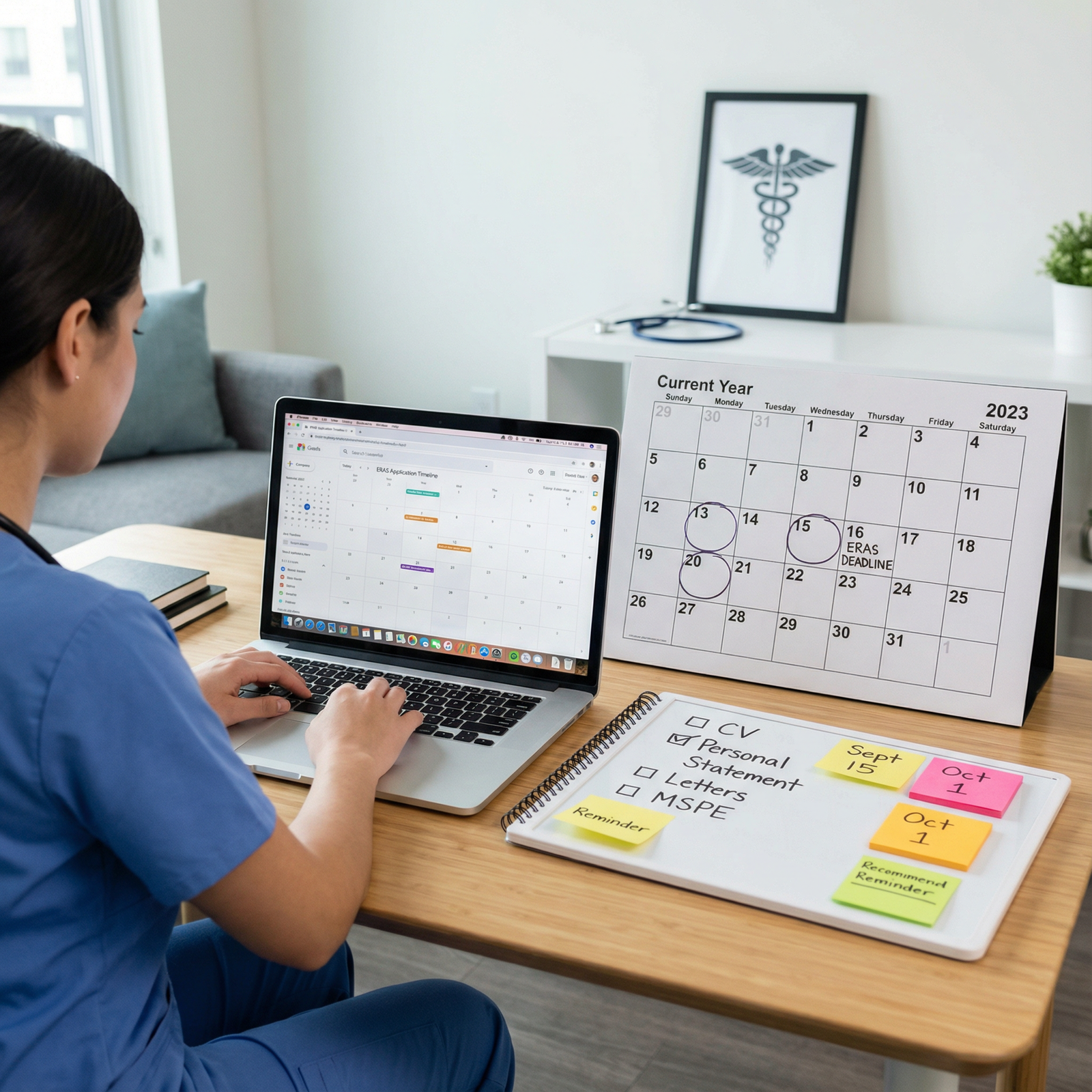
Incomplete files are handled unevenly, and that's one of the dirtiest little truths in residency recruitment. Some programs revisit them. Some put them in a lower-priority bucket. Some coordinators flag them to check later and then get buried under 4,000 applications and never come back promptly. I've watched this happen. Nobody announces it on a webinar, but volume changes behavior.
And here's another subtle mistake: assigning a program is not enough if the right documents are not assigned with it. I've seen applicants send an anesthesiology program the generic personal statement instead of the customized one, or forget to assign the fourth letter they were counting on, or assume a photo automatically goes everywhere. The application was "submitted." Technically true. Operationally messy. Review delayed.
That is a much bigger problem than fear that someone saw your polished draft two weeks too early. Programs are not scandalized by normal editing before application. They are inconvenienced by incomplete, mismatched, or missing materials once the file arrives.
The Timing Secret Program Directors Rarely Say Out Loud
Here it is plainly. The issue is almost never whether your unassigned ERAS application is lurking invisibly somewhere. The issue is whether your application is complete by the moment programs seriously begin review.
That moment varies.
Some programs in some specialties start downloading and screening the minute they can. Others wait for the MSPE release. Others review in waves. Some larger departments let coordinators run threshold filters first, then hand selected groups to faculty. Some faculty heavily sort by geographic ties, signals, board data, or school type before they read a single paragraph of your personal statement. Glamorous? No. Real? Absolutely.
This is why early assignment is useful only if your file is ready. If your application is polished, your letters are uploaded, your personal statement is correct, and your core documents are aligned, then yes, being in the pile when review starts matters. If you send a half-built file and assume people will lovingly revisit it later after your last letter appears, that is wishful thinking dressed up as strategy.
Programs don't usually announce how ruthless workflow becomes once volume hits. Coordinators are managing calendars, faculty availability, interview caps, and a flood of applications. They build systems to survive. Systems are efficient, not sentimental.
Here's the hierarchy most programs use at first review, whether they admit it publicly or not: Is the application complete enough to evaluate? Does the applicant meet minimum requirements? Are there obvious red flags? Is there basic specialty fit? Only after that do finer stylistic details start to matter. Tiny wording changes to one experience bullet? That's applicant-brain. Programs are looking at bigger gates first.
And yes, there are edge cases. Late Step 2 CK. Delayed letters from a famous chair who moves at geologic speed. Last-minute personal statement change because you finally realized your draft sounded like a hostage note. Pending MSPE release. Those things happen. The answer is not blind dogma. The answer is judgment.
But most applicants harm themselves through perfectionism, not strategic restraint. They wait because they want every sentence to feel immaculate. Meanwhile, programs start sorting real files. That's the part students hate hearing because it feels unfair. It is unfair. The process rewards readiness more than artistry.
A strong complete application on time beats a microscopically improved application that shows up after the initial sort. Every season, people lose ground over details no one would have cared about while missing timing everyone cared about.
How to Use This Reality to Time Your ERAS Submission Like a Savvy Applicant
So what should you actually do?
Aim for early completeness, not superstition about hidden visibility.
Build the core file first. Get the application content done early enough that you can review it with a clear head. Certify carefully. Then confirm your letters are uploaded. Confirm your transcript status. Confirm your personal statement assignments by program. Confirm the photo if relevant. Confirm everything manually. I mean manually. Don't trust your memory, don't trust vibes, and definitely don't trust "I'm pretty sure it's attached."
One missing assignment can create an avoidable delay. I've seen applicants discover after submission that their top ten programs received the wrong personal statement version or only two letters instead of four. Brutal. Entirely preventable.
Once the core file is ready, apply before programs begin serious review. That's the strategic center. Not too early with junk. Not too late chasing perfection. Ready and reviewable.
Updates after submission can still matter, but applicants romanticize them. Yes, letters can arrive later. Scores can update. Some components become visible as they're added. But major waiting games usually hurt more than they help because first-pass screening has momentum. Once interview offers start moving, nobody pauses the machine because you finally fixed a paragraph or added a nonessential line.
Specialty matters here. Ultra-competitive fields and high-volume programs punish lateness harder. Lower-volume settings may have more flexibility, but don't use that as permission to drift. The process is not kinder than it looks.
If a critical element is delayed, the smart move is often to submit the strong core file on time and add the missing piece as soon as it becomes available, unless a specialty-specific advisor gives you a compelling reason to hold. That's the kind of judgment call where local advising matters. But the default should not be paralysis.
The applicants who do well are not the ones who memorize folklore from group chats. They're the ones who understand workflow. They know exactly what has been certified, what has been assigned, what has been transmitted, and what a program will actually receive on day one. That's how adults handle ERAS.
Common Mistakes That Matter More Than the Myth Itself
Let's name the real errors, because they cause more damage than the invisibility myth ever will.
Not certifying on time. Forgetting to assign letters. Assigning the wrong personal statement. Assuming one uploaded document automatically reaches every program. Waiting for perfection while the season starts without you. Those are the classics. I see them every year.
And here's the coordinator-level truth nobody should sugarcoat: programs can forgive normal human imperfections. A sentence that isn't elegant. A hobby description that's slightly bland. A personal statement that's good, not literary. Fine. What they cannot review is what is missing from the transmitted file.
That's the hidden cost of late fixes. By the time your corrected application is finally complete, interview slots may already be moving and faculty attention may already be elsewhere. The machine doesn't stop because you noticed an assignment mistake on Thursday night.
So adopt an audit mindset. Operational readiness. Checklist discipline. Calm, boring accuracy. That beats rumor-driven anxiety every time.
You do not need folklore. You need a file that lands complete, correct, and on time. That's how you give yourself a real chance when the bottleneck hits.

The applicants who match well usually aren't the ones asking whether ERAS is secretly invisible. They're the ones who understand what counts as visible to the people making decisions. That's a different question. Better question. And if you build your strategy around that reality instead of applicant mythology, you move earlier, cleaner, and smarter.