A blueprint change does not erase your work. It does, however, punish lazy study plans.
That's the truth. If you built your prep around the old exam blueprint, you do not need to torch your notes, buy six new resources, and spiral for a week. You need a rebuild. Targeted. Practical. Fast.
What actually changes with a blueprint update? Usually one or more of these:
- content weighting
- question style
- task domains
- emphasis on clinical presentations rather than organ systems
- more integrated competencies and longitudinal reasoning
I've seen the most common mistake over and over: people panic, assume everything is obsolete, and throw out a study system that was mostly working. Bad move. The smarter play is to audit first, then rebuild.
This matters whether you're a student, intern, resident, repeat test-taker, or anyone whose plan was built on the previous version of the exam. If your schedule, question-bank strategy, or weak-area list was designed for the old blueprint, you need to update the engine without junking the whole car.
Here's the promise: these 7 steps will help you protect momentum, close the new gaps, and stop wasting study hours on low-yield comfort work.
Rebuild, Don't Restart: What a Blueprint Change Actually Means
A blueprint change is usually a shift in what gets rewarded, not a declaration that your prior studying was useless.
Maybe cardiology went from 8% to 12%. Maybe "diagnosis" questions now show up as management chains. Maybe the exam committee wants more integrated outpatient-to-inpatient decision-making. Maybe pediatrics is grouped differently. Fine. That changes your targeting. It doesn't mean you suddenly forgot medicine.
The practical question is this: what now counts more, what counts less, and what is being tested in a different way?
That's where people get sloppy. They keep studying from a vague PDF, or worse, from memory of what upper-years said last cycle. That's how you lose two weeks.
Your job is not to react emotionally. Your job is to translate the change into an operational plan. One page. Clear priorities. Specific fixes.
Step 1: Get the New Blueprint Into One Page You Can Actually Use
Start with the official documents. Not Reddit summaries. Not hearsay from a class group chat that's half panic and half fantasy.
Download:
- the official blueprint
- content outline
- exam committee update notes
- sample items, if available
- any test-day format updates
Then compress it into a one-page working document with 3 columns:
- Domain/Topic
- Old Emphasis
- New Emphasis
Your goal is to answer three questions fast:
- What is truly new?
- What is just renamed or regrouped?
- What got heavier or lighter?
Use a simple code:
- Red = increased weight or high-risk change
- Yellow = unchanged but core
- Green = decreased emphasis
This is where the fog lifts. A lot of blueprint changes look dramatic until you realize half of it is relabeling. That matters. You don't want to waste a weekend rebuilding around cosmetic changes.
Example:
- "Women's health" might now be spread across preventive care, ambulatory management, and acute presentations.
- "Ethics" may now be embedded in patient safety and systems-based care.
- "Pulmonary" might be stable in content but show up more often in integrated ICU-style questions.
That's not random. That tells you how to study.
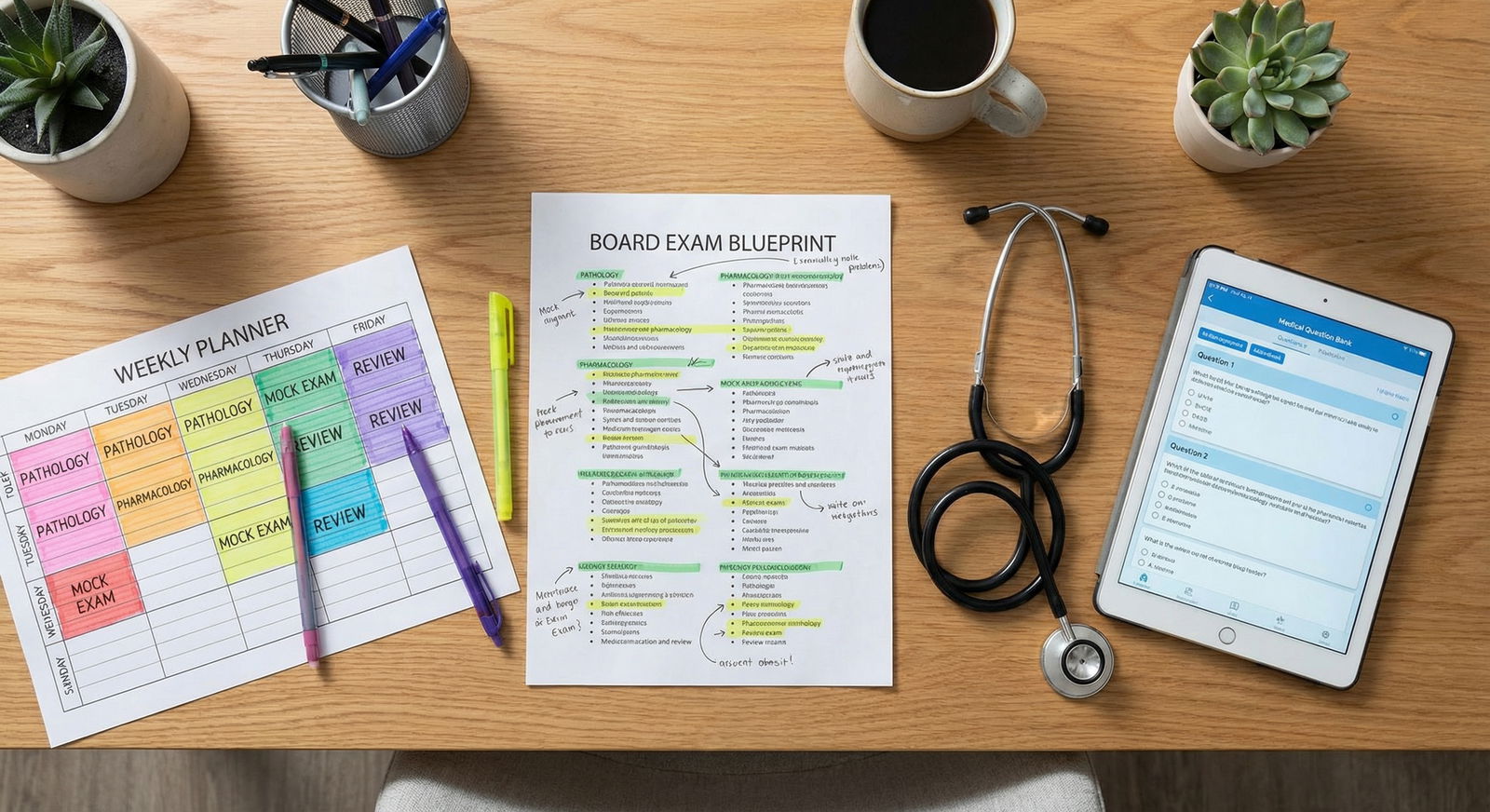
The fix here is simple: stop studying from a static PDF and start studying from an operational map you can review daily. Print it. Keep it visible. Your plan should be driven by that sheet, not by vibes.
Step 2: Run a Study Inventory Before You Change Resources
Do not start buying new resources because the blueprint changed. That's panic spending.
First, list what you already have:
- question banks
- notes
- videos
- Anki decks
- practice exams
- tutoring or coaching
- protected study time
- peer groups or accountability systems
Now audit each one against the new blueprint.
Build a table with these columns:
- Resource
- Blueprint Match
- Strength
- Weakness
- Keep / Modify / Drop
What you're looking for:
- resources that still cover the right content well
- resources that teach outdated question logic
- resources that are technically accurate but mismatched to new weighting
- resources you're using because they feel productive, not because they help
This is where false security shows up. I've seen residents proudly say, "I finished 85% of my bank," while their bank was weak in the exact domains the new blueprint boosted. Completion is not coverage. And it definitely isn't readiness.
A practical way to audit:
- If a resource matches the new blueprint and trains reasoning well: keep
- If it covers content but needs selective use: modify
- If it misses the new style or overinvests in low-yield areas: drop
Cost-saving principle: keep what still works. Replace only what clearly fails.
Most people don't have a resource problem. They have a resource alignment problem.
Step 3: Reclassify Your Weaknesses Based on the New Exam Logic
Your old weak list may be wrong now. Not because you suddenly improved, but because the exam is asking different things.
"Renal is weak" is not useful enough. Weak how?
Reclassify misses into 3 buckets:
Content deficit You didn't know the fact, algorithm, guideline, or association.
Application deficit You knew the material but misused it in a case.
Blueprint mismatch You were prepared for the old framing, not the new one.
Examples:
- You know hypertension guidelines, but you miss integrated outpatient follow-up questions. That's application.
- You know asthma facts, but longitudinal management questions keep getting you. Application again.
- You studied OB as isolated facts, but now the exam blends preventive care, risk counseling, and acute triage. Blueprint mismatch.
- You miss thyroid questions because you simply don't know them. That's content.
Use your missed-question reviews to find the real cause:
- Didn't know the content?
- Misread the stem?
- Fell for timing pressure?
- Failed to prioritize next best step?
- Got caught by the new domain emphasis?
Here's the fix: rebuild your weak list around testable tasks, not just subject names.
Instead of this:
- endocrine
- ID
- peds
Use this:
- choosing first-line therapy after diagnosis
- recognizing unstable versus stable management pathways
- counseling + prevention questions
- longitudinal follow-up adjustments
- integrated multisystem cases
That list is much more useful. And much harder to fake your way through.
Step 4: Rebuild Your Weekly Schedule Around Weight, Not Habit
Most study schedules are built around habit. That's why they collapse after a blueprint change.
You need a weekly plan built on 3 variables:
- blueprint weight
- your current performance
- time remaining until exam
Use a simple rule:
- High weight + high weakness = most hours
- High weight + strong performance = maintenance
- Low weight + high weakness = strategic review
- Low weight + strong performance = minimal time
A practical weekly structure:
- 2-4 core question blocks in high-priority domains
- 2 targeted review sessions for content repair
- daily spaced repetition for facts you keep dropping
- 1 cumulative mixed block each week to maintain switching ability
- 1 short planning review every weekend
And yes, comfort studying is a trap. If you keep spending half your time in cardiology because you "like cardio," while the new blueprint boosted ambulatory women's health and ethics-in-systems questions, you're not being disciplined. You're hiding.
If you have 4 weeks left
- Prioritize only high-weight, high-risk gaps
- Use mostly question-driven study
- Cut low-yield resources fast
- Do at least one mixed cumulative block weekly
If you have 8 weeks left
- Rebalance by domain
- Add targeted content repair for repeated misses
- Track timing and error pattern more aggressively
If you have 12+ weeks left
- Full remap
- You can afford structured content rebuild plus question integration
- Use two-week reassessment cycles from the start
Good scheduling feels a little unfair. That's normal. The blueprint doesn't care what you enjoy reviewing.
Step 5: Update Your Question Strategy to Match the New Test Style
If the test changed, your question strategy has to change with it. Passive review won't save you.
Your question work should now do two jobs:
- repair high-priority weaknesses
- train the reasoning style the new exam rewards
Use both:
- domain-specific blocks for targeted repair
- mixed blocks for real exam switching
Track the right metrics:
- accuracy by blueprint domain
- second-pass improvement
- average time per question
- recurring error pattern
- performance in integrated versus straightforward items
After every block, use this review protocol:
- Identify each miss
- Write why you missed it
- Record one takeaway
- Assign one corrective action
Example:
- Missed CHF outpatient management adjustment
- Why: knew diagnosis, didn't know next medication step
- Takeaway: review stepwise escalation in HFrEF
- Corrective action: 20-minute algorithm review + 10 targeted questions tomorrow
That's how you turn question banks into a repair tool instead of a scoreboard.
If your current bank lags behind the new blueprint, supplement intelligently:
- official sample questions
- newer question banks
- tutor-curated blocks
- updated specialty-specific modules
Don't overdo it. One outdated bank plus three random replacements is a mess. Better to use one main bank well, then add a narrow supplement where the gap is obvious.

Step 6: Build a 2-Week Feedback Loop Using Practice Data
Do not run the same plan for six weeks after a blueprint change and hope it works out. That's how people drift straight into a bad exam day.
Set a fixed review cycle every 2 weeks.
At each checkpoint, answer 4 questions:
- What improved?
- What stayed flat?
- What worsened?
- What feels better but isn't actually scoring better?
That fourth one matters. Confidence lies. Data doesn't.
Anchor decisions to:
- question-bank performance by domain
- self-assessment scores
- timing trends
- error-type trends
- mixed-block performance
Use a simple checkpoint template:
- Score trend
- Domain trend
- Timing trend
- Top 3 recurring misses
- Next 14-day adjustment
How to decide what to do:
- Improving: maintain or slightly advance difficulty
- Flat: change method, not just effort
- Declining: increase time and tighten remediation
- High confidence, low score: stop admiring your notes and do more applied questions
This cycle prevents you from studying an outdated version of the exam in your head.
Step 7: Protect Morale, Timing, and Your Exam Date Decision
Blueprint changes trigger panic. Fair enough. But panic is a planning problem, and planning problems are fixable.
The worst thing you can do is renegotiate your exam date every 72 hours. I've watched people lose more ground from indecision than from the actual blueprint change.
Use clear criteria for keeping your test date versus postponing:
- recent practice scores relative to target
- score trend stability
- unresolved holes in high-weight domains
- time available for focused repair
- ability to complete at least one full rebuild cycle before test day
If your scores are close to target, trends are stable, and your remaining gaps are manageable, keep the date.
If scores are below range, flat or falling, and your biggest holes sit in newly emphasized domains, postponing is usually the right move. Not weak. Smart.
Set a firm decision deadline. For example:
- 4 weeks out if your exam is near
- after your next self-assessment if you have more runway
Then stop revisiting it unless new data clearly changes the picture.
Protect morale with a few hard rules:
- keep one dashboard
- have one plan owner, you, a tutor, or a mentor, not five different opinions
- reduce resource switching
- schedule recovery time every week
- don't compare your plan to someone still studying for the old blueprint
Control reduces panic. Clarity reduces wasted motion.
Here are your next moves:
- Build your one-page blueprint map
- Audit your current resources
- Reclassify weak areas by task and reasoning type
- Reallocate weekly hours based on weight and weakness
- Update your question strategy
- Start a 2-week feedback cycle
- Make one clean exam-date decision
Rebuild. Don't restart. That's how you keep your progress and adapt fast.