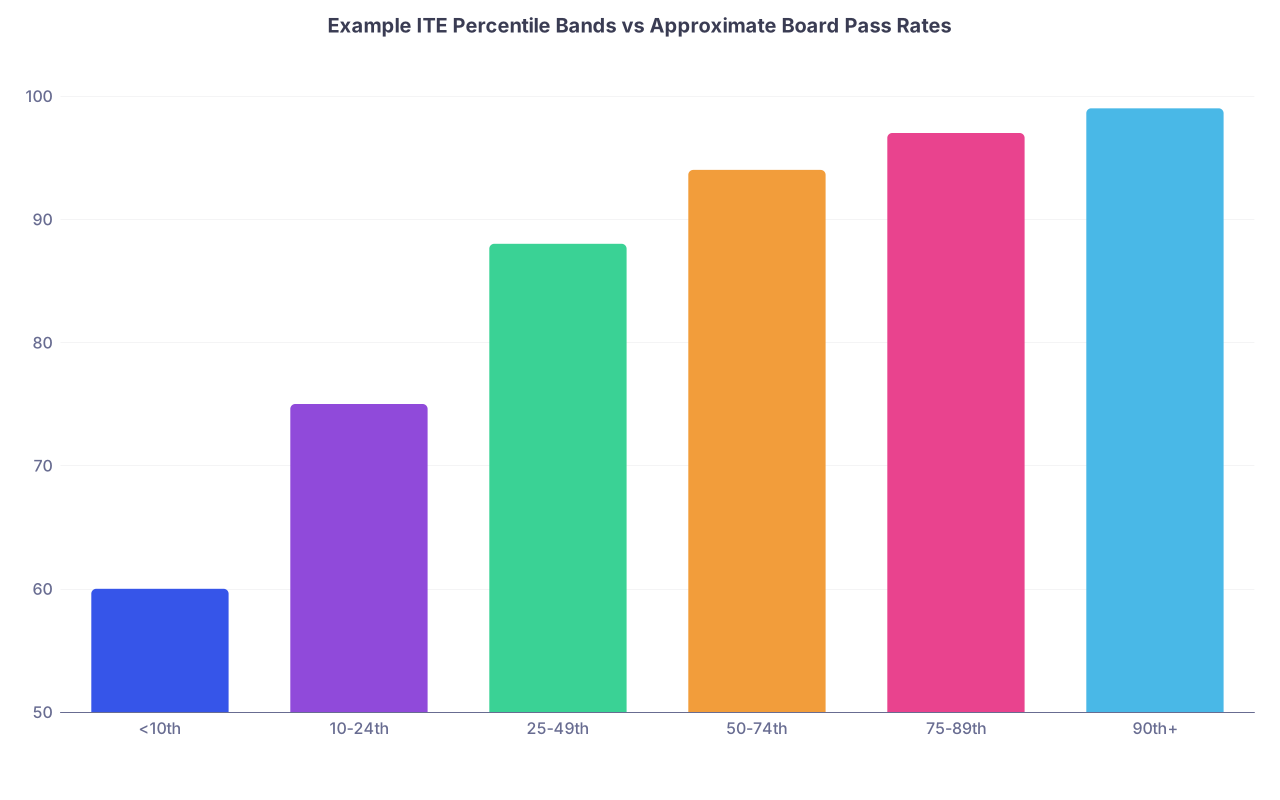
Strict timed Qbank practice is not a universal requirement for passing medical boards.
Doing 100 timed questions a day is the golden ticket to passing your boards. That's the confetti they throw at you during intern orientation. But let's look at what timed Qbank practice actually means in the trenches. We're talking strict countdown timers, no pausing, random blocks, and the relentless psychological pressure of a ticking clock.
The myth? That this rigid simulation reliably boosts board pass rates for everyone. The reality? The data shows the effect is highly dependent on your baseline skill, question familiarity, and most importantly, how you use the feedback. Timing helps when it exposes pacing deficits and forces deliberate error review. It backfires spectacularly when it mainly induces anxiety and prevents you from actually reading the explanations.
What Improves Scores (Spoiler: It's Not the Timer Alone)
What actually moves the needle on board scores? Retrieval practice, high-quality feedback, spaced repetition, and aggressive error correction. These dominate the effect size. The timer is just a metronome. It doesn't teach you the music.
We need to separate "test-taking skill" from "medical knowledge" and "test strategy." Timing trains pacing (a test-taking skill), but it does absolutely nothing to build your foundational pathophysiology knowledge. If you don't know the mechanism of action for a drug, giving yourself 90 seconds to stare at the screen won't magically download it into your brain.
Then there's the cognitive science concept of "desirable difficulties." A moderate challenge, like a slight time crunch or interleaved topics, can improve encoding and retrieval by forcing your brain to work harder. But excessive difficulty? That just spikes cortisol. When the timer turns a learning session into a panic attack, you impair memory encoding. You're not learning. You're surviving.
What the Research Actually Says About Timing and Practice
People love to say "studies show timed practice works." Sure, if you're studying for a basic reading comprehension test or a working memory task. But residency boards? The literature on high-stakes medical exams shows that timing effects are heavily mediated by attention, comprehension, and feedback loops.
When study time is the constraint, a timer acts as a behavioral forcing function. It makes you sit down, stop scrolling, and do the work. It prevents you from spending 20 minutes on a single question. But here is the contrarian truth: if timed practice replaces untimed, deep review, it actively reduces learning. You trade depth for volume.
I've seen residents boast about finishing 3,000 questions in a month, only to fail their boards. Why? Because they were doing 40-question timed blocks and spending exactly 10 minutes skimming the explanations before moving on. The timer forced them to prioritize completion over comprehension.
Look at the trajectories. Timed practice with thorough review wins in the long run. Untimed learning with spaced review builds a great foundation but might leave you scrambling on pacing later. Timed practice with minimal review? That's a fast track to a plateau.
Why Timed Qbanks Backfire: The Failure Modes You Can Avoid
I've watched countless residents tank their scores because they fell into predictable failure modes. Avoid these at all costs.
Failure mode 1: Speed before understanding. You rush the question stem, guess based on pattern recognition, and skip the deep explanation review. You get the question right by luck and fail to learn the underlying concept.
Failure mode 2: Anxiety conditioning. Every wrong answer under a ticking clock feels like a threat. Your brain shifts from reflective learning to threat-avoidance. Timed sets amplify this, making you dread the Qbank rather than engage with it.
Failure mode 3: Miscalibrated pacing. Some topics, like complex nephrology acid-base disorders or multi-step genetics calculations, require slow, deliberate reasoning. A one-size-fits-all 90-second timer punishes depth and trains you to guess when you should be calculating.
Failure mode 4: The quantity illusion. Doing more timed questions without an error taxonomy is not improvement. It's just noise. You are reinforcing bad habits at high speed.

When Timed Practice Helps: A Practical Framework for Board-Style Performance
So when does the timer actually help? When you use it as a diagnostic tool, not a weapon.
Track your time-per-question. Mark your uncertainty. Figure out if your errors are comprehension failures, knowledge gaps, or just careless misreads. Start with untimed or lightly timed learning blocks. Don't touch the strict timer until your accuracy hits a threshold of 60-65% with meaningful review.
Use tiered timing. Warm up untimed to build knowledge. Calibrate with a moderate timer to build pacing. Use strict exam simulation only after you've proven you can review and correct errors efficiently.
Choose the right question structure. Do mixed, random sets closer to the exam to train context-switching. Do topic-focused sets earlier to build foundational schemas. And always use reattempting of wrongs after a spaced delay.
Convert timing into a scoring system. Give yourself points for review quality. Write one or two lines in an error log on why you missed it. Reward the correction, not just the speed.
If your accuracy is low and your time is variable, strict timing will destroy your confidence. Fix the knowledge first. If your accuracy is high but your time is variable, add pacing training. Only when both are stable should you run full-length timed simulations.
Action Plan: A 2-Week Timed Qbank Strategy That Minimizes Backfire
Let's operationalize this. Here is a 2-week plan that actually works for busy residents.
Week 1 Goal: Reduce concept errors and build your explanation-review routine. Introduce light timing (e.g., 120 seconds per question) just to begin pacing awareness. Focus entirely on the quality of your error log.
Week 2 Goal: Test efficiency under constraints. Use strict timers (90 seconds per question) only after your error taxonomy is in place and you know why you are missing questions.
Daily Template (60-90 min):
- 25-35 min: Practice block (15-20 questions).
- 20-40 min: Deep review with an error log. Read the explanations for both the right and wrong answers.
- 10-15 min: Targeted remediation. Look up the specific concept you missed in your primary text or flashcards. Include a reattempt plan for missed concepts later in the week.
Metrics to monitor: Track your accuracy trend, your time-per-question trend, and the proportion of errors attributed to comprehension vs. careless mistakes vs. pure knowledge gaps. If careless errors spike, your timer is too tight. Back off.
Myth-Busting Checklist (Reality-Based Rules for Timed Practice)
Let's clear the air with some reality-based rules.
- Myth: "If you're not doing strict timed questions, you're wasting time." Reality: Your learning loop matters infinitely more than the clock. Deep review of 10 questions beats shallow guessing on 40.
- Myth: "Timed practice always increases accuracy." Reality: It can actively decrease accuracy during the learning phase if it reduces your review depth and triggers anxiety.
- Rule: If you can't explain your misses, you're practicing guessing, not practicing reasoning.
- Rule: Use timing to find your bottleneck (knowledge vs. comprehension vs. pacing), then fix the bottleneck. Don't just stare at the clock and hope it gets better.
Closing Reminder: Time It, Then Teach Your Brain What It Did Wrong
Timed Qbanks can absolutely improve your board readiness. But only when that ticking clock is paired with high-quality feedback and ruthless error correction. Choose the least harmful practice mode for your current stage of studying. Learn the material first. Then, and only then, simulate the constraints. Time it, but more importantly, teach your brain what it did wrong.