
How many question bank subscriptions does it take before your board score actually goes up—two, three, or “I’ll just get all of them and hope for the best”?
Let me be blunt: the residency culture around Qbanks is completely distorted. People talk about “10,000 questions” like it’s a personality trait. Interns are buying three overlapping products they barely use. PGY-2s flex on having done “every UWorld question twice.” And underneath all of it is one assumption:
More questions = higher scores.
That sounds logical. It is also, in a lot of cases, wrong—or at least incomplete to the point of being misleading.
Let’s unpack what the data actually shows, and where people are straight-up wasting time and money.
What the Evidence Actually Says About Qbanks and Scores
There is some reality behind the Qbank obsession. Question-based learning works. But not in the way the average resident uses it.
Several consistent patterns show up across Step/COMLEX/board prep research and large internal datasets from companies like UWorld and Amboss:
- Doing a reasonable volume of high‑quality questions correlates with better exam scores.
- That relationship is strong early on and then flattens out fast.
- The way you use the Qbank often matters more than how many questions you “complete.”
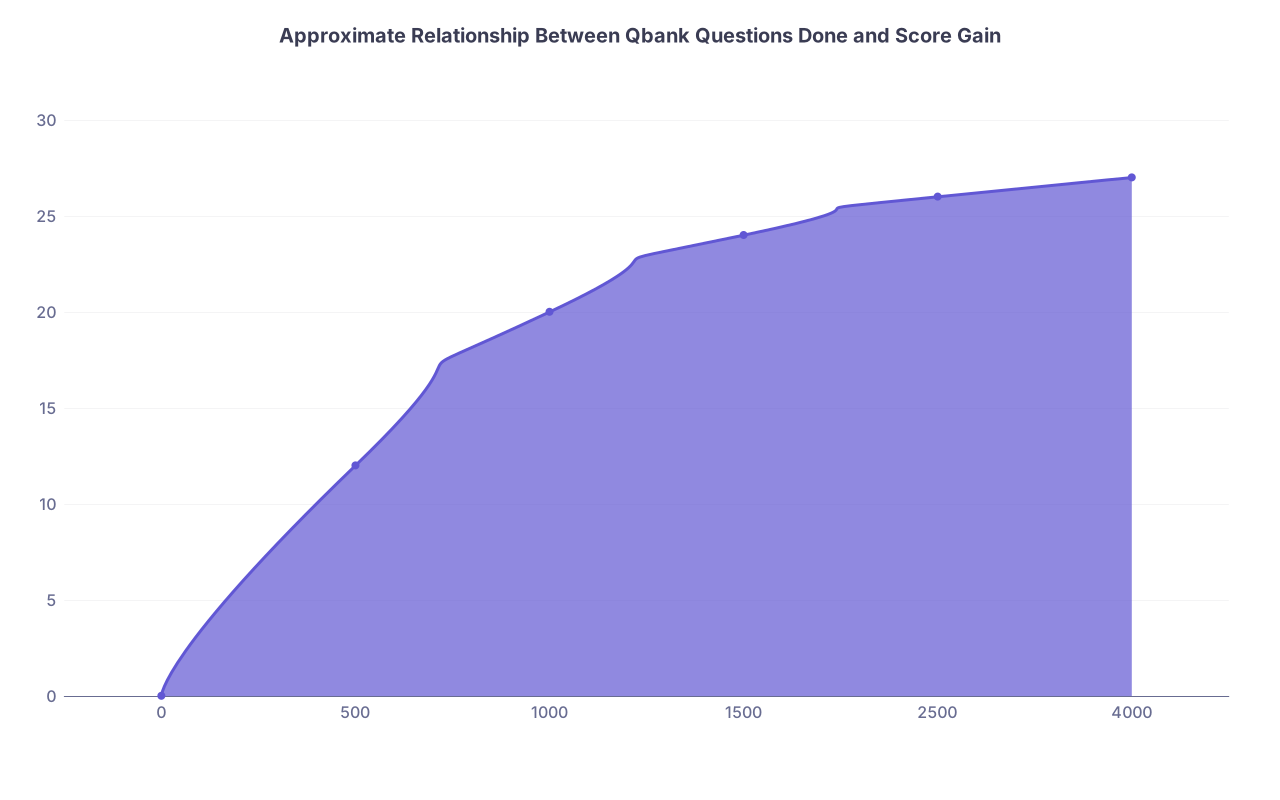
Think S‑shaped curve, not straight line.
| Category | Value |
|---|---|
| 0 | 0 |
| 500 | 12 |
| 1000 | 20 |
| 1500 | 24 |
| 2500 | 26 |
| 4000 | 27 |
Those numbers are illustrative, not pulled from one magic study, but they reflect what repeatedly shows up: big gains going from 0 → ~1000 questions, diminishing returns after 2000–2500, and near‑flat beyond that.
I’ve seen residents do:
- 800 focused questions and outperform classmates who did 3,000.
- A single Qbank thoroughly and land in the 90th percentile.
- Four Qbanks half‑done and fail.
The key difference wasn’t the absolute question count. It was:
- Are the questions at exam difficulty?
- Are you doing timed blocks that simulate the real test?
- Are you reviewing explanations properly, not just skimming the percent correct?
- Are you targeting weak areas instead of random dopamine farming?
“More” helps only up to the point where those factors are optimized. Beyond that, it’s just question hoarding.
The Problem With “More Is Better”: Overlap, Fatigue, and Fake Confidence
Residents rarely fail boards because they did too few total questions. They fail because they did lots of questions badly.
The Qbank arms race has a few specific traps.
1. Massive Overlap Between Qbanks
The big Qbanks draw from the same content universe: standard curricula, exam blueprints, widely known high‑yield topics. That means:
- Owning three big‑name Qbanks doesn’t give you three times the coverage.
- You’re re-answering the same concepts with slightly different wording and branding.
| Comparison | Rough Concept Overlap | Unique Value Add |
|---|---|---|
| UWorld vs Amboss | 70–80% | Style + explanations |
| UWorld vs BoardVitals | 60–70% | Difficulty calibration |
| Amboss vs BoardVitals | 60–70% | UX, analytic features |
Do I have a peer‑reviewed RCT for those exact percentages? No. I have years of side‑by‑side content review and what many program directors quietly say: “They’re all teaching the same stuff, just packaged differently.”
If you’re weak on heart failure, doing 200 variations on heart failure across three platforms is not automatically smarter than 80 well‑chosen, deeply reviewed questions on one platform.
2. Cognitive Fatigue and Diminishing Returns
Your brain has a daily limit for truly effortful processing. The thing you know as “I’m actually thinking and learning” instead of “I’m just clicking.”
Residents burning through 120–160 questions a day for weeks:
- Score worse on later blocks in the same day.
- Retain less of what they reviewed.
- Start shortcutting—skimming stems, guessing more, half‑reading explanations.
You can feel this happening in real time. That 4th block where you’re reading the same sentence three times and still not processing? Those questions barely count.
There’s a point where extra questions become busywork that feels like productivity but doesn’t move your score.
3. The Percent-Correct Illusion
Another big myth: “My Qbank percent correct is 75%, so I’m set.”
Two problems:
- Self‑selection bias. People often switch to “tutor mode,” pick easier systems, avoid their weakest areas “for now,” and inflate their percent correct.
- Platform differences. A 70% in an easier, less exam‑realistic Qbank is nowhere near a 70% in UWorld for a harsher exam like ABIM or ABSITE.
I’ve watched residents with “80% in X Qbank” miss their target score because under timed, mixed, exam‑level questions, they collapse.
What actually matters: how you perform in timed, mixed, random blocks that resemble the real board. Not cherry‑picked, un‑timed, tutor‑mode question sessions at 11 pm post‑call.
What Higher Scorers Actually Do Differently With Qbanks
Let’s separate the behaviors of people who just “do a ton of questions” from those who consistently crush boards.
1. They Commit to One Primary Qbank
Not four. Usually one, sometimes two with a clear division of labor.
For example:
Internal medicine boards:
- Primary: UWorld (depth, difficulty).
- Secondary (if time): Amboss for quick review/extra exposure.
Surgery/ABSITE:
- Primary: TrueLearn or ABSITE‑oriented bank.
- Maybe some UWorld IM for medical management gaps.
The pattern: One Qbank is the workhorse. Any others are clearly supplemental, not equal.
Buying everything is usually an anxiety maneuver, not a strategy.
2. They Focus On Review Quality, Not Just Question Volume
Here’s where the data and lived experience align strongly.
Residents who improve the most:
- Spend 2–3x as long reviewing a block as they spend doing it.
- Actually read the explanations, not just the green/red highlight.
- Build or add to a small, targeted notebook or Anki deck from missed or lucky‑guessed questions.
- Revisit recurring weak topics until they stop being weak.
The low‑yield move: 60 questions, 15‑minute “review,” shrug at the explanations, tell yourself you’ll “see it again later.”
You might. But you probably won’t learn it.
3. They Use Timed, Mixed Blocks Early
Common weak pattern: people avoid mixed blocks “until I’m ready.” Translation: until it’s almost exam day and the stress spikes when it goes badly.
Higher scorers:
- Start timed, mixed blocks weeks (or months) before the exam.
- Accept the lower percent correct early as the price of adaptation.
- Use early pain to identify which systems are disastrous and then deliberately target those.

| Step | Description |
|---|---|
| Step 1 | Baseline self-assessment |
| Step 2 | Choose primary Qbank |
| Step 3 | Timed mixed blocks 2-3x per week |
| Step 4 | Targeted blocks in weak topics |
| Step 5 | Deep review and notes |
| Step 6 | Increase difficulty and pacing |
| Step 7 | Identify weak areas |
That loop—mixed → identify weak → targeted → back to mixed—is where most of the real score movement happens. Not from adding a third Qbank.
When Adding Another Qbank Actually Makes Sense
Let me be fair. There are cases where using more than one Qbank is rational. But they’re narrower than people think.
Roughly three legitimate reasons:
You finished your primary Qbank with time left, and you:
- Actually reviewed it well.
- Didn’t just shotgun it in tutor mode.
- Are now consistently strong in mixed blocks and want more exposure.
You need a style adjustment:
- One Qbank feels too easy or too off‑style compared to the real exam.
- You want a second one known for higher difficulty or exam realism.
You have a niche gap:
- For subspecialty or in‑training exams where your main Qbank doesn’t cover certain procedures or scenarios well.
- Example: using a niche ICU Qbank to supplement IM boards prep if your ICU exposure was weak.
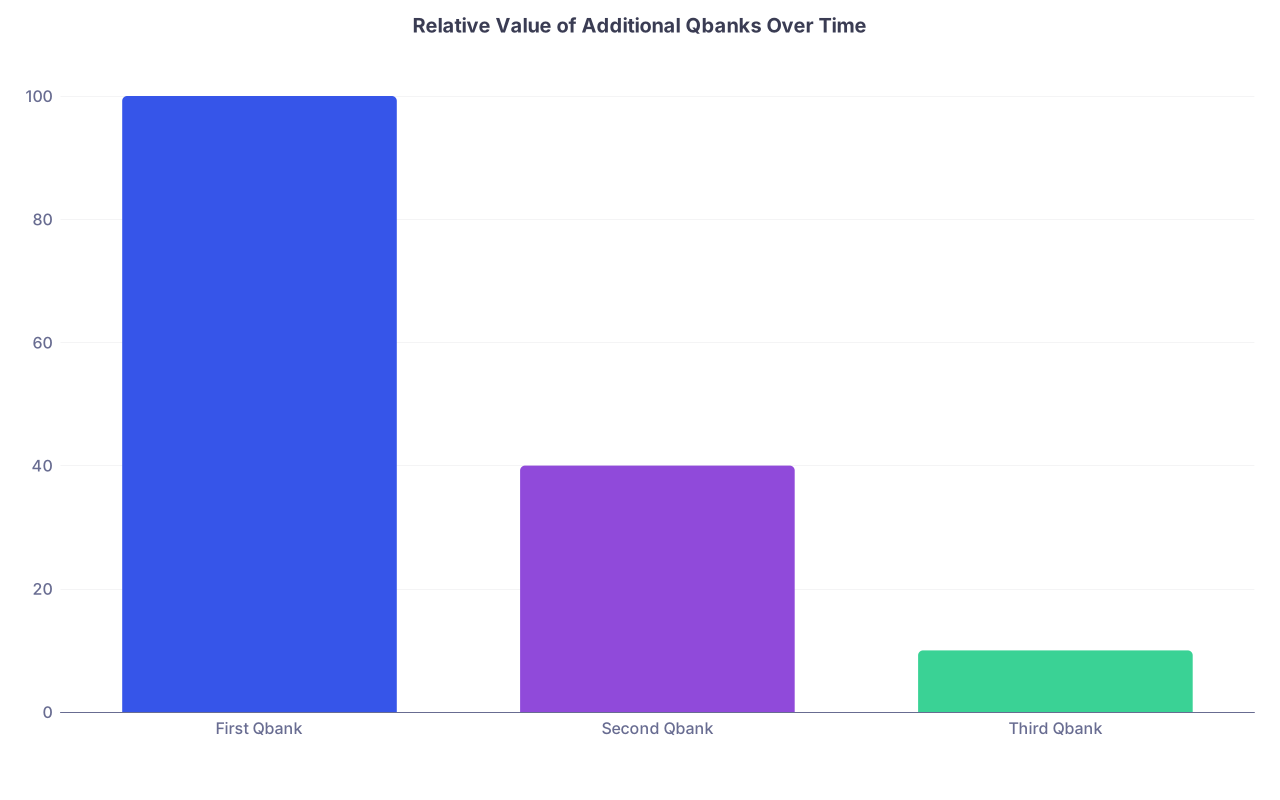
But even then, the second Qbank is a booster, not a reset button.
| Category | Value |
|---|---|
| First Qbank | 100 |
| Second Qbank | 40 |
| Third Qbank | 10 |
That’s the point: each extra Qbank gives you sharply less marginal benefit. Past two, it’s mostly psychology and FOMO.
Why Residents Still Believe “More Qbanks = Higher Scores”
You’re not crazy. The system nudges you in this direction.
Three main drivers:
- Marketing and peer culture
Qbank companies don’t say “You probably only need one of us.” They say “Our questions are most representative.” Now multiply that message by five companies and a panicked group chat.
You end up hearing:
- “Program X said to use Y and Z.”
- “Everyone on my service used both A and B.”
- “Top scorers all did multiple Qbanks.”
Except when you actually talk to those top scorers, a lot of them say, “I mostly just did UWorld properly and reviewed like crazy.”
- The illusion of control
Boards are high stakes and unpredictable. Buying more Qbanks feels like doing something. It feels safer than confronting the real fear: “What if I study and it still isn’t enough?”
So you subscribe to everything, line up four dashboards, and now you have a different kind of problem: fragmentation.
Attendings/PDs say things like:
- “Make sure you’re doing lots of questions.”
- “I recommend using a few different resources.”
- “Most residents use UWorld and one other.”
Super generic. Rarely do they say: “Do 2000–2500 high-quality questions in one main bank and deeply review them; anything more is marginal.”
So residents interpret “a few” as “all.”
A Sanity-Checked Qbank Strategy That Actually Tracks With Data
Let’s pull this together into something actionable, not just “don’t overdo it.”
Step 1: Pick One Primary Qbank—And Commit
For most residents:
- IM/Family/Peds/Neuro boards: UWorld or Amboss as primary.
- Surgery/ABSITE: TrueLearn/ABSITE‑specific as primary.
- EM: Rosh or BoardVitals EM‑specific.
Then stop shopping. Decision fatigue kills consistency.
Step 2: Set a Realistic Question Target, Not an Ego Target
For a standard 2–3 month prep window:
- Aim for 1500–2500 questions in your primary Qbank.
- That’s ~20–40 questions per day on average, with some heavier days.
Could you do more? Yes. Will 4000 automatically beat 2000? No. I’ve seen plenty of the opposite.
Step 3: Make Review the Main Event
Rough ratio that actually works for most residents:
- 1 hour doing questions.
- 2 hours reviewing them.
In review:
- Understand why the right answer is right.
- Understand why each wrong answer is wrong.
- Write down or tag anything that:
- Surprised you.
- You guessed but got right.
- You got flat‑out wrong.
Those three categories are where the score gains hide.
Step 4: Layer In Mixed, Timed Blocks Early
Do not wait for some imaginary “ready” moment.
- Start with mixed, timed blocks at least once a week, ideally more.
- Use them as stress tests. Not for your ego, for your process.
If your score tanks in mixed blocks, the answer is not “add another Qbank.” It’s “figure out which systems and question types collapse under time pressure” and attack those.
Step 5: Only Add a Second Qbank If You’ve Truly Maxed the First
Your checklist before adding another bank:
- Finished most or all of your primary Qbank.
- Did thorough reviews, not superficial glances.
- Identified and substantially improved major weak areas.
- Have time and cognitive bandwidth left (not 2 weeks and panic).
If you can’t say yes to those, a second Qbank is usually a distraction dressed up as productivity.
The Bottom Line: What the Data Suggests, Not Your Group Chat
Let me strip it down.
Qbanks work. Doing zero questions is stupid. But the “more is always better” narrative is equally stupid.
Key points:
There is a clear point of diminishing returns. After ~2000–2500 well‑reviewed questions in a solid Qbank, extra volume adds relatively little unless you’re fixing specific, known weaknesses.
How you use the Qbank matters more than how many you own. Timed, mixed blocks plus deep review of explanations and mistakes will outperform 10,000 half‑assed questions across four platforms almost every time.
Multiple Qbanks are optional, not mandatory. A second Qbank can be useful; a third is usually just anxiety with a login screen.
You do not need to turn your life into a Qbank marathon to pass—or excel—on boards. You need one main engine, a ruthless review habit, and the discipline to ignore the resident who thinks “I did 8,000 questions” is a strategy instead of a warning sign.