
Why does a single low in‑training exam score instantly turn into a whispered prophecy of “You’re going to fail the boards” in every residency lounge?
Let me ruin that narrative up front: that leap is lazy, half-true, and often flat-out wrong.
Programs love to treat the in‑training exam (ITE) as a crystal ball. Residents get ranked, shamed, or “strongly encouraged” into extra call-free “study blocks” based on a single percentile. And the myth grows: your ITE score is your destiny.
Here’s what the data actually shows — across internal medicine, surgery, EM, peds and more: ITEs are moderately predictive, not fate. They’re a signal. Not a sentence.
Let’s dismantle this properly.
What In-Training Exams Really Measure (And What They Don’t)
Start with the basics: ITEs are not designed as mini-board exams. They’re program evaluation tools that happen to correlate with exam performance.
They generally measure three things:
- How much core knowledge you’ve accumulated so far
- How comfortable you are with standardized multiple-choice formats
- How much you’ve actually been doing question-based learning
What they don’t measure:
- Your clinical judgment on rounds
- Your procedural skills
- Your ability to manage three crashing patients and an angry family at 3 a.m.
- Your work ethic
- Your ceiling with focused study
They’re a snapshot of current knowledge under artificial conditions, not a holistic measure of you as a physician.
And yet, people keep asking: “Do they predict the boards?”
Let’s answer that with actual numbers.
What the Data Actually Says About Predicting Board Performance
We’ll keep this generalizable. Different specialties, different exams, same pattern: the ITE is a decent but not perfect predictor.
Across multiple studies:
- Correlations between ITE scores and board exam scores tend to land in the 0.5–0.8 range (Pearson r).
- That’s moderate to strong, but not “we can skip the actual board exam” strong.
- Low ITE scores increase risk of failing boards — but do not guarantee failure.
- High ITE scores decrease risk — but don’t guarantee passing.
Think “weather forecast,” not “mathematical proof.”
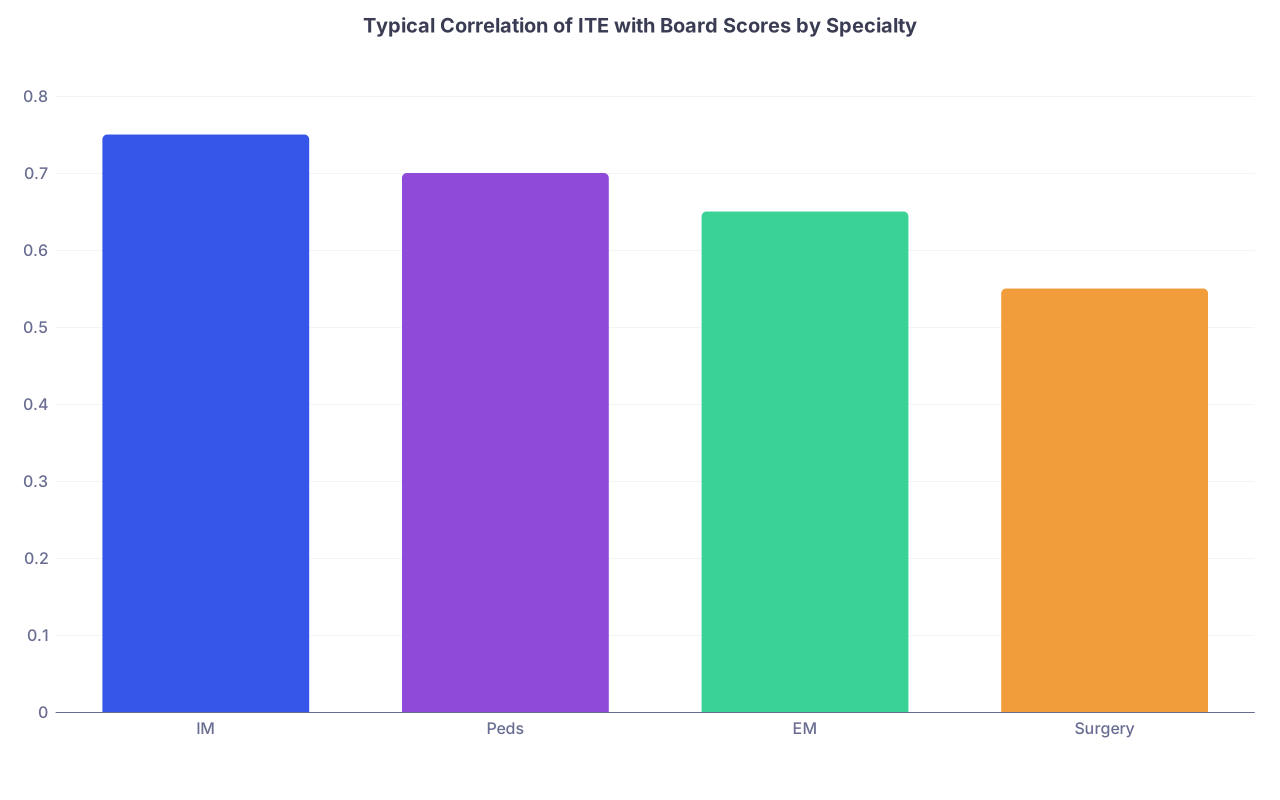
| Category | Value |
|---|---|
| IM | 0.75 |
| Peds | 0.7 |
| EM | 0.65 |
| Surgery | 0.55 |
Are these exact numbers for your specialty? No. But this is the ballpark the literature lives in.
Let’s translate that:
- In Internal Medicine, a resident with very low ITE percentiles (say <20th) is statistically much more likely to fail the ABIM exam than their peers.
- But plenty of those same residents pass on the first attempt once they get serious about boards.
- And yes, every year someone with solid ITE scores manages to fail because they coasted or timed their prep terribly.
ITE = risk flag. Not outcome.
The Biggest Myth: “My PGY-1 ITE Predicts My Boards”
I’ve lost track of how many scared interns I’ve talked to who got a 15th–20th percentile on the PGY‑1 ITE and immediately jumped to: “I’m screwed for boards.”
That’s not how this works.
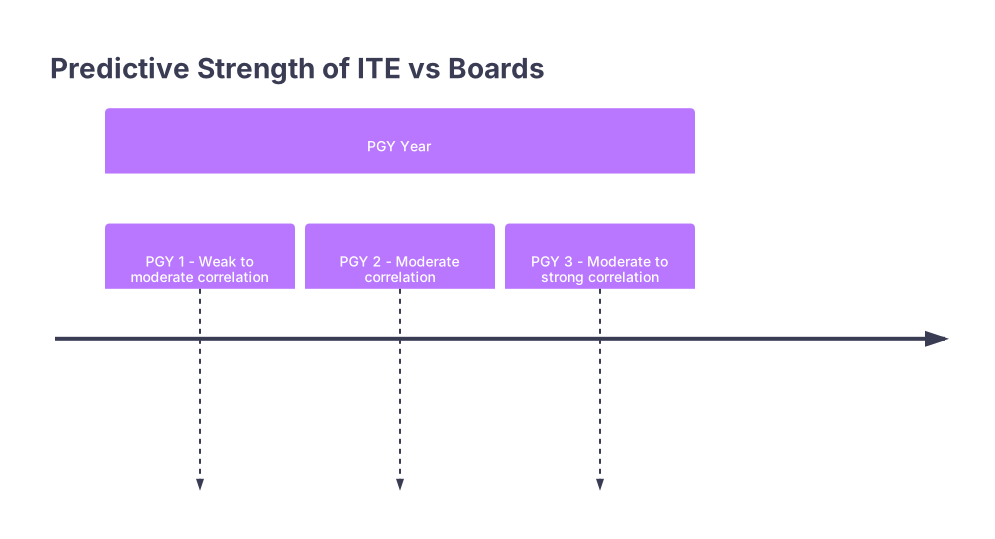
Early ITEs are weak-to-moderate predictors. The closer you get to the actual board exam date, the stronger the prediction gets.
Think of it as a moving target:
- PGY‑1 ITE: noisy signal, lots of growth left
- PGY‑2 ITE: stronger, more aligned with eventual boards
- PGY‑3 ITE: often fairly close to your eventual board performance — if your study habits don’t change much
So when attendings treat a low PGY‑1 ITE like a death sentence, they’re overreacting and misreading the data. The trajectory matters more than a single early score.
Here’s the pattern I’ve seen repeatedly:
- Intern with 20th percentile ITE who actually responds to it → board pass, often comfortably.
- PGY‑2 with 25–35th percentile ITE who keeps “meaning to start studying” → now you’re flirting with the fail zone.
- PGY‑3 with <20th percentile ITE and no structured plan → this is the group with very real risk.
The myth is that the first ITE is prophecy. The reality: your trend and your response matter more.
What ITE Scores Get Wrong (False Positives and False Negatives)
Programs rarely talk about the two kinds of error that matter here:
- False positives – low ITE, board pass
- False negatives – high ITE, board fail
Both happen every year.
False Positives: Low ITE, Still Fine
Typical profile:
- Struggling intern or PGY‑2 drowning in clinical work
- No real system for questions, just random UWorld on post-nights
- Mediocre ITE percentiles (10–25th)
When the pressure of boards becomes real and life calms down slightly (or they’re forced into a study block), they:
- Actually commit to daily questions
- Fix weak foundations with a structured resource
- Use NBME/official practice exams or in‑service practice tests strategically
End result: board score far above what their lazy ITE percentile would suggest.
I have seen interns jump from ~15th percentile ITE to comfortably passing ABIM or ABS on the first try. It’s not magical. It’s what happens when your study method catches up with your clinical brain.
False Negatives: Great ITE, Board Faceplant
Also common. Usually looks like this:
- Smart resident, naturally good test-taker
- High ITE percentiles (70–90th) with minimal focused studying
- Buys into their own narrative: “I’m just good at tests, I’ll be fine”
Then they:
- Never change from “residency study mode” to “board exam mode”
- Never run full-length practice tests under exam conditions
- Mis-time their studying (peaks too early, or starts 2 weeks before)
Result: they miss the pass mark by a handful of points. Everyone’s shocked. They shouldn’t be.
ITE told you, “You have the ability.” It didn’t say, “You’re exempt from serious prep.”
Specialty Differences: The ITE is Not Created Equal
Some ITEs are tightly engineered to mimic their boards. Others are more like vague academic assessments.
Different specialties, different rules of the game.
| Specialty | Typical ITE–Board Relationship | Practical Meaning |
|---|---|---|
| Internal Medicine | Strong | ITE trend very useful for risk stratification |
| Pediatrics | Strong | Similar pattern to IM |
| Emergency Med | Moderate | Helpful, but not destiny |
| General Surgery | Moderate | Growth and repetition matter a lot |
| Anesthesiology | Moderate–Strong | Later ITEs especially meaningful |
These aren’t absolutes, but the pattern is consistent in the literature: the bigger and more exam-focused the specialty, the tighter the correlation.
Universal rule though: no ITE is a perfect stand-in for actual boards. Different question writers. Different blueprints. Different stakes.
Program Abuse: How ITE Scores Get Weaponized
Here’s where I get more direct: a lot of programs misuse ITE data.
Common sins:
- Using a single bad score to label someone “weak” for the rest of residency
- Public posting of ITE percentiles by name or rank order
- Assigning “remediation” to residents based on arbitrary percentile cutoffs without asking how they study or what else is going on (night float month, personal crisis, etc.)
None of that improves board pass rates. It just punches morale.
What actually helps? Programs that:
- Track trends, not single points
- Look at ITE alongside clinical performance, feedback, and self-assessment scores
- Provide structured board prep support to anyone under a certain percentile, without shame theater
ITE is a tool. If your program uses it as a weapon, that’s not data-driven — that’s lazy leadership.
What You Should Actually Do with Your ITE Score
Forget what everyone else says. Here’s the honest, resident-level way to interpret your score and act accordingly.
1. Stop Obsessing Over Percentile Alone
Percentile is context-dependent. One year’s 35th could be another year’s 45th depending on the test cohort.
What matters more:
- How far are you from where you want to be?
- Are your scores stable, rising, or falling?
- How long until your boards?
If you’re:
- Above ~60–70th percentile consistently: you have margin, but you still need real board prep.
- 20–60th percentile: you’re in the wide “could go either way depending on prep” band. Your boards will reflect your strategy, not just your baseline.
- Below 20th percentile: you’re in the honest-risk zone and need to treat it like a problem to solve, not a character flaw.
2. Use the Content Breakdown… Properly
Most people glance at the breakdown, see “Cardiology: Low,” shrug, and go back to doing random QBank questions.
Better use:
- Identify your bottom 2–3 sections, not all 12
- Build a short, focused plan: a high-yield review source + 20–40 targeted questions/day in those weak areas
- Cycle back to those topics every 1–2 weeks instead of bingeing them once
The point is not to “fix everything.” It’s to raise the floor under your worst areas so you don’t bleed points on boards.
3. Match Your Plan to Your Risk Level
This is where residents get it wrong: same strategy, regardless of risk.
Here’s a more rational approach:
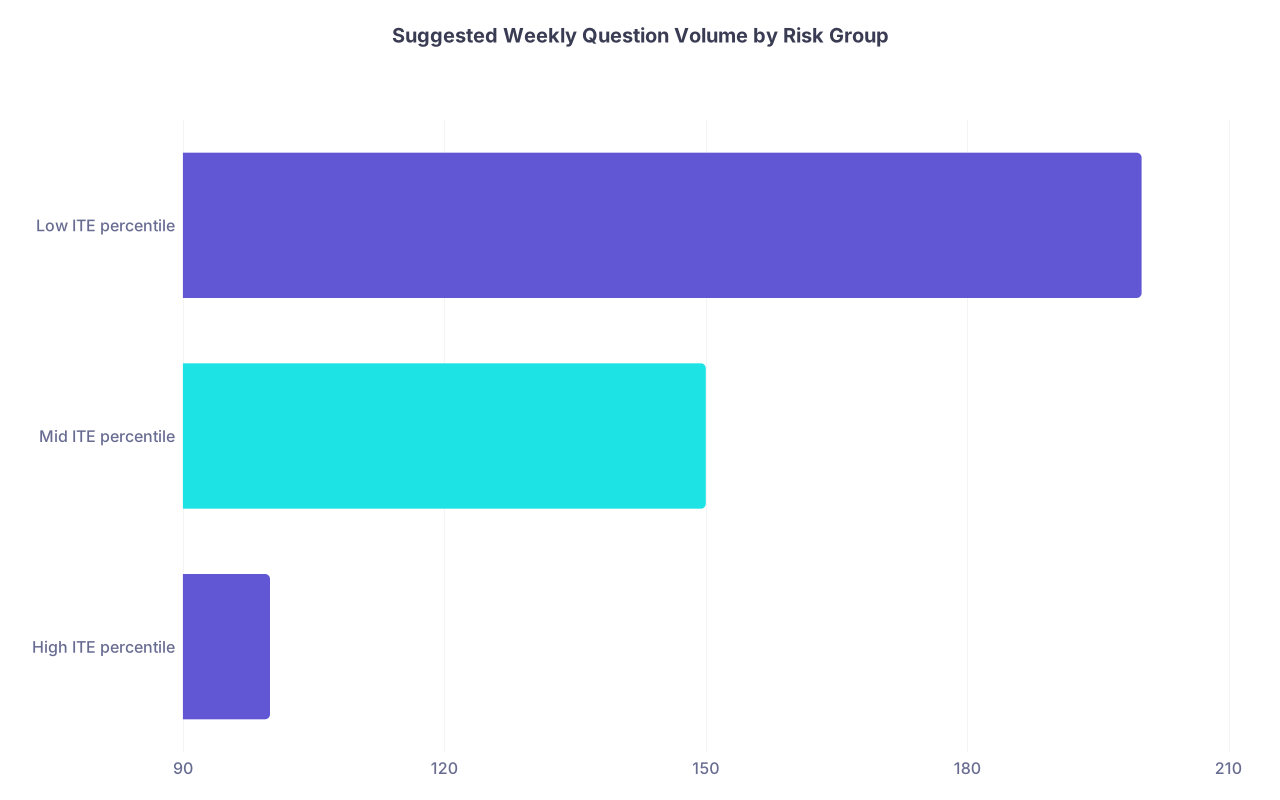
| Category | Value |
|---|---|
| High ITE percentile | 100 |
| Mid ITE percentile | 150 |
| Low ITE percentile | 200 |
Rough idea (adjust to your specialty and schedule):
- High percentile, boards ≥9–12 months away:
75–125 questions/week, mostly integrated into daily workflow, no panic. - Mid percentile or uneven profile:
125–200 questions/week, targeted topic blocks, plus 1–2 focused review resources. - Low percentile, boards ≤12 months away:
175–250 questions/week, scheduled review time, early practice exams, maybe faculty support.
No, that’s not a rigid prescription. It’s a reality check: if you’re in the bottom quartile and still doing 20 scattered questions twice a week “when I have time,” you’re betting against the statistics.
The Only Part of the Prediction That Really Matters
Forget all the noise: the question isn’t “Does the ITE perfectly predict my boards?”
The real question is: “Does my ITE give me actionable information I can still use?”
And the answer is yes — if you treat it as:
- A risk assessment, not a judgment
- A baseline, not a destiny
- A reason to build a deliberate plan, not a reason to panic or ignore
You’re not a percentile. You’re a moving target with 6–18 months of potential growth before the only exam that truly matters.
The Bottom Line: What’s Actually True
Let’s strip it down.
ITE scores moderately predict board performance, but they’re not fate. Lower scores raise your risk; they do not guarantee failure. High scores lower your risk; they do not guarantee passing.
Your trajectory and response matter more than a single number. A low PGY‑1 ITE with serious course correction beats a complacent PGY‑3 with a historically high percentile every single time.
Programs and residents misuse ITEs when they treat them as labels instead of tools. The rational move is to use the score to shape your prep — not to catastrophize, and not to coast.
That’s the truth behind the myth: ITEs are loud smoke alarms, not the fire itself. What you do when they go off is what actually decides your board outcome.