
The resident who says “I learn best clinically” and then actually passes boards on the first try is not doing what you think they’re doing.
They’re not just “being a good doctor” and trusting that osmosis will carry them through. They’re quietly doing structured, boring, unsexy prep when nobody’s watching. The myth is that clinical learning and exam prep are competing philosophies. The reality: every resident who passes reliably is combining both—on purpose.
Let’s strip away the comforting stories and talk about what people who actually pass these exams are doing with their time, attention, and ego.
The “I Learn Best Clinically” Lie You Tell Yourself
I’ve heard this line in so many flavors:
- “I’m not a Q‑bank person, I just learn from patients.”
- “Guidelines don’t stick for me unless I see them on the wards.”
- “I’m a clinical thinker, not a test taker.”
Some of that is personality. A lot of it is defense mechanism.
Residents who say “I learn best clinically” usually mean one of three things:
- They’re exhausted and can’t face the idea of more structured work.
- They’ve been burned by preclinical-style grind and don’t want to relive it.
- They’re afraid if they really try at exam prep and still score badly, it says something about their intelligence.
So they hide behind clinical learning. Because it feels virtuous. You’re working. You’re in the hospital. You’re taking care of real people. How could that not prepare you?
Here’s the problem: clinical learning is chaotic, biased, and full of huge blind spots. It makes you a better doctor. It does not reliably make you pass a standardized exam.
Look at what every large testing organization actually does: they build questions specifically to escape the randomness of real-life exposure. They’re trying to sample the whole content universe. Real-life practice does the opposite: it narrows you.
You see what your patient mix, your attendings, your hospital protocols allow you to see. Boards don’t care what kind of pneumonia is common in your ZIP code, or whether your hospital uses drug A or B. They care if you know the guideline-driven framework and the classic presentations—even the ones you never saw at 3 a.m.
That’s why the residents who pass aren’t relying on “I’ll see it on the wards.” They use the wards as a hook, not as the syllabus.
What the Data Actually Shows: Clinical Work vs Exam Performance
USMLE and specialty boards don’t publish a line that says “clinical learners fail more,” but we do have some pretty unambiguous signals:
- Programs with formal, structured didactics, protected exam prep time, and required question banks have higher in‑training exam and board pass rates.
- Residents who use multiple-choice question banks consistently over months, not in a panic in the final 4 weeks, perform significantly better on in‑training exams.
- The number of hours worked clinically alone does not predict exam success after you adjust for exam-specific prep.
Translation: the structure and repetition of targeted exam preparation—not just “seeing a lot of patients”—is what moves scores.
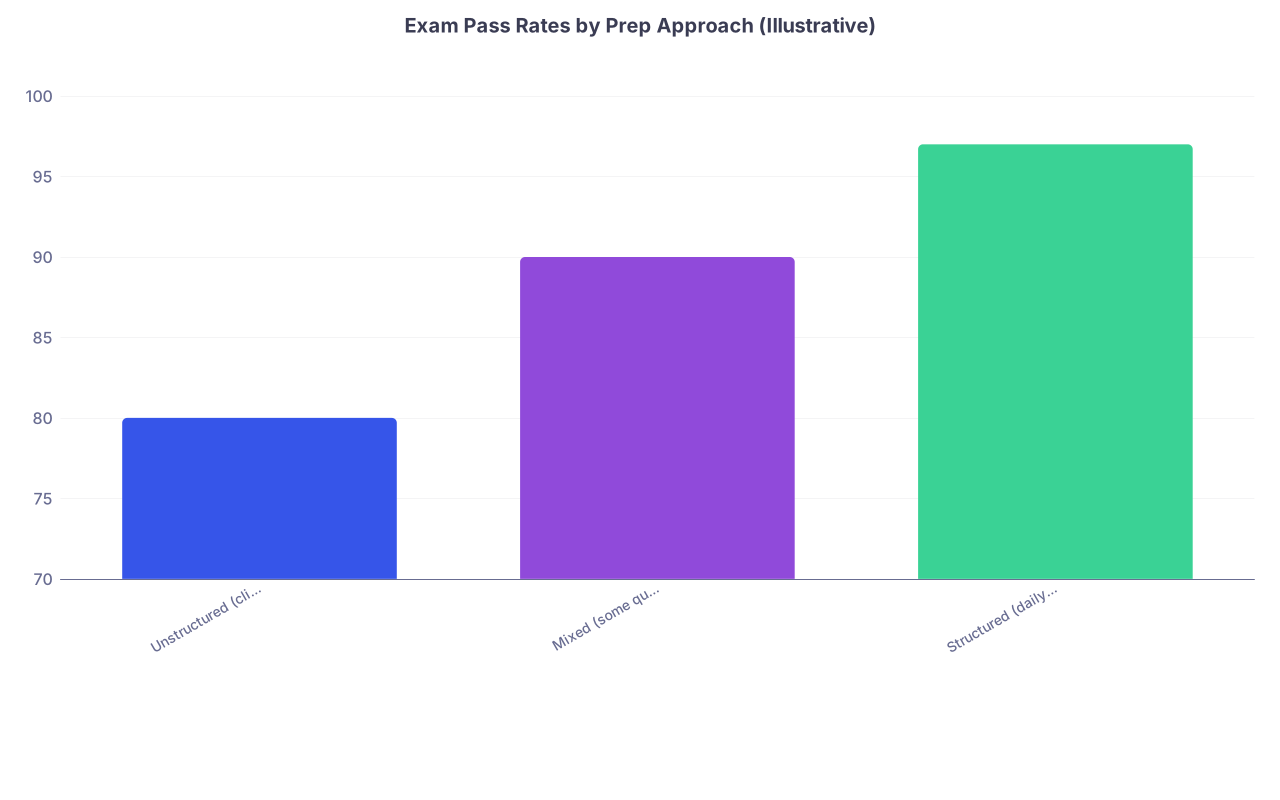
Here’s a simplified picture of what you actually see program-to-program:
| Category | Value |
|---|---|
| Unstructured (clinical only) | 80 |
| Mixed (some questions, sporadic) | 90 |
| Structured (daily Qs + review) | 97 |
These aren’t official board numbers; they mirror what program directors report anecdotally and in surveys: the more intentional and structured the prep, the closer your pass rate creeps toward “almost everyone.”
So when someone says “I mostly just learned on the job and I was fine,” they’re leaving out:
- The 1–2 years of structured prep they did for Step 1/2 that still lives in their head.
- The 20 questions a day they did on their phone and forgot about.
- The exam-focused morning reports, board review conferences, and pimping that functioned as structured repetition.
They didn’t just “learn clinically.” That’s revisionist history.
How Clinical Learning Actually Fails You on Boards
Let me walk through how clinical learning alone sets you up to be blindsided.
1. You learn skewed probability, not exam probability
On your wards:
- You see common diseases again and again.
- You see idiosyncratic local practice: what your ICU likes, what your OB team prefers.
- You anchor on memorable cases—dramatic outliers, weird presentations.
On exams:
- You see a curated mix that over-represents the “must-know but rare” and underrepresents the stuff you’re already drowning in.
- They expect textbook progression, not the messy, half-treated, bounced-from-urgent-care version you live with.
Example: You might see plain community-acquired pneumonia 100 times in residency and never once see classic rheumatic fever. Boards will still test Jones criteria. If you never touched that outside of a Q‑bank, you’re guessing.
2. You learn in fragments, not in organized schemas
Clinically, you learn:
- “When the lactate is 6, they crash fast.”
- “Dr. X loves vasopressin; Dr. Y hates it.”
- “The pharmacy can’t get that drug, we use this one instead.”
Boards test:
- Stepwise treatment algorithms.
- Definitions (exact cutoffs, staging systems).
- Class-level pharmacology (mechanisms, effects, side effects).
If the only time you see a drug is as a line item in Epic, you’ll recognize the name but you won’t recall the reasoning they’re testing. That’s where question banks, outlines, and reviews force you into mental frameworks instead of scattered anecdotes.
3. Your feedback loop in clinic is painfully slow
When you answer a question wrong in UWorld, you know immediately. You see the explanation. You build a correction in your brain.
On the wards:
- You might never find out you were wrong.
- Or you find out 3 months later when an attending says, “Why would you do that?” and you’re too busy defending yourself to deeply encode the correction.
- Or the patient does fine despite a suboptimal choice, and you accidentally reinforce the bad habit.
Exams are written assuming a world where the feedback loop is tight and clean. Clinical reality is neither.
Structured prep, done properly, is literally designed to fix that.
What Passing Residents Actually Do (That Failing Residents Don’t)
Let me be blunt. The residents who fail usually didn’t have some tragic knowledge defect. They had a planning defect. They believed some version of:
- “I’ll ramp up a few months before.”
- “I learn best from real cases.”
- “I’m good at tests; I always pull it off in the end.”
The residents who pass on the first shot do a handful of boring, repeatable things.
1. They bake questions into their daily life early
Not heroically. Not 200 questions a day. More like:
- PGY1: 5–10 questions on light days, 15–20 on easier rotations.
- PGY2: Most days they’re not drowning, some mix of 20–40 questions.
- Last 3–4 months: they ramp without needing a miracle.
They treat questions the way they treat coffee—small repeated doses, not a one‑week bender before an exam.
2. They turn clinical cases into exam hooks
They’ll see a patient with DKA and then:
- Do 10–15 questions on DKA that week.
- Skim a high-yield outline or guideline summary.
- Explicitly connect: “What I did today” → “What the exam wants for this topic.”
Instead of trusting that a memorable case will magically translate to a correct answer, they use the case as scaffolding for more structured review.
3. They track—not just “try”
Successful residents don’t say “I’ve been doing questions.” They know:
- How many questions they’ve done this month.
- Their rough performance trajectory.
- What’s left in the bank and when they’ll finish.
And they adjust when they’re behind, instead of realizing 6 weeks before the exam that they’ve done 18% of the Q‑bank.
Here’s roughly how behaviors differ:
| Behavior | Passing Residents | Struggling Residents |
|---|---|---|
| Q-bank usage | Daily/near-daily, months long | Intense spurts right before exam |
| Integration with clinical work | Link cases to topics to questions | Hope clinical exposure is enough |
| Tracking progress | Numbers, goals, rough schedule | Vague sense of “doing some questions” |
| Dealing with fatigue | Smaller consistent doses, protect off days | All-or-nothing: binge or complete avoid |
| Attitude toward structure | Accepts it as necessary, even if boring | Frames it as “not my style of learning” |
You’ll notice none of this is about intelligence. It’s about habits and honesty.
Building a Hybrid: Clinical Learner + Structured Prep
You actually can “learn best clinically” and still do exactly what boards require. You just have to kill the false dichotomy.
Here’s what a realistic hybrid looks like for a busy resident.

| Step | Description |
|---|---|
| Step 1 | Clinical Day |
| Step 2 | Identify 1-2 key cases |
| Step 3 | Pick 1 topic per case |
| Step 4 | Do 5-10 related Q bank items |
| Step 5 | Review explanations briefly |
| Step 6 | Note 1-2 takeaways in app or notebook |
| Step 7 | Revisit weak topics on off day |
Step 1: Case → Topic → Questions
You see a patient with:
- New diagnosis heart failure
- COPD exacerbation
- First seizure
You choose one of those topics and that same day or next:
- Search your Q-bank for that topic.
- Do a small block—5 to 15 questions is enough.
Why it works: your brain already has a fresh, emotionally salient anchor. Questions attach cleanly to that memory, and the board-version of the disease now feels familiar, not abstract.
Step 2: Short, structured review instead of vague promises
You don’t have time for 60-minute lectures every night. Fine. Use 10–20 minutes. But make it:
- Planned (e.g., “Every post-call afternoon after I wake up, 10 questions.”).
- Protected (phone flipped, notifications off).
- Finite (end time or question count is defined).
That’s how exam prep for residents looks when it’s sustainable.
| Category | Value |
|---|---|
| Clinical work | 70 |
| Sleep | 49 |
| Life/admin | 40 |
| Exam prep | 9 |
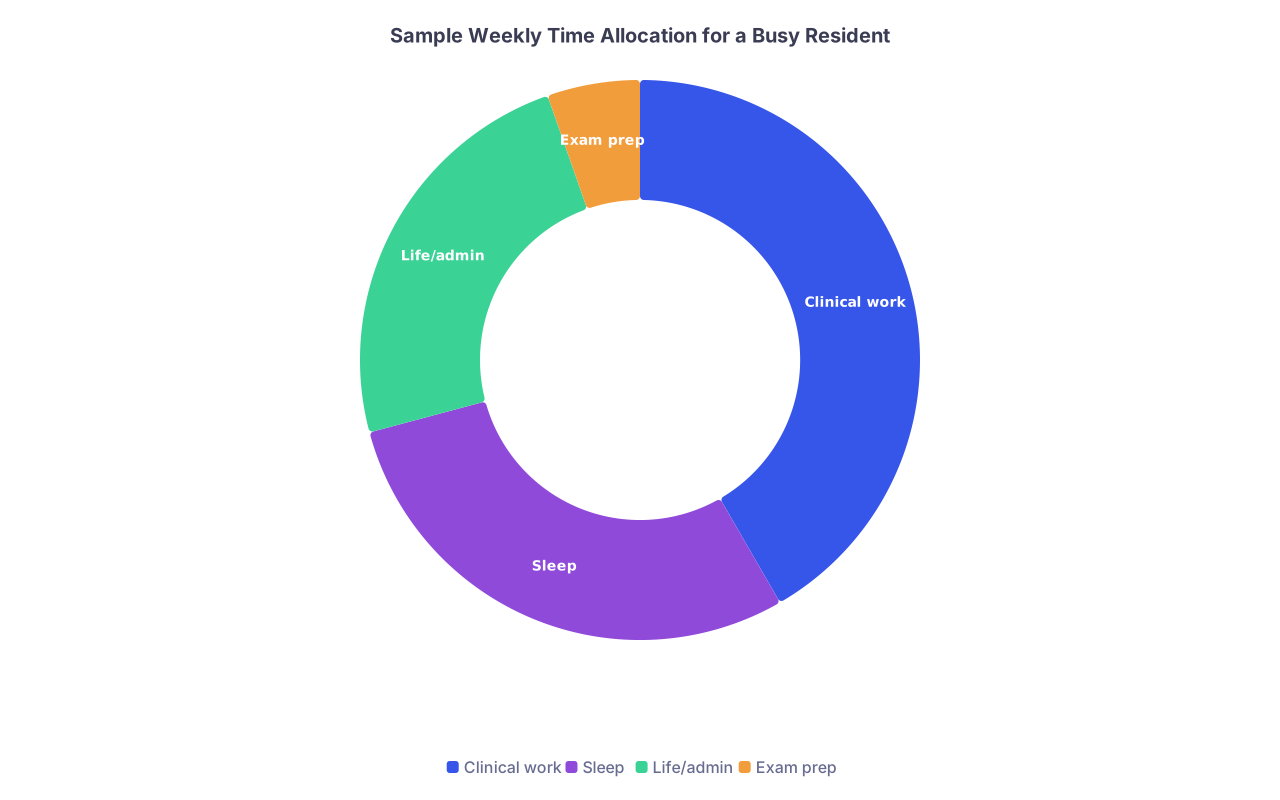
Those 7–10 hours of prep per week don’t appear magically. You manufacture them by cutting nonsense and adding structure, not by pretending you’ll find “free time.”
Step 3: Use your program, but don’t outsource your outcome
Morning report, noon conference, board review sessions—they help. They do not replace:
- Personal question bank time.
- Targeting your own weak areas.
- Actually sitting with explanations instead of zoning out while someone lectures at you.
The residents who get burned are the ones who think “I attend most conferences; that should cover it.” It won’t.
Fixing the Two Most Common Resident Excuses
Let’s deal with the two lines that keep showing up.
“I’m too tired to do structured prep.”
Of course you are. Residency is a fatigue factory. But watch what happens when you define “prep” differently:
Bad mental model: “Prep = an hour of focused study after work.”
Better mental model: “Prep = short, regular touches I can stomach even when tired.”
Realistic forms:
- 10 questions while you eat post-call breakfast.
- 5 questions before you open Instagram in bed.
- Audio review on the commute twice a week.
- One 25–30 question block on your golden weekend, with thorough review.
You’re not aiming for med-school-style monk mode. You’re aiming for “not zero” almost every day.
“Clinical learning just works better for me.”
Good. Use that. But stop using it as an excuse to avoid structure.
You can lean into your clinical mind by:
- Always linking questions back to cases you’ve seen.
- Asking on rounds, “What’s the exam answer to this?” occasionally.
- Turning your own patients into flashcard prompts (“Why this anticoagulant here?” “What stage is this?”).
Use your preference as a vehicle, not a shield.

A Concrete, No-Nonsense Plan Residents Actually Use
Here’s a hybrid structure I’ve seen work across IM, FM, EM, peds, and anesthesia. Adjust numbers, keep the skeleton.
Year before your exam:
- Pick one major Q‑bank. Commit. Stop switching.
- Target 3,000–4,000 questions total for the year.
- Roughly: 10 questions/day on tough weeks, 20–30 on lighter weeks.
Weekly rhythm:
- 3–4 workdays: 10–15 questions each, timed, from a mix of topics.
- 1 off day: 20–30 question block in exam mode + deeper review.
- Throughout: tag or flag questions you guessed or missed. These become your “high-yield list.”
Last 2–3 months:
- Tighten focus on weak systems identified by your Q‑bank stats and in‑training exam.
- Add at least one full-length practice block weekly that mimics real exam structure.
- Stop starting brand-new resources. Just deepen the ones you already know.
If you follow something like this, your “I learn best clinically” brain will have hundreds of patient anchors plus thousands of structured question-based reps. That combination is what almost all first-time passers have in common, whether they admit it out loud or not.
The Quiet Truth: Ego vs Outcome
The line “I just learn better clinically” sounds proud, independent, even a little superior. It’s a nice story. But stories do not protect your license, your visa, or your fellowship plans. Board scores do.
Residents who pass stop caring whether their prep style feels flattering to their identity. They care that it works.
You do not have to become a flashcard robot. You do not have to love question banks. You do have to accept that the people quietly walking out of these exams with passing scores are not magical “clinical learners.” They’re doing something more disciplined and less glamorous than that.
Years from now, you will not be reminiscing about how you “kept it real” by avoiding structured prep; you’ll remember whether you moved on with your class—or had to explain to everyone why you’re still here another year.