
The belief that you need to memorize every guideline to pass boards is not just wrong. It is actively making residents worse doctors.
Let me be blunt: the people who flame out on boards are almost never failing because they did not memorize the exact year the ACC/AHA guideline changed or the fifth-line therapy for some zebra condition. They fail because they never learned to separate core, testable patterns from the noise of real-world practice.
You are drowning in guidelines, pathways, “order sets,” and UpToDate summaries. The exam is not. The exam is weirdly cleaner and more old‑school than how we practice medicine now. That mismatch is where people get hurt.
Let’s fix that.
The Myth: “If It’s in the Guideline, It’s Fair Game”
There’s a very common resident brainworm: “If it’s a Level 1 recommendation, they can totally test it.” That line gets repeated on rounds like gospel.
Here’s the problem. Yes, they can test anything. But they do not. Boards are not written by a committee of subspecialty maximalists trying to shove every nuance of every 300‑page guideline into a 6‑hour exam.
Look at what we actually know:
- Board blueprints (ABIM, ABFM, ABS, etc.) list content domains, not guidelines.
- Question writers are instructed to target high-yield, widely accepted standards, not this-week’s subspecialty controversy.
- Psychometrics (the science behind test design) punishes over-specific, niche questions because they perform poorly and don’t discriminate between strong and weak candidates.
So while your cardiology attending might go off for 12 minutes about the exact differences between the 2017 and 2022 HFpEF thresholds, the board exam…mostly does not care. It cares that:
- You recognize HFpEF vs HFrEF.
- You know the foundational therapies.
- You know which ones help with mortality vs symptoms.
You pass by owning the spine of the guideline, not every rib.
How Boards Actually Use Guidelines
Exams use guidelines as backbone, not script.
There are three consistent patterns in how guidelines appear on exams:
They reflect settled, boring consensus.
Not cutting-edge. Not Twitter-argument-of-the-week. Stuff that’s been standard for years and shows up in every review book. Example: using high-intensity statins for secondary prevention in established ASCVD. That’s not “memorizing a guideline,” that’s practicing modern medicine.They simplify real-world nuance.
On rounds, there’s debate:- “Is this class IIb or class IIa?”
- “Is this more ESC or ACC style?”
On exams, the stem is written so that one answer is glaringly most aligned with mainstream practice. They’re not graded on “but actually, in 2024 the ESC said…” You will not lose points for not knowing the precise recommendation grade.
They reward pattern mastery, not table memorization.
Hypertension? The exam cares about:- Differentiating urgency vs emergency
- JNC/ACC‑style BP thresholds in broad strokes
- Rational initial drug choices in prototypical patients
It does not care if you can quote the algorithm box 3B for “hypertension in CKD age <55 with albuminuria if ACE intolerant.”
So when you sit there agonizing over whether to memorize whether it’s 130/80 or 140/90 in some special subgroup, you’re missing the forest. The test is asking: do you recognize poorly controlled hypertension, and can you escalate therapy appropriately and safely?
What the Data and Pass Rates Actually Tell You
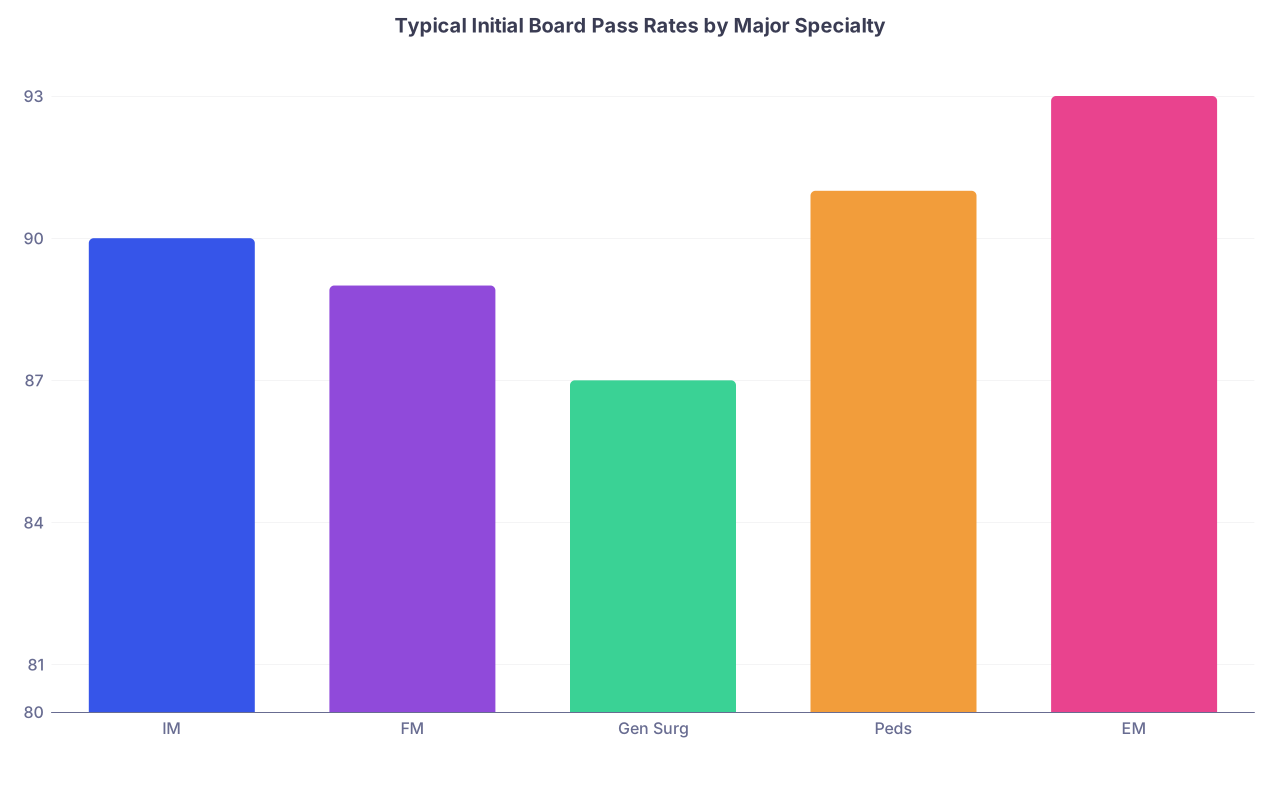
Let’s look at hard outcomes for a second.
| Category | Value |
|---|---|
| IM | 90 |
| FM | 89 |
| Gen Surg | 87 |
| Peds | 91 |
| EM | 93 |
You see pass rates in the 85–95% range across major specialties. If passing required near‑photographic recall of every guideline, those rates would be much lower. Residents are not collectively memorizing every page of ACC/AHA, ADA, GOLD, KDIGO, IDSA, and whatever else your program emails you at 11 pm.
What are the people who fail actually missing? I’ve reviewed score reports and watched residents retake boards. The recurring patterns are:
- Weak foundation in bread‑and‑butter (diabetes, HTN, common infections, CAD)
- Terrible test strategy (burning 3 minutes on zebras, panicking, rushing later sections)
- Neglecting question banks in favor of just “reading guidelines” (this is a slow-motion disaster)
Virtually none of them failed because they didn’t know the third-line pharmacologic option for obesity in a post-bariatric-surgery patient with resistant hypertension and migraines.
Right-Sizing Guidelines: What’s Actually Worth Memorizing
Here’s where residents swing from one extreme to the other. They either try to memorize everything or they overcorrect and treat guidelines like they’re completely irrelevant.
The reality is in the middle: you need the scaffolding, not the wallpaper.
Think in tiers.
Tier 1: Non-negotiable Core (You Must Know This Cold)
This is guideline-backed, but it’s also common sense medicine at this point. If you miss this, both boards and patients punish you.
Examples:
- Initial management of STEMI and NSTEMI: aspirin, anticoagulation, timing of cath.
- Basic sepsis bundle: fluids, early antibiotics, vasopressors.
- First-line therapy and major side effects for:
- Hypertension
- Type 2 diabetes
- Asthma/COPD
- Heart failure
- Cancer screenings: broad age ranges and what test, not who wrote the guideline.
- Stroke: time window for tPA / thrombectomy in broad terms, contraindications.
You shouldn’t be “looking these up” on an exam. This is your clinical reflex. If a question stem reads like something you’ve seen 500 times on the wards, that’s Tier 1.
Tier 2: Patterns and Priorities (You Need the Logic, Not the Exact Flowchart)
This is where memorizing full algorithms becomes a waste.
Take heart failure:
- Yes, technically there is an intricate uptitration scheme for ACEi/ARB/ARNI, beta‑blocker, MRA, SGLT2, diuretics, hydralazine/ISDN.
- On exams, what they want is:
- Do you grasp which drug classes are foundational?
- When should you add vs switch?
- Are you aware of major contraindications?
Same story with diabetes:
- Exam cares that you know:
- Metformin first line (unless contraindicated).
- SGLT2/GLP‑1 for ASCVD/CKD/obesity benefits.
- Hypoglycemia risk hierarchy: insulin > SU > everything else.
- They do not expect you to quote the exact A1c goal language for every demographic slice.
Tier 2 is “understand the structure and sequence.” Not “memorize the ladder.”
Tier 3: Fine Print and Edge Cases (You Can Safely Ignore 90% for Boards)
This is the poison many residents drink.
Examples:
- Exact LDL thresholds for PCSK9 initiation in every risk subgroup.
- The detailed staging cuts for some rarely tested cancer.
- Every class IIb recommendation in a cardiology document.
- The 20 different subclasses of pulmonary hypertension mechanistic categories.
Those are great if you’re a fellow or doing a niche board. For basic specialty boards, these show up in maybe one question out of hundreds, if at all. You don’t chase one point with twenty hours of studying.
How to Decide If a Guideline Detail Is Worth Your Time
Here’s a simple mental filter I’ve used with residents who went from barely passing in‑service to crushing boards.

| Step | Description |
|---|---|
| Step 1 | See a guideline point |
| Step 2 | Probably low yield for boards |
| Step 3 | Learn concept lightly if time |
| Step 4 | Do not memorize detail |
| Step 5 | High yield - learn pattern |
| Step 6 | Common clinical scenario? |
| Step 7 | Appears in qbanks or review books? |
| Step 8 | Changes management clearly? |
If you want to be even more ruthless:
- Have you seen it in more than one reputable question bank or major review resource?
- Does it change what you would actually do for the patient in a way that’s clearly better or safer?
- Is it about a common condition (not some subspecialty side street)?
If the answer is no across the board, that detail is a time sink.
Qbanks vs Guidelines: Where Your Time Actually Pays Off
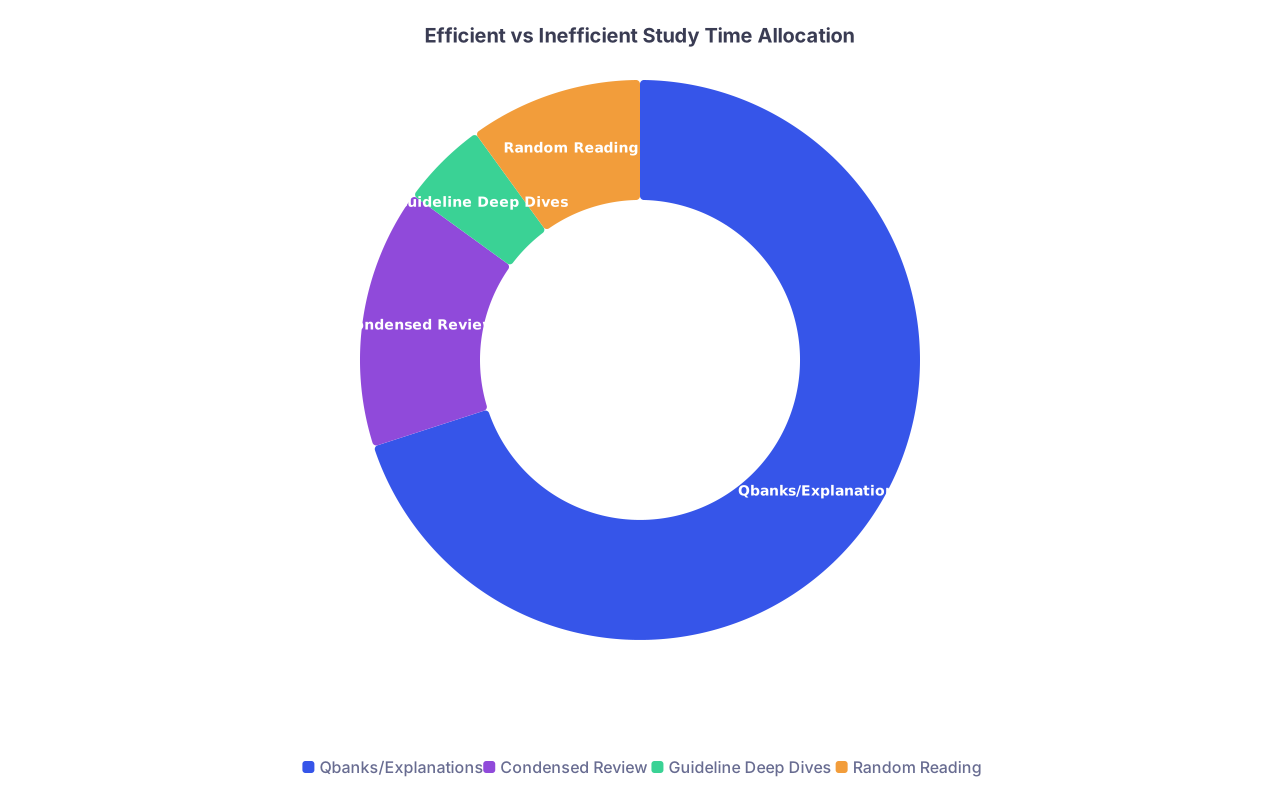
Let’s look at how effective time allocation typically looks for residents who pass comfortably vs those who are miserable and borderline.
| Activity | Efficient Resident | Struggling Resident |
|---|---|---|
| Question Banks | 55% | 25% |
| Reviewing Explanations | 20% | 15% |
| Focused Review Book | 15% | 20% |
| Reading Full Guidelines | 5% | 25% |
| Random Online Articles | 5% | 15% |
| Category | Value |
|---|---|
| Qbanks/Explanations | 70 |
| Condensed Review | 15 |
| Guideline Deep Dives | 5 |
| Random Reading | 10 |
The efficient resident uses guidelines as reference, not primary study material. They learn:
- From questions what topics truly recur.
- From explanations and review books what the current consensus expectation is.
- From guidelines only when they see there’s a gap in understanding of a core topic.
The struggling resident does the opposite. They get anxious after seeing some niche recommendation on rounds (“they’ll totally test that”), detour into a rabbit hole, and never build speed or pattern recognition on common bread‑and‑butter stuff.
Exams are written in question format. Your brain needs to practice in question format. Reading guidelines end‑to‑end is like training for a marathon by reading shoe catalogs.
Boards Are Behind Real-World Practice (Use That to Your Advantage)
This part annoys people but you need to accept it: boards lag reality.
New drugs. New devices. New thresholds. They all take time to show up in exam content:
- Items are written.
- Items are reviewed.
- Items are piloted.
- Items are analyzed for performance.
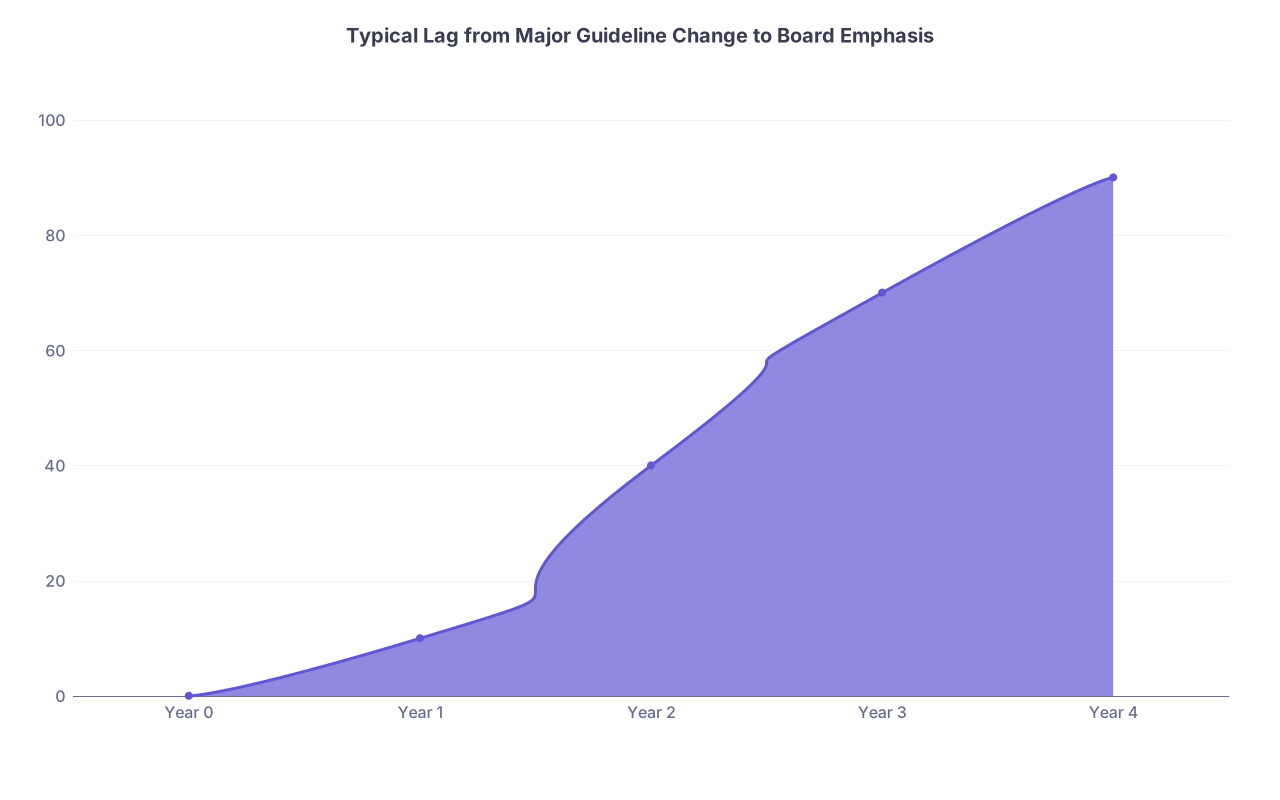
That’s a multi‑year pipeline.
| Category | Value |
|---|---|
| Year 0 | 0 |
| Year 1 | 10 |
| Year 2 | 40 |
| Year 3 | 70 |
| Year 4 | 90 |
Roughly: big changes may barely appear in year 1 as pilot items, then gradually become mainstream over several exam cycles. Meanwhile, your attendings may already be living in year 0.5—bringing conference hot takes and recent trials to bedside discussion.
On exams, the safe bet is:
- Trust major review resources and current qbanks over the latest conference abstract.
- If something is so new it barely appears in your question bank, it is not going to dominate the exam.
So no, you do not need to memorize every new HFpEF subgroup RCT or the latest GLP‑1 vs tirzepatide nuance. The test will still be hitting you with classic DKA management, COPD exacerbations, AF with RVR, and colon cancer screening patterns.
A Practical Way to Study Guidelines Without Drowning
Here’s a sane strategy that residents have actually used and stuck to.
Step 1: Start With Questions, Not PDFs
Do 20–40 questions a day depending on your schedule. While reviewing explanations:
- When you miss something that sounds like guideline-level management (e.g., which agent to start, target, threshold), flag it.
- Only then open a short guideline summary or a reputable condensed review (e.g., ACC cards, UpToDate “Summary and Recommendations,” or your board review book’s relevant section).
You’re letting the exam format tell you which parts of the guideline matter.
Step 2: Build One-Page “Guideline Skeletons”
For each major topic (HTN, DM, CAD, HF, asthma/COPD, sepsis, anticoagulation), make a one‑page cheat sheet that covers:
- Initial decision point (diagnosis or severity cut).
- First‑line therapies.
- When to escalate or add a key second agent.
- One or two “don’t miss” contraindications or safety points.
No wall-of-text tables. No copying PDFs. Just the spine.

If you cannot fit it on one side of a page, you’re overdoing it for boards.
Step 3: Recalibrate With Reality
When an attending or fellow goes 8 levels deep on some nuance:
- Ask yourself: “Does this change what I pick on a multiple-choice test in a classic scenario?”
- If the answer is “not really,” mentally tag it as fellowship-level.
You’re not dishonoring the craft of medicine by not memorizing every detail during residency. You’re preventing cognitive overload so you can actually be safe and effective.
What to Do When Anxiety Screams “But What If They Ask This?!”
They probably won’t. And if they do, you’re not supposed to get 100%.
Most boards are scaled so that:
- A solid but not perfect performance comfortably passes.
- You can miss many questions on obscure details and still be fine.

The residents who sleep the night before their exam are the ones who’ve made peace with this. They aim to:
- Dominate the 70–80% of questions that are common, pattern-based, and tied to bread‑and‑butter guidelines.
- Accept that a minority will be curveballs, weird details, or experimental content. And let them go.
If your study strategy is built to avoid ever feeling, “I don’t know that detail,” you’ll never stop studying. Because there is always another PDF.
The Bottom Line
You do not need to memorize every guideline. You need to:
- Master the core patterns and first-line decisions embedded in guidelines, not every step of every algorithm.
- Let question banks and recurring exam themes tell you which guideline details matter, instead of letting anxious attendings or giant PDFs set your priorities.
- Accept that boards reward solid command of common conditions, not encyclopedic recall of subspecialty fine print.
Stop trying to be a walking guideline app. Be a clinician who knows the fundamentals cold, recognizes the patterns, and answers like someone who has actually taken care of patients. That is who boards are written to pass.