The idea that you must study every single day for boards is overrated. But the fantasy that “I’ll just crush it on weekends and coast during the week” is also mostly nonsense.
Both sides are wrong in different ways.
Let me be blunt: weekend‑only studying for boards can work for some residents in some situations — but for most people, done the way they imagine it, it’s a trap. The data, your clinical schedule, and basic cognitive science all agree on that.
Let’s tear this apart properly.
What People Think “Weekend‑Only” Studying Looks Like
Here’s the dream I hear all the time on wards:
“PGY‑2 will be brutal, I’ll just do 6–8 hours each Saturday and Sunday for Step 3 / boards. Weekdays are impossible.”
Sounds reasonable on paper. Full‑time job, call, notes, prior auths, a life (allegedly). So you batch learning into two monster days.
What they actually do:
- Get out of bed late post‑call.
- Spend 1–2 hours getting organized (“Which qbank? Maybe I’ll make an Anki deck from every question.”).
- Grind questions until their brain is soup.
- Skip Sunday because they picked up a shift or are wrecked.
- Repeat the cycle with massive guilt, then ramp up panic 6 weeks before the exam and try to “make up” 3–4 months of inconsistent effort.
The problem isn’t the weekend. It’s the fantasy.
What the Data Actually Shows About How People Learn
Let’s get away from vibes for a second and look at what has real evidence behind it.
Three big principles from learning science:
Spacing effect – Information sticks better when study is spread out over time, not crammed into a few long sessions. This has been shown across multiple domains, including medical learning and standardized exams.
Testing effect – Repeated retrieval (questions, flashcards) beats rereading or passive review. Qbanks and targeted recall trump “reading the book” for the fifth time.
Desirable difficulty – A bit of mental strain improves long‑term retention. But “I’m delirious, post‑call, slogging through 100 questions while half‑asleep” is not desirable difficulty. It’s just garbage input.
Weekend‑only studying fights directly against the first principle: spacing.
You can brute‑force around this with very high total hours and genuinely excellent focus on weekends, but now we’re talking about a tiny minority of residents with:
- Reasonable rotations
- No dependents
- Good baseline test‑taking ability
- Prior strong Step / in‑training performance
In other words, not the majority of people asking this question.
The Math: What Weekend‑Only Actually Buys You
Let me quantify it, because numbers are less polite than your co‑resident.
Say you’re aiming for a solid performance on an in‑service exam or ABIM/ABEM/ABP/etc boards. A realistic, effective prep effort often looks like:
- Around 200–300 hours of real study
(not “time with the app open,” actually engaged time)
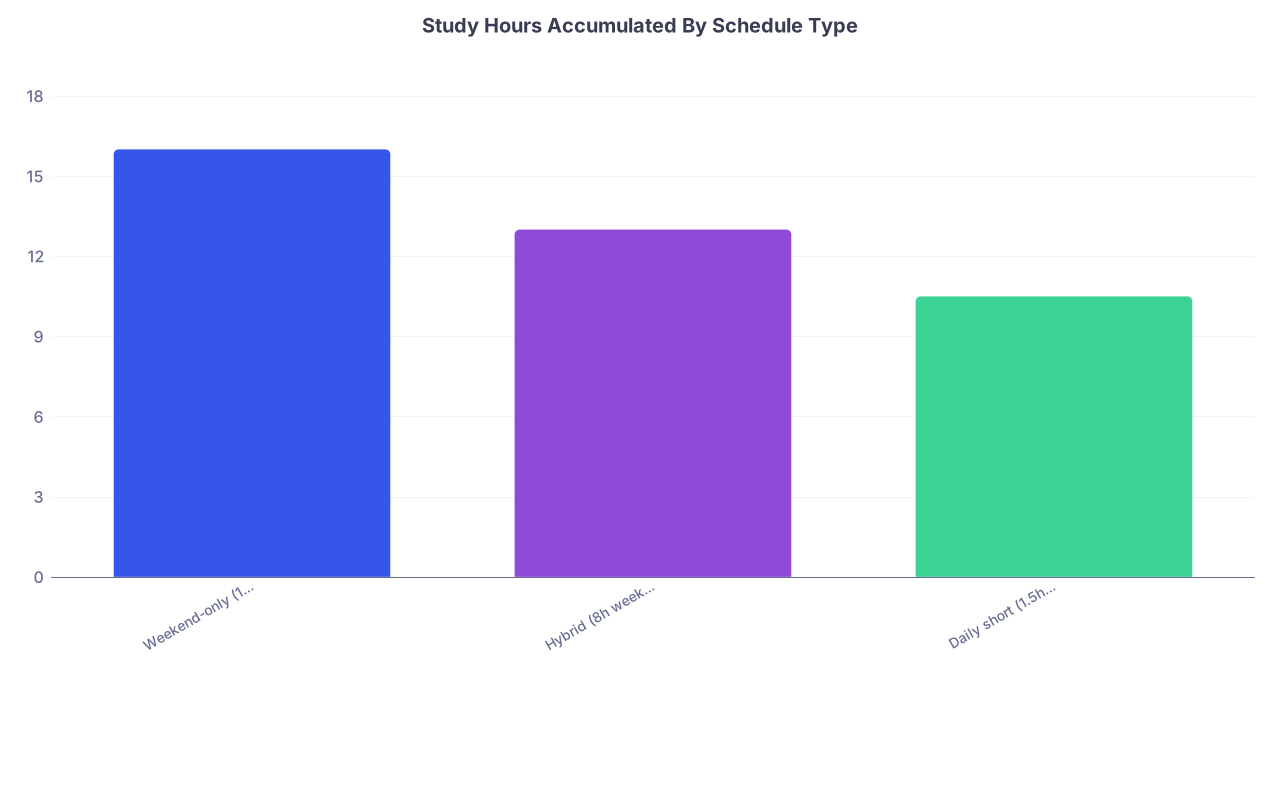
You tell yourself: “I’ll just do 8 hours on Saturday and 8 on Sunday.”
So that’s 16 hours/week.
| Category | Value |
|---|---|
| Weekend-only (16h) | 16 |
| Hybrid (8h weekend + 5h weekday) | 13 |
| Daily short (1.5h/day) | 10.5 |
On paper:
- 16 hours/week gets you 240 hours in 15 weeks.
- Looks decent.
Here’s the catch: nobody does 16 good hours every weekend for 15 straight weeks in residency. Some weekends:
- You’re post‑call
- You work both days
- You travel
- You’re sick
- You’re just done
Realistically, most “weekend‑only” plans decay to something like:
- 6–10 hours on a good weekend
- 0–4 on a rough one
Average: ~8–10 hours/week over time, if we’re being honest.
At that rate, 250 hours takes 6+ months. Most people “start” 8–12 weeks out with this plan. The math doesn’t care about your intentions.
Specialty, Exam, and Baseline Matter More Than Your “Plan”
Not all residents are playing the same game.
| Resident Profile | Weekend-Heavy Plan Viable? |
|---|---|
| Strong test taker, high prior Step scores | Often yes |
| Mid-range test taker, average Steps | Maybe, with structure |
| Prior low Step / in-service performance | High risk |
| Studying for ABIM-style exam | More forgiving |
| Studying for ultra-competitive subspecialty boards | Less forgiving |
If you’re:
- Historically a high scorer
- Already strong on day‑to‑day clinical reasoning
- In a specialty where boards track fairly closely with your daily bread‑and‑butter (general IM, peds, FM more than say, interventional cards boards)
…then a weekend‑heavy approach with small weekday touch points can absolutely work.
If you’re:
- Someone who barely passed Step 1 or 2
- Failed an in‑training exam
- Weak on foundational pathophys
- In a high‑stakes subspecialty with low tolerance for failure
Then betting your boards on “weekends only” is like going into a code saying, “I’ll do compressions, but only in the last minute.”
The Real Problem: Cognitive Load, Not Just Time
Residents massively underestimate the effect of cognitive load.
That line you hear — “I’m too fried to study on weekdays” — is real, but incomplete. You are fried. But you’re also underestimating what 30–45 minutes of low‑friction, low‑ego work can do for you between Saturday marathons.
Weekend‑only studying usually means:
- Long, dense sessions
- Huge topic jumps
- Little reinforcement during the week
- Big gaps → lots of forgetting → re‑learning instead of building
That’s not time‑efficient. It just feels emotionally neat: “I study on weekends; I’m off the hook Mon–Fri.” Your brain likes clean stories. Boards do not care about your story.
What Actually Works: Hybrid, Not Fantasy
Here’s the uncomfortable middle ground where outcomes are actually better:
Weekend‑heavy. Weekday‑light. Daily contact.
Call it:
- 6–8 focused hours per weekend day max
- Plus 20–40 minutes on most weekdays
Yes, even on “brutal” rotations. No, not every single day. But enough days that your brain sees the material five to six times a week instead of two.

| Step | Description |
|---|---|
| Step 1 | Start 12-16 weeks out |
| Step 2 | Weekend long blocks |
| Step 3 | Weekday short sessions |
| Step 4 | Adjust volume by rotation |
| Step 5 | Peak review last 3-4 weeks |
That weekday touch can be:
- 10–20 qbank questions while you eat
- Reviewing missed questions from the weekend
- Cards on your commute (if you’re not driving)
- One small topic outline (e.g., syncope algorithm, asthma severity steps)
Not sexy. Not “grindset.” But this actually respects spacing, retention, and your limits.
Let’s Talk Evidence: What Program Data Suggests
Most programs don’t publish “study schedule vs pass rate,” but we do have indirect evidence.
Things consistently associated with better board or in‑service performance:
- Regular qbank use over months, not weeks
- Higher in‑training exam scores (which correlate with consistent prep, not panic cramming)
- Use of at least one structured resource (question bank + a single core text/video series) rather than a chaotic buffet approach
Things associated with poor performance:
- Starting “for real” within 4–6 weeks of the exam
- Inconsistent engagement (big bursts, long gaps)
- Overreliance on reading/notes without adequate questions
Notice what’s missing? There’s no magic in which days you study. The pattern that matters is continuity and question exposure.
So can someone who only truly studies on weekends pass? Yes, especially if:
- They start early enough
- Weekend work is real and high‑quality
- They at least touch material once or twice midweek
Pure, rigid “I do nothing Mon–Fri, ever” is the part that’s fantasy for most residents.
Common Myths About Weekend‑Only Studying
Let me kill a few specific myths I see over and over.
Myth 1: “I’ll be more efficient if I save it for big weekend blocks.”
No. Up to a point, longer blocks help (you get into flow, do deeper questions, synthesize). Past that, productivity drops off sharply. Most residents are garbage after 4–5 hours of real cognitive work in a day.
Those “8‑hour” days? Often 3–4 real hours plus guilt scrolling.
Myth 2: “Weekdays are useless for me, I’m too tired.”
You are too tired for heroic studying. You’re not too tired for:
- 10–15 questions
- Spaced repetition cards
- 1 short video on a high‑yield topic
The trick is to stop pretending you’re going to do 2 hours on a post‑call Tuesday. Aim for 20–30 minutes and be done. You need the contact, not the theatrics.
Myth 3: “Plenty of people just cram and pass.”
True. Some do. But look closer at who they are:
- They crushed prior standardized tests
- They’ve been absorbing content all along (reading UpToDate, being pimped, teaching students)
- They aren’t actually starting from zero
If your prior performance is shaky, you are not them.
How to Make a Weekend‑Heavy Plan That Actually Works
If you’re still thinking, “Okay, but weekdays truly are limited,” then do this like an adult, not a fantasist.
Step 1: Be brutally honest about your baseline
Look at:
- Last in‑training exam
- STEP scores
- How medicine questions feel right now (timed block, random, no filter)
If you’re already roughly near the passing threshold with casual knowledge, your margin is bigger. If you bomb that test block, you don’t have room to play games.
Step 2: Set realistic weekly targets
Instead of “8 hours/day on weekends,” use:
- Questions per week (e.g., 150–200)
- Content modules per week (e.g., 3–4 topics)
Step 3: Allocate like this (example for 12‑week runway)
| Day | Task | Approx Time |
|---|---|---|
| Sat AM | 40-50 questions + review | 2.5–3 h |
| Sat PM | Videos/reading on weak topics | 2–3 h |
| Sun AM | 40-50 questions + review | 2.5–3 h |
| Sun PM | Light review / flashcards | 1–2 h |
| 2–4 weekdays | 10–15 questions or cards | 20–30 min |
That schedule gets you:
- 80–100 questions on weekends
- Another 20–40 sprinkled during the week
- 100–140 questions/week, consistently
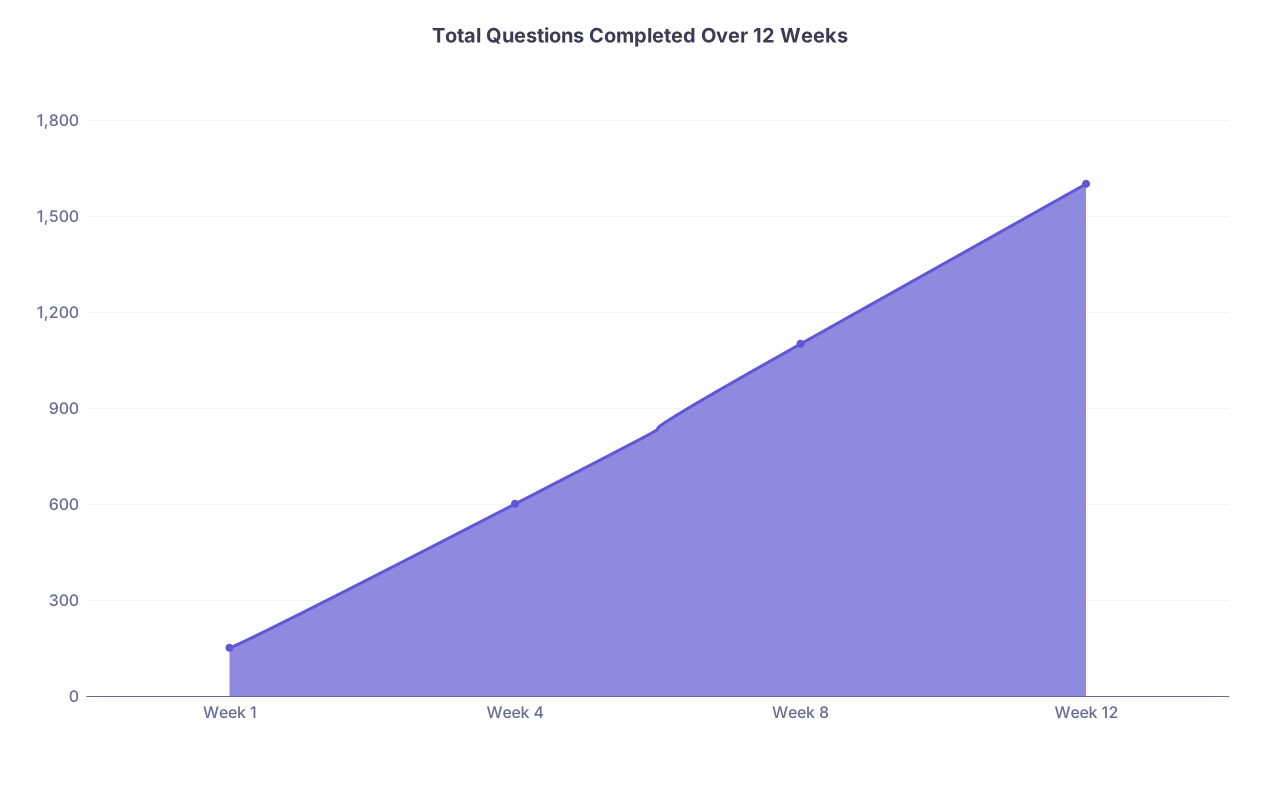
Over 12 weeks, that’s 1200–1700 questions — very much in the zone of what high scorers actually do.
| Category | Value |
|---|---|
| Week 1 | 150 |
| Week 4 | 600 |
| Week 8 | 1100 |
| Week 12 | 1600 |
This is weekend‑heavy. But not weekend‑only.
When Weekend‑Only Is Flat‑Out Dangerous
There are some situations where I’d tell you directly: do not rely on weekends alone.
- You’ve failed a board exam before.
- You’re in a remediation or probationary situation.
- Your visa, job, or fellowship offer is contingent on passing this specific sitting.
- You genuinely cannot stay awake reading a single UpToDate article after work right now.
In those cases, you either:
- Change something bigger (rotation schedule, exam date, ask for real study time), or
- Accept that you’re gambling your career on a plan that mostly works in motivational YouTube videos, not in actual PGY‑2 life.
What About People Who Truly Have No Weekday Bandwidth?
I’ve seen a few setups like this:
- Malignant schedules, 80+ hours every week, bad commute
- Single parents with no help
- Residents covering two services due to staffing disasters
For them, the question becomes: do you try to shove boards into the cracks, or do you negotiate structural protection?
Options that actually help more than wishful thinking:
- Moving your exam date back into a lighter rotation period
- Asking your PD explicitly for a board‑prep elective or lighter month in the lead‑up
- Using vacation time partially as true study time (unpopular but sometimes necessary)
This is not “grind harder on weekends.” This is “change the frame so the exam isn’t stacked against you.”
The Bottom Line: Can Weekend‑Only Studying Work?
Here’s the honest verdict.
Pure, hard‑line “I only study on weekends, zero contact on weekdays” is a bad plan for most residents. It ignores:
- Spacing effect
- Real weekend fatigue
- The math of hours needed vs weeks available
A weekend‑heavy, weekday‑light plan can work very well if:
- You start early enough (12–16 weeks, not 4–6)
- You hit consistent question volume
- You maintain even tiny weekday contact
- Your baseline performance is at least average
And for a small subset of very strong test takers with good memory, strong clinical training, and relatively humane rotations? They really can pull off something close to weekend‑only and come out fine. But they’re the exception that everyone else uses to justify magical thinking.
The real myth is not “weekend‑only studying.”
The myth is that your schedule will suddenly become disciplined and perfect because you put everything on weekends.
Years from now, you will not remember how many hours you logged in UWorld on a random Saturday. You will remember whether you were honest with yourself about what you needed — and whether you built a plan that matched your real life, not the fantasy version.