
What actually happens to the resident who fails a board exam on the first try but passes on the second—five, ten, fifteen years later? Are they quietly blacklisted forever, or does the failure vanish into the noise of a long career?
Let me ruin the drama up front: a single prior failure almost never ruins a career long-term. But it absolutely can wreck the short-term if you handle it badly, let shame drive your decisions, or pretend the data does not exist.
Let’s separate myth from reality.
Myth #1: “Failing Boards Once Means You’ll Never Be Board Certified”
This myth is mostly nonsense.
Board exams are built with retakes in mind. The boards know people fail. They literally design policies around that fact. The “one and done or you’re out of medicine” narrative is residency gossip, not reality.
Across most specialties, the eventual pass rate (meaning people who pass by second or third attempt) is very high among residents who actually complete training and stay in the field.
| Attempt Number | Approx Pass Rate | Comment |
|---|---|---|
| First | ~88–90% | Program-director monitored |
| Second | ~60–70% | Self-selected group, often remediated |
| Third+ | ~50–60% | Smaller, more complex group |
Numbers move slightly year to year, but the pattern’s consistent: most people who stick with it and have real support eventually pass.
Where people get hurt is not the failure itself. It is the cascade:
- Delayed graduation in some programs
- Temporary loss of credentialing or hospital privileges
- Visa headaches for IMGs if the timeline stretches
- Financial strain if you’re repeating a chief year or taking unpaid time
Those are real. They suck. But they’re logistical and timing problems, not permanent career execution.
If you fail the exam, honestly examine two questions:
- Did you mostly have a knowledge gap (weak fundamentals, poor question volume, bad test prep structure)?
- Or did you have a performance gap (severe anxiety, life chaos, health issues, sleep deprivation, untreated ADHD/depression)?
The residents who worry me are not the ones who fail. It’s the ones who treat the failure like a random lightning strike and change nothing. Then they repeat the exact same approach with a new UWorld subscription and “better vibes” and are shocked when they stall again.
Myth #2: “Every Employer Sees—and Cares About—Your Initial Failure”
No. And no.
Here’s how it works in real life, not in paranoid resident group chats.
Your permanent record concern breaks into three buckets:
- Board status
- Examination history
- Training/credentialing paperwork
1. Board status
Most employers care about one line:
- Board certified in [specialty], American Board of X
Once you’re certified, 90% of people outside academic medicine will never dig deeper. Community hospital? Large private group? Locums agency? They want the box checked.
2. Exam history
This is where the myths explode.
- The boards themselves know your full history, obviously
- Some state medical boards ask: “Have you ever failed a licensing or certifying exam?”
- Some privileging forms at hospitals ask similar questions
Do some employers care? Yes—particularly hyper-competitive academic departments or brand-name specialty groups. But outside those circles, the conversation usually goes like this:
“Board certified?”
“Yes.”
“Great, send your certificate.”
End of story.
The big exception: if your failure is part of a pattern. Multiple Step failures, in-training exam disasters, board failures, professionalism flags—that cluster raises concern not because you are morally flawed, but because it signals you may struggle repeatedly in high-stakes settings.
But a single failure with a clean narrative and a clear eventual pass? That’s not the scarlet letter you think it is.
3. Training paperwork
This is the unsexy part, but it’s what actually matters.
Your residency program has to complete verification forms for:
- State licenses
- Hospital privileges
- Credentialing packets
Those forms usually ask:
- Did you complete training successfully?
- Any extensions, leaves, or disciplinary actions?
- Any concerns about competence or professionalism?
If your program supported you, documented appropriate remediation, and you ultimately passed, the forms typically read as: “Resident required additional time for board preparation, then successfully completed program and is qualified for independent practice.”
You know what most committees do when they see that?
They nod. Move on. Next application.
Myth #3: “Fellowship Doors Slam Shut After a Board Failure”
This one’s partially true, partially fabricated. You need nuance here.
Let’s talk competitiveness, with internal medicine as a clean example.
| Fellowship Type | Typical Reaction to 1 Prior Failure |
|---|---|
| Elite cards/GI/heme-onc at top-10 places | Significant negative weight |
| Solid academic programs | Concerned but willing to hear story |
| Community/university-affiliated programs | Often flexible if passed later |
| Less competitive subspecialties | Usually care more about letters, fit, skills |
You want GI at MGH, cards at Duke, or heme-onc at MD Anderson? Yes, a prior board failure is a real stain. They have 3–5 applicants per spot with spotless records, publications, and glowing letters. You are competing at the margins.
But that’s very different from “you’ll never do GI or cards anywhere.” I’ve seen fellows with:
- Prior Step 1 fail, Step 2 low but pass, IM boards fail once, then pass
- Match into solid, non-brand-name GI programs
- End up doing exactly what they wanted in community practice or mid-tier academic centers
The tradeoff is not “fellowship vs no fellowship.” It’s “top 5 glitter-name vs strong but less branded program.” Big difference.
The other reality: once you’re in practice for a few years, fellowship program directors become completely irrelevant to your life. Your patients, partners, and hospitals care that you:
- Are competent
- Are board certified
- Show up and do the work without creating chaos
Nobody in a tumor board in 2036 will care about your ABIM score report from 2026.
What Failing Boards Actually Predict (And What It Does Not)
Let’s cut through the emotional noise and talk predictors.
The biggest risk factor for failing your specialty boards?
- Poor performance on in-training exams
- Borderline or failed USMLE/COMLEX attempts
- Weak or chaotic study habits
- Serious mental health, sleep, or life instability during training
The exam failure is often a symptom, not the pathology.
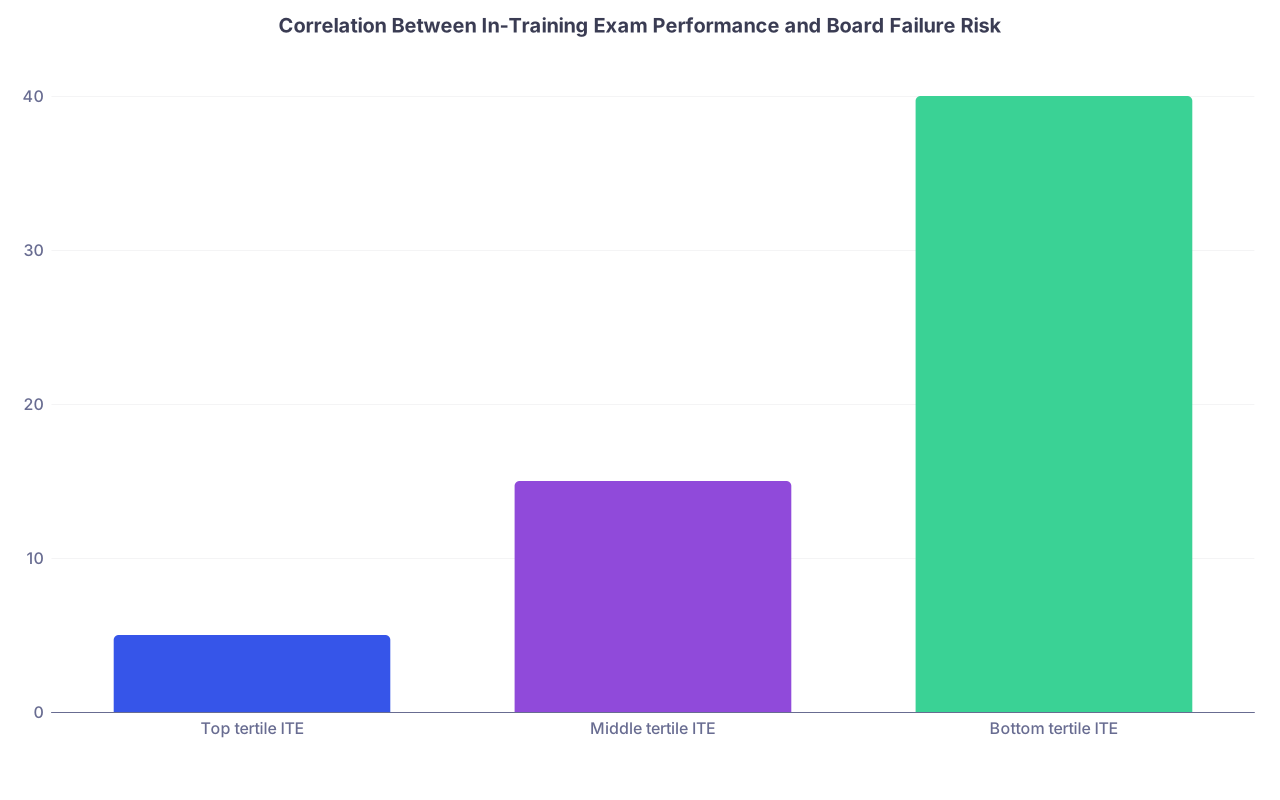
| Category | Value |
|---|---|
| Top tertile ITE | 5 |
| Middle tertile ITE | 15 |
| Bottom tertile ITE | 40 |
Those numbers aren’t exact across all specialties, but the pattern is the same: if you’ve been scraping by at the bottom of in-training exams without changing anything, board failure isn’t bad luck. It’s math catching up.
What the failure does NOT automatically predict:
- Long-term clinical incompetence
- Inability to have a stable job
- Permanent earning penalties
- Automatic blacklisting from all “good” positions
What it does predict in some people:
- Ongoing test anxiety and repeat struggles if never properly treated
- Difficulty with later recertification exams if habits never change
- Slightly narrower lane of hyper-competitive fellowships or elite academic jobs
That’s the trade. Not career death. Just fewer paths at the very top of the pyramid.
Where Prior Failures Do Keep Hurting You
There are some landmines no one tells you about.
1. Visa and immigration
If you’re on a J-1 or H-1B, delayed board certification can become a bureaucratic nightmare. Some states and employers tie your license or ongoing employment to board status within a set number of years post-training.
If you’re IMG on a visa and you’ve already had:
- Step failures
- Long training timelines
- Board failures
You have zero room to “see what happens.” You need an immigration-smart game plan with actual timelines and backup routes, not just wishful thinking.
2. Highly litigious practice environments
Certain malpractice carriers and hospital systems quietly prefer clean records. Add in a prior board failure plus a state board issue plus a malpractice suit, and suddenly that history starts compounding.
The failure alone is rarely the dealbreaker. But stacked with other “concerns,” it makes committees nervous faster.
3. Academic promotion
If you want gold-star academic medicine—division chief, endowed chair, high-level leadership—every blemish is a bit more costly. Not fatal, but cumulative.
You’ll need:
- Strong research
- Excellent teaching evals
- Clean recent recertification performance
In that world, your narrative matters. “I struggled early, here’s what I changed, here’s my consistent performance since” plays better than “test anxiety lol.”
How to Handle a Board Failure Without Letting It Own You
This is where people either quietly recover—or spiral.
Failing boards and then:
- Hiding it
- Minimizing it
- Repeating your same study strategy
- Avoiding any psychological or learning assessment
is how you turn one bad year into a five-year disaster.
What actually works, based on seeing residents claw back from real trouble:
Get a brutally honest diagnostic.
Not just “I need more questions.” You need to know: content gaps vs reading speed vs test strategy vs anxiety vs executive function. That sometimes means neuropsych testing or a real learning specialist, not just another board review course.Loop your program in early.
The worst emails I’ve seen: residents who fail, try to “fix it” quietly, and only tell leadership when timelines are already blown. Most PDs are surprisingly pragmatic when they have time; they are much less kind when you dump a crisis in their lap.Treat performance issues like a medical problem.
If you had atrial fibrillation, you would not “manifest” it away. You’d get a cardiologist, rhythm control, anticoagulation. Massive anxiety, depression, ADHD, sleep apnea? Same idea. Pretending you’re fine because you’re “tough” is how people keep failing.Make your retake obviously different.
Different schedule, different resources, different accountability. If your only change can be summarized as “more questions, earlier,” that is not a real plan.Craft a clean future narrative.
At some point, someone will ask: “What happened with your boards?” The winning answer is short, specific, and shows growth:“I failed on my first attempt during a period when I’d taken on too much clinical and family responsibility. I worked with my program and a learning specialist, adjusted my schedule, and passed comfortably on the next attempt. Since then, I’ve consistently scored above average on our recert modules.”
Then stop talking. Don’t bleed all over the interview with your shame story.
Long-Term Reality: Where You Actually End Up
This is the part residents do not believe until they’re five years out.
Fast-forward a decade or two:
- You’re board certified
- You’ve maybe recertified once
- You’ve got a stable practice, a panel, and a reputation locally
- Your daily problems are EMR nonsense, staffing, call schedules, prior auth hell
You know what almost no one cares about?
Your first-time board pass vs second-time pass.
Here’s what they care about:
- Are you clinically solid and safe?
- Are you reliable and not a black hole of drama?
- Can they trust you with sick patients and difficult families?
Your early exam story becomes one line in your own mental footnotes unless you keep rehearsing it as your identity.
The people who feel “ruined” by an early failure 15 years later are almost always the ones who:
- Stayed in environments that weaponized it against them
- Never updated their self-concept from “the one who failed”
- Avoided leadership, new challenges, or growth because “I’m not that type”
The people who don’t? They did real remediation once, moved on, and let their subsequent decade of competence speak louder than one bad test.
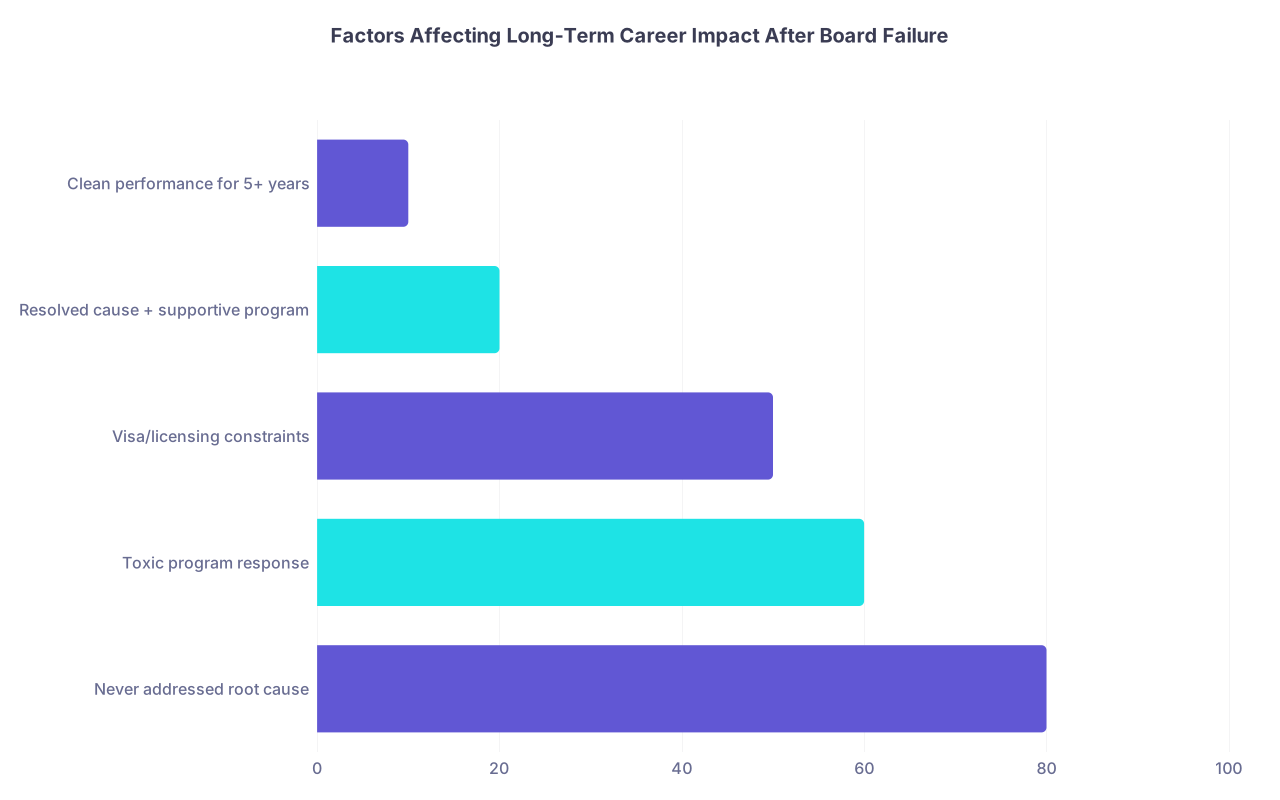
| Category | Value |
|---|---|
| Never addressed root cause | 80 |
| Toxic program response | 60 |
| Visa/licensing constraints | 50 |
| Resolved cause + supportive program | 20 |
| Clean performance for 5+ years | 10 |
The higher the value, the more likely that factor correlates with ongoing negative impact. Notice what’s not on the list: “failed once, then passed.”

| Step | Description |
|---|---|
| Step 1 | Board failure |
| Step 2 | Structured remediation |
| Step 3 | Hide and delay |
| Step 4 | High chance of long term recovery |
| Step 5 | Repeat struggle risk |
| Step 6 | Trust issues with program |
| Step 7 | Tell program early |
| Step 8 | Address root cause |
FAQ (Exactly 3 Questions)
1. Will a single board failure stop me from getting a “good” job?
Usually not. For most community and many academic jobs, once you are board certified, the prior failure is a footnote, not a veto. It may limit you at a few elite institutions or hyper-competitive fellowships, but it very rarely blocks you from solid, stable, well-paying positions.
2. Do I have to disclose my prior failure on job or license applications?
If they ask explicitly, yes. Lying on credentialing or license paperwork is far more dangerous than the failure itself and can get you in real regulatory trouble. Most forms care more about current board status and any ongoing restrictions than about one past failed attempt.
3. How many failures is “too many” before my career really is at risk?
There is no magic number, but repeated failures (USMLE + in-training + boards) without clear remediation and improvement start to scare both programs and employers. One failure, then a clean pass and stable performance? Manageable. Multiple failures across exams, plus shaky references or professionalism issues? That pattern can absolutely narrow your options significantly.
Key points:
- A single prior board failure very rarely ruins a career long-term; it mainly complicates the short-term logistics and narrows some elite options.
- The real danger is ignoring the root cause—if you do not change why you failed, retaking becomes roulette, not a plan.
- Ten years out, what matters far more than your first attempt is whether you’re board certified, clinically solid, and not a walking disaster in real-world practice.