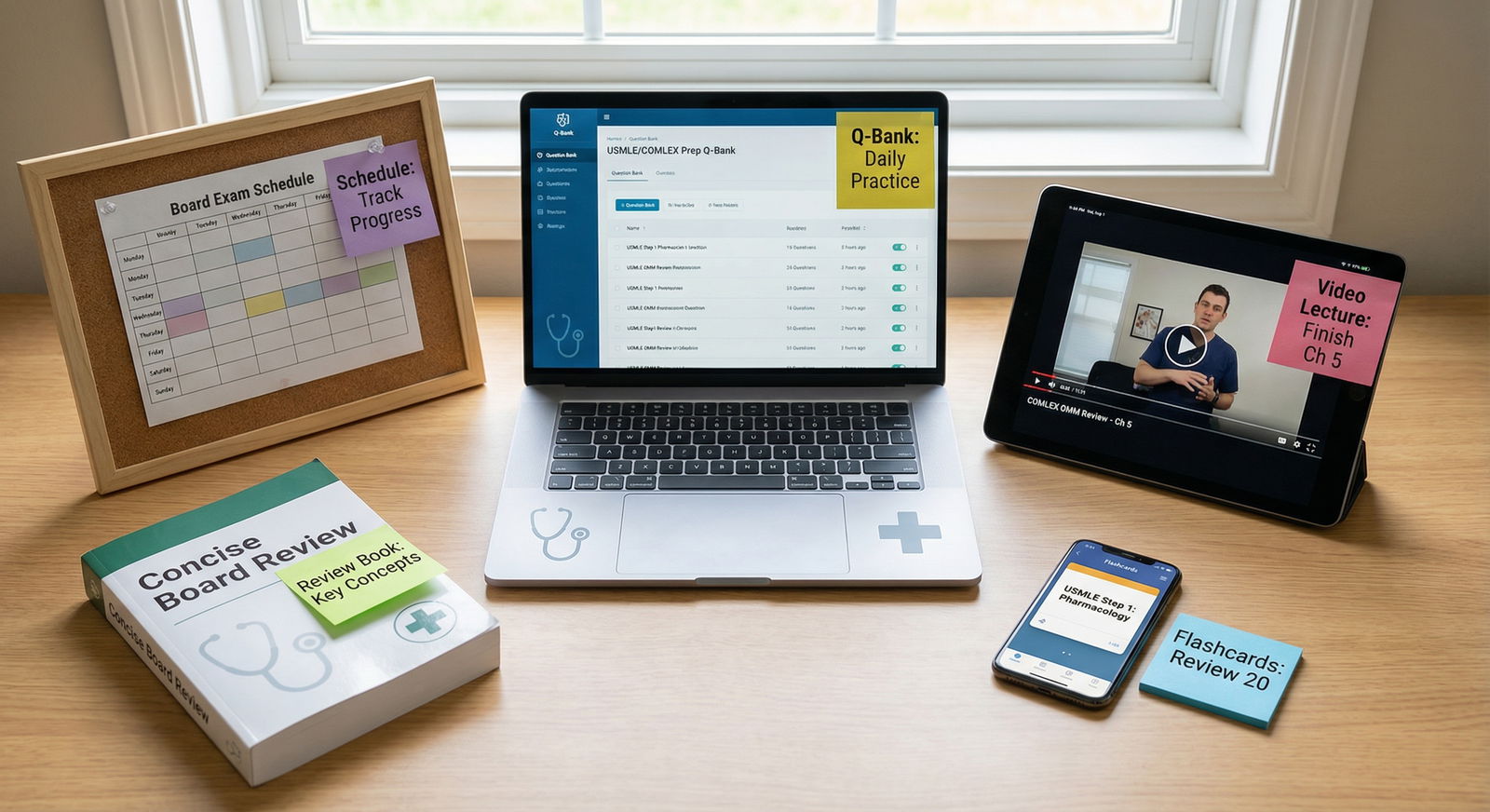
The belief that “you need a big-name board review course to pass” is mostly marketing, not medicine.
The Myth: Big Brand = Better Boards
You know the script.
Someone on your service says: “Just do [insert big course: MKSAP, UWorld Live, OnlineMedEd, BoardVitals, DIT, Mayo, Pass Machine, etc.]. Everyone uses it. It’s the best.”
Attendings parrot it. PDs hint at it. Co-residents swear by it.
The implication is clear: if you are not paying four figures and watching hundreds of hours of branded video, you’re “under-preparing” for boards. And if you fail? Well, you clearly didn’t “take it seriously” because you didn’t do the “real” course.
Let me be blunt: the actual evidence that any specific big-name board review course is superior to high-quality alternatives is thin, biased, and routinely oversold.
Not that these courses are useless. Many are good. Some are excellent. But “necessary” or “clearly superior”? That’s a leap the data does not support.
What the Evidence Actually Shows
Most residents assume there are robust, head-to-head trials comparing board review products. There are not.
What we mostly have:
- Retrospective surveys
- Self-reported pass rates from companies with financial skin in the game
- Uncontrolled before–after studies (we used this course; scores went up)
- Program-level correlations with multiple changes happening at once
That’s weak evidence. In any other clinical context, you’d rip it apart at journal club.
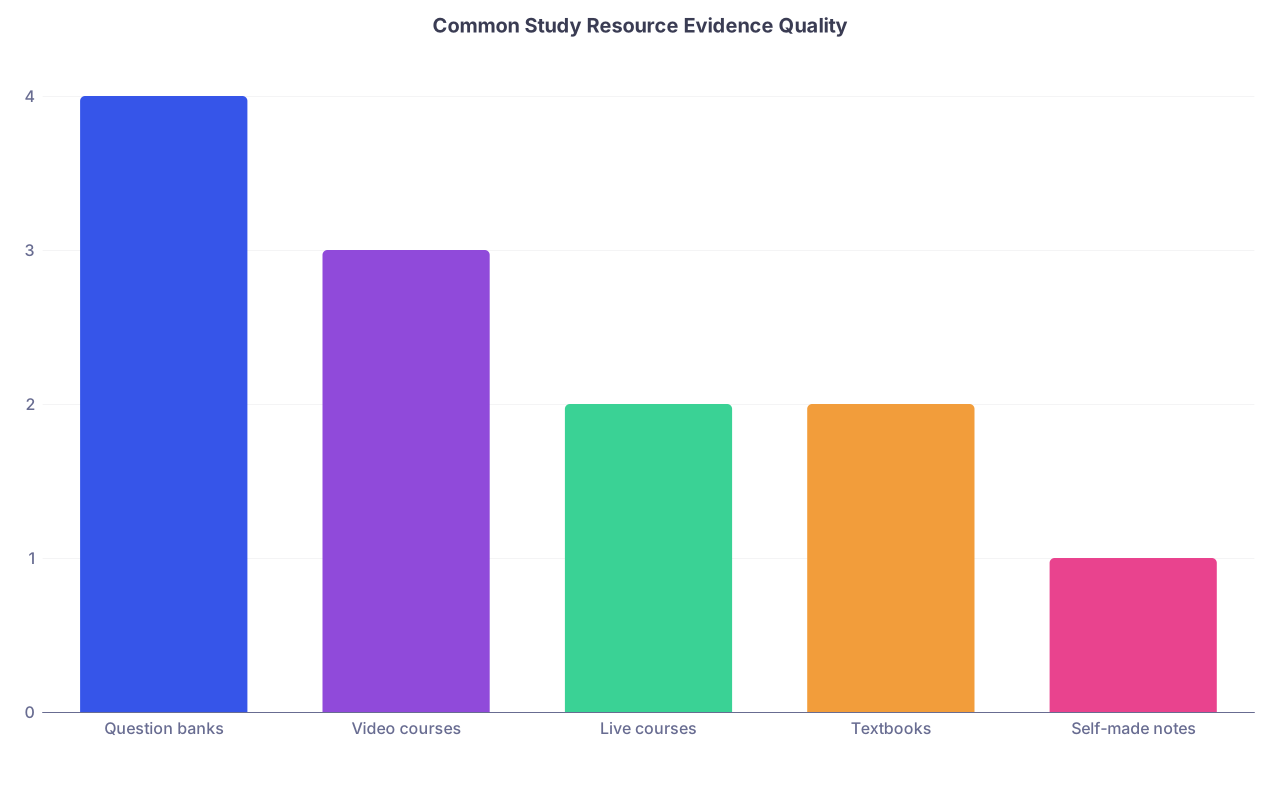
| Category | Value |
|---|---|
| Question banks | 4 |
| Video courses | 3 |
| Live courses | 2 |
| Textbooks | 2 |
| Self-made notes | 1 |
Legend (implied): 4 = strongest relative evidence, 1 = weakest. None of this hits “high-quality RCT” territory.
There are some themes that show up again and again across specialties (IM, EM, Peds, Anesthesia, Surgery):
- Number of high-quality practice questions completed correlates strongly with passing
- Consistent, distributed study over months beats last-minute cramming, regardless of resource
- Diagnostic assessments + targeted remediation help, whether they come from a “big-name” brand or your program’s own materials
- Learner engagement and time-on-task predict outcomes far more than specific logo on the front of the course
When people dig into predictive factors for passing boards, brand rarely survives multivariable adjustment. Study behavior does.
I have literally sat in meetings where a PD bragged about “our board review partnership,” and when we pulled the numbers, the biggest factor in pass rate improvement was… instituting a mandatory monthly in-training exam review conference. Not the branded package.
How Commercial Courses Sell You – And Where The Logic Breaks
Let’s dissect a few of the usual marketing claims.
“99% pass rate!”
This sounds impressive until you compare it to the baseline.
If the national pass rate for your exam is already 90–95%, a course boasting 99% means one of a few things:
- They’re counting only people who actually completed the whole product
- They’re selectively reporting subgroups
- They’re using self-reported “I passed!” emails, which exclude non-responders (guess who is less likely to reply)
- Or it’s basically within noise range of the baseline rate
If your baseline chance of passing is 93% and their paying customers pass at 96–99%, you need to ask: is that course effect, or is that just the kind of resident who buys an expensive, structured program? Because those people are usually more conscientious and motivated to begin with.
Selection bias, not magic.
“Our learners improved their scores by X points!”
Classic before–after trap.
Residents are older, more experienced, and more focused the second time they take an in-training exam or a self-assessment. They’ve seen board-style questions all year. They’ve matured clinically.
If you do any structured study – a question bank plus a decent review book – your scores will go up. The question is not, “Does this big-name course associate with improvement?” Of course it does. So does almost anything that forces you to study.
The question is, “Is this improvement larger than what I’d get from cheaper or simpler methods?” Almost nobody publishes that comparison.
“Developed by leading experts!”
So is UpToDate. So are many textbooks. So are free or low-cost question banks. Being an expert doesn’t automatically make your course uniquely superior; it just makes it credible enough to charge a premium.
What matters more: is the content board-aligned, updated, and high-yield? Many mid-tier or even small players do this just as well, without the hype.
What Actually Predicts Passing (Across Specialties)
Across internal medicine, pediatrics, EM, anesthesia, and surgical boards, there’s a pattern. When programs or researchers run regression models, the same variables keep popping up:
- Prior test performance (USMLE/COMLEX, in-training exam scores)
- Number of practice questions completed
- Consistent, longitudinal study (months, not weeks)
- Engagement with explanations (not just clicking through)
- Baseline knowledge gaps identified early and remediated
- Adequate sleep and scheduling space to actually study
Brand of the course? Rarely even measured, and when it is, usually non-significant after controlling for the rest.

I’ve seen residents pass using:
- Just UWorld or Rosh plus a topic outline
- Only the free questions from boards or specialty societies and a used review book
- Self-made Anki decks built off guidelines and in-training weaknesses
I’ve also seen people fail after dropping $1,500+ on brand-name live courses, multiple question banks, and video subscriptions. Their problem wasn’t “wrong brand.” It was “inconsistent, fragmented use” and “no honest feedback on weaknesses.”
Where Big-Name Board Courses Do Help
Now, let’s be fair. There are specific situations where the big-name courses can be genuinely useful – not because the logo is magical, but because of the structure they impose.
You need external structure and accountability
Some residents are exhausted, disorganized, or frankly burned out. The idea of building their own plan from scratch is laughable.
For those people, a pre-built syllabus with:
- Daily/weekly study schedules
- Clearly defined content blocks
- Embedded question sets
- Reminders and progress tracking
can be the difference between “I kind of want to study” and “I actually studied.”
You’re not buying content. You’re buying scaffolding.
If you know you don’t self-organize well, a big course that forces a plan on you can be worth actual money. Placeholder: any structured program (even if your program builds one internally) can serve this role. It doesn’t strictly have to be a commercial giant.
You are a repeat test taker
For repeat failures or those who barely passed in-training exams, some programs require a formal commercial course. Sometimes that works, not because that course is uniquely powerful, but because:
- It triggers dedicated study time or leave
- It comes with performance analytics to show where you’re getting crushed
- It reassures PDs and boards that “we did something formal”
In that context, a big-name review can be a politically useful tool, even if academically there are cheaper ways to achieve the same outcome.
Live courses as psychological reset
I’m not going to dismiss the psychological benefit. A 3–5 day intensive live course, away from the hospital, with other anxious residents, can function as a reset switch. People leave thinking, “OK, I can do this.”
Is that necessary for learning? No. But the mental reframing can be valuable if you’ve been stuck in avoidance mode.
Just don’t confuse “I feel better” with “this course single-handedly saved my board score.”
Where Big Courses Are Overrated or Flat-Out Inefficient
Here’s where I get more blunt.
Passive video bingeing is terrible yield
Residents love to feel productive by streaming hours of video lectures. They “watch at 1.5x” and convince themselves it’s efficient.
The research on learning says otherwise. Passive listening yields much less durable retention than active recall and spaced retrieval. In board prep language: questions beat videos almost every time.
If your brand-name course is 80% video and 20% questions, and you follow their default (watch everything, do a few questions), you’re on a slow train.
You’d be better off doing 3,000–5,000 solid questions with deep review, plus a concise text for gaps.
Content bloat and misalignment
Many courses cram in way more material than the blueprint emphasizes. Why? Because saying “we cover absolutely everything” sells better than “we ruthlessly cut low-yield fluff.”
Boards follow relatively stable blueprints. Good prep respects that. Many big players, trying to satisfy every attending on the faculty roster, end up overweighting pet topics and rare zebras.
Your time is finite. Over-coverage is a hidden cost.
Diminishing returns beyond one solid primary resource
Once you have:
- One good question bank
- One concise summary source (review book, guideline summary, or tightly focused video series)
- A realistic study schedule
the marginal gain of layering a second full “big” course on top is tiny. And often negative, because it fragments your effort.
You’re not short of content. You’re short of time and focus.
| Approach | Typical Outcome |
|---|---|
| One Q-bank + tight review source | High yield, sustainable |
| Two Q-banks, no schedule | Busywork, inconsistent |
| Big video course only | Feels productive, low retention |
| Big course + targeted Q-bank | Good if used with discipline |
| DIY schedule + free/cheap resources | Works well if honest and consistent |
How To Decide If a Big-Name Course Is Worth It For You
Here is the grown-up way to think about this, not the herd-resident way.
Step 1: Brutally assess your baseline
Your last in-training score, past standardized test history, and current clinical workload matter more than reviews on Reddit.
- Strong prior test taker, decent ITE, average anxiety levels, stable rotation schedule → You probably do not need an expensive flagship course.
- Borderline ITE, history of struggling on standardized exams, chaotic schedule, poor self-organization → You might benefit from structured commercial help if your program cannot or will not provide it.
Step 2: Define the job description of your primary resource
What do you actually need?
- Question exposure and pattern recognition? → Q-bank is non-negotiable.
- Conceptual understanding of weak areas? → Targeted, not global, video or text.
- Accountability and structure? → A course with built-in schedule, not just loose content.
Then pick tools that match those needs, not tools that happen to have the loudest marketing or biggest name.
Step 3: Protect time first, then spend money
A $1,500 course with no protected time is worse than a $200 Q-bank plus a sane schedule you actually follow.
If you can negotiate lighter rotations before the exam, or dedicated study weeks, that will move your score more than simply adding another branded product.
The Uncomfortable Truth For Programs
Programs love big-name partnerships because:
- It looks good to the ACGME and hospital leadership
- It offloads responsibility: “We bought them the gold standard course; not our fault if they failed”
- They can use it as a checkbox intervention for struggling residents
But many of those same programs never:
- Track how residents actually use the material
- Correlate specific usage patterns with pass/fail outcomes
- Compare results before and after switching resources in any controlled way
So they spend tens of thousands of dollars per year on something they “feel” is good.
If we held educational interventions to the same standard we pretend to apply in evidence-based medicine, a lot of these default contracts would not survive.
The Bottom Line
Big-name board review courses are not a scam. Many are well-constructed, thoughtfully curated, and genuinely helpful for certain types of residents.
But superior by default? No. Necessary to pass? Absolutely not.
If you poured the average resident’s course budget into:
- One high-quality Q-bank
- One concise review text or focused video collection
- A realistic 3–6 month study schedule
- A couple days of protected time before the exam
you’d match or exceed the outcomes of most “premium” packages in the real world.
Stop worshipping the brand. Start respecting the method.
FAQ
1. If I can only afford one resource, should it be a question bank or a big-name course?
A good question bank, almost every time. The evidence is much stronger for active practice questions than for passive lecture watching. Complete the entire bank, review explanations deeply, and tie what you learn to guidelines and key concepts. If you still feel lost in certain domains, add a focused, cheap secondary resource for those specific gaps rather than a massive general course.
2. Are live in-person board review courses worth the travel and time off?
They can be, but not because they’re uniquely educational. The main benefit is immersive focus: you’re away from the hospital, thinking about nothing but boards. If you’re already disciplined and can recreate that focus at home with dedicated time, you don’t need a live course. If your program will pay and you’re a chronic procrastinator, it might nudge you into actually engaging with the material. Just do not treat the course alone as sufficient—follow it with heavy question-based practice.
3. I failed my boards once. Do I have to buy a big-name course for my second attempt?
Not automatically. What you need is an honest autopsy of why you failed: low question volume, poor test-taking strategy, unmanaged anxiety, language issues, or major knowledge gaps. Sometimes a structured course helps address those; sometimes it just repeats what you already did, but more expensively. If your prior prep was unstructured or extremely light on questions, fixing that may give a larger return than simply adding a branded course. If your program requires a commercial course, use it strategically rather than passively.
4. How many total questions should I aim for before boards?
For most major specialties, somewhere in the 3,000–5,000 range of high-quality, exam-style questions is reasonable. The exact number matters less than how you use them: do them over months, not weeks; review explanations carefully; track patterns in your misses; and circle back with spaced repetition. Doing 2,000 questions well beats rushing through 6,000 with shallow review. If your schedule is brutal, prioritize depth over raw count.