
The idea that “everyone passes the boards” is fiction. A comforting story residents tell each other to stay sane. But if you look at the data—and I mean actual pass rates, specialty by specialty—the picture is very different.
Some specialties fail 5–10% of first-time takers. Every single year. Others are higher. That’s not “everyone.”
Let’s walk through what really happens with board exams in residency, why some people get blindsided, and which reassuring slogans you should stop believing now.
Myth #1: “Everyone passes the boards from our program”
I’ve heard PDs say this on interview day with a straight face: “Everyone passes the boards from our program.” Then you talk to a PGY-3 at 2 am on night float and get the real story: “Yeah… except those two people last year. And the one the year before.”
Programs love to quote “ultimate pass rates” because it sounds great on slides. But ultimate pass rate means: “Eventually passed after multiple attempts.” You do not want to be the “eventually.”
Look at the actual first-time pass rates where they’re published:
| Exam Type | First-Time Pass Rate |
|---|---|
| ABIM Internal Medicine Cert | ~90–93% |
| ABFM Family Medicine Cert | ~95% |
| ABP Pediatrics Cert | ~85–90% |
| ABS General Surgery Qualifying | ~80–85% |
| ABEM Emergency Medicine Cert | ~90–92% |
Those numbers vary year to year and by subgroup, but they’re nowhere near 99–100%.
The game PDs play is subtle:
- They talk about ultimate pass rate, not first-time.
- They talk about “graduates”, but quietly push out weak residents before graduation so they don’t count in the stats.
- They cherry-pick cohorts: “Of our categorical residents who completed our full training, our pass rate is…”
So no, “everyone passes” is false, even in good programs.
A more honest statement would be: “Most residents in reasonably functioning programs pass if they engage with a structured study plan and do not ignore red flags.” That’s not nearly as comforting, but it’s true.
Myth #2: “If you’re not a disaster, you’ll be fine”
The bar is not “don’t be a disaster.” The bar is: be consistently competent in a compressed time frame, on top of a brutal work schedule, while taking care of real patients and maybe having a life.
I’ve seen residents who:
- Scored >250 on Step 1
- Did fine on IM shelf exams
- Were “average” in residency
…and then failed their boards.
Why? Because residency performance and test performance are related but not identical. The resident who presents flawless plans on rounds might:
- Never do questions because they “learn better from patients”
- Rely on UpToDate snippets instead of systematic review
- Let fatigue and call schedules derail any kind of structured studying
Contrast that with the quieter PGY-2 who:
- Does 40–60 questions a week, every week
- Tracks their weak areas and deliberately remediates
- Uses ITE scores as a personal dashboard, not an ego test
Guess which one usually passes easily?
Programs sometimes reinforce this myth: “If you show up, work hard, and take care of patients, you’ll be fine on boards.” That sounds noble. It’s also misleading. Being a good resident and being a good test-taker overlap, but they’re not the same skill set.
Myth #3: “The in-training exam doesn’t matter”
Residents love to say this. “ITE doesn’t matter, it’s just formative.” Faculty say it too, often because they don’t want to panic people.
Reality: ITE is not everything. But it’s not nothing.
For many specialties, there’s a very clear correlation between ITE percentile and board pass rates. It’s not perfect, but it’s strong enough that most program directors use ITE as their main early warning sign.
Here’s the pattern I’ve seen multiple times:
- PGY-1: 15th percentile on ITE
- PGY-2: 18th percentile
- PGY-3: 22nd percentile, everyone shrugs — “you’re improving!”
- Certification exam: fail by a narrow margin
The issue isn’t that 20th percentile means you’re doomed. The issue is that coasting at the bottom without a serious intervention keeps you in the danger zone.
Let’s make this concrete:
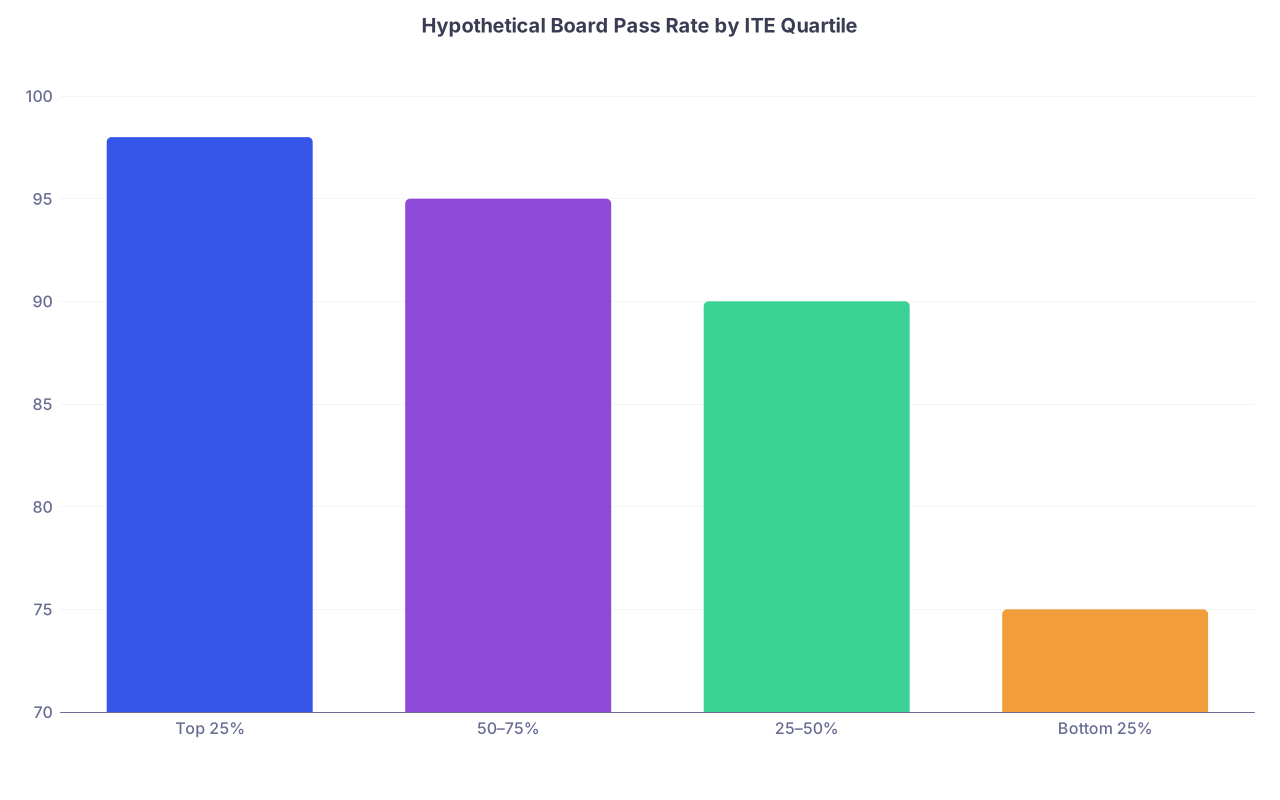
| Category | Value |
|---|---|
| Top 25% | 98 |
| 50–75% | 95 |
| 25–50% | 90 |
| Bottom 25% | 75 |
These are illustrative numbers, but they match what many specialty boards and PDs report informally: If you live in the bottom quartile and do nothing differently, your failure risk is very real.
What you should do instead:
- Treat each ITE as a data point, not a judgment on your worth.
- Compare your score to national norms, not just your program.
- If you’re under ~35th percentile, assume you need a deliberate study plan, not “I’ll read more UpToDate.”
ITE does not go on your CV. It does, however, predict whether you’re going to be staring at a failure screen when your certification score report drops.
Myth #4: “I’ll really start studying PGY-3… once life calms down”
Life does not “calm down” in PGY-3 or PGY-4. It just shifts shape.
As a PGY-1 you’re drowning in pages and new responsibilities. As a PGY-2 you’re running the team. As a senior you’re managing juniors, chiefs, fellowship applications, maybe a relationship, maybe kids, maybe moonlighting.
Procrastinating board prep to your last year of residency is a classic way to end up in trouble.
Typical bad plan:
- PGY-1: “I’m just trying to survive. I’ll worry about boards later.”
- PGY-2: “This year is so much busier than I thought. Next year I’ll do a QBank.”
- PGY-3: “I’ll take a 4-week elective and cram… oh wait, I’m chief / applying to fellowship / burnt out.”
Then what actually happens is three stressed-out weeks of full-time panic studying… on top of Q4 call and a newborn.
A simpler, less dramatic plan works 10x better:
- Start with low but consistent question volume PGY-1. Even 10 questions a day, 5 days a week.
- Use rotations as anchors: ICU month → hammer ventilator, shock, and sedation questions. OB month → hypertensive disorders, hemorrhage, etc.
- Treat exam year (PGY-3 or 4) as refinement and consolidation, not first-time exposure.
To visualize the difference:
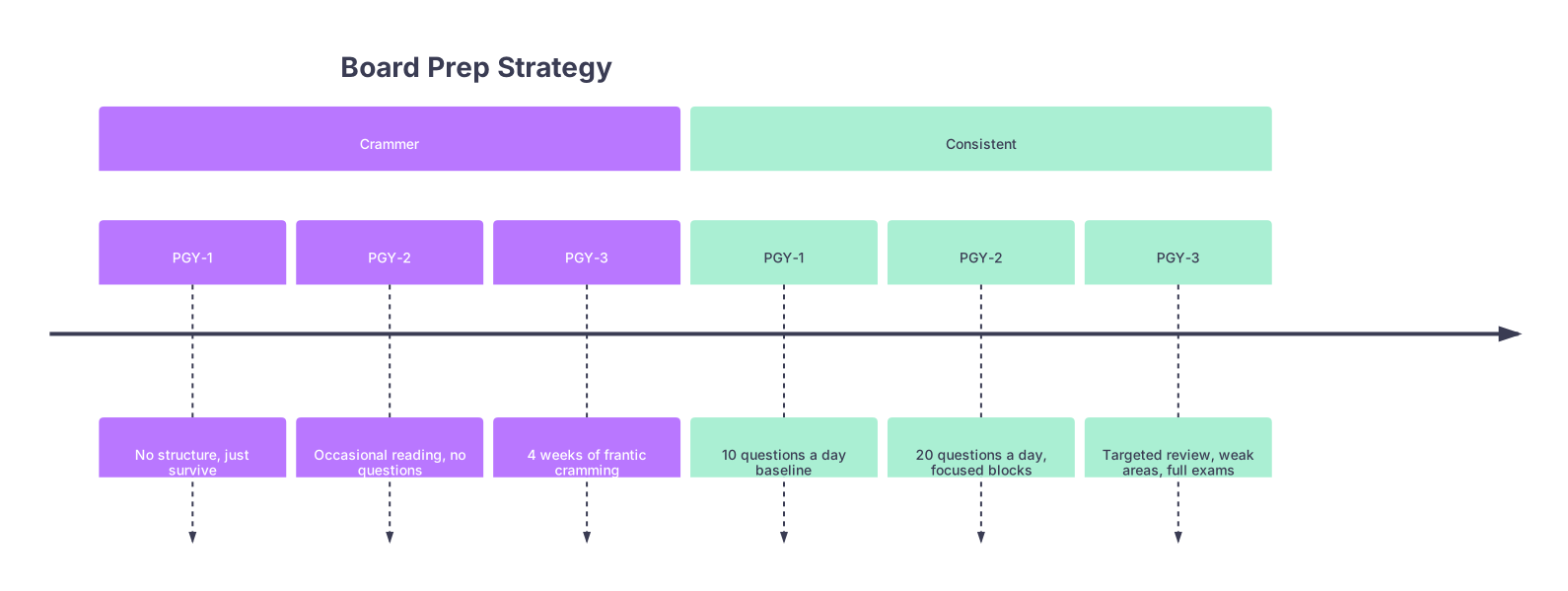
| Period | Event |
|---|---|
| Crammer - PGY-1 | No structure, just survive |
| Crammer - PGY-2 | Occasional reading, no questions |
| Crammer - PGY-3 | 4 weeks of frantic cramming |
| Consistent - PGY-1 | 10 questions a day baseline |
| Consistent - PGY-2 | 20 questions a day, focused blocks |
| Consistent - PGY-3 | Targeted review, weak areas, full exams |
One path feels “easier” in the moment and is much more likely to end with a failing score. The other looks harder on paper but is massively less painful long term.
Myth #5: “Good clinicians don’t need to grind QBank questions”
This one sounds romantic. “I focus on being a good doctor, not a test-taking machine.” I’ve heard attendings brag about never doing questions. Residents pick that up and wear it like a personality trait.
Here’s the blunt truth: Most board exams now are heavily QBank-style. Vignettes. Pattern recognition. Management decisions with specific thresholds. You cannot just “reason your way” through questions if the style is unfamiliar and the recall demands are high.
Being a good clinician absolutely helps, because:
- You’ll have better illness scripts.
- You’ll understand why management decisions are made.
- You’ve seen how guidelines play out in real life.
But the exam will still:
- Test management nuances you rarely see (zebras, guideline edge cases).
- Punish non-specific time-wasting on each question.
- Expect you to know exactly what they’re asking for in their particular language.
So yes, you need to grind questions. Not 8 hours a day. But consistently, in a way that trains:
- Test-taking pace and endurance.
- Recognition of common distractor patterns.
- Translation of clinical intuition into board-style answers.
Residents who intentionally avoid questions because they think it’s “beneath them” are the ones I see most shocked by their scores.
Myth #6: “If I fail, I’ll just retake—no big deal”
Failing boards isn’t the end of your career. But it’s not a small thing either. People downplay the consequences because it’s terrifying to think about them honestly.
Concrete costs of failing:
- Money: Exam fees, QBank subscriptions, sometimes unpaid time off to remediate.
- Time: You’re studying intensely during your early attending years or late residency instead of building skills, income, or sanity.
- Reputation and stress: Programs and partners do notice. Even if they’re nice about it, you’ll feel the pressure.
And structurally:
- Some jobs and hospital credentials require board certification within X years of training. Multiple failures can start to close doors.
- If you’re in a competitive subspecialty, fellowship or group practices may quietly prefer board-certified candidates.
- Visa holders can face extra complications tied to certification timelines.
I’ve seen a new attending take unpaid leave from their first job to study for a retake. I’ve seen residents pushed into “research years” that were really remediation years. None of this is career-ending, but calling it “no big deal” is delusional.
Myth #7: “This is all about intelligence; I either have it or I don’t”
Residency culture still worships raw intelligence. Step 1 scores, “gunner” reputations, fast talk on rounds. People internalize the idea that board performance is some pure reflection of brainpower.
It’s not.
Once you’re in residency, the variance in raw intelligence is not that huge. The variance in:
- Study habits
- Sleep
- Burnout
- Mental health
- Program support
- Life chaos (kids, illness, finances)
…is massive.
If you insist on making this about inherent ability, you’ll miss the levers you can actually pull:
- Designing a realistic study schedule that fits your life, not your fantasy.
- Cutting low-yield “studying” (passive reading) and doubling down on high-yield (questions + explanations + spaced review).
- Getting evaluated early: using ITE, QBank percent-correct, and practice exams as real metrics.
- Asking for help from PDs or mentors instead of hiding.
People with “average” standardized test histories pass boards all the time with solid process. People with “genius” Step scores fail when they assume they’re immune.
What Actually Works: Boring, Unsexy, Effective
Since I’m ripping myths apart, here’s the pattern I’ve seen in residents who pass comfortably without wrecking their lives.
They usually:
- Start some form of board prep early (PGY-1), but at low intensity.
- Use one primary QBank and actually finish a large chunk of it (60–80%) in timed, mixed mode.
- Build a personal “error log” or notebook for concepts they repeatedly miss.
- Let their clinical rotations dictate content focus, not random chapters.
- Take at least 1–2 full-length practice exams under simulated conditions in their exam year.
- Treat ITE scores as feedback, not identity.
And they do all of that imperfectly. With missed weeks, bad rotations, and stretches of burnout. But they keep coming back to the plan instead of pretending the exam doesn’t exist.
To put the contrast simply:

The myth-resident says: “Everyone passes, I’ll be fine. I’ll really study next year.”
The boring winner says: “Future me will be exhausted and busy. Let me make things 20% easier on them, starting now.”
Final thought
Years from now, you’ll barely remember the exact score you got on your boards. What will stick—and what quietly shapes your career—is whether you treated hard realities like grown-up problems to be managed, or fairy tales to be ignored.
Stop telling yourself “everyone passes.” Start acting like your pass is not guaranteed, but very much earnable.