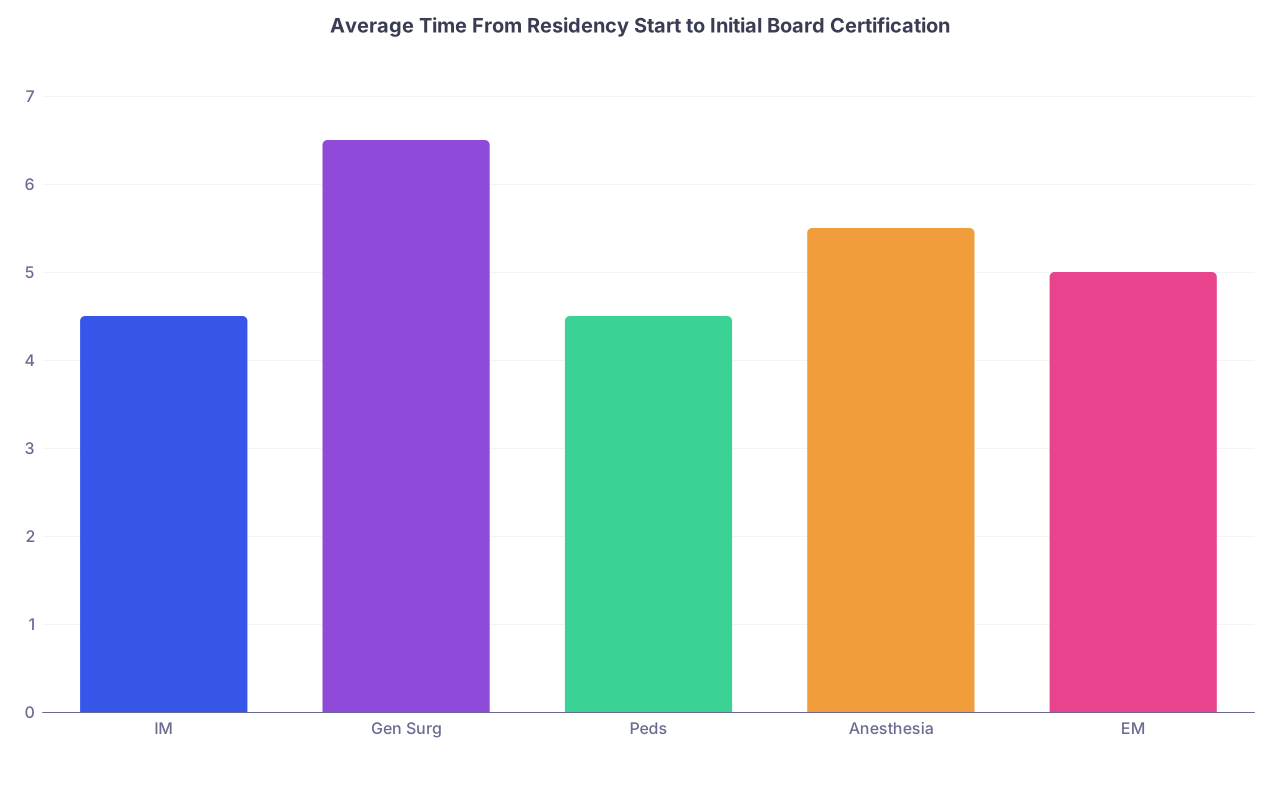
Here's the answer you're looking for: during heavy clinical rotations, your true daily study capacity is somewhere between 1.5 and 3.5 hours. Not eight. Not the heroic 12-hour grind sessions from study-with-me videos filmed during dedicated. If you plan around a fantasy number, you'll fail your plan daily, feel terrible about it, and burn out before test day. If you plan around your real number, you'll make steady, compounding progress.
The problem was never discipline. It's math. Let's do it properly.
The Reality of Rotation-Era Studying: Why Gross Study Time Fails
To avoid common pitfalls during busy months, review Board Prep Traps: 10 Study Habits That Sabotage Busy Residents before building your daily calendar.
Before you restructure your daily calendar, review how Master Your Board Exam Prep: Create an Effective Study Schedule approaches setting realistic baseline goals.
The 14-hour study day during rotations is a myth, and it's a harmful one. On my surgery service, the day looked like this: up at 4:45, pre-rounds at 5:30, OR by 7:00, lucky to leave by 6:30 PM. Where exactly do 14 study hours fit in that? They don't. I've watched third-years haul a 600-page review book into the OR lounge and crack it open exactly zero times in eight weeks. The book isn't a study tool. It's luggage.
So let's define two terms that will run this entire article:
For residents struggling to keep pace, I'm Always Behind on Board Prep: Is Everyone Else Really Studying More? offers valuable perspective on realistic benchmarks.
- Gross Study Time, the hours you block off on a calendar. "I'll study from 7 to 10 PM." Three hours. Looks great on paper.
- True Cognitive Capacity, the hours in which your brain can actually encode, retrieve, and consolidate new information.
The gap between those two numbers is where most board study plans die. Because by 7 PM on a heavy rotation, you've already made hundreds of micro-decisions: dosing adjustments, presentation phrasing, pages from nursing, a difficult conversation with a patient's family. Your prefrontal cortex is cooked. Decision fatigue is real, and it doesn't care how motivated you are.
Then there's post-call exhaustion, which isn't ordinary tiredness, it's a measurable cognitive impairment. And the administrative tax: progress notes, discharge summaries, duty hour logging, the email from your clerkship coordinator. All of it consumes the same mental bandwidth you'd otherwise spend on UWorld.
You know the feeling. You read the same question explanation four times and retain nothing. Your eyes move. Nothing sticks. That's not studying. That's self-punishment with extra steps.
The Decision Framework: Calculating Your Baseline Daily Capacity
Here's the formula, then we'll walk it step by step:
True Daily Capacity = (24 - Fixed Commitments) × Cognitive Availability Factor
Step 1: Tally your fixed daily commitments
To help structure your limited hours effectively, consult Mastering Residency Board Exams: 10 Essential Study Techniques for high-yield strategies.
Write down, honestly, what every weekday actually costs you:
- Sleep: 7-8 hours. Non-negotiable, and we'll come back to why.
- Clinical hours: Be brutally honest. Include pre-rounding, sign-out, and the "quick note" that eats 40 minutes.
- Commute: Door to door, both ways.
- Life admin: Food, shower, dishes, the text back to your mom. Usually 1-1.5 hours.
Worked example, inpatient wards: 24 - 7.5 (sleep) - 11.5 (work) - 1 (commute) - 1.5 (life) = 2.5 raw hours. That's your gross time. We haven't applied the fatigue penalty yet.
Step 2: Map your peak cognitive hours
Not all hours are equal. An hour at 6 AM when you're sharp is worth two at 9 PM when you're mush. For one week, rate your mental sharpness from 1-10 at a few fixed points: 6 AM, 10 AM, 2 PM, 6 PM, 9 PM. You'll find your windows fast, most people have one strong peak and one serviceable secondary window. Reserve Q-bank blocks and new content for the peak. Passive review goes in the trough.
Step 3: Apply the fatigue penalty
This is the step everyone skips. Multiply your raw hours by a factor based on rotation intensity:
- Outpatient / elective: 0.85-0.9
- Inpatient wards / pediatrics: 0.6-0.75
- Surgery / OB / ICU: 0.4-0.6
- Night float / post-call: 0.3-0.5
Back to our wards example: 2.5 hours × 0.7 = 1.75 hours of true capacity. About 100 minutes. That might feel discouraging. It shouldn't. It's the first honest number you've worked with.
Practical Application: Maximizing Micro-Capacity Windows
Once you accept that your capacity is small, the game changes. You stop chasing big blocks and start harvesting scraps. This is where the residents who finish strong actually win.
Convert dead time into Anki time. The 15 minutes after rounds while your attending chats. The 20 minutes waiting for the OR to flip. The back half of lunch. I've seen residents clear 150 due cards in a day without ever sitting down at a desk, just relentless 10-minute bursts on their phones.
Your commute is a study session. Audio question banks and board review podcasts turn a 30-minute drive into 5 hours of passive review per week. That's not nothing. That's roughly a full extra study day, hidden inside time you were already losing.
Match the task to the fatigue level. This matters more than any other tactic in this article:
- Fresh brain: active recall, timed Q-bank blocks, new material.
- Tired brain: Anki due cards, re-reading your own annotations.
- Fried brain: audio only, or nothing. Genuinely nothing is sometimes the right call.
Set targets that can't break you. On heavy rotations, 10-20 Q-bank questions plus your daily Anki reviews is a legitimate win. Ten questions a day, every day, beats 80 questions in a Sunday panic, and it's not close. Consistency is the entire ballgame during rotations.
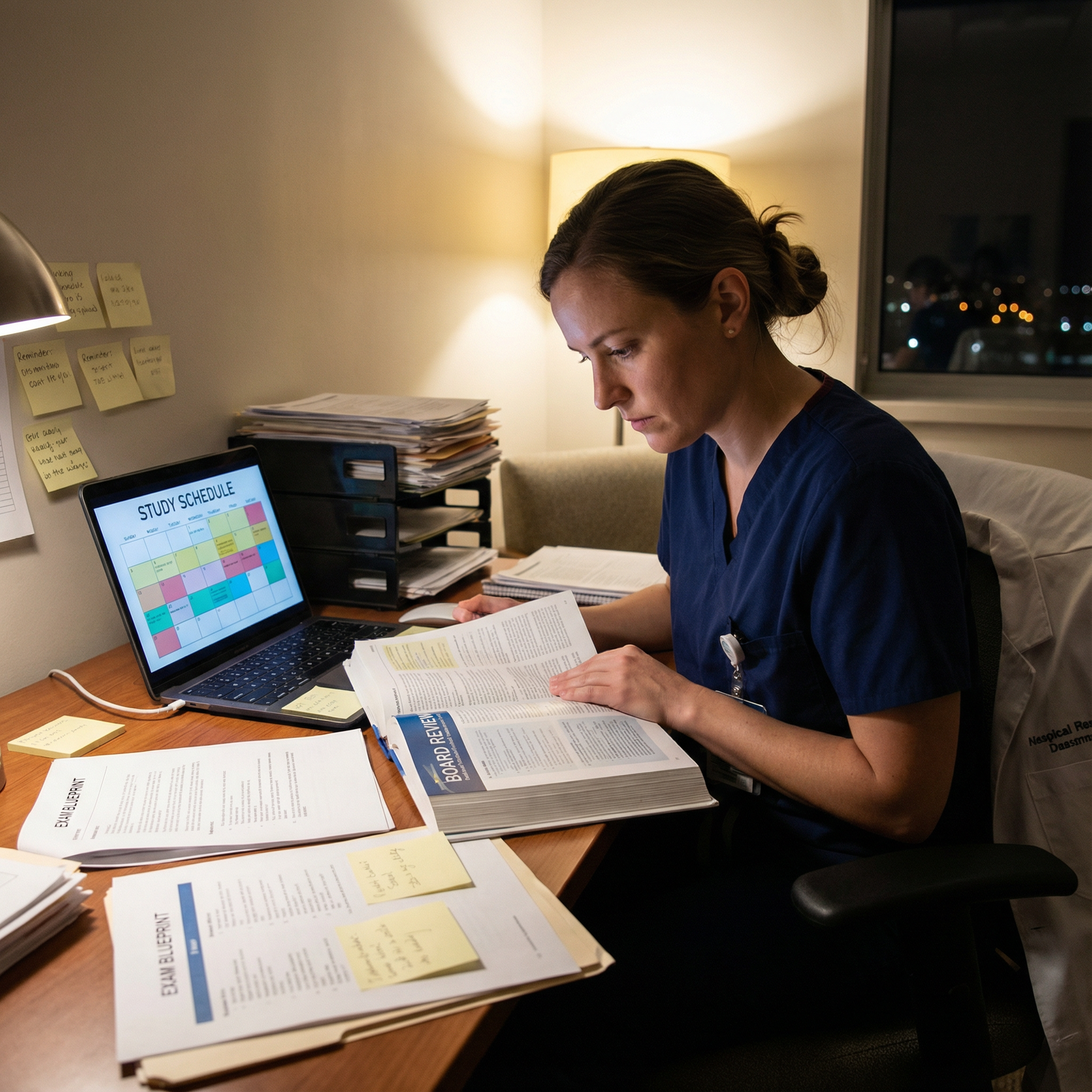
Adjusting Your Plan: Rotation-Specific Capacity Adjustments
Your study plan should breathe. Fixed daily quotas across an entire year of rotations is a guaranteed failure design. Adjust by service:
Surgery and OB/GYN, maintenance mode only. Your capacity is 1-1.5 hours on a good day. Keep your Anki streak alive, do 10 questions, and protect sleep. Do not schedule practice exams during these months. You'll take one post-call, score 15 points below your baseline, and spiral into a confidence crisis that was entirely self-inflicted.
Outpatient and elective rotations, this is your bank. Four-plus hours of real daily capacity means these blocks are where you make your gains. Heavy content synthesis, full-length practice exams, big timed Q-bank blocks. Front-load your dedicated-style studying here, because you won't get another chance until actual dedicated.
Night float, flip deliberately, don't drift. The residents who suffer most on nights are the ones half-flipping their sleep schedule. Pick an anchor sleep block, the same core 4-5 hours every day, and build around it. Study in the late afternoon before shift, when you're freshest. Blackout curtains and a phone on do-not-disturb aren't luxuries here; they're load-bearing.
Protecting Your Capacity: Preventing Burnout Before Test Day
Two more rules. Both non-negotiable.
Respect the diminishing returns cliff. Past your cognitive threshold, retention drops to nearly zero. An extra hour of zombie-studying buys you almost nothing and costs you tomorrow's sharpness. Stopping when you're depleted isn't weakness, it's resource management.
Take one true rest day per week. Not a "light day." Off. No Anki, no questions, no guilt. Your hippocampus consolidates memory during genuine rest, and your motivation system needs the reset. I've watched far more board prep plans collapse from chronic overwork than from underwork. It isn't close.
Re-audit every two weeks. Rotations change, call schedules change, your number changes. Spend five minutes every other Sunday recalculating with the framework above. A plan calibrated to last month's schedule is already wrong.

Key Takeaways
- True study capacity during heavy rotations is 1.5-3.5 hours per day, not 8. Calculate yours: (24 - fixed commitments) × fatigue factor.
- Match study tasks to your fatigue level. Active Q-bank work when fresh, passive audio and Anki when tired, sleep when fried.
- Rotate your expectations by service. Maintenance mode on surgery and OB; aggressive progress on outpatient and electives.
- Consistent low-volume, high-yield studying beats sporadic marathons. Every time. It isn't close.