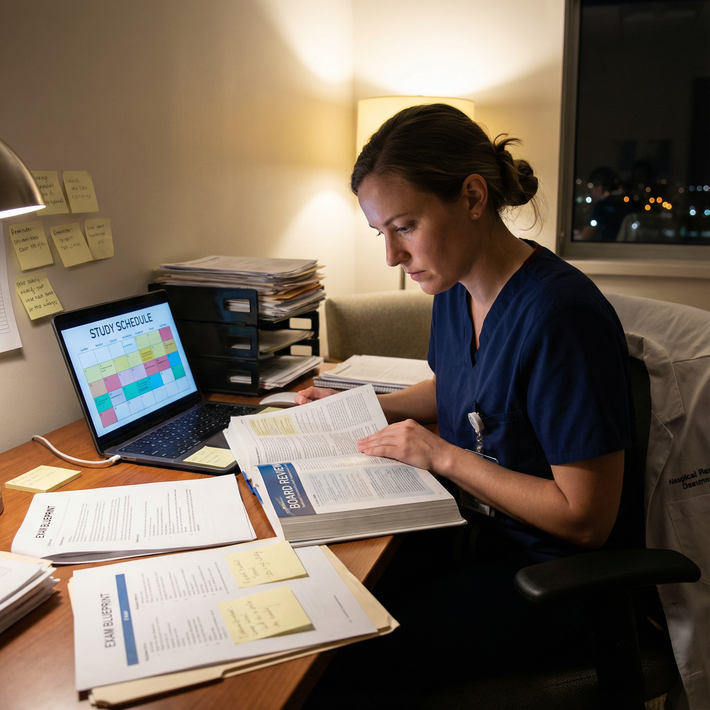
Preparing for residency board exams is one of the most demanding phases of medical education. Between long clinical hours, call shifts, and personal commitments, finding time and energy for focused board prep can feel overwhelming. Yet thousands of residents successfully navigate this challenge every year—not by studying more randomly, but by studying more strategically.
Below are ten proven, high-yield study techniques tailored specifically for residency board exams. These exam strategies integrate evidence-based learning science, real-world examples, and practical residency preparation tips to help you maximize your limited time, improve retention, and reduce anxiety.
1. Build a Realistic, Comprehensive Study Schedule
A well-designed study schedule is the foundation of any effective board exam strategy. It turns a vague intention—“I need to study more”—into a concrete, actionable plan.
Map the Big Picture First
Start by working backwards from your exam date:
- Determine your total available time: Count the weeks until the exam, then estimate realistic study hours per week considering your rotation schedule, calls, and days off.
- Identify major content domains: Use the exam blueprint from your specialty board (e.g., ABIM, ABFM, ABS, etc.) to see what topics are tested and in what proportion.
- Assign time proportionally: Allocate more study time to heavily weighted domains and to areas where you feel less confident.
Example structure for a 4-month study period:
- Months 1–2: Broad content review by system or topic (e.g., cardiology, pulmonary, GI)
- Month 3: Second pass of weak areas + intensified question practice
- Month 4: High-yield review, mixed question blocks, and 2–3 full-length mock exams
Translate the Blueprint into Weekly and Daily Plans
Break the long-term plan into weekly and daily goals:
- Weekly goals
- Example: “This week: complete cardiology + 150 cardiology questions + 1 mixed block.”
- Daily structure
- 1–2 hours: review content for a single topic/system
- 1–2 hours: targeted question blocks & review
- 30–60 minutes: spaced repetition (flashcards, notes)
Be specific: instead of “study cardiology,” write “review heart failure guidelines + valvular disease + 40 HF/valve questions.”
Why It Works
- Time management: Prevents last-minute cramming and ensures coverage of all key topics.
- Reduced cognitive load: You don’t waste mental energy deciding what to study each day.
- Lower stress: Having a plan makes progress visible and exam prep more manageable.
2. Use Active Recall as Your Primary Learning Tool
Active recall is one of the most powerful study techniques in medical education. Instead of re-reading notes or highlighting textbooks, you repeatedly test yourself to pull information from memory.
How to Implement Active Recall
- Question-first learning: Start with questions, not reading. Use question banks or self-made questions to identify gaps, then study around those gaps.
- Closed-book recall: After reading a section, close the material and:
- Write down everything you remember.
- Draw a diagram or flowchart from memory.
- Teach the concept out loud as if explaining to a junior resident or patient.
- Flashcards: Use apps such as Anki, Quizlet, or Brainscape with:
- One question or prompt per card
- Short, focused answers
- Clinical vignettes where possible
Example:
- Front: “First-line treatment for hemodynamically stable SVT?”
- Back: “Vagal maneuvers; if ineffective, IV adenosine (unless contraindicated).”
Why It Works
- Strengthens long-term memory: Retrieving information creates stronger neural connections than passive review.
- Mirrors exam conditions: You practice doing exactly what you’ll do on exam day—pulling information from your brain under pressure.
- Identifies weak spots: Immediate feedback highlights topics that need more work.
3. Harness Spaced Repetition for Long-Term Retention
Spaced repetition complements active recall by optimizing when you review information. Instead of cramming, you revisit material at increasing intervals to solidify it in long-term memory.
Practical Spaced Repetition Strategies
Use a spaced repetition platform:
- Anki’s algorithm automatically schedules cards right before you’re likely to forget.
- Create decks by system (e.g., “Renal,” “Infectious Disease”) and by priority (“High-Yield,” “Guidelines”).
Manual spacing if not using apps:
- 1st review: within 24 hours of first learning
- 2nd review: at 3–4 days
- 3rd review: at 1–2 weeks
- 4th review: at 1 month
Adjust based on your exam timeline.
Apply spacing to question bank errors:
- Maintain an “error log” or tagged set of missed questions.
- Revisit these questions or topics at regular intervals (e.g., weekly, then biweekly).
Example: After studying acute kidney injury today:
- Tomorrow: brief flashcard review
- Next week: short question block focused on AKI
- Two weeks later: mixed block including AKI cases
Why It Works
- Combats the forgetting curve: Timed reviews counteract natural memory decay.
- Efficient learning: You spend time where it has the greatest impact—just before you forget.
- Ideal for busy residents: Short, targeted review sessions fit into limited windows between clinical duties.
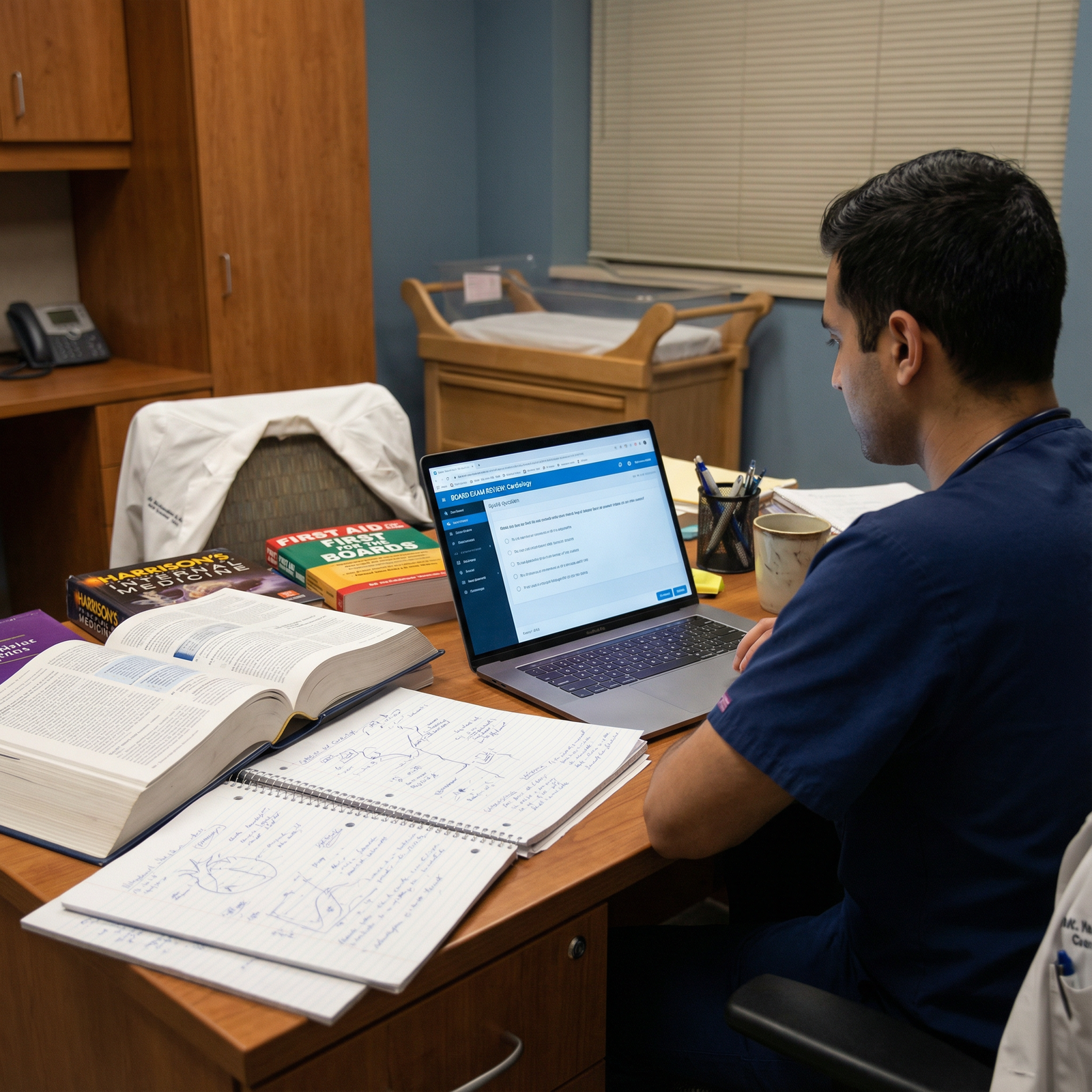
4. Master Practice Questions and Full-Length Mock Exams
High-quality practice questions are central to effective board exam preparation. They train your clinical reasoning, test-taking skills, and familiarity with the exam format.
Use Question Banks Strategically
- Choose 1–2 primary question banks:
Common options include UWorld, Kaplan, or specialty-specific banks. - Set performance-neutral expectations early:
Your initial percentage scores are diagnostic, not final. Use them to identify weaknesses, not to judge yourself. - Prioritize mixed and timed blocks as you progress:
- Early phase: topic-specific blocks (e.g., all cardiology).
- Later phase: mixed-system blocks under timed conditions to simulate the real exam.
Review Explanations Thoroughly
The learning happens in the review:
- For every question—right or wrong—ask:
- Why is the correct answer correct?
- Why are the other options wrong?
- What clinical clues in the stem pointed to the right diagnosis or management?
- Capture key takeaways:
- Add short bullet points to your notes or flashcards.
- Tag “must review” questions for spaced repetition.
Schedule Full-Length Mock Exams
Simulating the exam is a core exam strategy:
- Take at least 2–3 full-length practice exams:
- 1st: 6–8 weeks before exam, to baseline performance.
- 2nd: 3–4 weeks before exam, to guide final review.
- 3rd: 1–2 weeks before exam, to solidify test-day routine.
- Recreate exam conditions:
- Timed blocks
- Same or similar break schedule
- No phone or notes during blocks
Why It Works
- Familiarity with exam format reduces test anxiety.
- Builds mental stamina for multiple consecutive hours of concentration.
- Highlights knowledge gaps you might miss with passive studying.
5. Use Study Groups Intentionally (Not Randomly)
Study groups can be a powerful tool in residency preparation when used with structure and clear goals.
Design High-Yield Study Groups
- Keep the group small: 3–5 people is ideal.
- Set explicit expectations:
- Frequency: e.g., 1–2 sessions per week
- Duration: 60–90 minutes
- Focus: questions, concepts, or guidelines—avoid unfocused chatting
- Assign rotating roles:
- Moderator/timekeeper
- Topic presenter
- Question leader
This prevents one person from dominating and keeps sessions efficient.
High-Value Group Activities
- Case-based discussions:
- Each member brings 2–3 challenging cases from question banks or real clinical scenarios.
- The group walks stepwise through diagnosis, management, and guideline-based reasoning.
- Teach-back sessions:
- Each person teaches a specific topic (e.g., anticoagulation choices, sepsis management) in 10–15 minutes.
- Teaching reinforces your own understanding far more than passive listening.
- Guideline updates review:
- Divide new practice guidelines (e.g., heart failure, diabetes, sepsis) among members.
- Each person summarizes and presents high-yield points.
Why It Works
- Shared knowledge and diverse clinical exposure enrich understanding.
- Accountability: You’re less likely to procrastinate when others depend on you.
- Clarification of difficult concepts: Real-time discussion resolves confusion faster than solo study.
6. Leverage Visual Learning: Diagrams, Algorithms, and Mind Maps
Board exams test integration and pattern recognition. Visual aids help you connect and retain complex information more effectively.
Practical Visual Study Techniques
- Flowcharts and algorithms:
- Great for diagnostic pathways (e.g., evaluation of chest pain, DKA management).
- Keep them simple and color-coded.
- Mind maps:
- Put a central concept (e.g., “Hyponatremia”) in the middle.
- Branch into causes, workup, treatment, complications.
- Tables and comparison charts:
- Compare similar conditions (e.g., different vasculitides, types of shock, anemia patterns).
- Whiteboard sessions:
- Once a week, pick one difficult topic and draw the entire pathway from memory (e.g., RAAS system, coagulation pathway).
Example: For valvular heart disease, create a table with:
- Valve affected
- Murmur characteristics
- Maneuver changes
- Typical causes
- Key management points
Why It Works
- Condenses complex information into digestible formats.
- Engages multiple learning pathways (visual + spatial + verbal).
- Quick review tool during the final weeks of board exam preparation.
7. Integrate Clinical Rotations into Your Study Strategy
As a resident, your greatest asset is daily exposure to real patients. Use this as an extension of your exam preparation instead of seeing clinical work and board prep as separate worlds.
Turn Clinical Cases into Learning Opportunities
- Case-of-the-day method:
- Each day, choose one patient whose case puzzled you or was high-yield (e.g., STEMI, septic shock, AKI).
- That evening, read guidelines or review questions directly related to that case.
- “Why?” habit on rounds:
- When attendings make a management decision, ask yourself, “Would this show up on boards? What guideline supports this?”
- Later, look up the rationale and evidence.
- Link cases to guidelines and algorithms:
- If you admit a COPD exacerbation, review GOLD or specialty guidelines that night.
- If you manage a GI bleed, review risk scores and transfusion thresholds.
Use Teaching and Presentations as Study Tools
- Offer to present:
- Brief topic reviews on rounds (“5-minute teaching on DKA”).
- Noon conference cases with literature review.
- Use these as deadlines to master topics; teaching others imprints knowledge deeply.
Why It Works
- Contextual learning: Real patients give meaning to abstract facts.
- Better retention: You’re more likely to remember what you learned in the setting of a memorable clinical encounter.
- Bridges exam strategies and real practice, making your studying feel more relevant and less abstract.
8. Protect Your Performance with Intentional Self-Care
Board preparation during residency is a marathon layered on top of another marathon. Burnout directly impairs memory, focus, and exam performance.
Sleep as a Core Study Technique
- Aim for 7–8 hours when possible:
- On call-heavy rotations, protect at least a consistent minimum (e.g., 5–6 hours) on post-call and off days.
- Avoid all-night cram sessions in the final week; they undermine consolidation of memory.
- Use short naps strategically (20–30 minutes) during post-call or long days to restore alertness.
Physical and Mental Health Habits
- Micro-exercise:
- 10–20 minutes of walking, stretching, or bodyweight exercises most days.
- Even small amounts improve concentration and mood.
- Mindfulness and stress management:
- 5–10 minutes of breathing exercises, meditation, or prayer can help reset your nervous system.
- Apps like Headspace, Calm, or Insight Timer can guide short sessions.
- Boundaries and expectations:
- Share your exam date with your program and co-residents.
- When appropriate, negotiate lighter rotations or elective time closer to the exam.
Nutrition and Caffeine Use
- Stable energy:
- Favor balanced meals with complex carbs, protein, and healthy fats.
- Avoid excessive sugar crashes during long study sessions.
- Smart caffeine:
- Use caffeine to enhance focus, not to mask chronic sleep deprivation.
- Avoid large doses late in the day, especially during the final exam week.
Why It Works
- Optimizes brain function: Sleep, nutrition, and physical activity are non-negotiable for memory and focus.
- Reduces burnout and anxiety, making studying more sustainable.
- Improves test-day performance: A rested, calm brain will always outperform an over-caffeinated, exhausted one.

9. Prioritize Deep Conceptual Understanding Over Rote Memorization
While some memorization is unavoidable in board exams, over-relying on it can limit your ability to handle unfamiliar or complex clinical vignettes.
Study for Mechanisms and Relationships
- Ask “why?” repeatedly:
- Why does this disease cause these symptoms?
- Why is this treatment first-line?
- Why is this lab pattern characteristic?
- Connect basic science to clinical practice:
- Link pathophysiology to typical presentations.
- Relate pharmacology mechanisms to side effects and contraindications.
Example: Instead of just memorizing “ACE inhibitors help in heart failure,” understand:
- How they affect preload/afterload
- Impact on remodeling
- Renal effects and contraindications
- Why they’re superior (or inferior) to other options in specific scenarios
Use Clinical Frameworks
Develop mental frameworks for common board topics:
- Chest pain: Ischemic vs. non-ischemic vs. non-cardiac; use ABCDE (Acute life-threatening, Basic evaluation, Chronic causes, etc.)
- Shock: Hypovolemic, cardiogenic, distributive, obstructive—key hemodynamic patterns and treatments.
- Anemia: Low production vs. increased destruction vs. blood loss; use MCV + retic count.
These frameworks help you quickly orient in complex vignettes and narrow down diagnoses.
Why It Works
- Improves clinical reasoning, not just recall.
- Prepares you for novel question twists you haven’t seen verbatim in question banks.
- Enhances your actual practice, not just your test score—crucial for long-term success.
10. Review, Reflect, and Continuously Refine Your Approach
Your study plan should be a living document, not something you write once and ignore. Regular reflection helps you adapt and stay efficient.
Weekly Self-Assessment Ritual
Set aside 20–30 minutes once a week to ask:
- What worked well this week?
- Which study techniques helped most (questions, flashcards, group sessions)?
- Where did I struggle?
- Specific topics? Fatigue? Time management?
- What do my question bank stats show?
- Are there content domains consistently below your target accuracy?
- What will I change next week?
- Adjust time allocation, add or remove resources, schedule extra review of weak areas.
Track Progress Objectively
- Monitor:
- Question bank performance by system and overall
- Mock exam scores over time
- Number of completed questions vs. total goal
- Avoid obsessing over minor score fluctuations; look at trends over weeks, not days.
Final 2–3 Weeks: Fine-Tuning
- Shift focus from broad content learning to:
- Reviewing high-yield summaries (e.g., your personal notes, key tables).
- Revisiting your error log and weak topics.
- Doing mixed question blocks and practicing test-day pacing.
- Use lightweight review tools (flashcards, summary sheets) for tired days; preserve heavier tasks for when you’re more alert.
Why It Works
- Prevents plateauing by continually optimizing your strategies.
- Builds confidence as you see measurable improvement.
- Ensures alignment between your daily work and your ultimate goal: exam readiness.
FAQs: Residency Board Exam Study Techniques and Strategies
1. How many hours per day should I study for residency board exams?
The ideal amount varies with your baseline knowledge, rotation schedule, and time until the exam, but a common target is:
- On lighter rotations: 3–5 focused hours per day
- On heavy inpatient or call rotations: 1–2 focused hours on most days, with longer blocks on days off
- In the final 4–6 weeks: Aim for consistent daily engagement, even if some days are shorter
Quality matters more than raw hours. Two hours of fully focused, distraction-free studying using active recall and questions are more valuable than five hours of passive reading while fatigued.
2. When should I start serious board prep during residency?
A practical timeline for many residents:
- PGY-1 (late): Light exposure—get comfortable with question banks, review key topics from challenging rotations.
- PGY-2 (early to mid): Begin more structured studying, especially for knowledge-heavy specialties.
- 6–9 months before boards: Start a deliberate study schedule with regular question blocks and content review.
- 3–4 months before boards: Intensify focus—second pass of weak areas, frequent mixed question blocks, and mock exams.
If you’re closer to your exam date, don’t panic—adjust your strategy to focus on the highest-yield topics and question practice.
3. Are question banks more important than textbooks for board exam preparation?
For most residents, yes—question banks are more central for board exam success, while textbooks are best used as references:
Question banks:
- Train you to think in exam-style clinical reasoning.
- Teach patterns, common distractors, and typical board phrasing.
- Quickly expose weak areas through performance metrics.
Textbooks and reference resources:
- Useful for deep dives into stubborn topics.
- Best kept selective—avoid attempting full textbook cover-to-cover reading for board prep.
A balanced approach: use questions as your primary driver and textbooks/online references (e.g., UpToDate, guidelines) when explanations are unclear or when you encounter repeated weaknesses.
4. How can I stay motivated and avoid burnout during board preparation?
A few practical strategies:
- Set short-term goals: Daily and weekly milestones (e.g., “40 questions/day,” “finish pulmonary this week”) give frequent wins.
- Track progress visually: Use a checklist, calendar, or study tracker to see your completed tasks.
- Reward yourself: Plan small rewards after meeting goals (a favorite meal, an episode of a show, time with friends or family).
- Connect study to purpose: Remind yourself that this isn’t just about passing an exam—it’s about becoming a safer, more confident physician.
- Keep life in balance where possible: Protect time for sleep, relationships, and brief relaxation. Excessive sacrifice often backfires.
5. What should I do in the final week before the exam?
Focus on consolidation and readiness, not cramming:
Do:
- Light to moderate mixed question blocks with careful review.
- Review high-yield notes, algorithms, and flashcards.
- Practice your exam-day routine, including sleep and wake times.
- Confirm logistics (test center location, required documents, allowed items).
Avoid:
- Starting new, low-yield resources.
- Pulling all-nighters or radically changing your sleep schedule.
- Obsessively tracking question bank percentages day to day.
Use the last day or two for light review only, relaxation, and ensuring you arrive at the exam mentally and physically ready.
By combining these study techniques, exam strategies, and self-care habits, you can transform board preparation from a source of chronic stress into a structured, manageable project. With consistent effort, thoughtful planning, and smart use of your clinical experiences, you’ll be well-positioned to excel on your residency board exams and carry that knowledge confidently into your career.