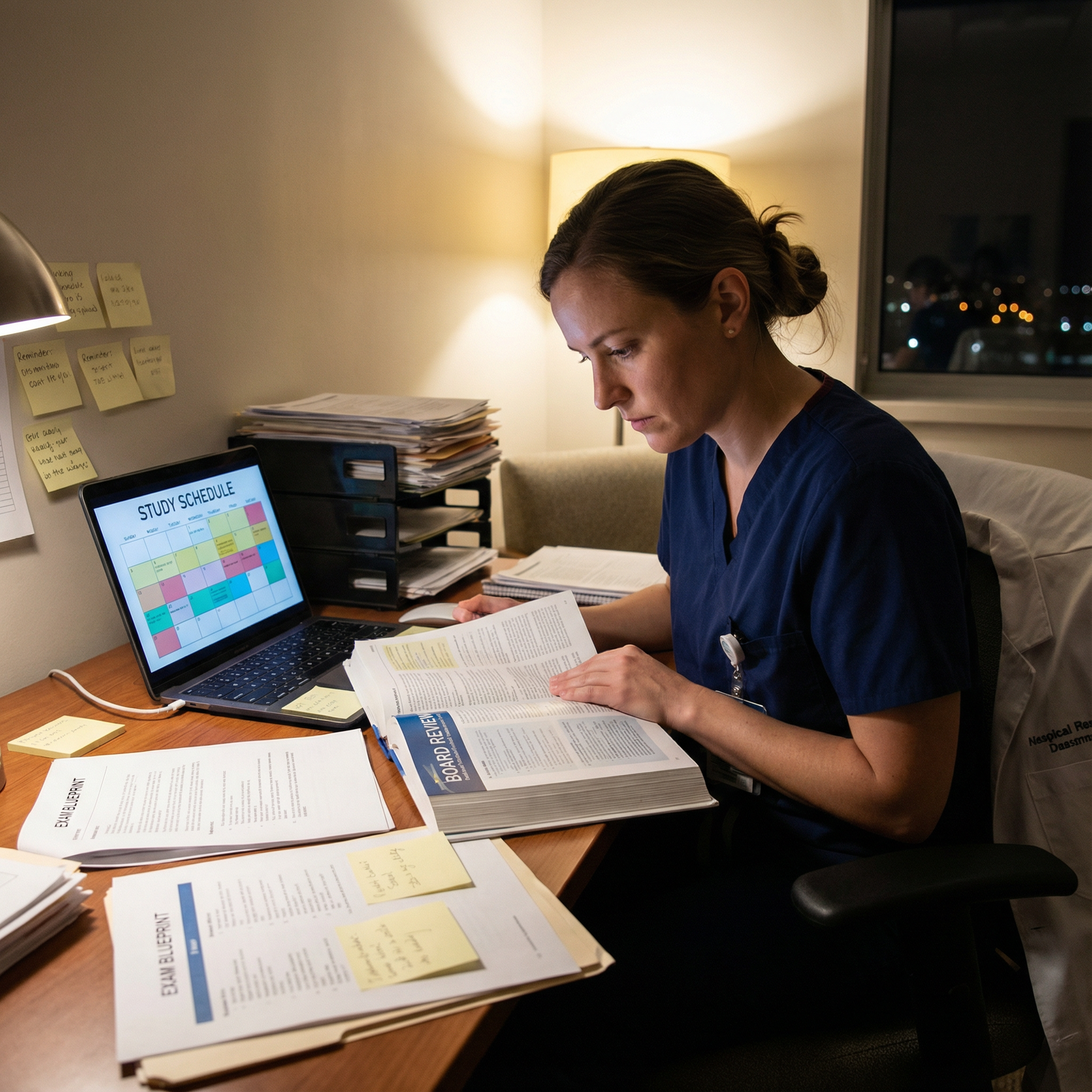
Why a Strategic Study Schedule Matters for Specialty Board Exams
The transition from residency to board-certified specialist is one of the most high-stakes phases of your medical education. Specialty board exams are designed to test not just memorized facts, but the clinical reasoning, pattern recognition, and judgment you use daily in practice.
In this intense period, a well-designed Study Schedule is more than a calendar—it’s a survival tool. It helps you make the most of limited time, balance work and life, and approach exam day with confidence instead of panic.
A strong study plan for Board Exams provides:
Organization and structure
It turns a vague intention—“study cardiology”—into specific tasks with deadlines and measurable progress.Effective Time Management
It ensures you systematically cover all high-yield content areas, rather than over-studying your favorite topics and neglecting weaker ones.Reduced anxiety and decision fatigue
When you’ve planned what to do each day, you spend less mental energy deciding where to start and more on actual learning.Customization to your reality
As a resident or fellow, your life is not predictable. A good schedule is flexible and built around call, rotations, and personal responsibilities.
The goal isn’t to create the “perfect” study schedule; it’s to build a realistic, sustainable, and adaptable exam preparation plan that fits your specialty, your life, and your learning style.
Step 1: Understand Your Exam Blueprint and Format
Effective exam preparation starts with clarity. You cannot build a high-yield Study Schedule until you know exactly what you’re preparing for.
Analyze the Exam Structure
Start with your specialty board’s official website (e.g., ABIM, ABEM, ABP, ABS, ABOG, ABFM, etc.). Look for:
Exam format
- Number of questions
- Duration and number of blocks/sessions
- Multiple-choice only vs. including:
- Oral exams (e.g., some surgical specialties)
- OSCE-style stations
- Case simulations or clinical decision-making modules
Scoring details
- Passing standard (scaled score vs. percent correct)
- Any penalties for guessing (most U.S. boards do not penalize)
Exam frequency and retake rules
- How often it’s offered (once vs. multiple times per year)
- Retake limitations if you don’t pass
Understanding these components informs how you study:
- Heavy MCQ format → prioritize question banks and timed blocks
- Oral exams → focus on case presentations, algorithms, and articulation of reasoning
- OSCE/simulation → emphasize systematic approaches and checklists
Break Down Exam Content Areas Using the Blueprint
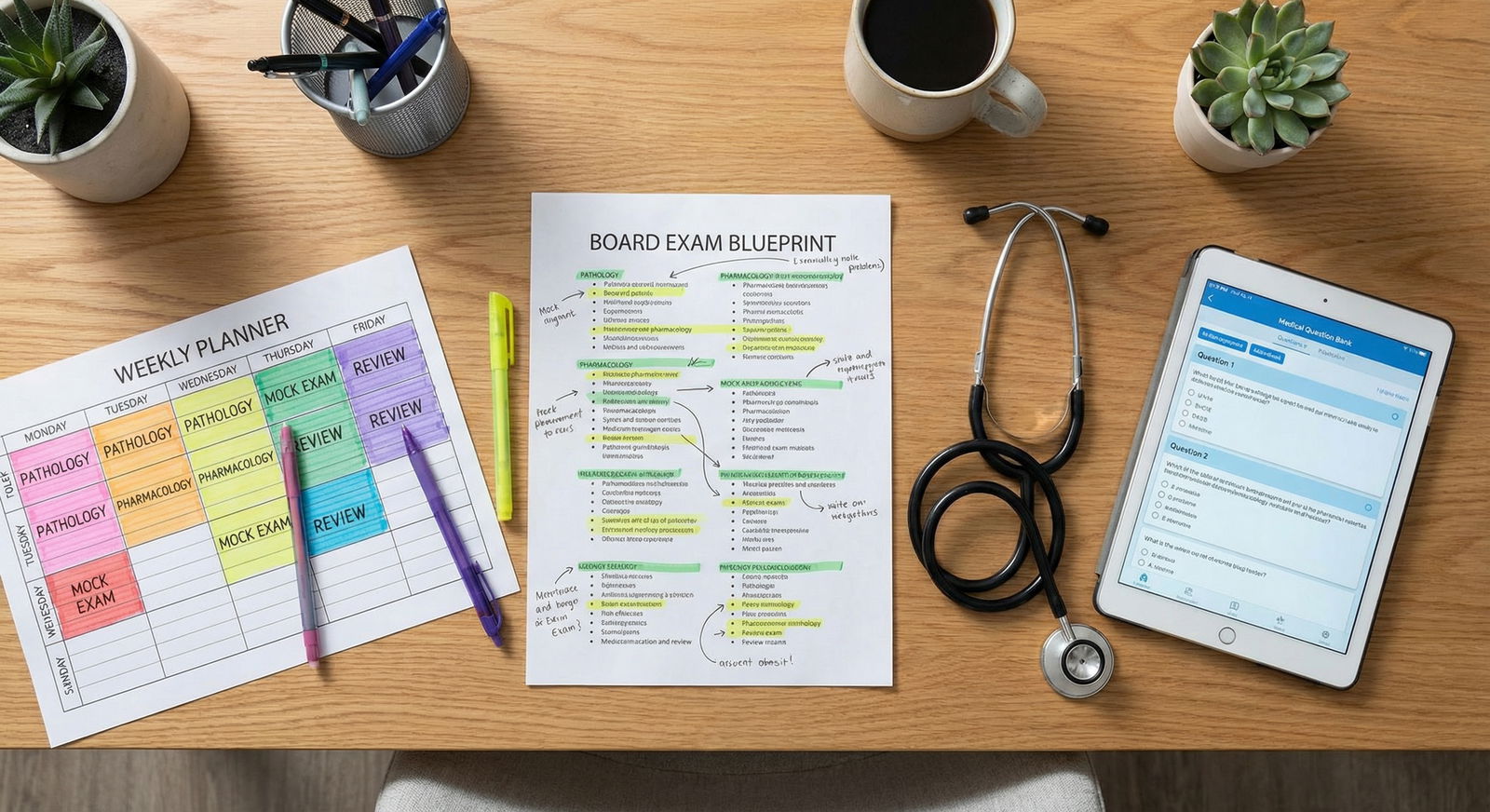
Most specialty boards publish a detailed exam blueprint or content outline. This is your master roadmap.
Typical blueprint elements include:
- Major domains (e.g., for Internal Medicine: Cardiology, Pulmonary, GI, Endocrine, ID, Hem/Onc, Rheumatology, etc.)
- Approximate percentage of questions per domain
- Sometimes specific subtopics or competencies within each domain
Action steps:
- Download the blueprint (PDF or web page).
- List all content areas in a spreadsheet or notes app.
- Next to each area, note:
- Percentage of the exam (e.g., Cardiology 15–18%)
- Your subjective comfort level (e.g., 1–5 scale)
- Key textbooks, chapters, or resources
This “content map” becomes the skeleton of your Study Schedule.
Example: Internal Medicine Board Exam – rough distribution:
- Cardiology: 15–18%
- Pulmonary/Critical Care: 10–12%
- Gastroenterology: 10–12%
- Infectious Diseases: 9–11%
- Endocrinology: 8–10%
- Rheumatology, Nephrology, Hem/Onc, Geriatrics, etc.: smaller percentages but still critical
You should allocate more time and question practice to high-weight topics, while ensuring you have at least baseline competence in all areas.
Pro tip: The blueprint is not optional reading—build your Study Schedule directly from it. If a topic isn’t on the blueprint, it’s lower priority. If it’s emphasized, it deserves multiple passes and question-heavy review.
Step 2: Assess Your Starting Point and Constraints
Before planning your path, you need an honest baseline—both academically and logistically.
Evaluate Your Knowledge and Exam Readiness
Use multiple methods to assess your current level:
Baseline practice exam
- Take a full or half-length practice test from:
- Your specialty board’s practice materials (if available)
- A reputable question bank
- A formal in-training exam (if recent) as a starting benchmark
- Simulate real conditions: timed blocks, no interruptions, no notes.
- Take a full or half-length practice test from:
Section-level performance
- Identify:
- Strong domains (70–80%+ correct)
- Moderate domains (60–70% correct)
- Weak domains (<60% correct)
- Compare this to blueprint weight. A weak, high-weight domain demands priority.
- Identify:
Qualitative feedback
- Reflect on recent clinical rotations:
- Which consults or cases make you uncomfortable?
- Where do you frequently look up same-type information?
- Ask senior residents or attendings which topics are commonly tested but often underprepared.
- Reflect on recent clinical rotations:
Document your findings. A simple table or color-coding (green/yellow/red) is enough to guide intensity of focus.
Map Out Your Real-Life Constraints
A Study Schedule lives in the real world of residency life and challenges. Time Management must reflect:
- Rotation type (ICU vs. elective vs. clinic-heavy)
- Call schedule or night float
- Family and personal responsibilities
- Fatigue and recovery needs
Action steps:
- Pull your rotation and call schedule for the months before the exam.
- Mark:
- Heavy months (ICU, nights, wards → limited capacity)
- Lighter months (electives, research → more study hours)
- Estimate realistic daily study capacity:
- Heavy rotations: 0.5–1.5 hours/day
- Moderate: 1–2 hours/day
- Light/electives: 2–4 hours/day
- Days off: 3–6 hours, divided into blocks
This honest audit prevents creating an idealized schedule you cannot follow. Instead, you’ll build something sustainable.
Step 3: Set Clear, SMART Study Goals
Vague intentions (“study more”) do not translate into exam success. Effective Exam Preparation requires structured, trackable goals.
Create Long-Term and Short-Term Study Milestones
Use SMART criteria: Specific, Measurable, Achievable, Relevant, Time-bound.
Long-term goals (3–6 months out):
- “Complete 3,000 board-style questions with review and annotations by exam day.”
- “Finish one full read (or watch-through) of my core board-review resource by six weeks before the exam.”
- “Achieve at least 10% improvement on a full-length practice exam by one month before test day.”
Medium-term goals (monthly):
- “Complete all cardiology and pulmonary questions in my QBank by the end of Month 1.”
- “Finish reading/rereading all GI and ID sections of my primary review book this month.”
- “Take a half-length practice exam every 4 weeks and track domain-specific progress.”
Short-term goals (weekly/daily):
- “Do 100 rheumatology questions and review all explanations by Sunday.”
- “Create and review 30 flashcards on endocrine hormones this week.”
- “Spend 2 hours on nephrology cases and algorithms on Wednesday evening.”
Write these down in your planner, digital calendar, or task manager. Your Study Schedule should be goal-driven, not just time-driven.
Prioritize by Impact and Weakness
Layer your goals using two dimensions:
- Exam weight (from blueprint)
- Your performance (from baseline assessment)
High-weight + Weak performance = Top priority topics
Low-weight + Strong performance = Maintenance level review
This allows you to spend your best energy where it will move your score the most.
Step 4: Build a Weekly Study Schedule Template
Now convert goals into a concrete Study Schedule you can follow week after week, adjusting for rotation demands.
1. Use Time Blocks, Not Endless Hours
Research in learning and productivity shows that focused, time-limited blocks with breaks outperform marathon sessions.
Consider:
- 25–50 minutes focused study + 5–10 minute break (Pomodoro style), or
- 90-minute deep work blocks with a 15–20 minute break
Within each block, set a clear target:
- “Do and review 20 cardiology MCQs.”
- “Read and summarize one endocrine chapter.”
- “Review flashcards for 30 minutes, spaced repetition.”
Schedule your most cognitively demanding work (e.g., new topics, complex questions) during your peak alertness time—early morning for many residents, evenings for others.
2. Distribute Content Across the Week (Spaced Repetition)
Instead of cramming one specialty for an entire day, aim for spaced repetition:
- Rotate 2–3 content areas per week.
- Revisit high-yield domains multiple times over your preparation period.
Example: Weekly Template During a Moderate Rotation
Monday
- 6:30–7:15 AM: Cardiology questions (20–25) + quick review
- 8 PM–9 PM: Read cardiology review sections corresponding to missed questions
Tuesday
- 6:30–7:15 AM: Pulmonary questions
- 8 PM–9 PM: Pulmonary review videos/chapters
Wednesday
- 6:30–7:15 AM: GI questions
- 8 PM–9 PM: Flashcards (mixed systems)
Thursday
- 6:30–7:15 AM: Infectious diseases questions
- 8 PM–9 PM: ID guidelines or UpToDate review on key syndromes
Friday
- 6:30–7:15 AM: Mixed questions (all topics)
- Evening: Light review or rest, depending on fatigue
Saturday
- 9–11 AM: Two 45-minute blocks of questions (one topic-focused, one mixed)
- 2–4 PM: Review missed questions, make notes or flashcards
Sunday
- 9–11 AM: Content review (chapters, high-yield notes)
- 3–4 PM: Weekly recap + plan next week
Adjust intensity for heavy or light rotations, but preserve:
- Consistent daily contact with material
- Dedicated question time
- Dedicated review time
3. Build in Question Practice and Review Intentionally
For most specialty Board Exams, performance on test day correlates strongly with:
- Total number of quality practice questions completed
- Depth of review of each question
Aim to:
- Start questions early (ideally from day 1 of your plan)
- Progress from tutor/untimed mode for learning to timed blocks for exam stamina
- Log and actively review concepts you miss
Practical pattern:
- 60–70% of study time: Question-based learning
- 30–40% of study time: Reading, watching lectures, flashcards, synthesis
Never skip explanations, even for questions you got right by guessing. The “why” is more valuable than the score in practice mode.
4. Reserve Weekly Review and Integration Time
Every week, add:
- Review block (1–2 hours) to:
- Revisit incorrect questions
- Summarize high-yield pearls
- Update flashcards or notes
- Planning block (15–20 minutes) to:
- Check off completed goals
- Reschedule missed tasks realistically
- Adjust focus for the next week based on performance
This rhythm transforms your Study Schedule into a living system that learns and adapts with you.
Step 5: Choose and Use Your Resources Wisely
More resources do not equal better preparation. Strategic Time Management in board prep includes limiting resource overload.
Core Resource Categories
Primary board-review resource
- A comprehensive review book (e.g., specialty-specific board review texts)
- Or a structured online review course with lectures and handouts
- Use this as your spine for content review.
Question banks (QBanks)
- Choose 1 primary QBank with high-quality, exam-style questions.
- Ideal features: detailed explanations, references, performance analytics, specialty alignment.
- Optional: A second smaller QBank closer to the exam for variety, if time allows.
Guideline and clinical references
- UpToDate, specialty society guidelines, or summaries within review resources.
- Focus on high-yield guidelines frequently tested (e.g., ACS, sepsis, COPD, diabetes, hypertension, anticoagulation, etc., depending on specialty).
Flashcards and spaced repetition tools
- Anki, Quizlet, or custom digital/physical cards.
- Use for formulas, diagnostic criteria, scoring systems, and lists that require memorization.
Study groups or peer teaching
- Small groups (2–4 people) can be effective for:
- Discussing tough questions
- Teaching each other high-yield topics
- Practicing oral case presentations
- Small groups (2–4 people) can be effective for:
How to Integrate Resources into Your Schedule
- Assign specific resources to each time block:
- “7–8 AM: 20 QBank cardiology questions”
- “8–9 PM: Review cardiology chapter from [X review book]”
- Avoid jumping between multiple review books or full-length courses. Depth with 1–2 solid resources beats superficial pass through 5.
Tip: If you’re short on time, prioritize:
- High-yield QBank + thorough review of explanations
- One good review resource
- Targeted flashcard practice for weak areas

Step 6: Monitor Progress and Adapt Your Plan
Your first version of a Study Schedule is a hypothesis. You refine it based on data.
Weekly and Monthly Checkpoints
Build in regular checkpoints:
Weekly
- Did you meet your study hour and question targets?
- Which topics still feel shaky?
- Do you need to redistribute time (e.g., more nephrology, less cardiology)?
Monthly
- Take a half- or full-length practice exam.
- Compare domain performance to your baseline.
- Identify:
- Improvers (maintain or slightly reduce time)
- Persistent weaknesses (increase focus, change strategy)
- Time-management issues (running out of time, mental fatigue)
Document changes, don’t just notice them. Even a simple note:
“Month 2: ID score stuck at 55%. Plan: add 50 extra ID questions/week + 1 guideline review session.”
Adjusting Strategy, Not Just Time
If a topic isn’t improving:
- Change how you study it, not only how much:
- Use a different resource or explanation style
- Teach the topic to a co-resident
- Create diagrams, flowcharts, or one-page summaries
- Do more mixed-question sets to practice discrimination between similar diagnoses
If you’re feeling burned out or consistently failing to meet your planned hours:
- Shorten each block, but increase consistency.
- Trim nonessential tasks or low-yield resources.
- Reassess goals to make them challenging but realistic.
Step 7: Protect Your Health and Mental Bandwidth
Sustained high performance on Board Exams depends on your brain and body functioning well, not just on the number of hours logged.
Sleep, Exercise, and Nutrition as Performance Tools
- Sleep
- Aim for 7–8 hours most nights when possible.
- Chronic sleep deprivation damages memory consolidation and test performance.
- Exercise
- Even 15–20 minutes of walking, stretching, or light cardio on busy days can:
- Improve focus
- Reduce anxiety
- Enhance mood and stamina
- Even 15–20 minutes of walking, stretching, or light cardio on busy days can:
- Nutrition
- Favor consistent, balanced meals and adequate hydration.
- Avoid relying solely on caffeine and snacks, which can worsen energy crashes.
Schedule these into your week just like study blocks—they’re non-negotiable parts of exam preparation.
Stress Management and Burnout Prevention
Residency is demanding; adding board prep often amplifies stress. Tactics to cope:
- Micro-breaks during study
- Stand up, stretch, drink water every 45–60 minutes
- Mindfulness or relaxation
- 5–10 minutes of breathing exercises, meditation, or prayer before bed
- Boundaries
- Designate “study-free” times (e.g., one evening per week, family events)
- Communicate your exam timeline to family/friends so they understand when you need focused time
If anxiety feels unmanageable or you notice signs of burnout (emotional exhaustion, depersonalization, decreased performance), consider:
- Talking with a mentor, program director, or wellness officer
- Accessing counseling or mental health resources
Long-term success in medicine requires caring for yourself as seriously as you care for your patients.
Putting It All Together: A Sample 12-Week Board Exam Preparation Framework
Here’s how you might structure a 3-month Study Schedule, customizable to your specialty and rotation load:
Weeks 1–4: Foundation and Baseline
- Take a baseline practice exam (week 1).
- Build your topic list from the blueprint.
- Focus:
- High-yield topics with weakest performance
- 20–40 questions/day most days of the week
- Steady content review from your main resource
- Goal:
- Complete 25–30% of your QBank
- Finish first pass of 30–40% of core review material
Weeks 5–8: Expansion and Integration
- Increase question volume (30–60/day depending on rotation).
- At least one half- or full-length practice exam in this period.
- Start incorporating:
- More mixed-topic blocks
- Timed sessions under exam-like conditions
- Target:
- 60–70% of QBank completed by end of week 8
- Almost full coverage of high-yield blueprint areas
Weeks 9–11: Refinement and Simulation
- Emphasize:
- Weak domains identified from practice exams
- Timed blocks replicating real exam length and structure
- Reduce new content; shift towards:
- Review of notes, flashcards, incorrect questions
- Practicing stamina and time management
- Target:
- QBank nearly complete (80–100%)
- Clear improvement from initial baseline scores
Final Week: Taper, Consolidate, and Rest
- No cramming of brand-new topics.
- Focus on:
- Reviewing high-yield summaries
- Re-doing previously missed questions
- Light, confident review of core algorithms and guidelines
- Sleep and stress management become top priority.
- The day before the exam: very light review or rest; prioritize sleep and logistics (route to test center, required documents, etc.).
FAQs: Study Schedules and Specialty Board Exam Preparation
1. How far in advance should I start studying for my specialty board exams?
Most residents begin structured board prep 3–6 months before the exam, depending on their baseline knowledge, specialty, and rotation intensity. If you have major knowledge gaps or a historically low in-training exam score, aim closer to 6 months. If you’ve been strong on in-training exams and rotate in your specialty frequently, a focused 3–4 month plan may be sufficient.
2. How many hours per week should I allocate to board exam preparation during residency?
It varies with rotation schedule:
- Heavy rotations (ICU, wards, nights): 5–7 hours/week (short, consistent daily blocks)
- Moderate rotations: 7–12 hours/week
- Light or elective rotations: 10–20 hours/week
Consistency is more important than occasional marathon days. Even 30–60 minutes daily on heavy weeks can maintain momentum.
3. What should I prioritize if my study time is very limited?
If time is tight, focus on:
- High-yield QBank questions with careful review of explanations
- Exam blueprint–aligned topics that are both heavily weighted and weak for you
- Concise board-review resources over full-length textbooks
Skip nonessential extras like multiple overlapping courses. Depth in one strong resource plus robust question practice is higher yield than scattered exposure to many.
4. How frequently should I take full-length practice exams?
For many residents, a good pattern is:
- Baseline full or half-length exam at the start of prep
- Another at 4–8 weeks before the exam
- A final one 2–4 weeks before the exam
If your schedule doesn’t allow full exams, do at least:
- Regular timed blocks (e.g., 40–60 questions in exam conditions)
- Occasional extended sessions to build stamina
Use practice exams not just for scores but to identify content weaknesses and refine time management.
5. How can I balance board studying with residency, family, and personal life without burning out?
Key strategies:
- Build a realistic Study Schedule around your concrete rotation and call pattern.
- Use time blocking and protect specific study times as you would clinic or sign-out.
- Communicate with partners/family about your exam timeline and specific periods when you’ll need more protected time.
- Schedule planned rest: at least one lighter evening or a few hours weekly where you don’t study.
- Prioritize sleep, short exercise, and nutrition as part of your exam preparation, not in competition with it.
Careful planning, realistic Time Management, and steady execution will help you face your specialty board exam with confidence. A thoughtful, adaptable Study Schedule turns an overwhelming goal into a series of achievable daily actions—one focused study block at a time.