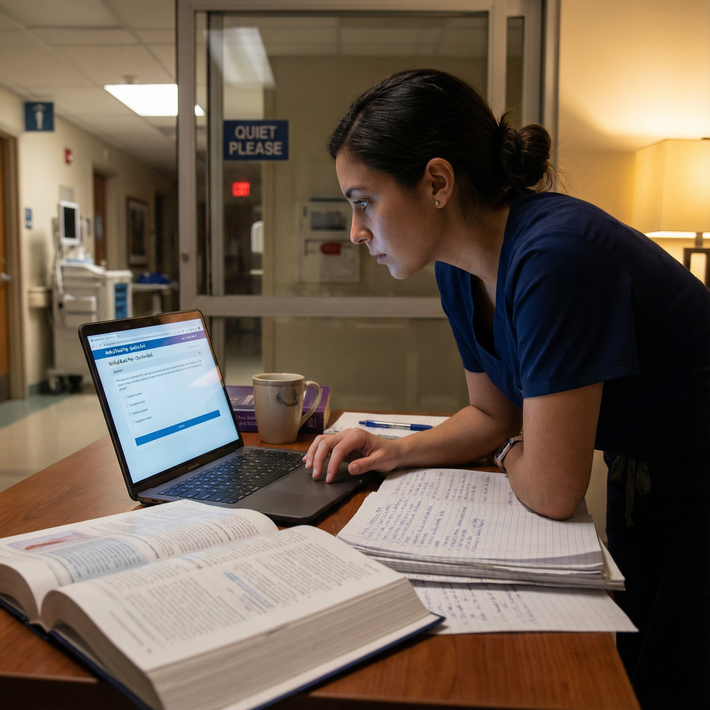
Closed-book board exams do not reward how much medicine you know. They reward how fast your brain can retrieve it under hostile conditions.
That distinction ruins most residents. You walk in with years of clinical competence, open-note habits, UpToDate on your phone, curbside consults on speed dial. The exam strips all of that away. No crutches. No second look. Just you, a stem that is intentionally ambiguous, four answers that all look plausible, and 90 seconds ticking down. Preparation that works on the wards fails here.
This article is for educational purposes only. It is not financial advice, not legal advice, and not tax advice. Figures vary by individual circumstances, so consult a qualified professional before acting.
The Neuro-Cognitive Baseline: Why Closed-Book Demands Structural Mastery
Let me break this down specifically. Clinical practice is an information retrieval exercise. Board exams are a pattern recognition and automated recall exercise. Completely different cognitive demands.
In clinic, you can be 70% sure and still function. You look it up. You confirm. On a closed-book exam, 70% sure is a wrong answer. The exam tests whether a concept has moved from declarative memory, I read this, to procedural memory, I just know this. Like knowing which way to turn the steering wheel. No deliberation.
Here is where most preparation collapses. The Fragmentation Penalty.
Passive reading, highlighting review books, watching videos at 2x, scrolling through slides, creates an illusion of competence. Your brain recognizes information. Feels familiar. That is not the same as being able to recall it. I have seen residents finish a 800-page review twice and score below the 20th percentile because every fact lived in isolation. No links. No structure. Under time pressure, fragmented memory cannot fire fast enough.
Structural mastery is different. Think of it as a lattice. Heart failure with reduced EF connects to neurohormonal activation connects to ACE inhibitor contraindications connects to that one exam question about angioedema with sacubitril. One recall triggers the entire chain. That reduces cognitive load dramatically. Your working memory is not searching. It is executing.
Your baseline metric for readiness should reflect this. Stop asking, "Have I covered all the material?" Start asking, "How many questions can I answer without consciously thinking through the pathophysiology?" If you still need to reason through first principles for high-yield topics like hyponatremia workup or pediatric immunization schedules, you are not ready. The goal is not to learn new material in the last month. The goal is to automate what you already claim to know.
Resource Triage: Eliminating Noise to Maximize Signal-to-Noise Ratio
More resources equals more anxiety. And lower scores.
You need to enforce resource restriction immediately. Day 1. No negotiation.
For any ABMS specialty board, internal medicine, pediatrics, anesthesia, surgery, the formula is identical:
ONE primary Qbank aligned to your board's question style. ONE comprehensive review text. That is it.
If you are doing ABIM, that is UWorld ABIM or BoardVitals plus MKSAP or perish. If ABP, it is PREP plus MedStudy. Do not collect three Qbanks because someone on Reddit said Kaplan was "also good." Resource multiplicity anxiety is real. You end up 40% through four resources instead of 120% through one. Shallow coverage kills you on closed-book exams where depth matters.
Categorize what you kept by function. This is critical:
- Qbank = Diagnostic Assessment and Active Retrieval Tool. It is not a learning tool. You do not use it to learn content. You use it to test whether your lattice holds. Every question is a forced retrieval event.
- Review Text = Conceptual Bridge. Use it only when your Qbank shows a structural gap. If you missed three questions on glomerulonephritis because you do not understand nephritic vs nephrotic patterns, go to the text for 20 minutes. Build the bridge. Then go back to questions.
- Flashcards = Rote Storage Only. Anki or similar is terrible for conceptual learning. Excellent for pure memorization: HLA associations, chemo toxicities, vaccine schedules, cutoffs. If it cannot be reasoned, flashcard it. If it can be reasoned, question-bank it.
Then perform a Kill List audit. Literally write it down. List every PDF, question set, video series, old notes from residency lectures, your friend's annotated First Aid. If it does not directly map to the current ABMS blueprint, not last year's, this year's, archive it. Move it to a folder you cannot see daily. Context-switching fatigue is one of the biggest silent performance killers. Every time your brain switches from UWorld logic to your old program director's slides, you pay a cognitive cost.
I tell my residents: if you touch more than two resources in a day, you studied poorly.
Deconstructing Question Architecture: Thinking Like the Writer
Board questions are not written to test knowledge. They are engineered to test decision-making under specific constraints. Once you see the engineering, you cannot unsee it.
Every stem contains anchor phrases. Those two or three words dictate the entire logic path. Miss them, you miss the question even with perfect knowledge.
- "Most likely diagnosis" = pattern recognition. Do not overthink.
- "Next best step" = risk stratification. Usually asks what prevents death immediately.
- "Must rule out" = this is an emergency disguised as something benign.
- "Initial test" vs "Most accurate test", completely different answers. Initial is cheap, safe. Most accurate is gold standard, often invasive.
You have to train your eye to catch these before you even look at the vignette details.
Second, master distractor taxonomy. Writers use the same traps repeatedly. I track five:
- The Distractor of Truth: Statement is factually correct, but does not answer the question asked. Classic example: question asks next step in management of ST elevation, option shows correct dosing of aspirin, true, but PCI is the answer.
- The Second-Best Diagnosis: Covers 80% of features but misses the one defining clue. Like answering ulcerative colitis when the stem mentions skip lesions and perianal fistulas.
- The Temporal Mismatch: Correct intervention, wrong timing. Giving the right antibiotic but as maintenance when acute treatment is needed.
- The Guideline Bait: Old guideline. Or correct guideline applied to wrong population. The board loves new cutoff changes.
- The Overcall Emergency: Everything looks like a catastrophe, but vitals are stable and the correct answer is reassurance or outpatient workup.
Implement a systematic decision matrix. Stop reading options first. That is how you get anchored.
Read the last line first. Identify anchor. Isolate core pathology in one sentence in your head: "Young woman with purpuric rash, abdominal pain, and hematuria." Then generate a differential before you permit yourself to see options. Then match. If you match options first, you are guessing based on partial cues. That is exactly how the board design wins.
Active Retrieval Protocols & Error Log Forensics
Re-reading notes feels productive. It is almost useless for closed-book retention.
Data on this is brutal and clear. Passive review creates high immediate familiarity and near-zero long-term retrieval. Active retrieval, forcing your brain to produce the answer without cues, is effortful, uncomfortable, and durable. Every time you struggle to recall, you strengthen the synaptic pathway.
Your protocol should be:
1. Spaced retrieval, not spaced review. Do not schedule days to re-read cardiology. Schedule days to do 40 cardiology questions you already did three weeks ago. Wrong answers go back into the stack within 48 hours. Right answers after 7-10 days. This is non-negotiable. Qbank reuse beats new Qbank material in the final month.
2. Forensic analysis of every missed question. Not just reading the explanation. Categorize the error.
I use three buckets with my mentees:
- Knowledge Deficit (Type K): You genuinely did not know the content. Solution: build conceptual bridge, create one flashcard.
- Stem Misinterpretation (Type S): You knew content but misread anchor, missed vital sign, ignored age. Solution: practice last-line-first technique, no content review needed.
- Distractor Error (Type D): You fell for second-best or truth distractor. Solution: log distractor pattern, rewrite question in your own words.
After 500 questions, your Type distribution tells you what to fix. 60% Type S? You do not need more MKSAP. You need to slow down and read.
3. Curate a High-Yield Insight Bank. Not a notebook. Not a 100-page document. A single, ugly, personal document limited to 10-15 pages max. Each entry comes only from your error log. Format: Clinical Pearl + Why I missed it + 1-line mnemonic.
Example: "Sodium correction >8 mEq/day -> osmotic demyelination. Missed because I focused on glucose. Anchor: check Na in DKA. D for Demyelination = Danger of fast correction."
This becomes your final sprint review. Not the textbook. Your mistakes have more yield than any review book chapter.
Look at the decay. Passive review drops off a cliff after Week 2. Active recall is lower initially, it feels harder, then overtakes and sustains. That is your board prep curve.
Executive Function & Simulation: Simulating Exam Pressure
Knowledge fails when executive function collapses. I have seen brilliant residents fail because they never trained for the actual test environment.
Engineer environmental fidelity. This is not motivational advice. This is neurophysiology.
Starting four weeks out, conduct full-length timed blocks in conditions mirroring Prometric. Same chair type if possible. Same mask policy if applicable. No phone. No coffee on desk. 60 questions, 90 minutes, strict. Only one 10-minute break after two blocks. Earplugs in. Ambient noise. You need to habituate your stress response. If your first time doing 8 hours of testing is on exam day, your cortisol will crater your recall.
Optimize executive function tactics. You need a personal rhythm:
- Flagging protocol: I recommend a two-pass system. First pass: answer anything you know in under 90 seconds. Flag anything that requires calculation, long differential, or where you vacillate between two. Do not waste 4 minutes on one hard question. Second pass: return to flagged with fresh eyes. This prevents fatigue from distorting judgment.
- Fatigue management: Cognitive performance drops predictably after hour 3 and hour 6. Schedule your hardest topic blocks there in practice so you learn to recognize fog. Have a physical reset cue, shoulder roll, deep breath, sip water, for transitions.
- Strategic guessing: Never leave blank. But also never change an answer unless you have a concrete, articulable reason you misread. Gut change from second-guessing is statistically wrong more often than right on boards.
Execute a final taper protocol. The last 7 days are not for heroics.
Shift to light review of your Insight Bank only. No new Qbank. No new content. This is athletic taper. Your brain consolidates during sleep, not during cramming. Prioritize 7.5-8 hours sleep, consistent wake time, morning light exposure. Avoid high-intensity new information that risks retroactive interference, where new, poorly encoded facts confuse well-encoded old facts.
Peak neurological alertness on exam day beats one more 40-block of mediocre retention. Every time.
Final Summary
Mastery of closed-book specialty boards is not about intelligence or clinical hours. It is a separate skill set.
Closed-book exams reward structural memory and automated recall; prioritize active retrieval and spaced repetition over passive consumption to build durable knowledge pathways that fire under pressure.
Treat every missed question as data: perform forensic analysis on errors, master distractor taxonomies, and think like the writer to dismantle pattern-based traps effectively instead of blaming knowledge gaps.
Strict resource triage and simulated environmental conditions are non-negotiable; depth of engagement with single high-quality sources beats superficial coverage and improves test-day executive function when fatigue sets in.
Stop preparing like a clinician. Prepare like an exam taker. The board does not care what you can look up. It cares what you can retrieve when you cannot look anything up.