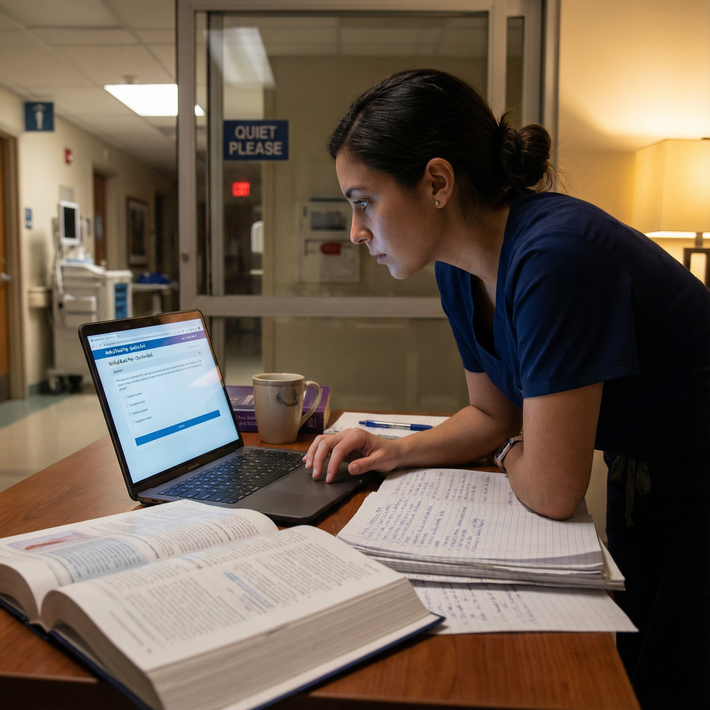
Let's get one thing straight right out of the gate: repeating the same question bank over and over is a trap. It feels incredibly effective. You fly through the blocks, your scores climb, and your anxiety drops. But here's what the data actually shows: familiarity is a master of disguise. It perfectly mimics learning.
When you see a question for the third time, your brain recognizes the pattern, retrieves the cached answer, and gives you a massive dopamine hit. You feel like a genius. But recognition is not retrieval. Board exams don't test your ability to recognize a familiar stem; they test your ability to retrieve obscure facts under extreme pressure. In residency prep, time is your most brutal currency. False efficiency doesn't just waste your time, it actively sabotages your test-day performance by masking your actual knowledge gaps.
Why do we keep doing it? Because it feels good. Familiarity drastically reduces cognitive friction. When you don't have to struggle to parse the vignette, your brain misreads that ease as intellectual progress. This creates recognition fluency. You read the first sentence of a cardiology question and think, "I know this one," confusing shallow recall with deep mastery.
Look at your repeat block scores. That jump from 45% to 85% on your second pass? That's not durable knowledge. That's just your brain remembering that the patient with the murmur and the funny ECG always has hypertrophic cardiomyopathy in this specific Qbank. You memorized the stem, not the pathophysiology.

This trap is especially seductive for anxious learners. Residency is stressful. Board prep is terrifying. Repetition gives you an illusion of control. It lowers uncertainty. Clicking through familiar questions feels safe, like wrapping yourself in a cognitive security blanket. But the exam room isn't safe, and the real test won't hold your hand.
What the Learning Science Actually Shows
Let's look at the cognitive science. The data is unambiguous: retrieval practice crushes passive review. Effortful recall, forcing your brain to dig up information without cues, strengthens neural pathways far more than simply recognizing a familiar prompt. This is known as the testing effect, and it is the most robust finding in educational psychology.
Massed repetition of the same items in the same order is one of the least effective ways to study. Spacing and interleaving are vastly superior. When you mix topics and space out your review, you force your brain to constantly reload different conceptual frameworks. It's exhausting. It's supposed to be.
Deliberate difficulty is a feature of effective learning, not a flaw. If your study session feels smooth and easy, your learning is probably shallow. This is the "desirable difficulty" principle. You need to struggle a bit to encode the memory deeply.
Here is the hard truth: performance during study is a terrible predictor of performance on test day. High scores on repeat blocks mean absolutely nothing if you can't transfer that knowledge to a novel vignette. Transfer requires varied practice, context switching, and rigorous error correction.
The Hidden Cost of Living in One Qbank
Living inside a single Qbank creates a massive blind spot. You develop severe selection bias. You get incredibly good at answering the way that specific company writes questions, but you completely miss the nuances of how the actual board exam emphasizes different concepts. I've seen residents cry over a 60% on a fresh NBME after scoring 90% on their third pass of their primary Qbank. The writing styles differ. The traps differ.
You end up memorizing the explanations without actually integrating the concepts. You can recite why answer A is right and B is wrong for question 412, but the moment the board writers flip the vignette and ask for the next best step instead of the most likely diagnosis, you freeze. Novel vignettes expose these shallow gaps instantly.
This breeds a dangerous overconfidence. When your dashboard shows 80% correct, you stop reviewing your weak domains. You assume you're ready. You aren't. Every hour you spend recycling the same 2,000 items is an hour you aren't spending on mixed blocks, attacking your weak areas, or consolidating high-yield facts.
What to Do Instead: A Smarter Board-Prep Strategy
So, how do we fix this? First, use your primary Qbank for exactly one pass to learn the material. Then, stop treating it as your main engine for progress.
Switch to mixed, timed blocks immediately. This simulates the brutal reality of exam conditions and forces you to retrieve information across wildly different topics. You have to shift gears from nephrology to psychiatry in seconds. That context-switching is where the real learning happens.
When you miss a question, don't just read the explanation and move on. Review the missed question by underlying concept. Build an error log categorized by theme, not by Qbank ID. If you keep missing questions on acid-base disturbances, your error log should flag that specific physiological mechanism, forcing you to confront your actual deficit.
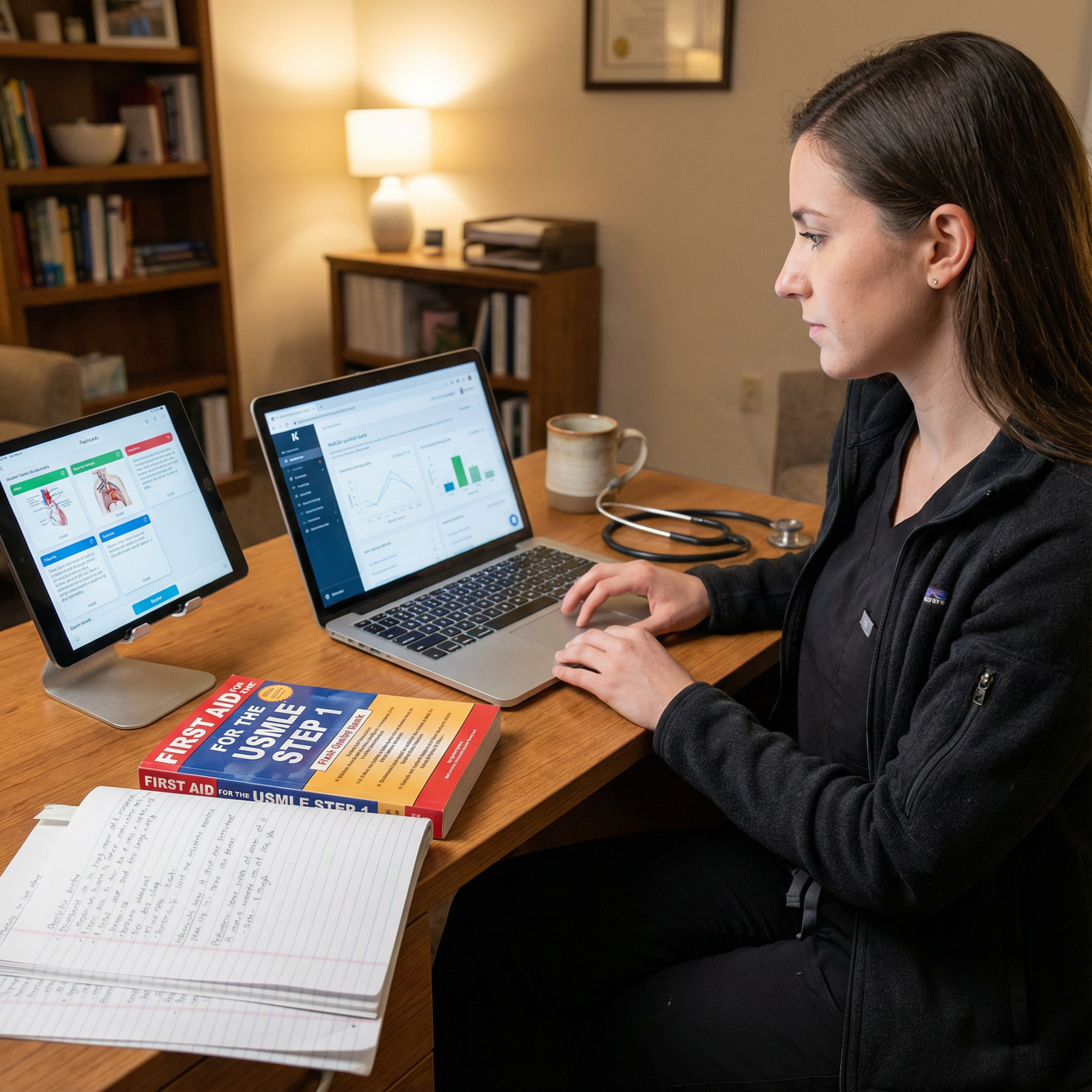
Drive your review sessions with spaced reworking of weak concepts, not blind repetition of old questions. Bring in active recall tools. Use closed-book teaching (explain the concept out loud to an empty room or a study partner), targeted flashcards for raw memorization of pharmacology and microbiology, and concept maps to link pathophysiology to clinical presentation.
Finally, track the metrics that actually matter. Stop obsessing over your cumulative Qbank percentage. Track your accuracy on new, unseen questions. Measure your speed under strict time pressure. Monitor the reduction in repeated error types in your log. If you are missing the same conceptual error three weeks in a row, your current study method is failing you.
How to Tell Whether You're Actually Improving
How do you know if you're actually getting better? Use new, previously unseen questions as your ultimate benchmark. Repeat-block score inflation is a lie; performance on fresh material is the truth.
Look for knowledge transfer. When you review a new question, can you explain exactly why the wrong answers are wrong in that specific vignette? If you can only justify the right answer, your understanding is incomplete. The board writers are experts at making the wrong answers look incredibly tempting if you only have a surface-level grasp of the disease process.
Measure your trend lines across weeks, not the one-day confidence spikes you get after crushing a familiar set. Look for steady, grinding improvement on mixed, timed blocks.
Repetition isn't inherently evil. Spaced repetition of facts is crucial for long-term memory. But repeating the exact same questions in the exact same order is an unreliable proxy for progress when used alone. Stop confusing the feeling of familiarity with the reality of mastery. Do the hard work.
Key Takeaways
- Feeling productive is not the same as learning effectively; repeated Qbank exposure often inflates confidence more than competence.
- The better strategy is mixed, timed retrieval with structured error review, spacing, and practice on new questions.