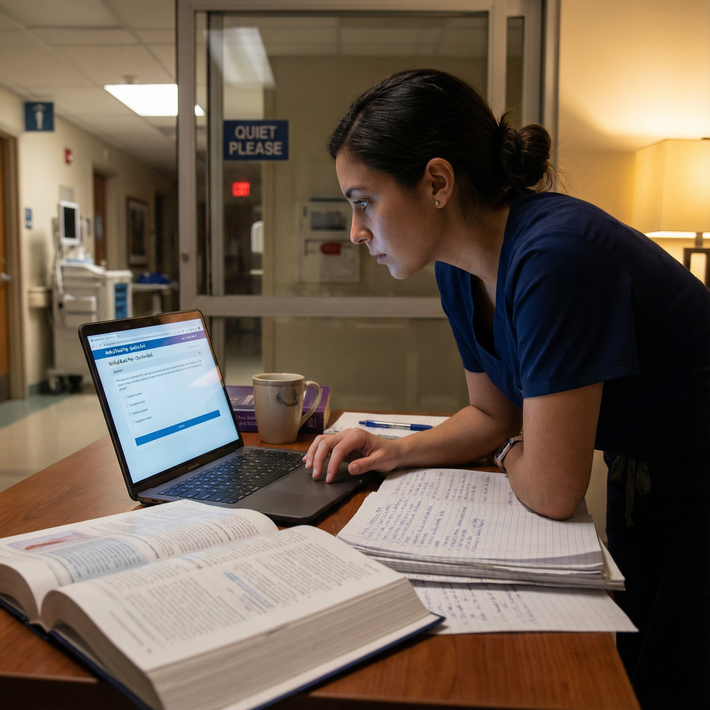
You're doing it again. It's 11:47 PM after a 28-hour call, and you're rereading that same chapter on hyponatremia from your intern guide. You highlight. You nod. It feels productive.
It's not. It's a trap.
If you're in PGY-1 and your primary study method is rereading foundational material, you are wasting the most valuable resource you have: time.
If you are struggling to build a study habit that actually sticks, read more about the PGY-1 to PGY-3: Year-by-Year Roadmap to Specialty Board Readiness to align your efforts.
The Illusion of Progress: Why Passive Review Fails PGY-1s
I've watched dozens of interns burn themselves out doing exactly this. They come into residency with the med student playbook, read Harrison's, re-read the basics, make pretty notes, and they crash into the same wall.
It's called the familiarity trap. Your brain reads something for the third time and whispers, "Oh yeah, I know this." You mistake recognition for mastery. Big difference.
Recognition is passive. It's seeing a list of causes for elevated anion gap acidosis and thinking, "Yep, looks familiar."
Recall is active. It's being paged at 2 AM about a patient with an lactate of 6 and a pH of 7.18, and having to retrieve that differential, that next step, that exact dose of bicarb, without a textbook in front of you. Under pressure. While tired.
Board exams, in-service exams, actual patient care, they all test recall, not recognition. Rereading only builds recognition.
And here's the PGY-1 reality check: you don't have time for inefficient study. You have 20 minutes between notes, 45 minutes on the train, maybe an hour before you collapse. Spending that hour rereading a chapter you already half-know is academically comforting and practically useless. You're not a med student anymore trying to pass Step 1. You're a doctor who needs to make decisions.
The Science of Retention: Moving Beyond the Basics
Your brain isn't designed to hold onto information you just passively look at. There's a reason for that, and it was described over 100 years ago.
To avoid the common traps many interns fall into, review our guide on The PGY-1 Mistake: Waiting to Learn Your Specialty's Board Blueprint before you finalize your study plan.
The Ebbinghaus Forgetting Curve. Without active reinforcement, you lose about 70% of what you read within 24 hours. Rereading resets the clock for another day, then you lose it again. It's Sisyphean.
Two techniques kill that curve. Rereading does neither.
1. Spaced Repetition. Instead of reviewing the same thing every night, you review it right when you're about to forget it. Day 2, Day 7, Day 14. Your brain has to work to retrieve it, and that effort is what cements it. This is why flashcards and spaced question banks dominate every high-scoring resident's toolkit. Not because they're trendy. Because they work.
2. Interleaving. Rereading chapters is blocked practice, you do all the nephrology, then all the cardiology. It feels organized. Your brain hates it. Interleaving mixes it up. A question on heart failure, then one on hyperkalemia, then one on COPD exacerbation. It's harder. It's frustrating. It forces cognitive flexibility, which is exactly what rounds and exams demand. Patients don't present in blocked chapters.
At this point you should stop thinking like a student trying to learn foundations and start thinking like a clinician building decision trees. Foundations are assumed. The job now is: what's your next step? What's your risk stratification? What kills this patient first?
That requires a different workflow.
This is the loop. Question first. Always. If you get it right, push it forward in your spaced system. If you get it wrong, that's data, now you do a surgical, targeted dive into why you were wrong. Not reread the whole chapter. Just the explainer for that concept. Takes 5 minutes instead of 50.
The Timeline Guide: A Strategic Pivot for Your PGY-1 Year
Rereading feels safe because it has no deadlines. You need structure. Here's your timeline to pivot off passive review for good.
Phase 1 (Months 1-3): The Honest Audit
At this point you should NOT be reviewing anything systematically. You should be diagnosing yourself.
Week 1-2: Take a baseline diagnostic. One full-length, timed practice set from your specialty's question bank, ITE, ABSITE, whatever applies. 100 questions max. Do it cold.
Week 3-4: Analyze the carnage. Don't just look at your score. Build a gap sheet. Three columns: Topic / Why I Missed It (knowledge deficit vs. misread vs. decision-making error) / Confidence (1-5). This sheet becomes your residency study bible. It tells you exactly what to study.
Your weekly checklist for Months 1-3:
- 20 board-style questions completed (untimed is fine)
- Every incorrect answer logged on gap sheet with a 2-sentence explanation in YOUR words
- Zero hours spent rereading foundational textbooks cover-to-cover
Phase 2 (Months 4-8): The Question-First Workflow
At this point you should be deep in the grind. This is the bulk of intern year and where most people waste months by going back to basics because they feel shaky.
You feel shaky because you're an intern. Everyone does. Going backward won't fix it.
Daily (20 min): 10 questions in the morning before sign-out. Timed. No books. During the day (5 min blocks): When you encounter a patient, say, alcoholic hepatitis, don't go reread the entire GI chapter later. Pull one high-yield question on alcoholic hepatitis that night. Active recall tied to a real patient is 10x stickier.
Weekly (1 hour Sunday): Review your gap sheet. You'll see patterns. Maybe you always miss questions on post-op fever timelines, or on interpreting ABGs. Now, and only now, you do targeted review. One UpToDate article, one 10-minute video, one guideline table. Not a chapter.
That chart isn't motivational. It's reality. The resident rereading is slowly forgetting. The resident sweating through questions is actually building a reserve.
Phase 3 (Months 9-12): Simulation and Clinical Vignette Integration
At this point you should shift from knowledge to execution. The boards aren't testing what hyponatremia is. They're testing what you do with a Na of 118 in a symptomatic 68-year-old.
Weekly checklist for Months 9-12:
- 40 mixed, timed vignettes. Simulate exam conditions. Warts and all.
- For each patient you admit that week, write your own 2-question vignette: Stem + What's the next best step? + Why not the other options.
- 1 hour of error review focused purely on decision-making, "I knew the fact, but I chose the wrong next step." That's the PGY-1 killer.
This is where you transition from student mindset, "Do I know enough?", to attending mindset, "Can I act correctly under uncertainty?" Rereading will never get you there. Practicing action will.
Summary: Reclaim Your Time and Your Residency
Time in residency is non-renewable. You don't get those hours back. Every hour you spend passively rereading something you already recognize is an hour you didn't spend learning to retrieve it when it counts.
Let me be blunt: if you aren't a little uncomfortable while you study, you aren't studying. If you aren't getting questions wrong, you aren't learning. If you finish a study session feeling calm and like you've covered everything neatly, you wasted it.
Stop trying to be complete. Start trying to be effective. The textbook will still be on the shelf in the call room. Leave it there.
Your job this year isn't to remember the basics. It's to stop needing to look them up.
Key Takeaways:
- Recognition is not mastery; stop confusing the ability to read a fact with the ability to retrieve it under pressure.
- Transition from textbook-heavy consumption to a question-first, error-analysis model immediately.
- Prioritize high-yield clinical vignettes over the 'completeness' of foundational chapters.