
"Protected research time" is a claim. Treat it like a duty-hours claim: don't accept the brochure version. Verify it.
In surgery, "protected" should mean three things: scheduled, funded, and enforceable. Not "we try." Not "usually." Not "if the service isn't busy." I've seen applicants hear "you'll definitely get time for research," then later learn that meant post-call afternoons, random admin gaps, and a research year constantly interrupted by coverage. That's not protected time. That's wishful thinking in scrubs.
Here's the framework that actually works before you rank a program:
- Structure: Is there a real policy and real scheduling logic?
- Resources: Is there funding, mentorship, data access, and support?
- Accountability: Does anyone track whether your research block stays intact?
- Outcomes: Do residents actually produce abstracts, manuscripts, and meaningful progress?
The verification mindset: what "protected" should mean in practice
Operationally, protected research time means this: your calendar has non-discretionary research blocks, and clinical work only intrudes under narrow, clearly defined rules. That's the standard. Anything softer is marketing.
A lot of programs use the phrase loosely. Common versions of fake protection:
- Funded but not scheduled: They have money for a research year, but no guarantee you'll actually be removed from routine service demands.
- Scheduled but not protected from call: You're "on research," but still covering nights, weekends, cross-cover, or OR backup often enough that your project never gets traction.
- Written policy with no teeth: The handbook says research is valued. Great. Who enforces it when the trauma service melts down? Silence.
- Flexible time: Usually code for "you can work on it if nothing else is happening." That's not a system. That's hope.
What you want is boring, concrete, enforceable design:
- named research block dates
- clear call expectations
- a rule for what can override the block
- a mechanism for make-up time if the block gets disrupted
- a mentor and project pipeline ready before the block starts
7 Ways to Verify "Protected Research Time" Before Ranking Surgery Programs
Use the next seven steps as a due-diligence workflow. During the interview day, on second looks, and especially in post-interview emails.
For each one, do three things:
- Ask a targeted question
- Request proof
- Watch for red flags
This isn't overkill. This is what serious applicants do. Surgery training is too long and too punishing to rank a program based on vague promises and a polished slide deck.
1) Ask for the exact mechanism that makes time "protected" (policy + scheduler logic)
Start here. Not with "Do you have research time?" Every program knows how to say yes. Ask instead:
- "What exactly makes the research block protected in the scheduling system?"
- "Is it written into the rotation policy for surgery residents?"
- "Who controls the schedule when service needs rise?"
- "What is the rule for overriding research time?"
Then request:
- a sample 12-month resident schedule
- a block diagram of the research year or elective structure
- any written policy describing research rotations
- clarification on whether this applies to all categorical residents or only a subset
The key issue is scheduler logic. That's the hidden lever. If the chief resident, service attending, or admin scheduler can pull you back to coverage whenever the census spikes, your time isn't protected. It's conditional.
Good answers sound like this: "PGY-3 to PGY-4 residents on the academic track have a dedicated 12-month block, no routine clinic, no weekday call, and weekend coverage limited to one home-call weekend per month." Specific. Useful.
Bad answers sound like this: "We really support resident scholarship." That's not an answer. That's a poster slogan.

2) Confirm what proportion of your time is truly protected (and what counts as "research work")
"Research year" can mean 100% effort. Or it can mean 50% plus a bunch of stray obligations they forgot to mention. You need the percentage.
Ask:
- "What percentage of the week is expected to be research-only?"
- "How many half-days or full days are clinically committed?"
- "What counts as research time in your definition?"
Then clarify what they include:
- manuscript writing
- IRB submissions and revisions
- data cleaning
- database work
- meetings with statisticians
- lab work
- grant or abstract preparation
- protected admin time tied to the project
This matters because some programs pretend only bench time or time physically in the lab counts as research, while writing and regulatory work somehow become "extra." That's nonsense. Real projects live or die on IRB, data access, analysis, and drafting.
If they say "about 80%" but the actual calendar shows clinic every Tuesday, call every fourth weekend, and backup OR coverage, the real number may be closer to 55%. Believe the schedule, not the pitch.
3) Verify clinical bleed-over: call, weekends, and "you'll still have to cover..." rules
This is where the truth usually leaks out.
Ask directly:
- "During research blocks, do residents still take call?"
- "Do they cross-cover services, round on weekends, or serve as OR backup?"
- "What happens during vacations, staff shortages, or high-volume months?"
- "If research time gets interrupted, is there make-up time?"
Then get examples. Not policy summaries. Examples.
You want to hear things like:
- "Research residents take no in-house call."
- "They may cover one limited backup role monthly."
- "If they lose a week to service coverage, that week is replaced."
You do not want:
- "Everybody helps out when needed."
- "It depends on the year."
- "Usually not much."
- "We try to be fair."
I've seen "light call during research" turn into q4 weekend burden plus weekday consult overflow. That's enough to wreck momentum. Research doesn't just require hours; it requires uninterrupted cognitive space. Data analysis after a 28-hour trauma call is fantasy.
Also ask about high-volume seasons. Some programs quietly cannibalize research months during winter staffing gaps or when multiple residents are on leave. If there's no formal make-up mechanism, your protected time is the first thing sacrificed.
4) Demand proof of resources that make the time usable (funding, mentorship, data access, stats support)
Protected time without infrastructure is protected waiting. I've seen this too many times: a resident finally gets the research block, then spends three months hunting for a mentor, two months waiting for database access, and another six weeks trying to find a statistician. By then the "year" is half gone.
Ask:
- "Who are the active mentors right now, and how many residents they supervise?"
- "Are there funded projects I can join immediately?"
- "Do residents have access to biostatistics support?"
- "Is there research coordinator help for IRB and regulatory work?"
- "What databases, registries, biobanks, or lab resources are actually available?"
- "Can I start project planning before the protected block begins?"
What you want:
- a named mentor model
- projects already in motion
- onboarding before the block starts
- stats support that doesn't take four months to book
- reliable data access
- coordinator help for paperwork and study logistics
A strong program can tell you, plainly, what a new research resident starts doing in month one. A weak program says, "You'll have a lot of flexibility to find your niche." That sounds nice. It's usually a setup for drift.
And don't ignore authorship culture. Ask residents whether they actually own projects or just feed data into an attending's machine. Protected time should move your academic development forward, not turn you into free labor with no first-author path.
5) Check accountability: how programs track research progress during protected blocks
Real protection includes accountability. Not because residents need policing, but because systems fail when no one owns the milestones.
Ask:
- "What milestones are expected during the block?"
- "Who reviews progress, and how often?"
- "What happens if a resident falls behind because support wasn't available?"
- "Is progress documented?"
The right milestones are practical:
- mentor assigned before block starts
- protocol defined
- IRB submitted
- dataset or lab access active
- analysis timeline set
- abstract target identified
- manuscript submission goal established
And there should be recurring review. Quarterly is common and reasonable. Monthly can work in more structured labs or trial-heavy environments.
What you're looking for isn't punishment. It's operational discipline. If a resident misses a milestone because the IRB office stalled, or because promised stats support never appeared, someone should step in and fix it. Programs that shrug and say "research can be unpredictable" are telling you they don't manage the process. That's bad.
6) Talk to current residents, get the "verification-grade" answers from lived schedules
This is the step applicants skip because it feels awkward. Don't skip it. Residents know exactly how this works in real life.
Ask current residents:
- "In the last 3 months of research, what percentage of your time was actually protected?"
- "How many calls or weekends did you cover?"
- "Did you lose any research weeks to service needs?"
- "If yes, did you get make-up time?"
- "What did a normal Monday-to-Friday week look like?"
- "How long did it take to get a project moving?"
Best move: ask one resident to walk you through a month-by-month account of their research period. Not the whole autobiography. Just the operational details. October: IRB submitted. November: database access delayed. December: covered two weekends for staffing shortage. January: abstract sent. That's the level you need.
Listen for consistency across residents. If the faculty say "no call during research" and two residents say "well, except for all the times we had to help," believe the residents.
Also notice tone. Residents who truly had protected time answer fast and concretely. Residents in messy systems get vague, laugh nervously, or say things like, "It depends who is chief," "you have to be proactive," or "if you're efficient, you can still get a lot done." Translation: the system won't protect you; you'll be fighting for scraps.
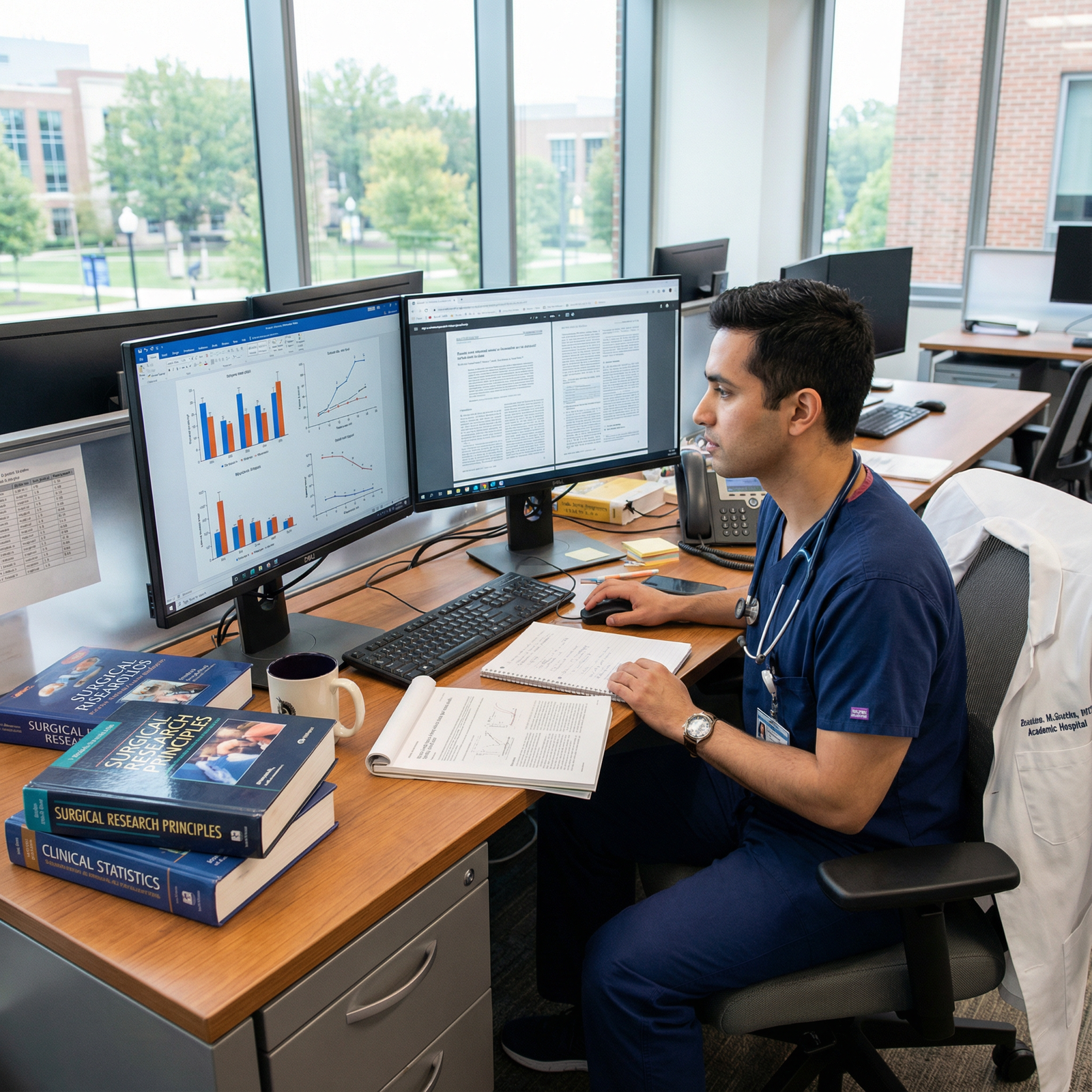
7) Compare outcomes that correlate with protection (not just promises): abstracts, manuscripts, and time-to-product
Output matters. Not because publication counts are everything, but because protected time should produce movement.
Ask for:
- abstracts submitted during the research block
- manuscripts submitted during or shortly after the block
- resident first-author opportunities
- median time to first abstract or submission
- examples from the last 2 to 3 resident cohorts
Then interpret the data intelligently.
A resident working on a retrospective outcomes study may submit an abstract in 3 to 5 months. A prospective trial or bench project may take longer. That's normal. So don't compare every project as if it's the same. But you can still compare systems.
Useful outcome signals:
- residents consistently produce something during the block
- projects don't stall for months waiting on access or approvals
- first submissions happen on a believable timeline
- multiple residents, not just one superstar, show progress
This point matters: high output alone doesn't prove a supportive program. Sometimes one hyper-productive resident or one famous mentor inflates the numbers. What you want is repeatability. Can an average solid resident enter the block and come out with meaningful progress? That's the test.
Time-to-first-submission is especially helpful. Faster isn't always better, but long delays often signal weak protection, poor project setup, or missing infrastructure. If one program's residents commonly produce an abstract by month 4 to 6, and another program's residents are still trying to get data by month 9, that's not subtle.
Practical closing checklist: what to ask, what to request, and how to decide
Here's the short version you can actually use.
Ask these questions
- "Can you show me a sample 12-month schedule with the research block?"
- "What percentage of that block is truly research-only?"
- "What call, weekend, or cross-coverage happens during research?"
- "What specifically can override the block?"
- "Who is assigned as mentor, and when?"
- "What support exists for IRB, data access, and statistics?"
- "What milestones are tracked?"
- "What do residents actually produce during or soon after the block?"
Request these documents or proofs
- sample rotation or block schedule
- written policy on research rotations
- milestone or progress framework
- examples of resident project timelines
- recent resident outcomes by cohort, if available
Use this decision framework
Rank programs higher when they have:
- enforceable scheduling
- minimal clinical bleed-over
- real make-up rules for interrupted time
- active mentorship and project infrastructure
- milestone tracking
- residents whose stories match leadership's promises
Rank programs lower when they rely on:
- vague "flexibility"
- unwritten norms
- faculty enthusiasm without scheduler protection
- frequent research-week loss
- no data/stats/IRB support
- output that seems dependent on one or two exceptional people
Bottom line: protected research time should be visible on the schedule, survivable in the real world, and productive by design. If you can't verify those three things, don't give the program credit for having it.