
The Question That Keeps Every IMG Up at Night
Let me paint you a scene I've watched play out dozens of times. It's 1 a.m. An IMG, solid Step scores, three months of US observerships, two letters from American attendings, is staring at her personal statement draft. There's a paragraph about her rotation in Chicago. A good one. And her finger is hovering over the delete key because a friend told her the personal statement should be "pure story," not a resume recap, and mentioning her US clinical experience feels like bragging.
She deletes it.
Then the panic sets in, and it's the panic that brought you here: Will a program director assume I'm hiding something? Will I get silently moved to the reject pile for leaving it out?
Here's the insider truth, and I'll give it to you straight rather than making you read 2,000 words for it. Program directors do notice when USCE is missing from your personal statement. They've read enough IMG applications to have a sixth sense for it. But, and this is the part nobody explains clearly, the penalty isn't automatic. Whether omission hurts you depends entirely on two things: whether your USCE shows up somewhere else in the application, and whether the rest of your file backs it up.
I've sat in those conference rooms in November. I've watched faculty reviewers triage stacks of IMG files. What follows is what actually happens to your application once you hit submit, not the sanitized version from webinars, but the real sequence of events.
Understanding these dynamics connects directly to the broader issue of red flags in US clinical experience that PDs discuss behind closed doors.
What Program Directors Actually Do When They Read Your PS
Let me tell you what really happens. Your personal statement is not read in a quiet, contemplative moment with a cup of coffee. It's read in a triage setting. A PD or a designated faculty reviewer at a mid-sized internal medicine program might have 400 to 800 IMG files flagged for review. They spend, and I'm being generous here, two to four minutes on your entire application in the first pass.
And here's the secret that changes everything: they don't read your PS in isolation. They read it side by side with your CV, your scores, and your letters. The PS is the interpretive lens, not the source of facts. What they're hunting for, consciously or not, is confirmation of one thing: this person understands the US clinical environment and won't need to be taught how an American hospital works from day one.
That's the whole game for an IMG. Your scores prove you know medicine. Your USCE, or the absence of it, answers the question that keeps PDs up at night: Can this person function on my wards in July without becoming a patient safety problem?
Now here's the mechanical part nobody tells you. If your personal statement doesn't mention USCE, the reviewer's next move is reflexive: they flip to your CV to look for it. I've watched this exact motion, eyes drop from the essay to the experiences section in about eight seconds. Two outcomes:
- If they find solid USCE on the CV, no real harm done. You missed an opportunity, but you didn't commit a crime.
- If they don't find it, the assumption is instant and brutal: this applicant has no US clinical experience. They won't email you to ask. They won't give you the benefit of the doubt. They just update their mental risk score and move on.
That's why the framing of "is it bragging?" is so wrongheaded. Mentioning USCE isn't bragging. It's solving the evaluator's problem, showing them exactly where your US familiarity comes from so they don't have to go digging. A reviewer who has to dig is a reviewer who's mildly annoyed, and mildly annoyed reviewers don't champion your file in rank meetings.
Those percentages are composites drawn from program surveys and what I've seen in my own committees, treat them as directional, not gospel. But the ordering is exactly right. The personal statement is where PDs expect the story of your US experience to live. The CV is the backup evidence. When the expected location is empty, the whole file gets a second, more skeptical look.
Why Silence Can Read as a Red Flag (Even When It Isn't)
Behind closed doors, here's the uncomfortable reality: USCE functions as a fast filter. Not because PDs think you're a bad doctor without it, most of them were trained by or alongside IMGs and know better. It's because in a pool of thousands of applications, every reviewer is doing risk math. Can this person handle the pace? The EHR? The direct, sometimes blunt style of American patient communication? The family meetings, the discharge planning, the interdisciplinary rounds?
USCE is the cheapest signal that answers those questions. Remove the signal, and the PD has to guess. Guessing is work. Work is risk.
Now let's walk through the two silence scenarios, because they're treated very differently.
Scenario one: your PS is silent, but your CV lists an observership. You'd think this is fine. It often isn't. The reviewer's internal monologue goes something like: Okay, four weeks in New Jersey. Was it real? Did she actually do anything, or did she follow a resident around with a coffee? Why didn't she write about it, was there nothing worth writing about? When you don't narrate your own experience, reviewers narrate it for you, and their version is always less charitable than yours. Silence lets them assume the weakest interpretation.
Scenario two: you genuinely have no USCE, and you say nothing. This is worse. PDs read the omission in one of two ways, both bad: either you lack the insight to know that missing USCE is a problem, or you know it's a problem and chose to hide it. In a rank meeting, "didn't address it" is code for "doesn't understand what residency here actually requires."
You might also benefit from learning how to structure your US clinical experience bullet points on ERAS for maximum impact.
I want to be fair here: no competent PD automatically rejects an otherwise strong applicant for an unmentioned or absent USCE. But I've watched plenty of files get quietly down-ranked, moved from "interview" to "maybe if we have slots", precisely because the PS gave no explanation and no plan. In a competitive cycle, "maybe" is a polite rejection that arrives in March.
The harsh truth, the one I'll put in plain language: in IMG applications, silence is rarely neutral. Your personal statement is the one document where you're expected to make sense of your entire file. When the file's biggest question goes unaddressed there, the absence itself becomes information.
That flowchart isn't a metaphor. It's nearly a transcript of what I've heard said out loud in screening meetings.
The 3 Situations Where Omitting USCE Genuinely Hurts You
Not all omissions are equal. Here are the three cases where leaving USCE out of your personal statement does real, measurable damage.
Situation 1: You have strong hands-on USCE and you don't mention it. A sub-internship, an acting internship, an away rotation where you wrote notes, presented on rounds, and got paged. This is your single best credential as an IMG, and burying it makes you look unaware of your own value. Worse, PDs will default to assuming it was shadowing. I've heard a PD say, verbatim: "If it had been hands-on, she'd have written about it." She had been hands-on. She just thought the PS was supposed to be about her childhood. She matched at her ninth-choice program.
Situation 2: You're applying to specialties where USCE is heavily weighted. Internal medicine, family medicine, pediatrics, neurology, the specialties where most IMGs match, are also the specialties where program leadership most expects to see USCE woven into your narrative. These are high-touch, communication-heavy fields. The PD wants evidence you've operated inside the American system of patient interaction, and they expect it front and center, not hidden on page two of the CV.
Situation 3: Your USCE contains your "why." Sometimes the defining patient story, the one that explains why you're pursuing this specialty, in this country, happened during your US rotation. If you cut the USCE from the PS, you often cut the most memorable, most human, most interview-generating material you have. I've read IMG statements that were beautifully written and completely forgettable because all the specificity got edited out in the name of "not repeating the CV."
And a fourth note, for the applicant with no USCE at all: do not fake one, and do not stay silent. Address the gap directly, then show the plan, a scheduled US elective, virtual USCE, simulation training, work alongside US-trained physicians in your home country. Reviewers forgive a gap with a plan far more readily than a gap with a shrug.
The common thread in all of this: the real mistake isn't omission itself. It's making the PD dig for information you should have handed them on a plate.
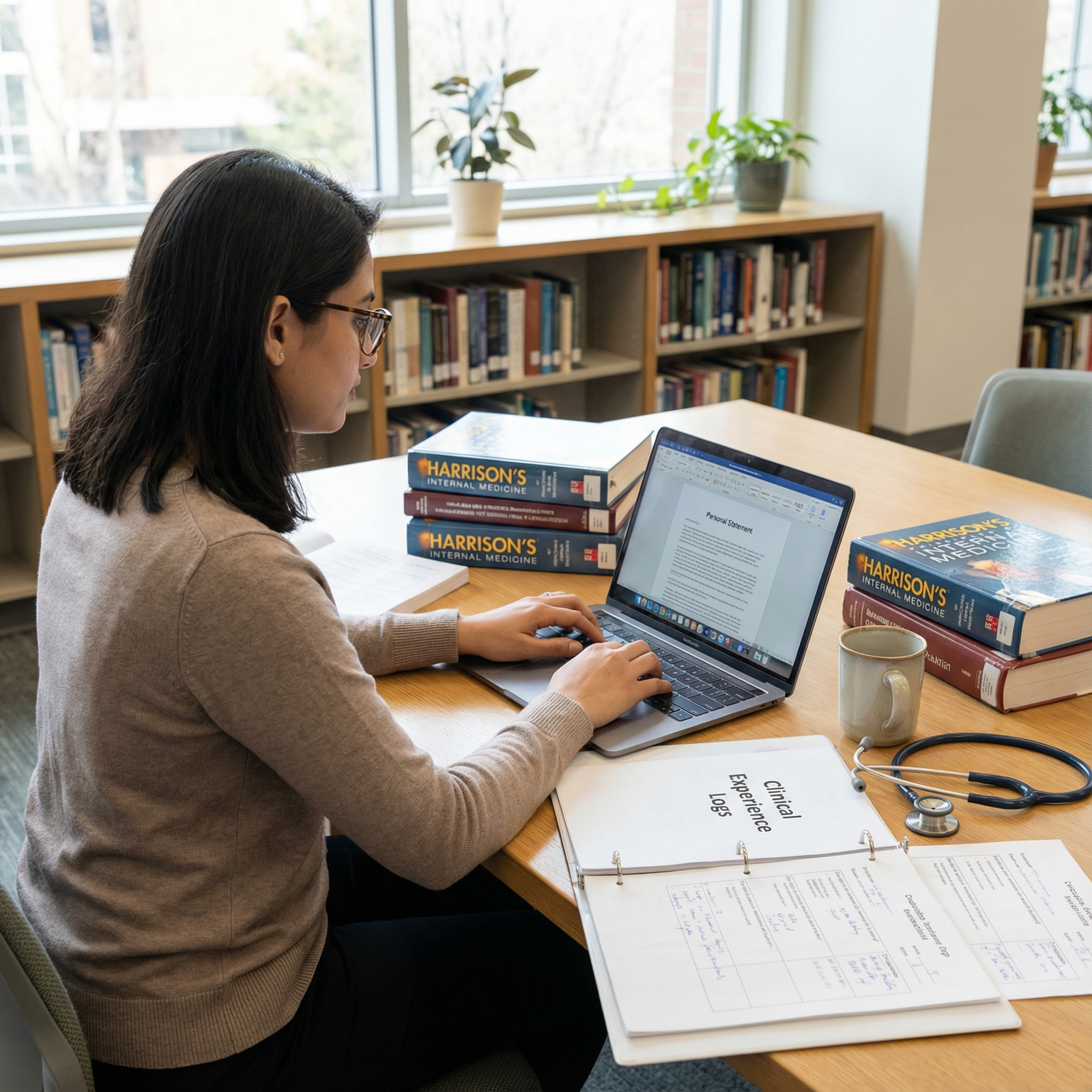
How to Mention USCE Without Sounding Like You're Bragging
The fix is simpler than the fear. Use a narrative frame with a before-and-after spine:
During my eight-week sub-internship at [hospital], I learned X. Since then, I've applied X to Y, and I now approach Z differently.
That structure does three jobs at once. It names the experience (the credential), it demonstrates insight (the thing PDs are actually grading), and it projects forward into residency (the thing they care about most). One paragraph. That's all it takes.
Now, what not to do. Do not list your rotations. "I completed USCE at ABC Hospital, DEF Clinic, and GHI Medical Center" is the single most boring sentence type in IMG applications, and PDs' eyes glaze over it on sight. A list of venues tells them nothing except that you were physically present somewhere. They can read the venues on your CV. The PS is for what the experience did to you.
If your USCE is limited, a few weeks of observership, don't inflate it, but don't skip it either. Frame it as foundation: This experience confirmed my career path and gave me my first real look at the responsibility a US resident carries. Honest, specific, useful.
If you have no USCE, substitute evidence of US clinical readiness: telemedicine exposure to US patients, USMLE-style clinical reasoning, simulation courses, HIPAA training, structured work with US-trained physicians. Then name your concrete plan to close the gap. That transforms a weakness into a demonstration of self-awareness, and self-awareness is the trait PDs complain is missing from 90% of the statements they read.
The numbers below reflect what programs report anecdotally about how framing correlates with interview offers. Look at the spread between telling the story and saying nothing at all, it's not subtle.
One last reminder, and I mean this: PDs are not hunting for reasons to reject you. Every program needs to fill its spots, and every PD I've worked with wants to say yes to IMG candidates, they're often the hardest-working residents in the building. But wanting to say yes isn't the same as being able to. Your job is to put the evidence in plain sight, in the place they expect to find it, and make their decision easy. The applicant who does that gets the interview. The one who makes them dig gets the spreadsheet cell that never turns green.
Key Takeaways
- PDs don't automatically penalize a missing USCE mention, but they notice it instantly, and if it's absent everywhere else too, they'll draw the worst conclusion.
- Mentioning USCE in your PS isn't bragging; it's answering the only question that matters: can this person function in a US residency from day one?
- Have USCE? Weave it in with specific learning outcomes, not a venue list. Don't have it? Address the gap directly and show your plan to close it.
- Silence reads as a red flag precisely because the PS is where you're expected to make sense of your whole file.
- Make it easy: what you did, where you did it, why it matters. Reviewers are too overwhelmed to dig for clues, and the ones who dig are annoyed while they do it.