

The biggest mistake IMGs make with US clinical experience is treating MICU and clinic as interchangeable checkboxes. They are not. They prove very different competencies—and programs read them very differently.
You are not “collecting hours.” You are building a portfolio that signals: this is the exact type of resident I can be, and here is hard evidence.
Let me break this down properly.
MICU vs Clinic: What Program Directors Actually Read From Your CV
Forget what students tell each other on WhatsApp. Look at what a PD sees when they skim your ERAS:
- “USCE – 4 weeks MICU, 4 weeks inpatient medicine”
versus - “USCE – 4 weeks outpatient internal medicine clinic, 4 weeks specialty clinic”
Those lines trigger completely different mental images.
In their head, MICU = “Can this person handle acuity, chaos, and real-time decisions?”
Clinic = “Can this person manage continuity, communication, and systems-based care?”
Neither is automatically “better.” But each proves different competencies. And depending on your target specialty, one will carry more weight than the other.
What MICU Experience Actually Shows
MICU experience is overrated in some IMG circles and underrated in others. Done well, it is gold. Done badly, it becomes “observed ventilators for four weeks, wrote nothing meaningful about it.”
Core Competencies MICU USCE Proves
When I read a strong MICU letter for an IMG, I expect to see evidence of:
- Comfort in high-acuity environments
- Ability to process complex data quickly
- Team communication under pressure
- Professionalism with stressed families and staff
- Resilience and emotional stability when patients crash and die
Let’s map that more concretely.
1. Clinical reasoning under pressure
MICU is where pattern recognition and structured thinking get tested brutally.
Typical MICU day as an IMG:
You watch a resident present: “This is a 63-year-old male with septic shock secondary to pneumonia, on norepinephrine 0.18, mechanically ventilated, P/F ratio 110, lactate 4.2.” Then an attending looks at you and says, “Walk me through the priorities right now.”
If you can, even at an observer level, articulate:
- Airway/vent settings priorities
- Hemodynamic goals
- Source control
- Organ support strategy
and do it in a coherent, stepwise way, that is a huge plus. A good MICU attending will note: “She asked targeted questions about vasopressor choices, fluid responsiveness, and ventilator adjustments, reflecting strong critical care reasoning even at an early level.”
That line in a letter lands.
2. Procedural literacy and comfort around technology
No, you are not placing central lines as an observer. But you are showing:
- You understand indications, contraindications, risks for:
- Central venous catheters
- Arterial lines
- Intubation
- Bronchoscopy
- You know your way around:
- Ventilator modes
- Vasopressor titration protocols
- Sedation and analgesia strategies
- Renal replacement therapy basics
Program directors, especially in internal medicine and anesthesiology, like to see you have not spent your entire life in low-tech ward environments. MICU experience in the US proves that you have been exposed to modern critical care standards, not just “ICU in name only.”
3. Interprofessional and team communication
MICU is heavy on:
- Rounds with multidisciplinary teams
- Briefings with nurses and respiratory therapists
- Family meetings
For IMGs, language and communication are constant question marks in PD minds. MICU gives you chances to demonstrate:
- You can present concisely in a structured way (system-based, problem-based, or organ-based formats).
- You can pick up handoff language: “pressors up,” “crashing,” “soft pressures,” “downtitrating sedation,” “goal-directed therapy.”
- You function in a team where you are not the captain—and you handle that.
A strong MICU letter often includes phrases like: “He integrated quickly into a fast-paced team, communicated clearly with nurses, and showed insight into the complexity of multidisciplinary decision-making.” That is huge for your application.
4. Emotional and ethical maturity
MICU is where you see:
- DNR/DNI discussions
- End-of-life care
- Futility discussions
- Family conflicts
If your personal statement or MICU evaluation mentions that you observed and reflected on:
- The ethics of continuing versus withdrawing care
- Cultural differences in end-of-life expectations
- How the team navigated family distress
you look like someone who has actually dealt with the moral side of medicine, not just diagnoses and treatments.
, Acuity Tolerance, [Continuity of Care](https://residencyadvisor.com/resources/clinical-experience-imgs/why-continuity-clinics-in-the-us-impress-pds-more-than-shadowing)](https://cdn.residencyadvisor.com/images/articles_svg/chart-key-competencies-demonstrated-micu-vs-clinic-9866.svg "Key Competencies Demonstrated: MICU vs Clinic")
| Category | Value |
|---|---|
| Clinical Reasoning | 9 |
| Communication | 7 |
| [System-Based Practice](https://residencyadvisor.com/resources/clinical-experience-imgs/using-us-clinical-experience-to-demonstrate-systems-based-practice) | 7 |
| Acuity Tolerance | 10 |
| [Continuity of Care](https://residencyadvisor.com/resources/clinical-experience-imgs/why-continuity-clinics-in-the-us-impress-pds-more-than-shadowing) | 3 |
(MICU emphasis: 0–10 scale, relatively speaking)
What Outpatient Clinic Experience Proves That MICU Cannot
A lot of IMGs chase ICU because it “sounds more impressive.” That is shortsighted.
Most residency work, even in internal medicine, is not MICU. It is chronic disease management, follow-up, medication reconciliation, and phone calls. PDs know this. Clinic rotations demonstrate competencies MICU cannot.
Core Competencies Clinic USCE Proves
From outpatient clinic letters and evaluations, PDs look for evidence of:
- Longitudinal thinking and problem prioritization
- Relationship-building and patient-centered communication
- System navigation and follow-up reliability
- Breadth of ambulatory diagnostics and management
Break that down.
1. Longitudinal care and problem list management
In clinic you see:
- Diabetes over years, not days
- Hypertension titration over months
- Chronic pain management with opioid monitoring
- Preventive care: vaccines, cancer screenings, statin decisions
If your experience shows you can:
- Prioritize a visit with 8 problems and 15 minutes
- Separate “urgent” vs “important”
- Think about medication adherence, cost, and insurance issues
you demonstrate a maturity that many fresh graduates simply lack.
A good clinic letter often says something like: “She was particularly strong at synthesizing complex problem lists into focused visit plans, recognizing what could be safely deferred and what required immediate action or referral.” That screams “ready for residency clinic.”
2. Communication across health literacy, culture, and language
Clinic is where you see:
- Patients who do not agree with you
- Patients who do not understand you
- Patients who cannot afford what you recommend
If you used interpreters properly, learned to check understanding, and adjusted your language (“water pill” instead of “diuretic” when appropriate), that is exactly what ACGME competencies are built on.
Residency clinics live or die by patient satisfaction and adherence. PDs care a lot more about your ability to explain insulin titration clearly than your ability to recite ARDS criteria perfectly.
3. Systems-based practice and real-world limitations
MICU is high tech, but in some ways simplified: you have everything, and you throw the textbook at people.
Clinic is the opposite. You must:
- Choose labs carefully
- Work within referral limitations
- Navigate prior authorizations
- Deal with “no-show,” “cannot pay,” or “lost to follow-up”
Letters that highlight your understanding of:
- When to escalate to ED
- When to manage outpatient
- How to schedule follow-up appropriately
show that you understand US healthcare, not just US medicine.
4. Breadth of ambulatory exposure
MICU is narrow but deep. Clinic is broad: CHF one visit, depression the next, back pain after that, then prenatal counseling, then a post-MI follow-up.
That breadth is particularly important if you are applying to:
- Family medicine
- Internal medicine with primary care focus
- Pediatrics
- Psychiatry (outpatient-heavy programs)
For those specialties, pure MICU experience without any clinic looks unbalanced. Some PDs will question whether you understand what the day-to-day job actually looks like.
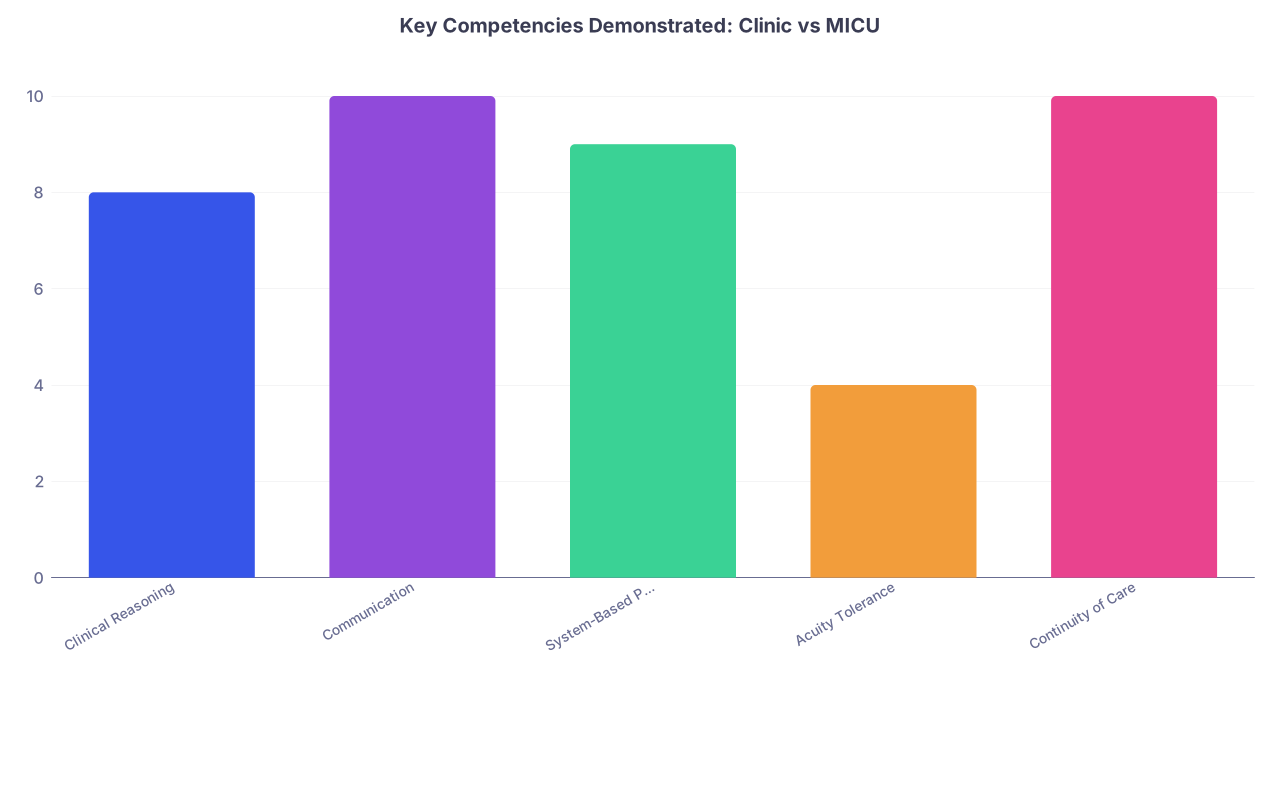
| Category | Value |
|---|---|
| Clinical Reasoning | 8 |
| Communication | 10 |
| System-Based Practice | 9 |
| Acuity Tolerance | 4 |
| Continuity of Care | 10 |
(Clinic emphasis: 0–10 scale, relatively speaking)
Specialty-Specific Strategy: Where MICU vs Clinic Matters Most
Now the part you actually care about: “For my specialty, what combination makes sense?”
Internal Medicine (Categorical)
For categorical IM in the US, balanced is stronger than extreme. A PD glancing at your application wants to see you can:
- Handle sick patients on wards and ICU
- Function in continuity clinic
- Think long-term about chronic disease
You ideally want:
- At least 1 US inpatient rotation (ward or MICU, preferably both)
- At least 1 US outpatient internal medicine clinic rotation
- Bonus: a subspecialty clinic (cardiology, GI, endocrine) if it aligns with your story
A pure “4 MICU rotations” track looks lopsided. It says you love crises but maybe cannot be bothered about statins, colon cancer screening, or A1c control. A pure “4 clinic rotations” track makes PDs worry you will sink on night float or ICU months.
Family Medicine
Here, outpatient clinic carries much more weight than MICU. Family medicine residency is continuity-heavy, community-oriented, and primary-care driven.
Ideal profile:
- Multiple outpatient experiences: FM clinic, community health centers, preventive care
- At least one inpatient or MICU rotation to prove you can handle acuity when needed
- Clear evidence of patient education, chronic disease management, and behavioral health exposure
If you are an IMG aiming for FM and you choose 2+ ICU electives but only a token clinic, you are misaligned with the specialty.
Pediatrics
Peds PDs like:
- General peds inpatient
- Outpatient pediatrics clinic
- NICU or PICU as a complement, not the core
MICU (adult) is less directly relevant unless your narrative ties it to critical care interest. For most peds applicants, an adult MICU rotation is lower yield than peds wards or peds clinic.
Psychiatry
This is where people really misunderstand.
Psych PDs care much more about:
- Outpatient psych clinic
- Consultation-liaison psych
- Community mental health centers
than about MICU. A medicine ward rotation might help show basic medical competence, but MICU is not going to win you a psych spot the way a strong psych clinic letter will.
If your USCE is 3 x ICU and 1 x outpatient psych, you look like someone who did not understand the field.
Neurology
Here, the combination matters:
- Inpatient neurology consults / stroke units
- Outpatient neuro clinics (epilepsy, movement disorders, general neurology)
- MICU can help only if neurology-heavy (neuro ICU, stroke ICU) or if framed as comfort managing complex, critically ill patients
| Target Specialty | High-Value MICU? | High-Value Clinic? | Ideal Mix Example |
|---|---|---|---|
| Categorical IM | Yes | Yes | 1 MICU, 1 wards, 1–2 clinics |
| Family Medicine | Optional/1 max | Essential | 1 inpatient, 3 clinics |
| Pediatrics | NICU/PICU > MICU | Essential | 1 peds inpt, 2 clinics, 1 NICU/PICU |
| Psychiatry | Low yield | Critical | 3 psych clinics, 1 medicine |
| Neurology | Neuro ICU > MICU | Important | 1 neuro inpt, 1 neuro clinic, 1 ICU |
How Evaluators Read MICU vs Clinic Letters Differently
You are not just choosing where to stand for four weeks. You are choosing what kind of letter is even possible.
What a strong MICU letter looks like
The best MICU letters for IMGs usually include:
- Specific clinical scenarios: “During an overnight decompensation from septic shock…”
- Comments on clinical reasoning: “She generated appropriate differentials for acute hypotension and suggested evidence-based interventions.”
- Comments on demeanor during chaos: “He remained calm and focused when multiple patients decompensated simultaneously.”
- Team and communication assessment: “Nurses frequently commented on her clear communication and reliability.”
Weak MICU letters sound like this: “She observed a variety of ICU cases and was punctual and professional.” Translation: you were wallpaper.
What a strong clinic letter looks like
High-quality clinic letters emphasize:
- Patient interaction: “She established rapport quickly with challenging patients, including those with low health literacy.”
- Practical management decisions: “He appropriately adjusted antihypertensive regimens and recognized when to escalate care.”
- Follow-up and reliability: “She consistently closed the loop on lab results, medication refills, and abnormal findings.”
- Insight: “He reflected thoughtfully on social determinants of health and patient barriers.”
If every outpatient letter you have says, “He saw patients and took histories,” you did not push yourself enough in clinic.

| Step | Description |
|---|---|
| Step 1 | Define Target Specialty |
| Step 2 | Prioritize MICU + wards |
| Step 3 | Prioritize clinics |
| Step 4 | Add at least 1 IM/FM clinic |
| Step 5 | Balance with 1 MICU, 1 wards |
| Step 6 | Add 1 inpatient month |
| Step 7 | Focus remaining time on specialty clinics |
| Step 8 | Hospital based or outpatient oriented |
| Step 9 | Have any US clinic yet |
| Step 10 | Any inpatient at all |
Crafting Your Story: How to Use MICU and Clinic Together in Your Application
US experience is not just about being “well rounded.” It is about coherence. Your MICU and clinic work should support a single, clear narrative.
1. Align experiences with your personal statement
If your personal statement says:
- “I am drawn to long-term relationships and preventive care”
but your entire USCE is MICU and step-down, PDs see the disconnect.
Or:
- “I am passionate about managing the sickest patients”
but all your USCE is low-acuity clinic, it looks like a generic line.
You want your narrative to sound like:
- “My MICU experience at [Hospital] showed me the cost of poorly controlled chronic disease; my outpatient clinic work at [Clinic] convinced me that residency is the pivot point to prevent those MICU admissions.”
That ties the two worlds together nicely.
2. Use MICU for “floor of competence,” clinic for “ceiling of maturity”
MICU proves you will not drown when the pager explodes. Clinic proves you can be trusted with your own panel and complex decisions.
In your interviews and essays:
- MICU stories: “Hard moments, decisions under pressure, ethical dilemmas, learning to triage.”
- Clinic stories: “Patients you followed, how you navigated disagreements, how you adapted your explanations, system barriers you recognized.”
Specificity wins. “A patient with decompensated cirrhosis whose family declined transplant evaluation” is far stronger than “a critically ill patient I saw.”
3. Avoid the “tourist observer” trap
PDs have seen hundreds of IMGs who came, stood at the back of rounds, nodded a lot, then left.
If all you can say is “I observed many patients in the MICU and clinic,” you are replaceable.
Push yourself to:
- Ask to present on rounds
- Write draft notes (even if they do not go in the chart)
- Prepare mini-presentations on relevant topics
- Volunteer to call pharmacies (if permitted) or practice patient education under supervision
Then your letters have something concrete to describe.

Practical Planning: How Many Weeks of MICU vs Clinic?
Assuming you can realistically secure 12 weeks of USCE, a strong pattern for an IMG applying IM might be:
- 4 weeks inpatient wards
- 4 weeks MICU
- 4 weeks outpatient clinic (IM or FM with adult focus)
If you can do more, you do not stack four MICUs. You diversify letters and competencies.
For FM-oriented IMG:
- 4 weeks core FM clinic
- 4 weeks community or underserved clinic
- 4 weeks inpatient FM or IM (with some ICU exposure built into the service)
For psych-oriented IMG:
- 4 weeks outpatient psychiatry
- 4 weeks consult-liaison psychiatry
- 4 weeks internal medicine ward or clinic
The logic stays the same: one or two experiences to prove you will survive the hospital side, majority to prove you match the day-to-day reality of the specialty.

| Category | MICU/Inpatient | Outpatient Clinic |
|---|---|---|
| Internal Med | 8 | 4 |
| Family Med | 4 | 8 |
| Psychiatry | 4 | 8 |
(Values represent weeks; example distributions)
Red Flags and Common Mistakes IMGs Make
Let me be blunt for a moment. There are patterns that make your application weaker, not stronger.
All ICU, no clinic
- Signals: adrenaline-seeking, poor understanding of US primary care, mismatch for FM/psych.
- Fix: add at least one substantive outpatient month.
All clinic, no inpatient
- Signals: fear of acuity, limited hospital experience.
- Fix: at least one inpatient or high-acuity month to show you can handle cross-covers and night float.
Letters that only say “observed” and “punctual”
- Signals: passive observer, low initiative.
- Fix: change your behavior on current/next rotations; ask for more responsibility and feedback.
No progression or integration
- If you did MICU and clinic rotations but cannot connect them in your interviews, it looks random. You must be able to explain how each one shaped your understanding of US medicine, not just “I wanted more exposure.”

How to Talk About MICU vs Clinic in Interviews
You need a couple of sharp, ready answers.
If asked: “Tell me about your US clinical experience”
You do not list rotations. You compare competencies.
Something like:
“I structured my US experience deliberately to cover both high-acuity and continuity care. In the MICU at [Hospital], I learned to think in terms of hemodynamics, ventilator management, and rapid prioritization during decompensations. In contrast, during my outpatient internal medicine rotation at [Clinic], I focused on chronic disease management, medication adherence, and navigating social determinants of health. Together, those experiences taught me how the decisions we make in clinic directly prevent or contribute to MICU admissions.”
That shows intention, integration, and insight.
If asked: “Why did you choose MICU rotations?”
You do not say “to see sick patients.” That is lazy.
You say something like:
“Coming from a system where ICU resources were limited, I wanted to understand how critical care is structured in US teaching hospitals. The MICU elective at [Hospital] gave me that exposure—especially seeing how multidisciplinary rounds, protocolized care, and rapid response systems work. It also tested my ability to analyze complex, rapidly changing clinical data, which I believe is essential for internal medicine training.”
If asked: “How did clinic rotations change your understanding of US healthcare?”
You might answer:
“In clinic I saw how much of medicine happens outside the hospital—medication costs, insurance coverage, social barriers. I realized that if we do not address those, the best inpatient care does not prevent readmissions. That shifted how I think about treatment plans: not just what is ideal medically, but what is realistic for that patient’s life.”
This is the maturity IM and FM programs want.

Final Takeaways
- MICU and clinic are not interchangeable; they prove different competencies.
- Strong applications use both strategically: MICU to show acuity tolerance and clinical reasoning under pressure, clinic to show communication, continuity, and system-based practice.
- Your mix must match your target specialty and feed a coherent narrative in your personal statement, letters, and interviews.


